From Surf Wiki (app.surf) — the open knowledge base
Independence Day (India)
Public holiday celebrated on 15 August
Public holiday celebrated on 15 August
| Field | Value |
|---|---|
| holiday_name | Independence Day |
| type | Public |
| image | A still of Red Fort, during the 62nd Independence Day celebrations, in Delhi on August 15, 2008.jpg |
| caption | The flag of India hoisted at the Red Fort in Delhi; hoisted flags are a common sight on Independence Day. |
| alt | The national flag of India hoisted on a wall adorned with domes and minarets. |
| observedby | India |
| month | August |
| duration | 24 hours |
| frequency | Annual |
| date | 15 August |
| scheduling | Same day each year |
| significance | Commemorates the independence of India |
| celebrations | Flag hoisting, parade, fireworks, singing patriotic songs and the National Anthem Jana Gana Mana, speech by the Prime Minister of India and the President of India |
| firsttime | |
| relatedto | Republic Day |
Independence Day is celebrated annually on 15 August as a public holiday in India commemorating the nation's independence from the United Kingdom on 15 August 1947. On this day the Indian Independence Act 1947 came into effect, transferring legislative sovereignty to the Indian Constituent Assembly. India attained independence following the independence movement noted for largely non-violent resistance and civil disobedience led by Indian National Congress under the leadership of Mahatma Gandhi.
Independence coincided with the partition of India, in which British India was divided into the Dominions of India and Pakistan; the partition was accompanied by violent riots and mass casualties. On 15 August 1947, the first Prime Minister of India, Jawaharlal Nehru raised the Indian national flag above the Lahori Gate of the Red Fort in Delhi. On each subsequent Independence Day, the incumbent Prime Minister customarily raises the flag and gives an address to the nation. The entire event is broadcast by Doordarshan, India's national broadcaster, and usually begins with the shehnai music of Ustad Bismillah Khan. Independence Day is observed throughout India with flag-hoisting ceremonies, parades and cultural events. It is a national holiday in the country.
History
Main article: Indian independence movement
European traders had established outposts in the Indian subcontinent by the late 17th century. Through overwhelming military strength, the East India Company fought and annexed local kingdoms and established themselves as the dominant force by the 18th century. Following the Indian Rebellion of 1857, the Government of India Act 1858 led the British Crown to assume direct control of India. In the decades following, civic society gradually emerged across India, most notably the Indian National Congress Party, formed in 1885. The period after World War I was marked by colonial reforms such as the Montagu–Chelmsford Reforms, but it also witnessed the enactment of the unpopular Rowlatt Act and calls for self-rule by Indian activists. The discontent of this period crystallised into nationwide non-violent movements of non-cooperation and civil disobedience, led by Mahatma Gandhi.
During the 1930s, the reform was gradually legislated by the British; Congress won victories in the resulting elections. The next decade was beset with political turmoil: Indian participation in World War II, the Congress' final push for non-cooperation, and an upsurge of Muslim nationalism led by the All-India Muslim League. The escalating political tension was capped by Independence in 1947. The jubilation was tempered by the bloody partition of colonial India into India and Pakistan.
Independence Day before Independence
Hasrat Mohani was the first person in Indian History who demanded 'Complete Independence' (Azadi-e-Kaamil), at the 1929 session of the Indian National Congress, the Purna Swaraj declaration, or "Declaration of the Independence of India" was promulgated, and 26 January was declared as Independence Day in 1930. The Congress called on people to pledge themselves to civil disobedience and "to carry out the Congress instructions issued from time to time" until India attained complete independence. Celebration of such an Independence Day was envisioned to stoke nationalistic fervour among Indian citizens, and to force the British government to consider granting independence. The Congress observed 26 January as the Independence Day between 1930 and 1946. The celebration was marked by meetings where the attendants took the "pledge of independence". Jawaharlal Nehru described in his autobiography that such meetings were peaceful, solemn, and "without any speeches or exhortation". Gandhi envisaged that besides the meetings, the day would be spent " ... in doing some constructive work, whether it is spinning, or service of 'untouchables,' or reunion of Hindus and Mussalmans, or prohibition work, or even all these together". Following actual independence in 1947, the Constitution of India came into effect on and from 26 January 1950; since then 26 January is celebrated as Republic Day.
Immediate background
In 1946, the Labour government in Britain, its exchequer exhausted by the recently concluded World War II, realised that it had neither the mandate at home, the international support nor the reliability of native forces for continuing to maintain control in an increasingly restless India. On 20 February 1947, Prime Minister Clement Attlee announced that the British government would grant full self-governance to British India by June 1948 at the latest.
The new viceroy, Lord Mountbatten, advanced the date for the transfer of power, believing the continuous contention between the Congress and the Muslim League might lead to a collapse of the interim government. He chose the second anniversary of Japan's surrender in World War II, 15 August, as the date of power transfer. The British government announced on 3 June 1947 that it had accepted the idea of partitioning British India into two states; the successor governments would be given dominion status and would have an implicit right to secede from the British Commonwealth. The Indian Independence Act 1947 (10 & 11 Geo 6 c. 30) of the Parliament of the United Kingdom partitioned British India into the two new independent dominions of India and Pakistan (including what is now Bangladesh) with effect from 15 August 1947, and granted complete legislative authority upon the respective constituent assemblies of the new countries. The Act received royal assent on 18 July 1947.
Partition and independence
Millions of Muslim, Sikh and Hindu refugees trekked the newly drawn borders in the months surrounding independence. In Punjab, where the borders divided the Sikh regions in halves, massive bloodshed followed; in Bengal and Bihar, where Mahatma Gandhi's presence assuaged communal tempers, the violence was mitigated. In all, between 250,000 and 1,000,000 people on both sides of the new borders died in the violence. While the entire nation was celebrating the Independence Day, Gandhi stayed in Calcutta in an attempt to stem the carnage. On 14 August 1947, the Independence Day of Pakistan, the new Dominion of Pakistan came into being; Muhammad Ali Jinnah was sworn in as its first Governor General in Karachi.
The Constituent Assembly of India met for its fifth session at 11 pm on 14 August in the Constitution Hall in New Delhi. The session was chaired by the president Rajendra Prasad. In this session, Jawaharlal Nehru delivered the Tryst with Destiny speech proclaiming India's independence.
The members of the Assembly formally took the pledge of being in the service of the country. A group of women, representing the women of India, formally presented the national flag to the assembly.
The Dominion of India became an independent country as official ceremonies took place in New Delhi. Nehru assumed office as the first prime minister, and the viceroy, Lord Mountbatten, continued as its first governor general. Gandhi's name was invoked by crowds celebrating the occasion; Gandhi himself however took no part in the official events. Instead, he marked the day with a 24-hour fast, during which he spoke to a crowd in Calcutta, encouraging peace between Hindus and Muslims.
Celebration
Government House 09.40 am. Procession of ministers to Constituent Assembly 09.50 am. State drive to Constituent Assembly 09.55 am. Royal salute to governor general 10.30 am. Hoisting of national flag at Constituent Assembly 10.35 am. State drive to Government House 06.00 pm. Flag ceremony at India Gate 07.00 pm. Illuminations 07.45 pm. Fireworks display 08.45 pm. Official dinner at Government House 10.15 pm. Reception at Government office.


.jpg)
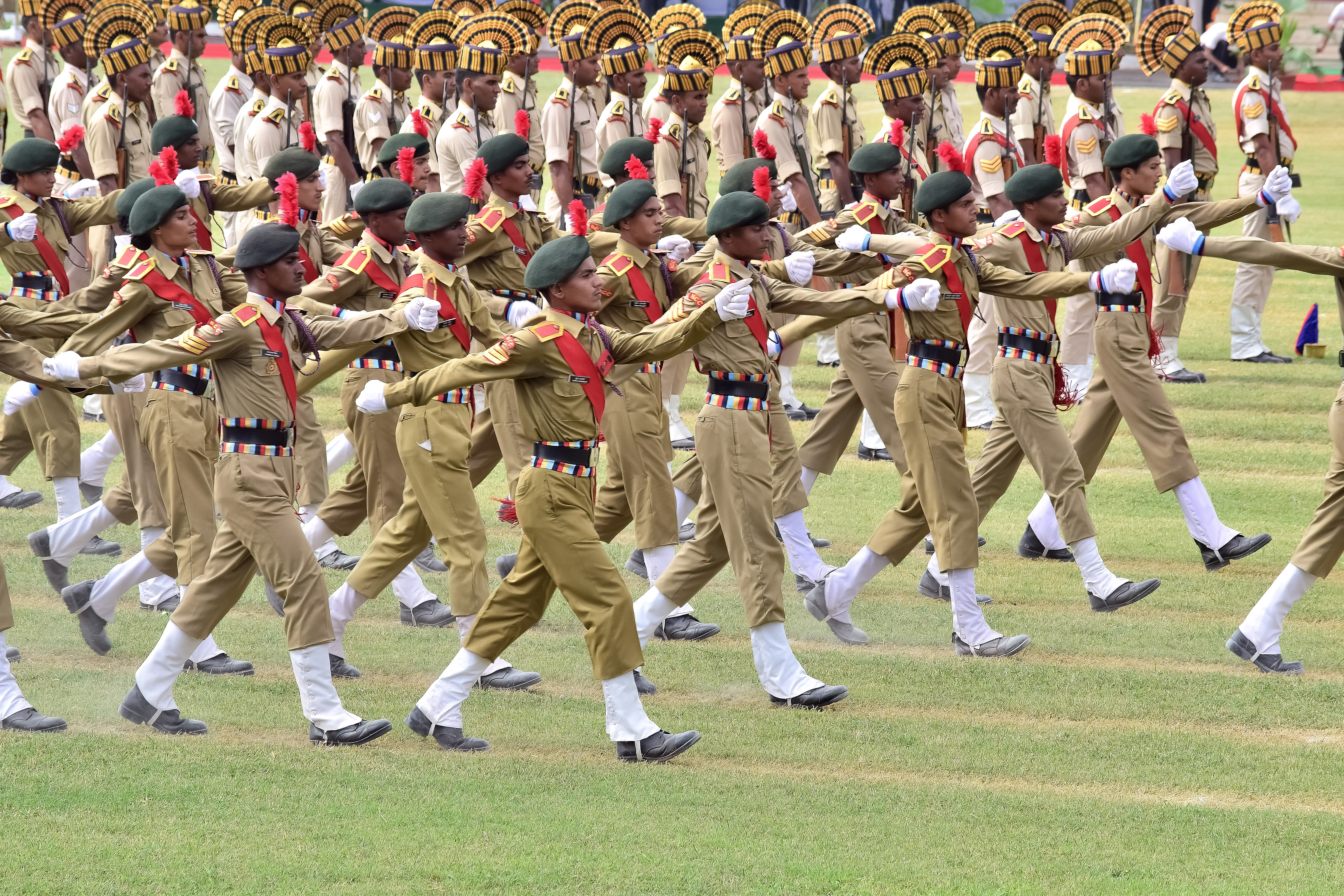
Independence Day, one of the three National holidays in India (the other two being the Republic Day on 26 January and Mahatma Gandhi's birthday on 2 October), is observed in all Indian states and union territories. On the eve of Independence Day, the President of India delivers the "Address to the Nation". On 15 August, the Prime Minister hoists the Indian flag on the ramparts of the historical site of Red Fort in Delhi. In his speech, the Prime Minister highlights the past year's achievements, raises important issues and calls for further development. He pays tribute to the leaders of the Indian independence movement. The Indian national anthem, "Jana Gana Mana", is sung. The speech is followed by a march past of divisions of the Indian Armed Forces and paramilitary forces. Parades and pageants showcase scenes from the independence struggle and India's diverse cultural traditions. Similar events take place in state capitals where the Chief Ministers of individual states unfurl the national flag, followed by parades and pageants. Until 1973, the Governor of the State hoisted the National Flag at the State capital. In February 1974, the Chief Minister of Tamil Nadu, M. Karunanidhi took up the issue with then Prime Minister Indira Gandhi that the Chief Ministers, like the Prime Minister, should be allowed to hoist the national flag on Independence Day. Since 1974, Chief Ministers of the respective states have been allowed to hoist the national flag on Independence Day.
Flag-hoisting ceremonies and cultural programmes take place in governmental and non-governmental institutions throughout the country. Schools and colleges conduct flag hoisting ceremonies and various cultural events. Governmental and non-governmental institutions decorate their premises with paper, balloon decorations with hangings of freedom fighter portraits on their walls and major government buildings are often adorned with strings of lights. In Delhi and some other cities, kite flying adds to the occasion. National flags of different sizes are used abundantly to symbolise allegiance to the country. Citizens adorn their clothing, wristbands, cars, household accessories with replicas of the tri-colour. Over a period of time, the celebration has changed emphasis from nationalism to a broader celebration of all things India.
In some places of Nadia, West Bengal, Independence Day celebrated on 17–18 August instead of 15 August, as the rest of Nadia district except Nabadwip had become part of Pakistan for map drawing error. The error was corrected on the night of 17 August after popular protests.
The Indian diaspora celebrates Independence Day around the world with parades and pageants, particularly in regions with higher concentrations of Indian immigrants. In some locations, such as New York and other US cities, 15 August has become "India Day" among the diaspora and the local populace. Pageants celebrate "India Day" either on 15 August or an adjoining weekend day.
Security threats
As early as three years after independence, the Naga National Council called for a boycott of Independence Day in northeast India. Separatist protests in this region intensified in the 1980s; calls for boycotts and terrorist attacks by insurgent organisations such as the United Liberation Front of Assam and the National Democratic Front of Bodoland, marred celebrations. With increasing insurgency in Jammu and Kashmir from the late 1980s, separatist protesters boycotted Independence Day there with bandh (strikes), use of black flags and by flag burning. Terrorist groups such as Lashkar-e-Taiba, the Hizbul Mujahideen and the Jaish-e-Mohammed have issued threats, and have carried out attacks around Independence Day. Boycotting of the celebration has also been advocated by insurgent Maoist rebel organisations.
In the anticipation of terrorist attacks, particularly from militants, security measures are intensified, especially in major cities such as Delhi and Mumbai and in troubled states such as Jammu and Kashmir. The airspace around the Red Fort is declared a no-fly zone to prevent aerial attacks and additional police forces are deployed in other cities.
Since the assassination of Indira Gandhi, prime ministers would give their speeches from behind a bullet-proof glass panel. Since 2014, when Narendra Modi was elected as prime minister, he did away with this tradition. Nevertheless, additional intense measures were taken to ensure security of Modi.
In popular culture
On Independence Day and Republic Day, patriotic songs in regional languages are broadcast on television and radio channels. They are also played alongside flag-hoisting ceremonies. Patriotic films are broadcast. Over the decades, according to The Times of India, the number of such films broadcast has decreased as channels report that audiences are oversaturated with patriotic films. The population belonging to Generation Y often combine nationalism with popular culture during the celebrations. This mixture is exemplified by outfits and savouries dyed with the tricolour and garments that represent India's various cultural traditions. Shops often offer Independence Day sales promotions. Some news reports have decried the commercialism. Indian Postal Service publishes commemorative stamps depicting independence movement leaders, nationalistic themes and defence-related themes on 15 August.
Independence and partition inspired literary and other artistic creations. Such creations mostly describe the human cost of partition, limiting the holiday to a small part of their narrative. Salman Rushdie's novel Midnight's Children (1980), which won the Booker Prize and the Booker of Bookers, wove its narrative around children born at midnight of 14–15 August 1947 with magical abilities. Freedom at Midnight (1975) is a non-fiction work by Larry Collins and Dominique Lapierre that chronicled the events surrounding the first Independence Day celebrations in 1947. Few films centre on the moment of independence, instead highlighting the circumstances of partition and its aftermath. On the Internet, Google has been commemorating Independence Day of India since 2003 with a special doodle on its Indian homepage.
References
References
- Chakraborty, Yogabrata. (15 August 2023). "মধ্যরাতে স্বাধীনতার সূর্যোদয়". [[Dainik Statesman]] (The Statesman Group).
- PTI (15 August 2013). [http://www.thehindu.com/news/national/manmohan-first-pm-outside-nehrugandhi-clan-to-hoist-flag-for-10th-time/article5025367.ece "Manmohan first PM outside Nehru-Gandhi clan to hoist flag for 10th time"]. {{webarchive. link. (21 December 2013 . ''[[The Hindu]]''. Retrieved 30 August 2013.)
- (5 August 2015). "Terror strike feared in Delhi ahead of Independence Day : MM-National, News". India Today.
- (28 February 2015). "69th Independence Day: Security Tightened at Red Fort as Terror Threat Looms Large on PM Modi". Ibtimes.co.in.
- "Independence Day of India, 15 August 2020: History, Significance, Facts and Celebration".
- Sarkar, Sumit. (1983). "Modern India, 1885–1947". [[Macmillan Publishers.
- (9 October 2006). "A Concise History of Modern India". [[Cambridge University Press]].
- Wolpert, Stanley A.. (12 October 1999). ["India"]({{Google books). University of California Press.
- Datta, V. N.. (2006). "India's Date with Destiny". Allied Publishers.
- Guha, Ramachandra. (12 August 2008). ["India After Gandhi: The History of the World's Largest Democracy"]({{Google books). Harper Collins.
- Vohra, Ranbir. (2001). ["The Making of India: a Historical Survey"]({{Google books). M. E. Sharpe.
- Ramaseshan, Radhika. (26 January 2012). "Why January 26: the History of the Day". [[The Telegraph (Kolkata).
- Nehru, Jawaharlal. (1989). ["Jawaharlal Nehru, An Autobiography: With Musings on Recent Events in India"]({{Google books). Bodley Head.
- Gandhi, (Mahatma). (1970). ["Collected Works of Mahatma Gandhi"]({{Google books). Publications Division, Ministry of Information and Broadcasting, Government of India.
- Hyam, Ronald. (2006). "Britain's Declining Empire: The Road to Decolonisation, 1918–1968". Cambridge University Press.
- Brown, Judith Margaret. (1994). "Modern India: the Origins of an Asian Democracy". [[Oxford University Press]].
- Sarkar, Sumit. (1983). "Modern India, 1885–1947". [[Macmillan Publishers.
- Romein, Jan. (1962). ["The Asian Century: a History of Modern Nationalism in Asia"]({{Google books). [[University of California Press]].
- (1 July 1999). ["The Proudest Day: India's Long Road to Independence"]({{Google books). W. W. Norton & Company.
- "Indian Independence Act 1947". [[The National Archives (United Kingdom).
- (2000). "India: A History". Grove Press.
- (28 March 2007). ["Civil Wars of the World: Major Conflicts since World War II"]({{Google books). [[ABC-CLIO]].
- Alexander, Horace. (1 August 2007). "A miracle in Calcutta". [[Prospect (magazine).
- "Constituent Assembly of India Volume V". Parliament of India.
- "Jawaharlal Nehru (1889–1964): Speech On the Granting of Indian Independence, August 14, 1947". [[Fordham University]].
- Guha, Rama Chandra. (2007). "India After Gandhi: The History of the World's Largest Democracy". Macmillan.
- (15 August 2012). "India Celebrates Its 66th Independence Day". [[Outlook (Indian magazine).
- (15 August 2007). "Barring Northeast, Peaceful I-Day Celebrations across India (State Roundup, Combining Different Series)". Monsters and Critics.
- (16 August 2009). "Karunanidhi had a role in Chief Ministers hoisting flag". The Hindu.
- "Karunanidhi Responsible For Chief Ministers Unfurling National Flag". NDTV.com.
- (1 January 2006). ["Concise Encyclopaedia of India"]({{Google books). Atlantic Publishers.
- "Independence Day Celebration". Government of India.
- "Independence Day". Government of India.
- Bhattacharya, Suryatapa. (15 August 2011). "Indians Still Battling it out on Independence Day". [[The National (Abu Dhabi).
- (15 August 2007). "When India Wears its Badge of Patriotism with Pride". [[Daily News and Analysis.
- (14 August 2005). "It's Cool to Be Patriotic: GenNow". [[The Times of India]].
- (19 August 2011). "Nadia keeps a date with history {{!}} Kolkata News - Times of India".
- (16 August 2019). "In West Bengal, some villages celebrate Independence Day after August 15; here's why".
- (16 August 2010). "Indian-Americans Celebrate Independence Day". [[The Hindu]].
- Ghosh, Ajay. (2008). "India's Independence Day Celebrations across the United States—Showcasing India's Cultural Diversity and Growing Economic Growth". NRI Today.
- Sharma, Suresh K.. (2006). ["Documents on North-East India: Nagaland"]({{Google books). Mittal Publications.
- Office of the Coordinator for Counterterrorism. (11 August 2011). "ULFA's Independence Day Gift for India: Blasts". United States Department of State.
- (2007). ["Terror, Insurgency, and the State: Ending Protracted Conflicts"]({{Google books). University of Pennsylvania Press.
- (15 August 2008). "Kashmir Independence Day Clashes". BBC.
- Behera, Navnita Chadha. (2007). ["Demystifying Kashmir"]({{Google books). [[Pearson Education.
- Das, Suranjan. (1 August 2001). ["Kashmir and Sindh: Nation-Building, Ethnicity and Regional Politics in South Asia"]({{Google books). Anthem Press.
- (14 August 2002). "LeT, JeM Plan Suicide Attacks in J&K on I-Day". [[NDTV]].
- (15 August 2011). "Maoist Boycott Call Mars I-Day Celebrations in Orissa". The Hindu.
- Verma, Bharat. (1 June 2012). ["Indian Defence Review Vol. 26.2: Apr–Jun 2011"]({{Google books). Lancer Publishers.
- Ramgopal}}{{dead link, Ram. (14 August 2002). "India Braces for Independence Day". CNN.
- (11 August 2006). "US Warns of India Terror Attacks". BBC.
- (16 August 2011). "Rain Brings Children Cheer, Gives Securitymen a Tough Time". The Hindu.
- (14 August 2006). "India Heightens Security ahead of I-Day". [[The Times of India]].
- (16 August 2014). "PM Narendra Modi says no to bullet-proof shield at Red Fort". The Economic Times.
- (15 August 2014). "How PM Modi got bullet-proof shield out of his way".
- Sikdar, Shubhomoy. (15 August 2014). "Tight security as Modi does away with bullet-proof shield". The Hindu.
- Nayar, Pramod K.. (14 June 2006). ["Reading Culture: Theory, Praxis, Politics"]({{Google books). SAGE.
- (26 January 2008). "Patriotic Films, Anyone?". [[The Times of India]].
- Ansari, Shabana. (15 August 2011). "Independence Day: For GenNext, It's Cool to Flaunt Patriotism". DNA.
- Vohra, Meera. (14 August 2012). "Fashion fervour gets tri-coloured!". [[The Times of India]].
- Sharma, Kalpana. (13 August 2010). "Pop Patriotism—Is Our ''Azaadi'' on Sale?". [[The Times of India]].
- (14 August 2010). "Retail Majors Flag Off I-Day Offers to Push Sales". [[The Economic Times]].
- Chatterjee, Sudeshna. (16 August 1997). "The Business of Patriotism". [[The Indian Express]].
- Sinha, Partha. (18 September 2007). "Commercial Patriotism Rides New Wave of Optimism". The Economic Times.
- "Indian Postage Stamps Catalogue 1947–2011". India Post.
- Cleary, Joseph N.. (3 January 2002). ["Literature, Partition and the Nation-State: Culture and Conflict in Ireland, Israel and Palestine"]({{Google books). Cambridge University Press.
- Bhatia, Nandi. (1996). ["Handbook of Twentieth-Century Literatures of India"]({{Google books). [[Greenwood Publishing Group]].
- Roy, Rituparna. (15 July 2011). ["South Asian Partition Fiction in English: From Khushwant Singh to Amitav Ghosh"]({{Google books). [[Amsterdam University Press]].
- Mandal, Somdatta. (2008). ["Partitioned Lives: Narratives of Home, Displacement, and Resettlement"]({{Google books). Pearson Education India.
- (2010). "Bollywood's India: Hindi Cinema as a Guide to Modern India". Asian Affairs.
- Sarkar, Bhaskar. (29 April 2009). ["Mourning the Nation: Indian Cinema in the Wake of Partition"]({{Google books). [[Duke University Press]].
- (2009). "Revisiting 1947 through Popular Cinema: a Comparative Study of India and Pakistan". [[Economic and Political Weekly]].
- (2009). "Resisting the Resistible: Re-writing Myths of Partition in the Works of Ritwik Ghatak". Social Semiotics.
- (15 August 2012). "Google doodles Independence Day India". CNN-IBN.
This article was imported from Wikipedia and is available under the Creative Commons Attribution-ShareAlike 4.0 License. Content has been adapted to SurfDoc format. Original contributors can be found on the article history page.
Ask Mako anything about Independence Day (India) — get instant answers, deeper analysis, and related topics.
Research with MakoFree with your Surf account
Create a free account to save articles, ask Mako questions, and organize your research.
Sign up freeThis content may have been generated or modified by AI. CloudSurf Software LLC is not responsible for the accuracy, completeness, or reliability of AI-generated content. Always verify important information from primary sources.
Report