From Surf Wiki (app.surf) — the open knowledge base
Inca Kola
Soft drink
Soft drink
| Field | Value | ||
|---|---|---|---|
| name | Inca Kola | ||
| image | [[File:IncaKolaBottleGlass.jpg | 200px | Inca Kola]] |
| type | Soft drink | ||
| manufacturer | Corporación José R. Lindley S.A. | ||
| origin | Peru | ||
| introduced | |||
| related | Coca-Cola, Kola Real |
Inca Kola, also known as Golden Kola in international advertising, is a soft drink invented in Peru in 1935 by British immigrant Joseph Robinson Lindley. It has a sweet, fruity flavor that somewhat resembles its main ingredient, lemon verbena (not to be confused with lemongrass, both of which can be known as hierbaluisa in Spanish). Americans compare its flavor to bubblegum or cream soda, and it is sometimes categorized as a champagne cola.
The Coca-Cola Company owns the Inca Kola trademark outside Peru. In Peru, the Inca Kola trademark is owned by Corporación Inca Kola Perú S.A., which since 1999 is a joint venture between the Coca-Cola Company and the Lindley family, former sole owners of Corporación Inca Kola Perú S.A. and Corporación Lindley S.A.
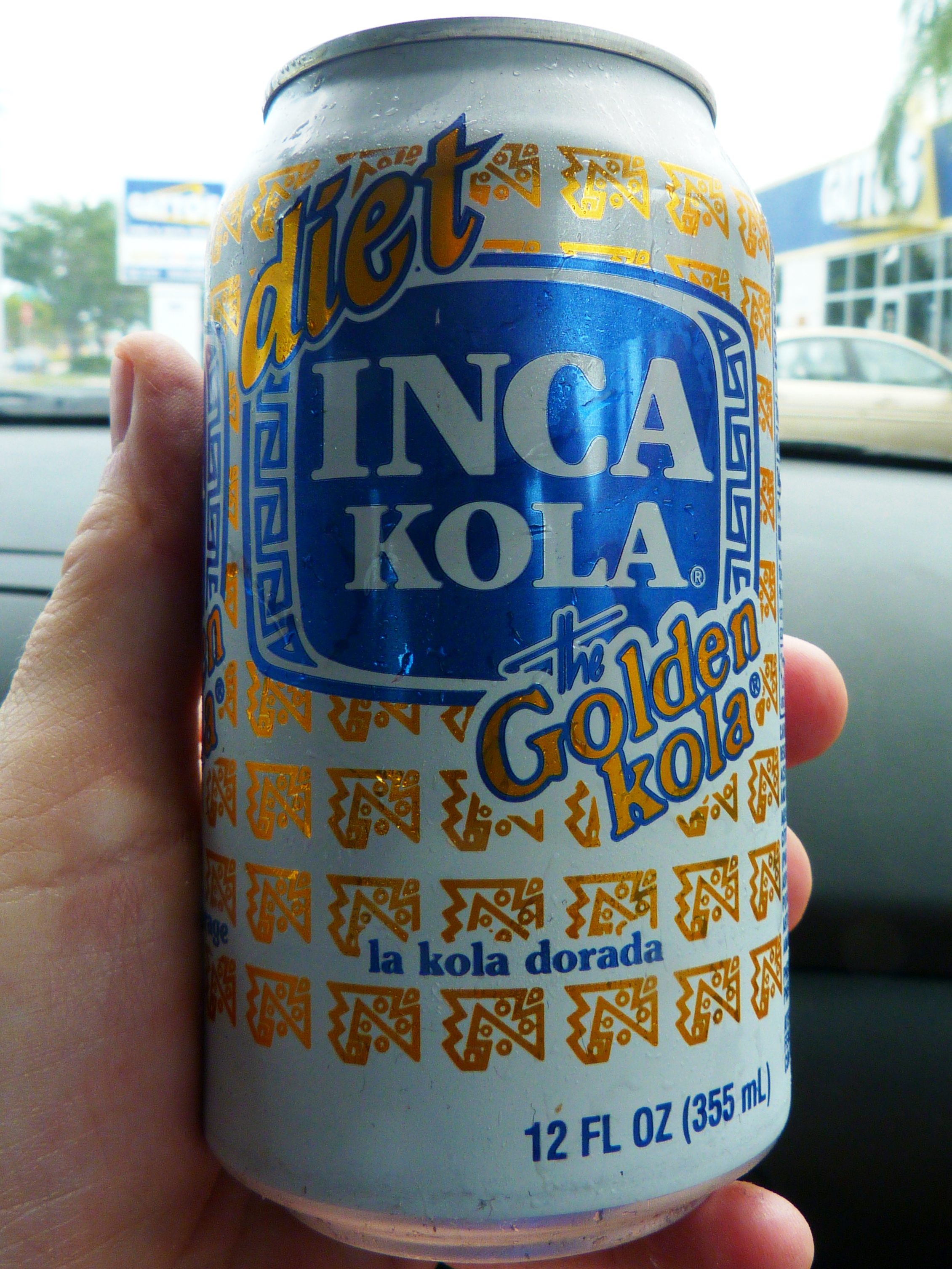
Inca Kola is available in parts of South America, North America and Europe. It is sold in bottles and cans and has an Inca motif.
History
In 1910, in Rímac, one of Lima's oldest and most traditional neighborhoods, an immigrant English family began a small bottling company under their family name, Lindley. In 1928, the company was formally chartered in Peru as Corporación José R. Lindley S.A., whereupon Joseph R. Lindley became its first General Manager.
By the early 1930s, the company had a line of ten flavors of soda including Orange Squash, Lemon Squash, Champagne Kola, and Cola Rosada. In 1935, on the occasion of the 400th anniversary of Lima's founding, Lindley introduced what was to become its most noted product, Inca Kola, whose flavor was based on Lemon Verbena (, Hierbaluisa or Cedrón). He had experimented with various mixtures, other ingredients and levels of carbonation, until finally he came up with this combination of thirteen special plant-derived flavors. The company launched "Inca Kola" under the slogan "There is only one Inca Kola and it's like no other" (Inca Kola sólo hay una y no se parece a ninguna).
By the mid-1940s, Inca Kola was a market leader in Lima due to an aggressive advertising campaign. Appealing to the Peruvian nationalism that was prevalent among the population, the company positioned Inca Kola as a traditional Peruvian drink, using national and indigenous iconography and images. This advertising campaign was very successful, and bottling volume expanded greatly.
Inca Kola reached levels of 38% market penetration by 1970, eclipsing all other carbonated drinks in Peru and firmly establishing itself as "Peru's Drink" (La Bebida del Perú). A common logo in the late 1970s and early 1980s featured the slogan "Made of National Flavor!" (¡De Sabor Nacional!), later changed to "The taste of Peru" (El Sabor del Perú).
On January 22, 2009, Inca Kola partnered with D'Onofrio, an iconic Peruvian ice cream brand owned by Nestlé, to launch an Inca Kola flavored ice pop.
In the United States, Inca Kola is manufactured by the Coca-Cola company and sold in supermarkets in 2 L bottles, cans, and individual bottles.
It also sells a diet version.
Competition
In 1995, Coca-Cola had 32% of the market share of soda sales in Peru while Inca Kola had 32.9%. Since that year, however, the market share for Inca Kola has increased due to some fast food chains including it in their menus. Bembos, a Peruvian fast-food chain, switched from serving Coca-Cola to Inca Kola in 1995. Due to popular demand, McDonald's also began to serve Inca Kola at its locations in Peru in 1995, before Coca-Cola owned the Inca Kola brand (at the time, the only place in the world where Coca-Cola agreed to such an arrangement).

Lindley underwent corporate restructuring in 1997. This expansion resulted in a significant debt load that took a heavy toll, leading to a loss of nearly $5 million in 1999. In search of external assistance, the company turned to Coca-Cola Co., which acquired half of Inca Kola Perú and one-fifth of Corporación José R. Lindley S.A. for an undisclosed sum believed to be around $200 million. Johnny Lindley Taboada, a grandson of the founder and chairman of Corporación José R. Lindley S.A., became the chairman of the joint venture between Coca-Cola and Inca Kola. Coca-Cola emerged as the sole owner of the Inca Kola trademark outside Peru, while a joint-venture agreement was established for operations within Peru. To date, Ecuador and the United States (mostly New York and the rest of the Northeast) are two of the countries where Inca Kola is bottled by the Coca-Cola Company.
During the time that the two giants were negotiating, various smaller companies began to emerge in Peru, selling drinks that competed both with Coca-Cola (Peru Cola, Cola Nacional, Inti Cola, Kola Real, etc.) and Inca Kola (Isaac Kola, Triple Kola, Concordia, Oro etc.). Their main selling point was that Inca Kola was no longer a Peruvian company, having sold out to a foreign company, and therefore not deserving of their money.
During 2004, Corporación José R. Lindley S.A. started talks to buy out Embotelladora Latinoamericana S.A., a bottling business that had been bottling Inca Kola since 1973. They complained that the price of Inca Kola concentrate had increased sixfold since the merger with Coca-Cola. Consequently, they cancelled their contract to bottle Inca Kola in 2000. As a result, in early 2005 Corporación José R. Lindley S.A. purchased two-thirds of Embotelladora Latinoamericana for $215 million. Corporación José R. Lindley S.A. now bottles Inca Kola as well as all the Coca-Cola products using these bottling facilities, with a combined market share of around 60%.


References
- {{cite web |access-date=January 11, 2012
References
- (30 May 2009). "Publicidad The Golden Kola". [[YouTube]].
- Sims, Calvin. (December 26, 1995). "Lima Journal; Peru's Pride That Refreshes: Kola of a Local Color". [[The New York Times]].
- Arce Saavedra, Silva Andrea. (2016). "El lovemark y su efecto en el consumo: Caso Inca Kola, Distrito de Trujillo, 2016".
- "Inca Kola 300 ml".
- "Inca Kola: The Curious Peruvian Cola".
- (February 24, 1999). "Coca-Cola Agrees to Buy Half of Inca Kola Peru". [[The New York Times]].
- "Product Descriptions: Inca Kola". [[The Coca-Cola Company]].
- "Gale Directory of Company Histories: Corporación José R. Lindley S.A.".
- "Ayuda a Pablo y sé parte de la historia del nuevo comercial de Inca Kola".
- "EMPRESAS TRANSNACIONALES EN EL PERÚ: Nestlé Peru S.A.".
- "Inicios de la Corporacion Jose R. Lindley .S.A.".
- "Corporación José R. Lindley S.A.". Inca Kola.
- (March 1, 1999). "Coca-Cola Buys Half of Peru Soft Drink, Rights to Global Distribution...And Unveils Its Own Bottled Water in the United States.". [[All Business]].
This article was imported from Wikipedia and is available under the Creative Commons Attribution-ShareAlike 4.0 License. Content has been adapted to SurfDoc format. Original contributors can be found on the article history page.
Ask Mako anything about Inca Kola — get instant answers, deeper analysis, and related topics.
Research with MakoFree with your Surf account
Create a free account to save articles, ask Mako questions, and organize your research.
Sign up freeThis content may have been generated or modified by AI. CloudSurf Software LLC is not responsible for the accuracy, completeness, or reliability of AI-generated content. Always verify important information from primary sources.
Report