From Surf Wiki (app.surf) — the open knowledge base
Impossible bottle
Bottle with an item larger than the neck

Bottle with an item larger than the neck
An impossible bottle is a bottle containing an object that appears too large to fit through the bottle's mouth.
The ship model in a bottle is a traditional type of impossible bottle. Other common objects include fruits, matchboxes, decks of cards, tennis balls, racketballs, Rubik's Cubes, padlocks, knots, and scissors. These may be placed inside the bottle using various mechanisms, including constructing an object inside the bottle from smaller parts, using a small object that expands or grows inside the bottle, or molding the glass around the object.
Ship in a bottle
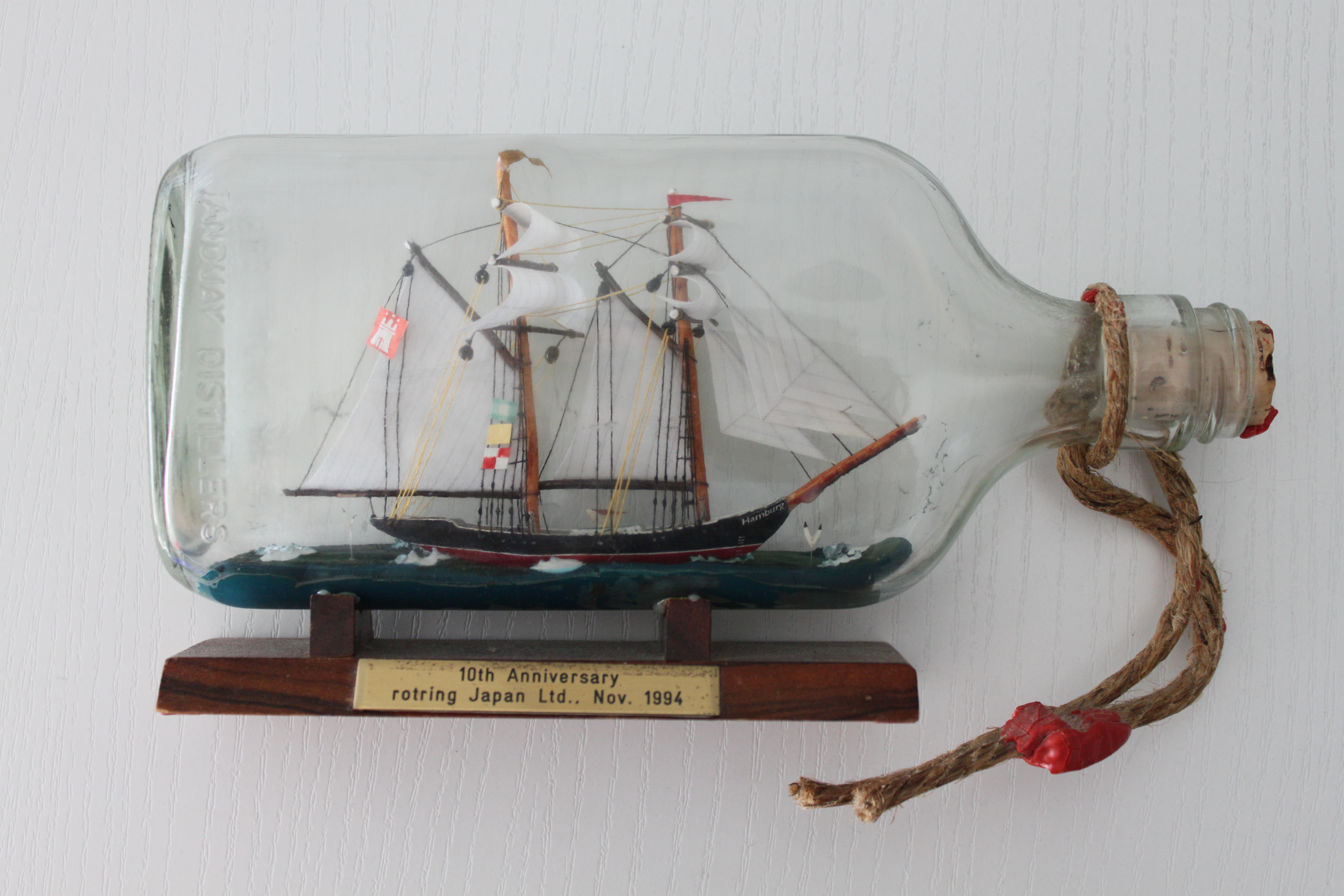
There are two ways to place a model ship inside a bottle. The simpler way is to rig the masts of the ship and raise it up when the ship is inside the bottle. Masts, spars, and sails are built separately and then attached to the hull of the ship with strings and hinges so the masts can lie flat against the deck. The ship is then placed inside the bottle and the masts are pulled up using the strings attached to the masts. The hull of the ship must still be able to fit through the opening. Bottles with minor distortions and soft tints are often chosen to hide the small details of the ship such as hinges on the masts. Alternatively, with specialized long-handled tools, it is possible to build the entire ship inside the bottle.
The oldest surviving ships in a bottle were crafted by Giovanni Biondo at the end of the eighteenth century; two, at least, reproduce Venetian ships of the line. These are quite large and expensive models: the bottles (intended to be displayed upside down, with the neck resting on a small pedestal) measure about 45 cm. The oldest (1784) is in a museum in Lübeck; another (1786) is held by a private collector; the third (1792), that apparently reproduces the heavy frigate PN Fama, is in the Navy Museum in Lisbon. Another old model (1795), from an unknown builder, is kept in a museum in Rotterdam.
Ships in bottles became more popular as folk art in the second half of the nineteenth century, after the introduction of cheap, mass-produced bottles made with clear glass.
A significant collection of ships in bottles is the Dashwood-Howard collection held by the Merseyside Maritime Museum.
God
God-in-a-bottle

God-in-a-bottle, or God-in-the-Bottle, is a symbolisation of the crucifixion of Jesus through the placing in a bottle of carved wooden items, including a cross and often others such as a ladder and spear . The crossbeam of the cross is attached to the vertical beam after both are in the bottle. The bottles were often filled with liquid, latterly sometimes with particles akin to a snow globe. Such bottles were used in 19th-century Irish Catholicism as devotional objects or as talismans akin to witch bottles. They were found elsewhere in Catholic Europe, and are related to older "Passion Bottles", made by glassblowers in their spare time, where a large variety of small glass symbols of the Passion of Jesus were inserted into a bottle.
The making of Gods-in-bottles was exported through Irish diaspora, notably to mining communities in Northern England, where scenes with mining tools sometimes replaced the crucifixion.{{multiref| | | |cited in |
Small objects that expand naturally

One variation of the impossible bottle takes advantage of pine cones opening as they dry out. In constructing the display, a closed, green cone of suitable size is inserted into a narrow-mouthed bottle and then allowed to dry inside the bottle.
Fruits and vegetables inside bottles are grown by placing a bottle around the blossom or young fruit and securing it to the plant. The fruit then grows to full size inside the bottle. This technique is used to put pears into bottles of pear brandy (most famously the French eau de vie Poire Williams).
References
References
- Lardas, Mark. "September 2006 Boys' Life magazine". Boyslife.org.
- "how to section". Shipbottle.ru.
- "How is a ship in a bottle made?". Answers.com.
- "Folk Art In Bottles - Giovanni Biondo - 1st Ship in Bottle Builder".
- (2016-01-10). "Ships in Bottles -- A Bit of the History and Lore".
- (1 March 2013). "Ships in Bottles and Their Origins in the Late Nineteenth Century". The Mariner's Mirror.
- (2020). "God-out-of-the-Bottle". Sligo Field Club Journal.
- (2020). "Irish country furniture and furnishings 1700–2000". Cork University Press.
- (1994). "A Passion Bottle by Alexandre Soudart". Journal of Glass Studies.
- (2012-01-12). "Passion bottle". [[Victoria and Albert Museum]].
- National Museum of Ireland. (6 October 2016). "Passion Bottle or ‘God in a Bottle’ contain wooden objects usually a crucifix symbolising the Passion of Christ, on display NMI-CountryLife".
- "God in a bottle". Beamish Museum.
- (1 June 2014). "Folk tales". Apollo.
- (28 July 2022). "A History of Irish Literature and the Environment".
- (October 2009). "Power, Richard (Dick) (de Paor, Risteard)". Royal Irish Academy.
- (1964). "The Land of Youth". Dial Press.
- (3 February 2023). "Keeping the ‘God in the Bottle’ craft tradition alive". Offaly Independent.
- "Pine Cone in the Bottle Display". Instructables.
- "Science Fair Project Ideas: Grow Apples or Tomatoes in Bottles".
- (2014-10-03). "How do you get a full-grown pear inside a Brandy bottle?".
This article was imported from Wikipedia and is available under the Creative Commons Attribution-ShareAlike 4.0 License. Content has been adapted to SurfDoc format. Original contributors can be found on the article history page.
Ask Mako anything about Impossible bottle — get instant answers, deeper analysis, and related topics.
Research with MakoFree with your Surf account
Create a free account to save articles, ask Mako questions, and organize your research.
Sign up freeThis content may have been generated or modified by AI. CloudSurf Software LLC is not responsible for the accuracy, completeness, or reliability of AI-generated content. Always verify important information from primary sources.
Report