From Surf Wiki (app.surf) — the open knowledge base
Imperial pigeon
Genus of birds

Genus of birds
Ducula is a genus of the pigeon family Columbidae, collectively known as imperial pigeons. They are large to very large pigeons with a heavy build and medium to long tails. They are arboreal, feed mainly on fruit and are closely related to the other genus of fruit-eating doves, Ptilinopus. Both genera display brightly coloured plumage, predominantly green, often with contrasting under-parts of purple, orange or red. Some Ducula have prominently swollen ceres. They have large gapes and swallow seeds whole, playing an important role in seed dispersal.
Imperial pigeons are found in forests of southern Asia, New Guinea, northern Australia and the Pacific islands. Many species are nomadic, travelling long distances to exploit seasonal fruit sources. Some undertake migrations and all are strong fliers.
Taxonomy
The genus Ducula was introduced in 1836 by the English naturalist Brian Houghton Hodgson with Ducula insignis as the type species. This taxon is now considered as a subspecies of the mountain imperial pigeon (Ducula badia). The genus name Ducula is from the Latin dux genitive ducis meaning "leader".
The taxonomy of the imperial pigeon is unresolved, with the number of species within the genus Ducula reported variably as 34 and 36. Derek Goodwin's 1959 paper on the taxonomy of the genus Ducula divides his arrangement of 36 species into 7 subgroups according to distribution and phenotype, and this classification is followed by Gibbs et al. The current (2024) version of the IOC World Bird List includes 42 extant species and this is followed here.
Species
The genus contains 42 species:
| Section | Image | Scientific name | Distribution | Poliocephala species-group | Carola species-group | Aenea species-group | Brenchleyi species-group | Zoe's imperial pigeon | Badia species group | Bicolor species-group | |||
|---|---|---|---|---|---|---|---|---|---|---|---|---|---|
| [[File:Pink-Bellied Imperial Pigeon.jpg | 120px]] | Ducula poliocephala (Gray, 1844) pink-bellied imperial pigeon | Philippines. | ||||||||||
| [[File:White-bellied Imperial Pigeon SMTC.jpg | 120px]] | Ducula forsteni (Bonaparte, 1854) white-bellied imperial pigeon | Indonesia (Sulawesi, Buton, Taliabu, Togian, and Peleng.) | ||||||||||
| [[File:CarpophagaMindorensisKeulemans.jpg | 120px]] | Ducula mindorensis (Whitehead, 1896) Mindoro imperial pigeon | Philippines (Mindoro) | ||||||||||
| Ducula radiata (Quoy & Gaimard, 1830) Grey-headed imperial pigeon | Indonesia (Sulawesi) | ||||||||||||
| [[File:Iconographie des pigeons (8100062636) (cropped).jpg | 120px]] | Ducula carola (Gray, 1844) Spotted imperial pigeon | Philippines | ||||||||||
| [[File:Green Imperial Pigeon RWD5a.jpg | 120px]] | Ducula aenea (Linnaeus, 1766) Green imperial pigeon | Nepal, southern India and Sri Lanka eastwards to southern China, Indonesia and the Philippines. | ||||||||||
| Ducula oenothorax (Salvadori, 1892) Enggano imperial pigeon | Enggano Island. | ||||||||||||
| Ducula nicobarica (Pelzeln, 1865) Nicobar imperial pigeon | Nicobar Islands. | ||||||||||||
| [[File:Carpophaga perspicillata - 1700-1880 - Print - Iconographia Zoologica - Special Collections University of Amsterdam - UBA01 IZ15600097.tif | 120px]] | Ducula perspicillata (Temminck, 1824) Spectacled imperial pigeon | Maluku Islands. | ||||||||||
| [[File:Seram imperial pigeon.jpg | 120px]] | Ducula neglecta (Schlegel, 1866) Seram imperial pigeon | Moluccas | ||||||||||
| [[File:Ducula concinna - Siau Island.JPG | 120px]] | Ducula concinna (Wallace, 1865) Elegant imperial pigeon | New Guinea, Talaud Islands, Sangihe, islands off southern Sulawesi, the southern Maluku Islands, and the eastern Lesser Sundas from Romang to Tanimbar, east up to the Aru Islands. | ||||||||||
| [[File:Ducula pacifica 13238830.jpg | 120px]] | Ducula pacifica (Gmelin, 1789) Pacific imperial pigeon | American Samoa, the Cook Islands, Fiji, Kiribati, Niue, Papua New Guinea, Samoa, Solomon Islands, Tokelau, Tonga, Tuvalu, Vanuatu, and Wallis and Futuna Islands. | ||||||||||
| [[File:Ducula oceanica townsendi 39750206.jpg | 120px]] | Ducula oceanica (Desmarest, 1826) Micronesian imperial pigeon | Palau, the Caroline Islands, the Marshall Islands and Nauru. | ||||||||||
| [[File:Polynesian Imperial Pigeon.jpg | 120px]] | Ducula aurorae (Peale, 1848) Polynesian imperial pigeon | French Polynesia. | ||||||||||
| [[File:Ducula galeata Nuku Hiva.jpg | 120px]] | Ducula galeata (Bonaparte, 1855) Marquesan imperial pigeon | Nuku Hiva in the Marquesas Islands of French Polynesia. | ||||||||||
| [[File:Pigeon of Stewart's Isld and San Christoval (48752852697).jpg | 120px]] | Ducula rubricera (Bonaparte, 1854) Red-knobbed imperial pigeon | Bismarck Archipelago and the Solomon Islands archipelago. | ||||||||||
| [[File:Spice Imperial Pigeon, Raja Ampat, Papua Barat, Indonesia imported from iNaturalist photo 338170162.jpg | 120px]] | Ducula myristicivora (Scopoli, 1786) Spice imperial pigeon | Indonesia | ||||||||||
| Ducula geelvinkiana Schlegel, 1873 Geelvink imperial pigeon | Indonesia's Schouten Islands | ||||||||||||
| [[File:Ducula rufigaster (13004532433).jpg | 120px]] | Ducula rufigaster (Quoy & Gaimard, 1830) Purple-tailed imperial pigeon | New Guinea. | ||||||||||
| [[File:Ducula basilica.jpg | 120px]] | Ducula basilica Bonaparte, 1854 Cinnamon-bellied imperial pigeon | Moluccas. | ||||||||||
| [[File:Finsch's imperial pigeon.jpg | 120px]] | Ducula finschii (Ramsay, 1882) Finsch's imperial pigeon | Papua New Guinea. | ||||||||||
| Ducula chalconota (Salvadori, 1874) Rufescent imperial pigeon | New Guinea. | ||||||||||||
| [[File:Ducula pistrinaria rhodinolaema.jpg | 120px]] | Ducula pistrinaria Bonaparte, 1855 Island imperial pigeon | Bismarck Archipelago and the Solomon Islands archipelago | ||||||||||
| [[File:Pink-headed Imperial Pigeon (8074116303) (cropped).jpg | 120px]] | Ducula rosacea (Temminck, 1835) Pink-headed imperial pigeon | Lesser Sunda Islands of Indonesia | ||||||||||
| [[File:Ducula whartoni.jpg | 120px]] | Ducula whartoni (Sharpe, 1887) Christmas imperial pigeon | Christmas Island | ||||||||||
| [[File:GREY IMPERIAL PIGEON.jpg | 120px]] | Ducula pickeringii (Cassin, 1854) Grey imperial pigeon | Sulu Archipelago, Miangas and Talaud Islands | ||||||||||
| [[File:Barking Pigeon (31941958135).jpg | 120px]] | Ducula latrans (Peale, 1848) Barking imperial pigeon | Fiji | ||||||||||
| Ducula brenchleyi (Gray, 1870) Chestnut-bellied imperial pigeon | Solomon Islands. | ||||||||||||
| Ducula bakeri (Kinnear, 1928) Vanuatu imperial pigeon | Vanuatu | ||||||||||||
| [[File:Notou.jpg | 120px]] | Ducula goliath (Gray, 1859) Goliath imperial pigeon | New Caledonia. | ||||||||||
| [[File:Ducula pinon (Pinon Imperial-pigeon)8.jpg | 120px]] | Ducula pinon (Quoy & Gaimard, 1824) Pinon's imperial pigeon | New Guinea. | ||||||||||
| [[File:CarpophagaMelanochroaSmit.jpg | 120px]] | Ducula melanochroa (Sclater, 1878) Black imperial pigeon | Bismarck Archipelago | ||||||||||
| [[File:Ducula mullerii -San Diego Zoo, California, USA-8a.jpg | 120px]] | Ducula mullerii (Temminck, 1835) Collared imperial pigeon | New Guinea | ||||||||||
| [[File:Ducula zoeae-20051003.jpg | 120px]] | Ducula zoeae (Lesson, 1826) Zoe's imperial pigeon | New Guinea. | ||||||||||
| [[File:Mountain Imperial Pigeon.jpg | 120px]] | Ducula cuprea (Jerdon, 1840) Malabar imperial pigeon | Western Ghats of India. | ||||||||||
| [[File:Mountain Imperial Pigeon Mahananda Wildlife Sanctuary West Bengal India 09.05.2016.jpg | 120px]] | Ducula badia (Raffles, 1822) Mountain imperial pigeon | Bangladesh, Bhutan, Brunei, Cambodia, China, India, Indonesia, Laos, Malaysia, Myanmar, Nepal, Thailand, and Vietnam | ||||||||||
| [[File:Dark-backed Imperial Pigeon.jpg | 120px]] | Ducula lacernulata (Temminck, 1823) Dark-backed imperial pigeon | Lesser Sunda Islands. | ||||||||||
| [[File:Carpophaga cineracea - 1700-1880 - Print - Iconographia Zoologica - Special Collections University of Amsterdam - UBA01 IZ15600113.tif | 120px]] | Ducula cineracea (Temminck, 1835) Timor imperial pigeon | Timor and Wetar. | ||||||||||
| [[File:Ducula bicolor - Chinese Garden.jpg | 120px]] | Ducula bicolor (Scopoli, 1786) Pied imperial pigeon | Myanmar and Thailand, throughout Indonesia and east to the Philippines and the Bird's Head Peninsula in New Guinea. | ||||||||||
| [[File:Sulawesi trsr DSCN0750 v1.JPG | 120px]] | Ducula luctuosa (Temminck, 1825) Silver-tipped imperial pigeon | Sulawesi | ||||||||||
| [[File:Torresian imperial pigeon cairns09.JPG | 120px]] | Ducula spilorrhoa (Gray, 1858) Torresian imperial pigeon | Australia (north-east Western Australia, north Northern Territory and north Queensland, including the Torres Strait Islands), New Guinea, Aru Islands, islands in the Geelvink Bay, D'Entrecasteaux Islands and Louisiade Archipelago. | ||||||||||
| [[File:Yellowish imperial pigeon (cropped).jpg | 120px]] | Ducula subflavescens (Finsch, 1886) Yellowish imperial pigeon | Bismarck Archipelago. |
Two recently extinct species have also been described from archaeological remains:
- Ducula tihonireasini from the Gambier Islands, French Polynesia
- Shutler's fruit pigeon (Ducula shutleri) from Tonga
Description
''Poliocephala'' species-group
Four species of imperial pigeon are found in Philippines and Sulawesi. All have a distinct pale band across the centre of the tail, and a rich green or purple dorsum. This grouping shares characteristics and distribution with Ptilinopus, and forms a link between the genera. The pink-belled (D. poliocephala) and the white-bellied (D. forsteni) imperial pigeon are similar and allopatric species. The Mindoro (D. mindorensis) and the grey-headed (D. radiata) imperial pigeons differ in size but are otherwise similar.
''Carola'' species-group
The spotted imperial pigeon (D. carola) is sympatric to D. poliocephala, and though smaller, short tailed and with spotted plumage, it is similar enough in appearance and distribution to suggest the taxa are related.
''Aenea'' species-group
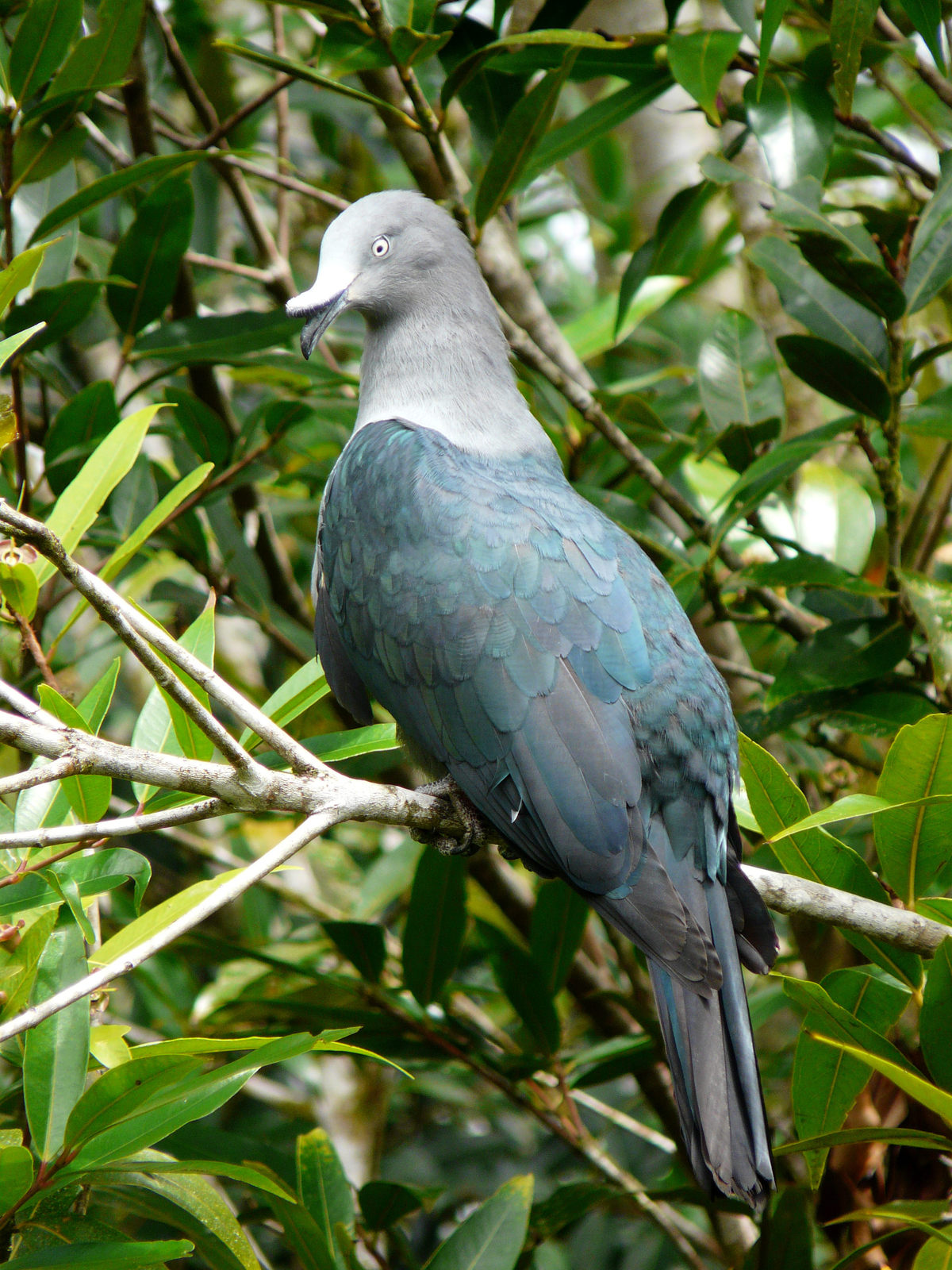
This group's nominate species is the green imperial pigeon (D. aenea), distinctive by its iridescent green, purple or bronze upper-parts and wings. The species-group is widespread through the Asia-Pacific. It is further separated into subgroups by Goodwin.
- Three Asian species with iridescent green upper-parts, pink head and neck with normal sized ceres; D. aenea, the elegant (D. concinna) and the white-eyed or spectacled (D. perspicillata) imperial pigeons.
- The pacifica subgroup of six species, similar to aenea but with enlarged ceres, and distributed throughout the Pacific. The Pacific (D. pacifica) and the Micronesian (D. oceania) imperial pigeons are similar allospecies, while the Polynesian (D. aurorae) and Marquesan (D. galeata) imperial pigeons are larger birds with dark plumage. The red-knobbed imperial pigeon (D. rubricera) and the spice imperial pigeon (D. myristicivora) are similar but found in Melanesia and New Guinea.
- The finschii subgroup of four species which may be New Guinea representatives of D. aenea stock; the purple-tailed (D. rufigaster), cinnamon-bellied (D. basilica) and Finsch's imperial pigeons, which all inhabit offshore islands. The shining or rufescent imperial pigeon (D. chalconota) occupies more elevated ranges on the New Guinea mainland.
- Another subgroup similar to aenea, but with upper parts not iridescent and less well defined, is the pink-headed imperial pigeon (D. rosacea) as the nominate species, the Christmas Island (D. whartoni), the grey (D. pickeringii) and the island (D. pistrinaria) imperial pigeons.
''Brenchleyi'' species-group
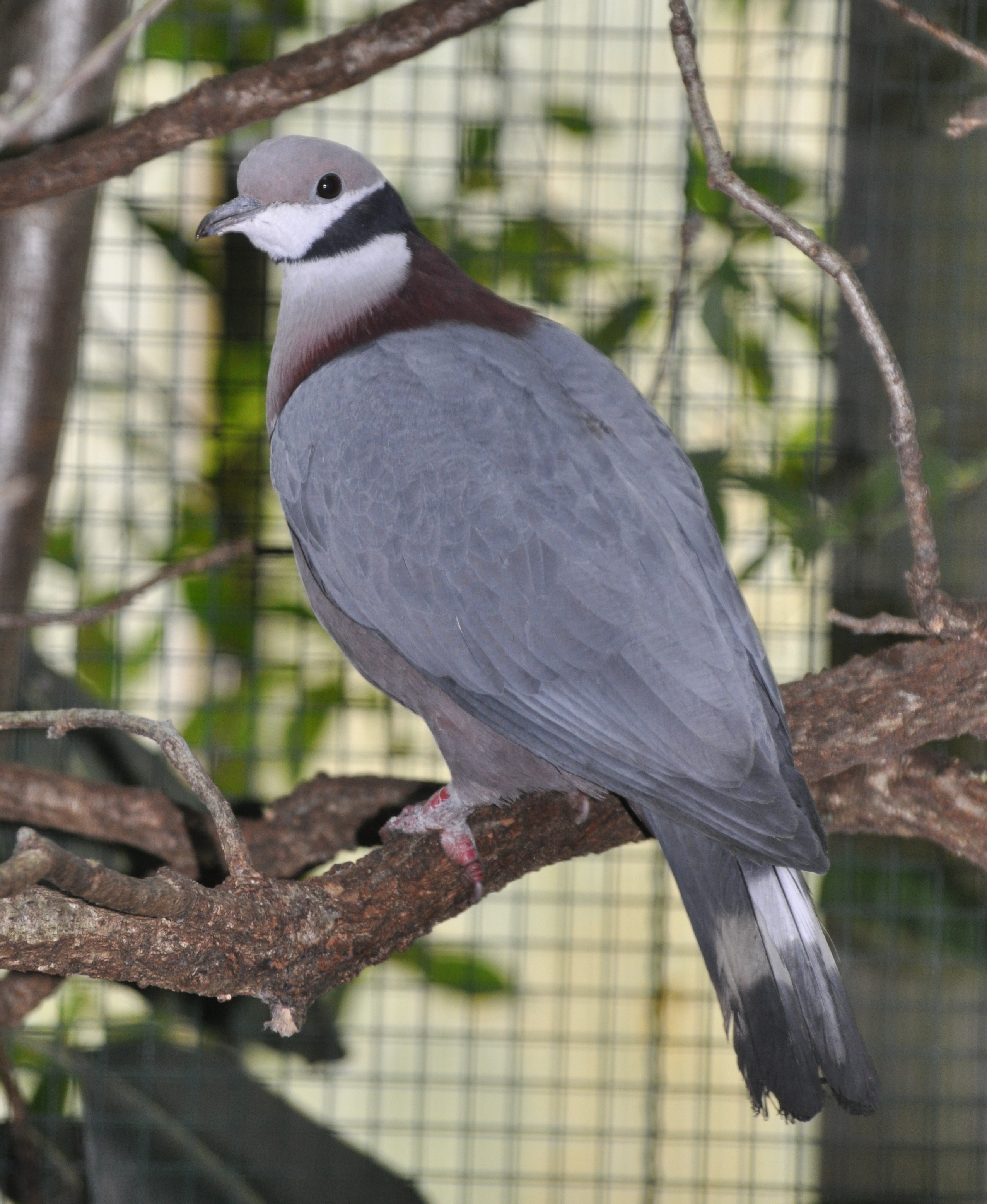
Contains 4 subgroups of large dark chestnut-bellied pigeons.
- The chestnut-bellied imperial pigeon (D. brenchleyi) is the nominate species with the Baker's (D. bakeri), Peale's (D. latrans), and New Caledonian (D. goliath) imperial pigeons, being allopatric through the Western Pacific islands.
- The Pinon imperial pigeon (D. pinon) is found in New Guinea and its islands.
- The collared imperial pigeon (D. mullerii) is found in New Guinea and Aru and has a distinctive dark collar.
- The Bismarck imperial pigeon (D. melanochroa) is found on the Bismarck Archipelago.
Zoe's imperial pigeon
D. zoeae of Indonesia and New Guinea, is sufficiently distinct in colour to be placed in a species-group of its own.
''Badia'' species group
- The mountain (D. badia) and the dark-backed (D. lacernulata) imperial pigeons have a widespread distribution, the former from Indian subcontinent to south China and Malaysia, and the latter in southern Indonesia.
- The Timor imperial pigeon (D. cineracea) is a similar grey pigeon, but found in Timor.
''Bicolor'' species-group

The pied imperial pigeons form a discrete group of large white pigeons with black wingtips, found in New Guinea and its islands, and northern Australia. Goodwin recognised three species; the pied (D. bicolor) the white (D. luctuosa) and the Torresian (D. spilorrhoa). Gibbs et al. group D. bicolor and D. spilorrhoa together, but adds the yellow-tinted imperial pigeon (D. subflavescens) as another species. Frith includes D. subflavescens as a race of D. spilorrhoa. Sibley and Monroe (1990) follow Goodwin.
The difficulty in assigning or removing species rank is compounded by the lack of data on behaviour and breeding patterns of the taxa. Similar species are allopatric, and there is no data on whether the species freely interbreed or not. Data on voice and behaviour is similarly poor.
The confusion is not helped by English naming. D. bicolor is variously described as the nutmeg pigeon, the Torres Strait pigeon, and the pied imperial pigeon. D. spilorrhoa is also described as the nutmeg pigeon, the white nutmeg pigeon, the Australian pied pigeon, the Australian pied imperial pigeon, the Torres Strait pigeon or the Torresian imperial pigeon.
Distribution and habitat
Imperial pigeons are only found in southern Asia, Australia, New Guinea and the Pacific, a distribution from the Himalayas (D. badia) to Tahiti in the South Pacific (D. aurorare). The greatest diversity of birds is in New Guinea. Imperial pigeons are strong fliers, are capable of flight over oceans, and have been successful in colonising islands and archipelagos.
Australia has a poor representation of Ducula amongst its fauna, with only one species breeding on the mainland (D. spilorrhoa). There is no clear explanation why more species of Ducula did not cross the Torres Strait islands to reach mainland Australia. The genus Lopholaimus, comprising only one species may have been well represented on the Australian mainland before European settlement, thus excluding Ducula.
Imperial pigeons are arboreal, and found almost exclusively in forest and woodland habitats where there is availability of fruit bearing trees. About half of the species occupy mountainous forest to elevations of 2500m. Many are found on islands, and live in coastal forests, with a few species inhabiting forest edges or mangroves.
Appearance
Tropical species of pigeons can display a rich variety of colour, presumably to facilitate species recognition. The plumage of the seed-eating genera of Columbidae is more often dull brown or grey. Typically imperial pigeons have dark dorsum and wings, ranging from grey to iridescent green. Their breasts are paler, ranging in colour from grey through orange and pink to dark grey. Less conspicuous markings are found on birds isolated to islands. Most species display little or no sexual dimorphism.
Imperial pigeons are large to very large pigeons; typical length is 35 to 45 cm, and they have medium to long tails. The critically endangered Marquesan imperial pigeon is 50 cm long and is the largest arboreal pigeon in the family Columbidae.
Fat quills are present in D. bicolor and D. spilorrhoa. Fat quills are modified feathers that produce a lipoid substance that is used in a similar way to the secretions of the preen gland. Fat quills are found around the rump of D. bicolor and in other Columbidae species. Preening with the yellow coloured lipid causes variations in colour of the head and shoulders of D. bicolor, ranging from cream to yellow. Colouration differs between individuals and the stage of molt, deeper colouring found just prior to molt, leading to some confusion in identifying taxa. The function of the fat quills is debatable, with suggestions of a sexual signal, an antibacterial, or as an olfactory signal. Yellow lipoid substance can be expressed from the base of a broken rachis
Behaviour
There is a paucity of information on most species of Ducula, many of which are shy and live in remote areas, making observation difficult. Breeding and nesting behaviour of species has been poorly documented. Though large and numerous, birds can be inconspicuous, feeding quietly in deep foliage.
Ducula are highly mobile and can travel large distances to find fruit. They are strong fliers and able to fly between islands to exploit erratic food sources. Small islands whose flora would be unable to sustain a long term population can provide a temporary food source for nomadic birds.
Some species live singly or in pairs, but many are highly social, forming flocks of 30 to 50 birds.
Pigeons drink by a pumping or sucking mechanism that allows them to drink with their beak continuously immersed in water. Fruit eating pigeons may utilize water from their diet and have less water requirements than other pigeons.
Diet
Imperial pigeons are arboreal, living in forests and mangroves that can supply seasonal fruit from tropical trees, palms, vines and bushes. Most birds clamber through twigs and branches of canopy, leaning or hanging upside down to reach fruit. Fruit is twisted off stems with their bill and swallowed whole. They are able to extend their gapes to 40mm in order to swallow large fruits. D. galeata can swallow seeds of 70mm. Their diet can be supplemented with flowers, leaves and insects.
In contrast to seed-eating pigeons, Ducula have thin-walled gizzards and short wide guts, allowing large seeds to pass through. After digesting the fleshy parts, they void the seeds intact, thus playing an important role as seed dispersers.
Other genera of Columbidae have grinding gizzards which either destroy seeds, or regurgitate larger seeds. Some large seeded fruits are eaten by both Nicobar pigeons (Colaenesa nicobarica) and imperial pigeons, with the former destroying seeds and the latter excreting them intact .
Imperial pigeons are amongst the largest frugivores in the forest, and can disperse seeds from fruit too large for most other species to handle. A fruit size of 30 mm would exclude all vertebrates other than hornbills (Bucerotidae) and Ducula. Pacific pigeons (D. pacifica) are shown to be excellent seed dispersers in Tonga and are thus critical in the management of forests throughout their habitat.
Reproduction
Imperial pigeons construct somewhat flimsy nests of loosely woven twigs placed in the fork of a tree. Species that roost in mangroves construct more substantial nests from mangrove shoots. They generally lay a single egg with a relatively short incubation period. Both sexes share incubation and care of nestlings. Ducula, typical of most pigeons, produce a nutritiously rich crop milk which allows the chicks to rapidly fledge and leave the nest, reducing their period of vulnerability. The breeding cycle is short, allowing several broods to be reared in succession over an extended summer breeding season.
Crop milk is a thick cheesy substance, derived from squamous cells sloughed off from the crop of both male and female pigeons which promotes a high growth rate in squabs. There are no studies of the composition of crop milk specific to Ducula. However, in domestic pigeons (Columba livia), the crop milk is found to contain lipids, proteins and enzymes, and also facilitates the transfer of maternal antibodies to squabs, as in mammals. The hypertrophy of crop tissue and production of crop milk is determined by the hormone prolactin, as in mammals.
An abundance of fruit is important to the breeding success of frugivorous birds. Large breeding colonies require unexploited forest to provide fruit bearing trees for daily feeding.
Voice
Variable between species, but ranging from typical 'coo' and 'coo-woo' of other pigeon families, to resonant 'whoops',
Migration
Columbidae are generally strong fliers and effective colonisers, being able to make across ocean flights to access seasonal fruit supplies. D. bicolor is partly migratory, its distribution changing according to food availability.
Ecology and conservation
About one third of extant pigeons in the family Columbidae are endangered to a greater or lesser degree, making the family one of the most threatened in the world. Asia, Australasia and Oceania are home to nearly two-thirds of extant species of Columbidae, but three quarters of those species are threatened.
The greatest threats to Columbidae species is habitat loss and degradation, hunting by man, and alien predators. Other threats include disease and possible competition from introduced species. Large flocks of Ducula are mobile and able to exploit large areas for food sources, but are nevertheless vulnerable to large scale loss of forests.
Pigeons are exploited by man for food and sport. Hunting of D. spillorhoa on the Australian mainland has reduced populations.
Many species of Ducula live on forested islands in the Indian Ocean, SE Asian archipelagos and on Pacific and Australasian islands. Island species are particularly vulnerable as highly specialised populations, ill-prepared for introduced predators such as cats, rats and stoats.
One of the most threatened species of Ducula is the Marquesan imperial pigeon (D. galeata) whose numbers have been reduced from 250 individuals in 1998 to fewer than 100 birds in 2000. A translocation programme has been initiated, increasing the number of islands in which D. galeata has a breeding colony.
Frugivorous pigeons play an important role in seed dispersal and the preservation of tropical forest diversity.
References
References
- . ["Columbidae"](https://www.aviansystematics.org/4th-edition-checklist?viewfamilies=66). *The Trust for Avian Systematics*.
- (1983). "Pigeons and Doves of the World". British Museum of Natural History.
- (1989). "Pigeons as seed predators and dispersers of figs in a Malaysian lowland forest". Ibis.
- (2007). "Geographical patterns of threat among pigeons and doves (Columbidae)". Oryx.
- Hodgson, Brian Houghton. (1836). "Notices of the ornithology of Nepal". Asiatic Researches, or, Transactions of the Society Instituted in Bengal.
- (2024). "Pigeons". International Ornithologists' Union.
- Jobling, James A.. (2010). "The Helm Dictionary of Scientific Bird Names". Christopher Helm.
- (1990). "Distribution and Taxonomy of Bird of the World". Yale University Press.
- (1959). "Taxonomy of the genus Ducula". Ibis.
- (2010). "Pigeons and Doves: A Guide to the Pigeons and Doves of the World". Bloomsbury Publishing.
- "Species Updates – IOC World Bird List".
- (2018). "New prehistoric avifaunas from the Gambier Group, French Polynesia". Palaeontologia Electronica.
- (2020). "Prehistoric avifaunas from the Kingdom of Tonga". Zoological Journal of the Linnean Society.
- (1996). "Handbook of Australian, New Zealand and Antarctic Birds: Volume 3 Snipes to Penguins". Oxford University Press.
- (1982). "Pigeons and Doves of the World". Rigby Publishers.
- (2003). "The biology of the critically endangered Marquesan imperial-pigeon (''Ducula galena''), Nuku Hiva, Marquesas Archipelago". Emu.
- (1967). "On the "creaminess" in the plumage of ''Ducula bicolor''". Bulletin of the British Ornithologists' Club.
- (2000). "Avian epidermal lipids: functional considerations and relationship to feathering". American Zoology.
- (2010). "Fat quill secretion in pigeons: could it function as a cosmetic?". Animal Biology.
- (2007). "Cosmetic coloration in birds: occurrence, function and evolution". American Naturalist.
- (2007). "Patterns of supra-canopy flight by pigeons and parrots at a hill-forest site in Papua New Guinea". Emu.
- (1998). "Frugivory and seed dispersal by vertebrates in the Oriental (Indomalayan) region". Biological Reviews.
- (1975). "Breeding feeding and status of the Torres Strait pigeon at Low Isles, North-eastern Queensland". Emu.
- (1996). "Drinking behaviour of sandgrouse in the Namib and Kalahari deserts, Africa". The Auk.
- (1989). "Pigeons as seed predators and dispersers of figs in Malaysian lowland forest". Ibis.
- (2005). "Seed dispersal by Pacific pigeons (''Ducula pacifica'') in Tonga, Western Polynesia". Emu.
- (1997). "Biochemical differences between crop tissue and crop milk of pigeons (''Columba livia'')". Comparative Biochemistry and Physiology.
- (1993). "Transmission of antibodies to ''Chlamydia psittaci'' and ''Coxiella burnetti'' through eggs and crop milk in pigeons". European Journal of Epidemiology.
- (1978). "Notes on the phylogeny, distribution and ecology of frugiverous pigeons in Polynesia". Emu.
- (2005). "Avian extinction and mammalian introductions on oceanic islands". Science.
- (1996). "The role of animals in the colonization of the Krakatau Islands by fig trees (''Ficus'' species)". Journal of Biogeography.
- (2013). "The birds of Tetapare Island, Solomon Islands". Australian Field Ornithology.
This article was imported from Wikipedia and is available under the Creative Commons Attribution-ShareAlike 4.0 License. Content has been adapted to SurfDoc format. Original contributors can be found on the article history page.
Ask Mako anything about Imperial pigeon — get instant answers, deeper analysis, and related topics.
Research with MakoFree with your Surf account
Create a free account to save articles, ask Mako questions, and organize your research.
Sign up freeThis content may have been generated or modified by AI. CloudSurf Software LLC is not responsible for the accuracy, completeness, or reliability of AI-generated content. Always verify important information from primary sources.
Report