From Surf Wiki (app.surf) — the open knowledge base
Imam Shamil

| Field | Value |
|---|---|
| name | Imam Shamil |
| image | Shamil by Denier.jpg |
| caption | Shamil in 1859 |
| religion | Sunni Islam |
| succession | Imam of Chechnya and Dagestan |
| reign | 1834–1859 |
| predecessor | Hamzat Bek |
| successor | Overthrown by the Russian Empire |
| father | Dengau |
| birth_date | 26 June 1797 |
| birth_place | Gimry, Dagestan, Avar Nutsaldom |
| death_date | |
| death_place | Medina, Habesh Eyalet, Ottoman Empire |
| place of burial | Jannatul Baqi, Medina |
| signature | Imam Shamil signature.svg |
Imam Shamil (; ; ; ; ; 26 June 1797 – 4 February 1871) was the political, military, and spiritual leader of North Caucasian resistance to Imperial Russia in the 1800s,{{cite book |url-access=registration
Family and early life
Imam Shamil was born in 1797 into an Avar Muslim family. He was born in the small village (aul) of Gimry (present-day Dagestan, Russia). Some sources state that he had a paternal Kumyk lineage.{{Cite web

Shamil grew up at a time when the Russian Empire was expanding into the territories of the Ottoman Empire and Qajar Iran (see Russo-Persian War (1804–1813) and Russo-Turkish War (1806–1812)). Many Caucasian peoples united in resistance to Russian imperial aspirations in what became known as the Caucasian War (1817-1864). Earlier leaders of Caucasian resistance included Hadji-Dawud, Sheikh Mansur and Ghazi Mollah. Shamil, a childhood friend of the Mollah, would become his disciple and counsellor.
Shamil had multiple wives, including one of Armenian ethnicity born in Russia named Anna Ivanovna Ulukhanova (or Ulykhanova; 1828-1877). Captured in a raid in 1840, she married Shamil six years later. She converted to Islam as a teenager and adopted the name Shuanet. Shuanet remained loyal to Shamil even after his capture and exile to Russia. After the death of Shamil (1871) she moved to the Ottoman Empire, where the sultan assigned her a pension.
War against Russia
Main article: Murid War
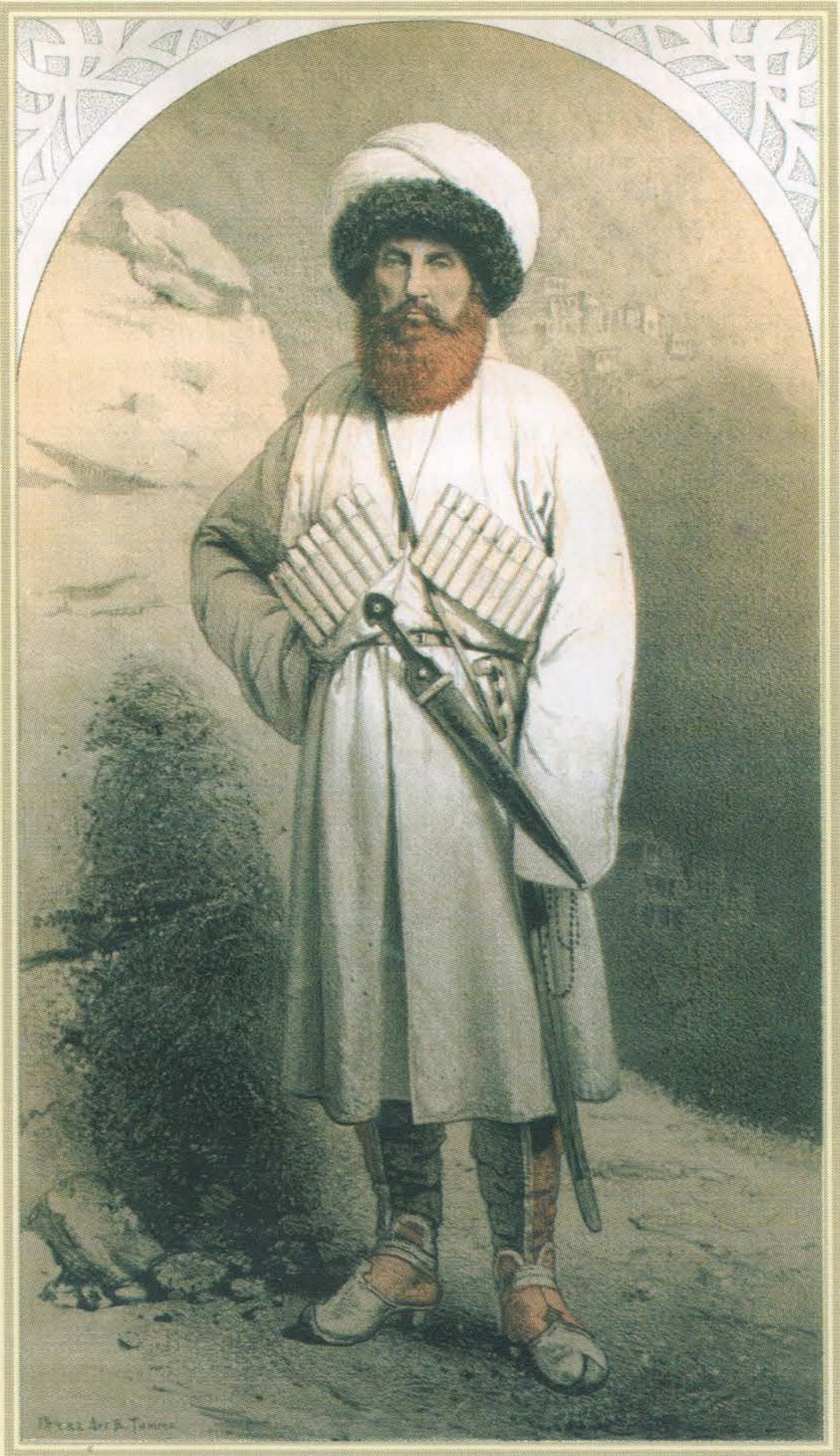

In 1832, Ghazi Mollah died at the battle of Gimry, and Shamil was one of only two murids to escape, but he sustained severe wounds. During this fight he was stabbed with a bayonet. After reportedly jumping from an elevated stoop "clean over the heads of the very line of soldiers about to fire on him ... [he landed] behind them, whirling his sword in his left hand he cut down three of them, but was bayoneted by the fourth, the steel plunging deep in his chest. He seized the bayonet, pulled it out of his own flesh, cut down the man, and with another superhuman leap, cleared the wall and vanished in the darkness". He went into hiding and both Russia and murids assumed him dead. Once recovered, he emerged from hiding and rejoined the murids, led by the second Imam, Hamzat Bek. He would wage unremitting warfare on the Russians for the next quarter century and become one of the legendary guerrilla commanders of the century. When Hamzat Bek was killed in 1834, Shamil took his place as the prime leader of the Caucasian resistance and the third Imam of the Caucasian Imamate.
In June–August 1839, Shamil and his followers, numbering about 4000 men, women and children, found themselves under siege in their mountain stronghold of Akhoulgo, nestled in the bend of the Andi Koysu, about ten miles east of Gimry. Under the command of General Pavel Grabbe, the Russian army trekked through lands devoid of supplies because of Shamil's scorched-earth strategy. The geography of the stronghold protected it from three sides, adding to the difficulty of conducting the siege. Eventually the two sides agreed to negotiate. Complying with Grabbe's demands, Shamil gave his son, Jamaldin, in a sign of good faith, as a hostage. Shamil rejected Grabbe's proposal that Shamil command his forces to surrender and for him to accept exile from the region. The Russian army attacked the stronghold, after 2 days of fighting, the Russian troops had secured it. Shamil escaped the siege during the first night of the attack. Shamil's forces had been broken and many Dagestani and Chechen chieftains proclaimed loyalty to the Tsar. Shamil fled Dagestan for Chechnya. There, he made quick work of extending his influence over the clans.
Shamil was effective at uniting the many, quarrelsome Caucasian tribes to fight against the Russians, by the force of his charisma, piety and fairness in applying Sharia law. One Russian source commented on him as "a man of great tact and a subtle politician." He believed the Russian introduction of alcohol in the area corrupted traditional values. Against the large regular Russian military, Shamil made effective use of irregular and guerrilla tactics. In 1845, an 8000-10000 strong column under the command of Count Mikhail Vorontsov followed the Imamate's forces into the forests of Chechnya. The Imamate's forces surround the Russian column, destroying it. This destroyed Vorontsov's attempt to cut away Chechnya from the Imamate, which was his plan.
His fortunes as a military leader rose after he was joined by Hadji Murad, who defected from the Russians in 1841 and tripled by his fighting the area under Shamil's control within a short time. Hadji Murad, who was to become the subject of a famous novella by Leo Tolstoy (1904), turned against Shamil a decade later, apparently disappointed by his failure to be anointed Shamil's successor as imam. Shamil's elder son was given that nomination, and in a secret council, Shamil had his lieutenant accused of treason and sentenced to death, on which Hadji Murad, on learning of the judgement, redefected to the Russians.
Although Shamil hoped that Britain, France, or the Ottoman Empire would come to his aid to drive Russia from the Caucasus, this never happened. After the Crimean War, Russia redoubled its efforts against the Imamate. Now successful, Russian forces severely reduced the Imamate's territory, and by September 1859, Shamil surrendered. Though the main theater closed, conflict in the eastern Caucasus would continue for several more years.
Last years
.png)
After his capture, Shamil was sent to Saint Petersburg to meet the Tsar Alexander II. Afterwards, he was exiled to Kaluga, then a small town near Moscow. After several years in Kaluga he complained to the authorities about the climate and in December 1868 Shamil received permission to move to Kyiv a commercial center of the Empire's southwest. In Kyiv he was afforded a mansion in Aleksandrovskaya Street. The Imperial authorities ordered the Kyiv superintendent to keep Shamil under "strict but not overly burdensome surveillance" and allotted the city a significant sum for the needs of the exile. Shamil seemed to have liked his luxurious detainment, as well as the city; this is confirmed by the letters he sent from Kyiv.
In 1859 Shamil wrote to one of his sons: "By the will of the Almighty, the Absolute Governor, I have fallen into the hands of unbelievers ... the Great Emperor ... has settled me here ... in a tall spacious house with carpets and all the necessities."
In 1869 he was given permission to perform the Hajj to the holy city of Mecca. He traveled first from Kyiv to Odesa and then sailed to Istanbul, where he was greeted by Ottoman Sultan Abdulaziz. He became a guest at the Imperial Topkapı Palace for a short while and left Istanbul on a ship reserved for him by the Sultan. In Mecca, during the pilgrimage, he met and conversed with Emir Abdelkader. After completing his pilgrimage to Mecca, he died in Medina in 1871 while visiting the city, and was buried in the Jannatul Baqi, a historical graveyard in Medina where many prominent personalities from Islamic history are interred. Two elder sons, ( and Muhammed Şefi), whom he had to leave in Russia in order to get permission to visit Mecca, became officers in the Russian army, while two younger sons, ( and Muhammed Kamil), served in the Turkish army whilst their daughter Peet'mat Shamil went on to marry Sheikh Mansur Fedorov, an Imam who later absconded from the Russian Empire out of fear for himself and his children's lives. He fathered 11 children, one being John Fedorov who changed his name to John Federoff after migrating to Childers in Queensland, Australia where he established a sugar cane farming empire.
Said Shamil, a grandson of Imam Shamil, became one of the founders of the Mountainous Republic of the Northern Caucasus, which was founded in 1917 and survived until 1920, when it was conquered by Soviet Russia. Forced to leave the region, in 1924 he established the "Committee of Independence of the Caucasus" in Germany.
Legacy
Russian historiography
While Russia had managed to conquer Chechnya and Dagestan in a series of bloody conquests, Russians had developed a great respect for Shamil. Tsar Alexander II of Russia had openly admired his resistance, thus in the later part of his life, Shamil was permitted for Hajj by the Russian authorities.
Shamil's career and legacy continue to be studied by Russian authorities and academics despite his defiance to Russian power. An entomologist with reformist ideas named a large swift moth after him.H. Christoph: Diagnosen zu einigen neuen Lepidoptera des palaearctischen Faunengebietes. Hor. Soc. Ent Ross. (Sankt Peterburg), vol 22. pp308 - 314 (1888). See Zenophassus.
Musical composition
At a gathering in 1958, the Lubavitcher Rebbe told a story about a great tribal leader named Shamil, who was rebelling against the persecuting Russian forces. Lured by a false peace treaty, he was captured and exiled. During his exile, he composed a heartfelt, wordless song emoting his rise, downfall and yearning for freedom. The song was seemingly heard by a passing Hasid, the melody remained obscure until the Rebbe taught it at the above-mentioned gathering. The song uncharacteristically was adopted by the Chabad movement (who usually compose their own melodies), as they take the deeper meaning of its stanzas as an analogy for the soul, which descends to a world of mortality and physicality, trapped in a body, knowing that it will one day return to its maker. (Another song uncharacteristically adapted by the Chabad movement is the tune of the La Marseillaise, which was put to the tune of the prayer Ho'aderes V'hoemunah.)
References
References
- Гапуров Ш. А. Тяжёлые страницы истории Чечни //Таллам. – 2015. – №. 1. – С. 24-29.
- [http://www.islamdag.info/story/551 The Great Shamil, Imam of Daghestan and Chechnya, Shaykh of Naqshbandi tariqah]
- Budak, Mustafa. "ŞEYH ŞÂMİL".
- "Şeyh Şamil".
- Doğan, Şahin. "Avrasya İncelemeleri Dergisi (AVİD), IV/1 (2015), 121-145".
- Tiryakioğlu, Okay. (March 2019). "Şeyh Şamil - Kafkas Kartalı". Timaş Yayınları.
- Başman, Sevgi. "Şeyh Şamil". Zafer Basin Yayin Ve Turizm Ve Bilg.ürünleri San.tic. Ltd. şti.
- ''Блиев М. М.'' Россия и горцы Большого Кавказа: на пути к цивилизации. — М.: Мысль, 2004; {{ISBN. 5-244-01004-2.
- ''Халилов А. М., Идрисов М. М.'' Шамиль в истории Северного Кавказа и народной памяти. — Махачкала, 1998. — 119 с.
- ''Халилов А. М.'' Национально-освободительное движение горцев Северного Кавказа под предводительством Шамиля. — Махачкала: Дагучпедгиз, 1991. — 181 с.
- Шамиль на Кавказе и в России, Биографический очерк / сост. М.Н. Чичагова — СПб.: Типография и литография С. Муллер и И. Богельман, 1889
- Şeyh Şamil Çarlara Baş Eğmeyen Dağlı, Samih Tansu, 1963, p. 14-15
- Дауев, Саламу Ахмедович. Чечня: коварные таинства истории / Саламу Дауев. - М. : Русь, 1999, стр. 133-136
- Gammer, Moshe. (1994). "Muslim Resistance to the Tsar: Shamil and the Conquest of Chechnia and Daghestan". Frank Cass.
- "Imam Shamil: The Lion Of Dagestan {{!}} Complete Documentary {{!}} - смотреть видео онлайн от «Звездные истории» в хорошем качестве, опубликованное 2 июля 2024 года в 5:38:03.".
- Thomas M. Barrett, ''At the Edge of Empire: The Terek Cossacks and the North Caucasus Frontier, 1700–1860'' (Westview Press, 1999), 193.
- Daniel R. Brower and Edward J. Lazzerinini, eds., ''Russia's Orient: Imperial Borderlands and Peoples, 1700–1917'' (Indiana University Press, 1997), p. 92.
- Invisible armies: Blanch, sabres("bare":70; "wild beast"; al-Qarakhi, shining (pulled out sword: 22);
- King, Charles. (2008). "The Ghost of Freedom". Oxford University Press.
- Gammer, Moshe. (September 2013). "Empire and Mountains: The Case of Russia and the Caucasus". Social Evolution & History.
- (April 2009). "Полтора века назад Чечню удалось победить «системой просек".
- Gary Hamburg, Thomas Sanders, Ernest Tucker (eds,),''Russian-Muslim Confrontation in the Caucasus: Alternative Visions of the conflict between Imam Shamil and the Russians, 1830-1859'', RoutledgeCurzon 2004 pèassim
- [[Malise Ruthven]], ''Terror: The Hidden Source'', [[New York Review of Books]], 24 October 2013, pp. 20-24.
- Gammer, Moshe. (September 2013). "Empire and Mountains: The Case of Russia and the Caucasus". Social Evolution & History.
- Андрей Манчук, [http://pk.kiev.ua/history/2007/09/06/090007.html Шамиль на печерских холмах] {{webarchive. link. (2007-11-15 , ''"Газета по-киевски"'', 06.09.2007)
- Pismo Shamilia Mukhammadanu, 24 November 1859, in Omarov, ed. 100 pisem Shamilia.
- "Re: John Federoff born Russia - Genealogy.com".
- (14 November 2018). "Теперь Кавказ в Калуге»: как жил имам Шамиль в русском плену".
- (28 August 2015). "Imam Shamil: A pioneer of the Caucuses's [sic] struggle for freedom".
- (2011). "Русские в государстве Шамиля". История, Археология И Этнография Кавказа.
- "A Song - A story of bondage and freedom portrays the mystery of life".
- "The Spiritual French Revolution: A Miracle in Our Times, 5752(1992)".
This article was imported from Wikipedia and is available under the Creative Commons Attribution-ShareAlike 4.0 License. Content has been adapted to SurfDoc format. Original contributors can be found on the article history page.
Ask Mako anything about Imam Shamil — get instant answers, deeper analysis, and related topics.
Research with MakoFree with your Surf account
Create a free account to save articles, ask Mako questions, and organize your research.
Sign up freeThis content may have been generated or modified by AI. CloudSurf Software LLC is not responsible for the accuracy, completeness, or reliability of AI-generated content. Always verify important information from primary sources.
Report