From Surf Wiki (app.surf) — the open knowledge base
Imam Reza shrine
Tomb of the eighth Imam of the Shiites in Mashhad, Iran

Tomb of the eighth Imam of the Shiites in Mashhad, Iran
| Field | Value |
|---|---|
| name | Imam Reza Shrine |
| native_name | حرمِ امام رضا |
| native_name_lang | fa |
| image | صحن ایوان طلا و سقاخانه.jpg |
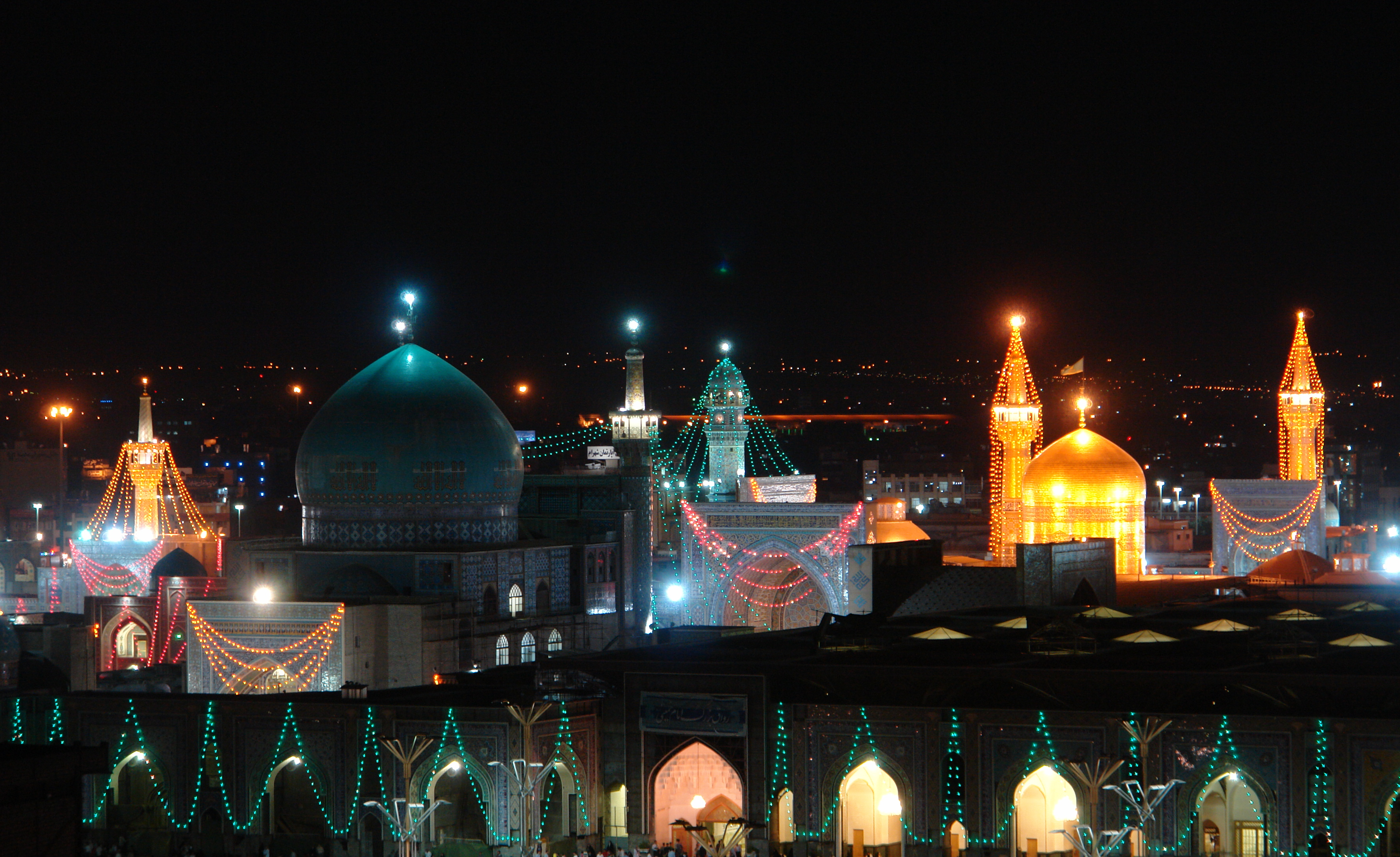
| caption | The dome, iwan, and minarets of the shrine from the Atiq Courtyard. |
| religious_affiliation | Shia Islam |
| festival | |
| organisational_status | Shrine, imamzadeh and mausoleum complex |
| leadership | Ahmad Alamolhoda (imam) |
| functional_status | Active |
| location | Mashhad, Razavi Khorasan province |
| country | Iran |
| map_type | Iran |
| map_size | 250 |
| map_relief | 1 |
| map_caption | Location of the shrine complex in Iran |
| mapframe | yes |
| administration | Astan Quds Razavi |
| coordinates | |
| architecture_type | Persian-Islamic architecture |
| architecture_style | |
| year_completed | 818 CE |
| date_demolished | |
| capacity | 700,000 worshippers |
| dome_quantity | Two (maybe more) |
| minaret_quantity | 12 |
| minaret_height | 70 m |
| site_area | 267069 m2 |
| shrine_quantity | Two: see Harun ِal-Rashid Mausoleum |
| elevation_m | |
| website | |
| module | {{Infobox historic site |
| embed | yes |
| designation1 | INHL |
| designation1_offname | Imam Reza shrine |
| designation1_type | Built |
| designation1_date | 6 January 1932 |
| designation1_number | 140 |
| designation1_free1name | Conservation organization |
| designation1_free1value | Cultural Heritage, Handicrafts and Tourism Organization of Iran |
The Imam Reza Shrine (; ) is the mausoleum of Ali al-Rida, the eighth Imam in Shia Islam, located in Mashhad, the province of Razavi Khorasan, Iran. As one of the holiest sites in Shia Islam, nearly 30 million Muslims making pilgrimages to the shrine every year, the most visited pilgrimage site in Islam.
Imam Reza was a descendant of the Islamic prophet Muhammad, known for his piety and learning. Born in 766 CE, his lineage traces back to Ali via Muhammad’s daughter Fatima, from their son Husayn. He is part of the chain of mystical authority in Sunni Sufism, making him widely respected in Sunni Islam as well. He is also regarded as a model of asceticism in Sufism, and the chains of authority in Shia Sufism progress through him. Uyoun Akhbar Al-Ridha have recorded miracles which have occurred at the shrine.
The shrine covers an area of 1,200,000 square meters, making it the third largest mosque in the world, after Masjid al-Haram in Mecca and the Prophet's Mosque in Medina. The Goharshad Mosque, a museum, a library, four seminaries, a cemetery, and the Razavi University of Islamic Sciences, are also contained within the complex. The complex was added to Iran's National Heritage List on 6 January 1932, and on 2 February 2017, it was added to the tentative list of UNESCO World Heritage Sites. Also buried within the shrine are the members of the Timurid, Safavid and Qajar family members, alongside the Abbasid caliph Harun al-Rashid, polymath Baha al-Din al-Amili, crown prince Abbas Mirza, and many other notable political figures, scholars, and clerics.
Religious significance
Shia sources quote several hadiths from the Shia Imams and Muhammad that highlight the importance of pilgrimage to the shrine. A hadith from Muhammad says:
History
Main article: History of the Imam Reza shrine
Early years
Dar-ul-Imarah (Royal Residence) or the garden of Humayd ibn Qahtaba al-Ta'i was a fortress in the village of Sanabad. It dates from before the Islamic era. It had been placed at the fork road of Sanabad, Neishabour, Sarakhs, Toos and Radkan. This fortress had been a place for the frontier guards to take position and establish the security of these roads and regions. After the demise of Harun al-Rashid, he was buried in this place. Due to this historical event, the Dar-ul-Imarah was known as the Mausoleum of Haruniyyeh. The original inner building of Dar-ul-Imarah had been a Zoroastrian temple. This building was demolished by the order of al-Ma'mun, and then it was reconstructed according to the special architecture of Khorasan. Four plain and short walls, covered with a low-slope dome, were constructed around the building. Afterwards, the name of the mausoleum (Haruniyyeh) was changed and known as the Mashhad-ur-Reza. Mashhad literally means 'a place where a martyr has been buried'.
Martyrdom of Ali al-Ridha
In 818, Imam Ali al-Ridha was murdered by the Abbasid caliph al-Ma'mun (ruled 813–833) and was buried beside the grave of al-Ma'mun's father, Harun al-Rashid (r. 786–809). After this event, the location was called Mashhad al-Ridha ("the place of martyrdom of al-Ridha"). Shias and Sunnis (for example, Ibn Hibban wrote in his Kitab al Siqqat that whenever troubled and in Mashad he would always visit the shrine to ask for relief from problems that bothered him) began visiting his grave on pilgrimage. By the end of the 9th century, a dome was built on the grave and many buildings and bazaars sprang up around it. For the next thousand years, it has been devastated and reconstructed several times.
The celebrated Muslim traveler Ibn Battuta visited Mashhad in 1333 CE and reported that it was a large town with abundant fruit trees, streams and mills. A great dome of elegant construction surmounts the noble mausoleum, the walls being decorated with colored tiles. Opposite the tomb of the Imam is the tomb of Caliph Harun al-Rashid, which is surmounted by a platform bearing chandeliers.
Samanid era
The Samanids (819–999 CE), who ruled over a large part of Greater Khorasan, were notable patrons of Sunni Islamic scholarship. They maintained and supported religious institutions, including the early structures around the Imam Reza shrine. Although there are limited architectural remnants from their time, historical accounts suggest that the Samanids contributed to the preservation and modest development of the shrine, ensuring that it remained a focal point for pilgrims in the region. Their support laid the groundwork for later dynasties to expand the shrine.
Ghaznavid era
By the end of the third Hijri century, a dome was built on the grave of Imam Reza and many buildings and bazaars sprang around the shrine. In , Sebuktigin, the Ghaznavid sultan devastated Mashhad and stopped the pilgrims from visiting the shrine. But in , Mahmud of Ghazni started the expansion and renovation of the shrine and built many fortifications around the city.
Seljuk era
Sultan Sanjar, after the healing of his son in the shrine, renovated the sanctuary and added new buildings within its precincts. At the time of Sultan Sanjar Saljuqi, after Sharaf al-Din Abu Tahir b. Sa'd b. Ali Qummi repaired the shrine, he began to construct a dome over it. In , as borne out by inscriptions on certain tiles, Allaudin Khwarezm Shah carried out renovations on the shrine.
Mongols
.jpg)
During the Khwarazmian dynasty, some repair and decoration was made inside the shrine. In two very glorious embossed Thuluth inscriptions in form of square tile work were fixed on both sides of the shrine entrance-by the side of Dar al-Huffaz porch—in which the names and descent of Imam Reza back to Imam Ali were written. The complex includes some other inscriptions and three mihrabs of this era. During the Mongol invasion in , Khorasan was plundered by the invading hordes and the survivors of this massacre took refuge in Mashhad and settled around the shrine. Sultan Muhammad Khudabandeh Iljaitu, the Mongol ruler of Iran, converted to Shi'ism and ruled Iran from until , once again renovated the shrine on a gran
d scale.
Timurid era

The glorious phase of Mashhad started during the reign of Shahrukh Mirza, son of Tamerlane, and reached its zenith during the reign of the Safavid Shahs, who ruled Iran from 1501 to 1736 CE. Shahrukh Mirza, whose capital was Herat, regularly visited Mashhad for the pilgrimage of the shrine of Imam Reza (A.S.). In the 15th century, during the reign of the Timurid Shahrukh Mirza, Mashhad became one of the main cities of the realm. In 1418 CE, his wife, Empress Goharshad, funded the construction of an outstanding mosque beside the shrine, which is known as the Goharshad Mosque.
Safavid era

With the emergence of the Safavid dynasty in 1501 CE and their declaration of the Twelver Shi'ite sect as the state religion, Mashhad reached the peak of its development. However, since Khorasan was a border province of the Safavid Empire, Mashhad suffered repeated invasions and periods of occupation by the Uzbek Khans – Muhammad Khan, Abdullah Khan Shaibani, Muhammad Sultan and especially Abdul-Momen Khan. These invasions continued up to , the reign of Shah Abbas I, who finally drove out the Uzbeks from Khorasan. Sahn Atiq was extended in the time of Shah Abbas I, and during the Safavid era, efforts were made for its further improvement.
During the Safavid era, the shrine also received patronage from rulers of the Indian subcontinent, namely Quli Qutb-ul-Mulk (founder of the Qutb Shahi dynasty) and Mughal Emperor Akbar. The latter was notably a Sunni.
Afsharid and Qajar era


Nader Shah Afshar and the Qajar Shahs who ruled Iran from 1789 to 1925 CE expanded the various places in the shrine. There were also some improvements in the shrine complex during the Qajar Dynasty. There was also some repair in both courtyards during Mozaffar ad-Din Shah's monarchy.
Following the coup in December 1911, Russian artillery shelled revolutionaries who had taken refuge in the shrine. The whole complex was greatly damaged in 1911, but it was repaired after a while.
Modern era

There were significant changes in the complex in . Old Falakah was extended up to a radius of 620 m before the victory of the Islamic Revolution, and an important part of Holy Buildings' historical structure was demolished without considering its antiquity and elegance.
On 13 July 1935 (11th Rabi al-Thani 1354 AH), during the Goharshad Mosque rebellion, armed forces of Reza Shah, the reigning monarch of Iran and founder of Pahlavi dynasty, invaded the shrine and massacred people gathered in the Goharshad Mosque. The people there were protesting against the modernization policies of the Shah which many, especially amongst the Shia clergy, considered to be anti-Islamic, including the banning of hijab for women in Iran. Shortly before the Iranian Revolution, on 21 November 1978, troops under orders from the regime of Mohammad Reza Shah, Reza Shah's son and successor, killed approximately 12,000 people within the shrine.
The shrine is depicted on the reverse of the Iranian 100 rials coin, issued since 2004.
Kitchen
The harem kitchen receives 10 to 40 thousand visitors per day and sometimes on occasional events cooks for as many as 250,000. It has an Astan quds website page and there is an ID register and ticket lottery for a one course meal per person every three years. During Ramadan, the Commune Kitchen feeds approximately one million pilgrims and citizens.
Incidents
1994 bombing
Main article: Imam Reza shrine bombing
On 20 June 1994, a bomb explosion occurred at the shrine. To maximize the number of casualties, the explosion took place on Ashura, one of the holiest days for Shia muslims, when hundreds of pilgrims had gathered to commemorate the death of their third Imam, Husayn ibn Ali. The attack left at least 25 dead and at least 70 injured. The bomb was equivalent to 10 lb of TNT, according to experts. Although a Sunni militant group claimed responsibility, the Iranian government laid the blame on the People's Mujahedin of Iran, and others accused a Pakistani militant.
2022 stabbings
Main article: Imam Reza shrine stabbings
On 5 April 2022, a stabbing attack took place at the shrine, killing two Shia clerics and wounding a third. The perpetrator, identified as foreign national Abdullatif Moradi, was immediately arrested along with six others accused of assisting him. The victims were active members of non-profit constructing and cultural communities, motivated by anti-Shi'ism.
Specifications
Courtyards
The complex contains a total of seven sahns, which cover an area of over 331578 m2: The courtyards also contain a total of 14 minarets, and three fountains.
| Name | Images | Area | appurtenant | Year of first building | m2 | sq ft |
|---|---|---|---|---|---|---|
| Islamic Revolution Courtyard | four balconies, steel window | |||||
| Freedom Courtyard | 4600 m2 | golden verandah | ||||
| Courtyard of Goharshad Mosque | ||||||
| Quds Courtyard | 2400 m2 | |||||
| Islamic Republic Courtyard | 10000 m2 | two minarets | ||||
| The Razavi Grand Courtyard | ||||||
| Gadeer Courtyard |
Halls

From the courtyards, external hallways named after scholars lead to the inner areas of the mosque. They are referred to as Bast (Sanctuary), since they were meant to be a safeguard for the shrine areas:
- Bast Shaykh Toosi – leads to the Central Library
- Bast Shaykh Tabarsi
- Bast Shaykh Hur Ameli
- Bast Shaykh Baha'i
The Bast hallways lead towards a total of 21 internal halls (Riwaq) which surround the burial chamber of Ali al-Ridha. Adjacent to the burial chamber is also a mosque dating back to the 10th century known as, Bala-e-Sar Mosque.
Goharshad Mosque

Main article: Goharshad Mosque
This mosque is situated adjacent to the shrine of Imam Ridha.
Ali al-Ridha's Tomb
It is located beneath the Golden Dome and surrounded by different porches each bearing a separate name.
Museums and other historical appurtenants
There are two museums within the shrine limits, the Astan Quds Museum and the Quran Museum.
Tourism information
The shrine is visible from far away and has entrances on all sides. There are separate entrance doors for males and female worshippers. Bags and cameras have to be left at luggage deposit offices outside the shrine for a 10,000 rials fee. Visitors are subject to a physical security check prior to entering the shrine gates. Mobile phones can be brought into the shrine. Females are required to wear a chador.
Notes
References
Bibliography
References
- "Sacred Sites: Mashhad, Iran". sacredsites.com.
- "Religious Tourism Potentials Rich". Iran Daily.
- "Imam Reza (PBUH) shrine is visited by nearly 30 million people annually".
- Higgins, Andrew. (2007-06-02). "Inside Iran's Holy Money Machine - WSJ". Wall Street Journal.
- Higgins, Andrew. (2007-06-02). "Inside Iran's Holy Money Machine". [[Wall Street Journal]].
- soltani, mis. "Islamic Republic of Iran: Over 30 million pilgrims visit Mashhad annually".
- (2014-09-08). "Mashhad: A Hub of Tourism and Pilgrimage {{!}} FinancialTribune".
- (2015-07-23). "Chapter 28: On Various Traditions from Imam Ali Ibn Musa Al-Ridha’ (a.s.)".
- (May 2025}}{{dead-link). "The Islamic Seminaries At The Holy Shrine". Imam Reza (A.S.) Network}}{{self-published-inline.
- "Shrine of Imam Reza in Iran's Mashhad, Once Visited By Guru Nanak". NDTV.
- "عيون أخبار الرضا(ع)". الشيخ الصدوق.
- (24 January 2012). "Look at the history of Imam Reza's burial ground (Persian)". mashreghnews.ir.
- (January 1996). "A Brief Biography of Imam Ali bin Musa (a.s.): al-Ridha". CreateSpace Independent Publishing Platform.
- "First photos taken of Imam Reza Shrine".
- jahannews.com. (2011-02-02). "معماران حرم امام رضا (ع) به روايت تاريخ".
- (2021-03-10). "حرم مطهر رضوی، نمودی از معماری ایرانی در دورههای مختلف".
- AdminTehran. (2022-07-11). "مدفن امام رضا (ع)".
- aria_pardis_a. (2023-12-25). "حرم امام رضا (ع) را بهتر بشناسید".
- (2014-01-03). "حرم امام رضا (ع) چگونه ساخته شد؟".
- (1970). "Islam in Iran". ketab.com.
- "How the shrine of Imam Reza was built?".
- (2010). "The A to Z of Iran". Scarecrow Press.
- (1999). "Landmarks of Mashhad". Foundation of Astan Quds Razavi.
- Bosworth, Clifford Edmund. (2008). "Historic cities of the Islamic world". Brill.
- Axworthy, Michael. (2010). "A History of Iran: Empire of the Mind". Basic Books.
- "روایتی از حمله مزدوران رژیم پهلوی به حرم امام رضا(ع) در 29 آبان 1357 - تسنیم". خبرگزاری تسنیم {{!}} Tasnim.
- "مرکز بررسی اسناد تاریخی".
- (2019-11-26). "۵آذر۵۷؛ حمله با تانک رژیم شاه به حرم امام رضا +عکس".
- "fars {{!}} وقتی محمدرضا پهلوی دستور گلولهباران حرم امام رضا(ع) را داد".
- YJC, باشگاه خبرنگاران جوان {{!}} آخرین اخبار ایران و جهان {{!}}. (2025-08-25). "عاقبت کسی که دستور حمله به حرم امام رضا را داد".
- "Banknotes & Coins". Central Bank of Iran.
- "100 Rials". Central Bank of Iran.
- link. eghtesadonline.com. (20 February 2020)
- "Archived copy". farsnews.ir.
- link. ISNA.ir. (March 29, 2023)
- (21 June 1994). "Bomb kills 25 and injures 70 at Iran's holiest shrine". The Independent.
- (21 June 1994). "Bomb Kills 25 At Holy Place In Iranian City". [[The New York Times]].
- (2011-06-02). "The 9/11 Encyclopedia: Second Edition". ABC-CLIO.
- "Context of 'June 20, 1994: Ramzi Yousef Bombs Iranian Shrine'".
- (1994). "Bomb explosion in Imam Reza Holy Shrine".
- link
- (May 2025}}{{dead-link). "Sahn (Courtyards) Around the Holy Shrine". Imam Reza (A.S.) Network.
- (May 2025}}{{dead-link). "Minarets". Imam Reza (A.S.) Network.
- (May 2025}}{{dead-link). "Saqqah Khaneh". Imam Reza (A.S.) Network.
- (May 2025}}{{dead-link). "The Bast (Sanctuaries) Around the Holy Shrine". Imam Reza (A.S.) Network.
- (May 2025}}{{dead-link). "Riwaq (Porch)". Imam Reza (A.S.) Network.
- (May 2025}}{{dead-link). "The Bala-Sar Mosque of the Holy Shrine". Imam Reza (A.S.) Network.
This article was imported from Wikipedia and is available under the Creative Commons Attribution-ShareAlike 4.0 License. Content has been adapted to SurfDoc format. Original contributors can be found on the article history page.
Ask Mako anything about Imam Reza shrine — get instant answers, deeper analysis, and related topics.
Research with MakoFree with your Surf account
Create a free account to save articles, ask Mako questions, and organize your research.
Sign up freeThis content may have been generated or modified by AI. CloudSurf Software LLC is not responsible for the accuracy, completeness, or reliability of AI-generated content. Always verify important information from primary sources.
Report