From Surf Wiki (app.surf) — the open knowledge base
Image spam
Type of email spam

Type of email spam


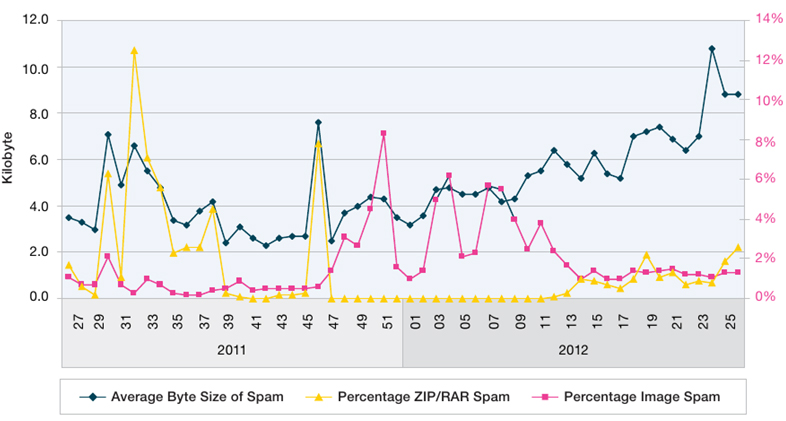
Image-based spam, or image spam, is a kind of email spam where the textual spam message is embedded into images, that are then attached to spam emails. Since most of the email clients will display the image file directly to the user, the spam message is conveyed as soon as the email is opened (there is no need to further open the attached image file).
Technique
The goal of image spam is clearly to circumvent the analysis of the email’s textual content performed by most spam filters (e.g., SpamAssassin, RadicalSpam, Bogofilter, SpamBayes). Accordingly, for the same reason, together with the attached image, often spammers add some “bogus” text to the email, namely, a number of words that are most likely to appear in legitimate emails and not in spam. The earlier image spam emails contained spam images in which the text was clean and easily readable, as shown in Fig. 1.
Detection
Consequently, optical character recognition tools were used to extract the text embedded into spam images, which could be then processed together with the text in the email’s body by the spam filter, or, more generally, by more sophisticated text categorization techniques. Further, signatures (e.g., MD5 hashing) were also generated to easily detected and block already known spam images. Spammers in turn reacted by applying some obfuscation techniques to spam images, similarly to CAPTCHAs, both to prevent the embedded text to be read by OCR tools, and to mislead signature-based detection. Some examples are shown in Fig. 2.
This raised the issue of improving image spam detection using computer vision and pattern recognition techniques.
In particular, several authors investigated the possibility of recognizing image spam with obfuscated images by using generic low-level image features (like number of colours, prevalent colour coverage, image aspect ratio, text area), image metadata, etc. (see for a comprehensive survey). Notably, some authors also tried detecting the presence of text in attached images with artifacts denoting an adversarial attempt to obfuscate it.
History
Image spam started in 2004 and peaked at the end of 2006, when over 50% of spam was image spam. In mid-2007, it started declining, and practically disappeared in 2008. The reason behind this phenomenon is not easy to understand. The decline of image spam can probably be attributed both to the improvement of the proposed countermeasures (e.g., fast image spam detectors based on visual features), and to the higher requirements in terms of bandwidth of image spam that force spammers to send a smaller amount of spam over a given time interval. Both factors might have made image spam less convenient for spammers than other kinds of spam. Nevertheless, at the end of 2011 a rebirth of image spam was detected, and image spam reached 8% of all spam traffic, albeit for a small period.
References
References
- "Spam filtering based on the analysis of text information embedded into images".
- (2011). "A survey and experimental evaluation of image spam filtering techniques, Pattern Recognition Letters". Pattern Recognition Letters.
- (2018-09-01). "WAF-Based Chinese Character Recognition for Spam Image Filtering". Chinese Journal of Electronics.
- Aradhye, H., Myers, G., Herson, J. A., 2005. Image analysis for efficient cat egorization of image-based spam e-mail. In: Proc. Int. Conf. on Document Analysis and Recognition, pp. 914–918.
- Dredze, M., Gevaryahu, R., Elias-Bachrach, A., 2007. Learning fast classifiers for image spam. In: Proc. 4th Conf. on Email and Anti-Spam (CEAS)
- Wu, C.-T., Cheng, K.-T., Zhu, Q., Wu, Y.-L., 2005. Using visual features for anti-spam filtering. In: Proc. IEEE Int. Conf. on Image Processing, Vol. III.pp. 501–504.
- Liu, Q., Qin, Z., Cheng, H., Wan, M., 2010. Efficient modeling of spam images. In: Int. Symp. on Intelligent Information Technology and Security Informatics. IEEE Computer Society, pp. 663–666.
- "Fuzzy - OCR Spam Assassin's Plugin".
- Battista Biggio, Giorgio Fumera, Ignazio Pillai, Fabio Roli , "[https://web.archive.org/web/20131212125519/http://pralab.diee.unica.it/en/node/791 Image Spam Filtering Using Visual Information]", 14th Int. Conf. on Image Analysis and Processing (ICIAP 2007), Modena, Italy, IEEE Computer Society, pp. 105--110, 10/09/2007.
- Fabio Roli, Battista Biggio, Giorgio Fumera, Ignazio Pillai, Riccardo Satta , "Image Spam Filtering by Detection of Adversarial Obfuscated Text", Workshop on Neural Information Processing Systems (NIPS), Whistler, British Columbia, Canada, 08/12/2007.
- Battista Biggio, Giorgio Fumera, Ignazio Pillai, Fabio Roli , "Improving Image Spam Filtering Using Image Text Features", Fifth Conference on Email and Anti-Spam (CEAS 2008), Mountain View, CA, USA, 21/08/2008.
- IBM X-Force® 2010, Mid-Year Trend and Risk Report (August 2010).
- IBM X-Force® 2012, Mid-Year Trend and Risk Report (September 2012).
This article was imported from Wikipedia and is available under the Creative Commons Attribution-ShareAlike 4.0 License. Content has been adapted to SurfDoc format. Original contributors can be found on the article history page.
Ask Mako anything about Image spam — get instant answers, deeper analysis, and related topics.
Research with MakoFree with your Surf account
Create a free account to save articles, ask Mako questions, and organize your research.
Sign up freeThis content may have been generated or modified by AI. CloudSurf Software LLC is not responsible for the accuracy, completeness, or reliability of AI-generated content. Always verify important information from primary sources.
Report