From Surf Wiki (app.surf) — the open knowledge base
Image-based flow visualization

In scientific visualization, image-based flow visualization (or visualisation) is a computer modelling technique developed by Jarke van Wijk to visualize two dimensional flows of liquids such as water and air, like the wind movement of a tornado. Compared with integration techniques it has the advantage of producing a whole image at every step, as the technique relies upon graphical computing methods for frame-by-frame capture of the model of advective transport of a decaying dye. It is a method from the texture advection family.
Principle
The core idea is to create a noise texture on a regular grid and then bend this grid according to the flow (the vector field). The bent grid is then sampled at the original grid locations. Thus, the output is a version of the noise, that is displaced according to the flow.
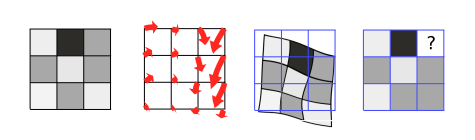
The advantage of this approach is that it can be accelerated on modern graphics hardware, thus allowing for real-time or almost real-time simulation of 2D flow data. This is particularly handy if one wants to visualise multiple scaled versions of the vector field to first gain an overview and then concentrate on the details.
References
References
- van Wijk, Jack. (2002). "Image Based Flow Visualization". Proceedings ACM SIGGRAPH 2002, San Antonio, Texas.
- (September 2024). "Visualization and Data Analysis 2006".
This article was imported from Wikipedia and is available under the Creative Commons Attribution-ShareAlike 4.0 License. Content has been adapted to SurfDoc format. Original contributors can be found on the article history page.
Ask Mako anything about Image-based flow visualization — get instant answers, deeper analysis, and related topics.
Research with MakoFree with your Surf account
Create a free account to save articles, ask Mako questions, and organize your research.
Sign up freeThis content may have been generated or modified by AI. CloudSurf Software LLC is not responsible for the accuracy, completeness, or reliability of AI-generated content. Always verify important information from primary sources.
Report