From Surf Wiki (app.surf) — the open knowledge base
IEEE 802.11s
IEEE standard for mesh networking
IEEE standard for mesh networking
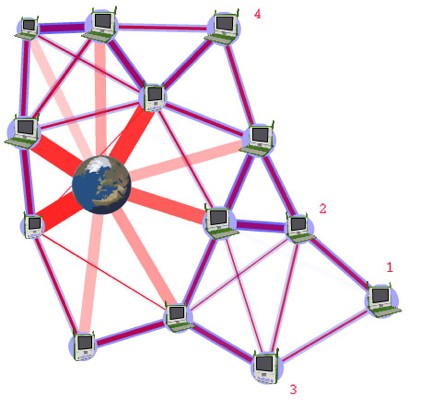
IEEE 802.11s is a wireless local area network (WLAN) standard and an IEEE 802.11 amendment for mesh networking, defining how wireless devices can interconnect to create a wireless LAN mesh network, which may be used for relatively fixed (not mobile) topologies and wireless ad hoc networks. The IEEE 802.11s task group drew upon volunteers from university and industry to provide specifications and possible design solutions for wireless mesh networking. As a standard, the document was iterated and revised many times prior to finalization.
802.11 are a set of IEEE standards that govern wireless networking transmission protocols. They are commonly used today to provide wireless connectivity in the home, office and some commercial establishments.
The IEEE 802.11s standard was issued in 2011 and was superseded in 2012 when it became part of the IEEE 802.11 standard that was issued in 2012.
Description
802.11s extends the IEEE 802.11 MAC standard by defining an architecture and protocol that supports both broadcast/multicast and unicast delivery using "radio-aware metrics over self-configuring multi-hop topologies."
Timeline
802.11s started as a Study Group of IEEE 802.11 in September 2003. It became a Task Group in July 2004. A call for proposals was issued in May 2005, which resulted in the submission of 15 proposals submitted to a vote in July 2005. After a series of eliminations and mergers, the proposals dwindled to two (the "SEE-Mesh" and "Wi-Mesh" proposals), which became a joint proposal in January 2006. This merged proposal was accepted as draft D0.01 after a unanimous confirmation vote in March 2006.
The draft evolved through informal comment resolution until it was submitted for a Letter Ballot in November 2006 as Draft D1.00. Draft D2.00 was submitted in March 2008 which failed with only 61% approval. A year was spent clarifying and pruning until Draft D3.00 was created which reached WG approval with 79% in March 2009.
In June 2011 the fifth recirculation Sponsor Ballot, on TGs Draft 12.0, was closed. The Draft met with 97.2% approval rate.
The 2012 release of the 802.11 specification (802.11-2012) directly incorporates Mesh Routing functionality.
802.11 mesh architecture
An 802.11s wireless mesh network device is labelled as Mesh Station (mesh STA), or simply an ad hoc node. Mesh STAs form mesh links with one another, over which mesh paths can be established using an ad hoc mobile routing protocol. A key aspect of this architecture is the presence of multi-hop wireless links and routing of packets through other nodes towards the destination node.
Routing protocols
802.11s defines a default mandatory routing protocol (Hybrid Wireless Mesh Protocol, or HWMP), yet allows vendors to operate using alternate routing protocols. HWMP is inspired by a combination of AODV (RFC 3561), which uses on-demand ad hoc routing approach and tree-based routing. Examples of on-demand ad hoc routing are Dynamic Source Routing and Associativity-Based Routing. AODV route discovery and localized route repair approaches are identical to Associativity-based Routing. Prior work has discussed and compared these various routing protocols in detail.
Mesh STAs are individual devices using mesh services to communicate with other devices in the network. They can also collocate with 802.11 Access Points (APs) and provide access to the mesh network to 802.11 stations (STAs), which have broad market availability. Also, mesh STAs can collocate with an 802.11 portal that implements the role of a gateway and provides access to one or more non-802.11 networks. In both cases, 802.11s provides a proxy mechanism to provide addressing support for non-mesh 802 devices, allowing for end-points to be cognizant of external addresses.
802.11s also includes mechanisms to provide deterministic network access, a framework for congestion control and power save.
Mesh security
There are no defined roles in a meshno clients and servers, no initiators and responders. Security protocols used in a mesh must, therefore, be true peer-to-peer protocols where either side can initiate to the other or both sides can initiate simultaneously.
Peer authentication methods
Between peers, 802.11s defines the secure password-based authentication and key establishment protocol Simultaneous Authentication of Equals (SAE). SAE is based on Diffie–Hellman key exchange using finite cyclic groups which can be a primary cyclic group or an elliptic curve. The problem with a Diffie–Hellman key exchange is that it does not have an authentication mechanism. So the resulting key is influenced by a pre-shared key and the MAC addresses of both peers to solve the authentication problem.
When peers discover each other (and security is enabled) they take part in an SAE exchange. If SAE completes successfully, each peer knows the other party possesses the mesh password and, as a by-product of the SAE exchange, the two peers establish a cryptographically strong key. This key is used with the "Authenticated Mesh Peering Exchange" (AMPE) to establish a secure peering and derive a session key to protect mesh traffic, including routing traffic.
Implementations
The IEEE 802.11s amendment is supported by many products such as open80211s, OLPC. In open80211s smaller meshes of under 32 nodes are supported. Some of the projects were based on earlier (draft) versions.
- A reference implementation of the 802.11s draft is available as part of the mac80211 layer in the Linux kernel, starting with version 2.6.26. The Linux community, with its many diverse distributions, provides a heterogenous testing ground for protocols like Hybrid Wireless Mesh Protocol. OpenWrt, a Linux distribution for routers, supports mesh networking.
- In FreeBSD, the 802.11s draft is supported starting with FreeBSD 8.0.
- The Google Wifi router uses the 802.11s mesh networking protocol.
- The MeshPoint.One router uses 802.11s mesh networking protocol.
References
References
- "Quick Guide to IEEE 802.11 Activities". [[IEEE]].
- (November 2006). "HWMP Protocol specification". The Working Group for WLAN Standards of the Institute of Electrical and Electronics Engineers.
- "IEEE P802.11 - TASK GROUP S - MEETINGS UPDATE".
- "2012 release of the 802.11 specification (802.11-2012)".
- (July 2003). "RFC 3561 Ad hoc On-Demand Distance Vector (AODV) Routing". Mobile Ad Hoc Networking Working Group of the Internet Engineering Task Force.
- "A Simulation Study of Table-Driven and On-Demand Routing Protocols for Mobile Ad Hoc Network - S J Lee, et. al., 1999.".
- "Performance Comparison of AODV, TODV, OLSR and ABR using OPNET - E. Nehra & J. Singh".
- "Compare the Performance of the Two Prominent Routing Protocols for Mobile Ad-hoc Networks".
- "A Review of Current Routing Protocols for Ad Hoc Mobile Wireless Networks, 1999".
- "Routing Protocols for Ad Hoc Mobile Wireless Networks by Padmini Misra".
- (2008). "2008 Second International Conference on Sensor Technologies and Applications (Sensorcomm 2008)".
- (January 2000). "IEEE 802.11s: The WLAN Mesh Standard". academia.edu.
- "What is the maximum number of nodes supported by Mesh?".
- "Linux 2.6.26 Changes".
- "802.11s". Linux Wireless.
- "Mesh/OpenWRT".
- BattleMesh contributors. "BattleMeshV7".
- "WifiMesh".
- (15 November 2016). "Making a 'mesh' of your Wi-Fi".
- "MeshPoint.One technical specification".
This article was imported from Wikipedia and is available under the Creative Commons Attribution-ShareAlike 4.0 License. Content has been adapted to SurfDoc format. Original contributors can be found on the article history page.
Ask Mako anything about IEEE 802.11s — get instant answers, deeper analysis, and related topics.
Research with MakoFree with your Surf account
Create a free account to save articles, ask Mako questions, and organize your research.
Sign up freeThis content may have been generated or modified by AI. CloudSurf Software LLC is not responsible for the accuracy, completeness, or reliability of AI-generated content. Always verify important information from primary sources.
Report