From Surf Wiki (app.surf) — the open knowledge base
Icositetragon
Polygon with 24 edges
Polygon with 24 edges
In geometry, an icositetragon (or icosikaitetragon) or 24-gon is a twenty-four-sided polygon. The sum of any icositetragon's interior angles is 3960 degrees.
Regular icositetragon
The regular icositetragon is represented by Schläfli symbol {24} and can also be constructed as a truncated dodecagon, t{12}, or a twice-truncated hexagon, tt{6}, or thrice-truncated triangle, ttt{3}.
One interior angle in a regular icositetragon is 165°, meaning that one exterior angle would be 15°.
The area of a regular icositetragon is: (with t = edge length) : A = 6t^2 \cot \frac{\pi}{24} = {6}t^2(2+\sqrt{2}+\sqrt{3}+\sqrt{6}).
The icositetragon appeared in Archimedes' polygon approximation of pi, along with the hexagon (6-gon), dodecagon (12-gon), tetracontaoctagon (48-gon), and enneacontahexagon (96-gon).
Construction
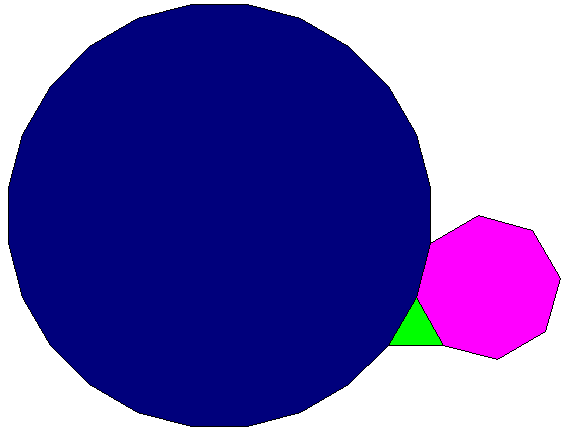
As 24 = 23 × 3, a regular icositetragon is constructible using a compass and straightedge. As a truncated dodecagon, it can be constructed by an edge-bisection of a regular dodecagon.
Symmetry
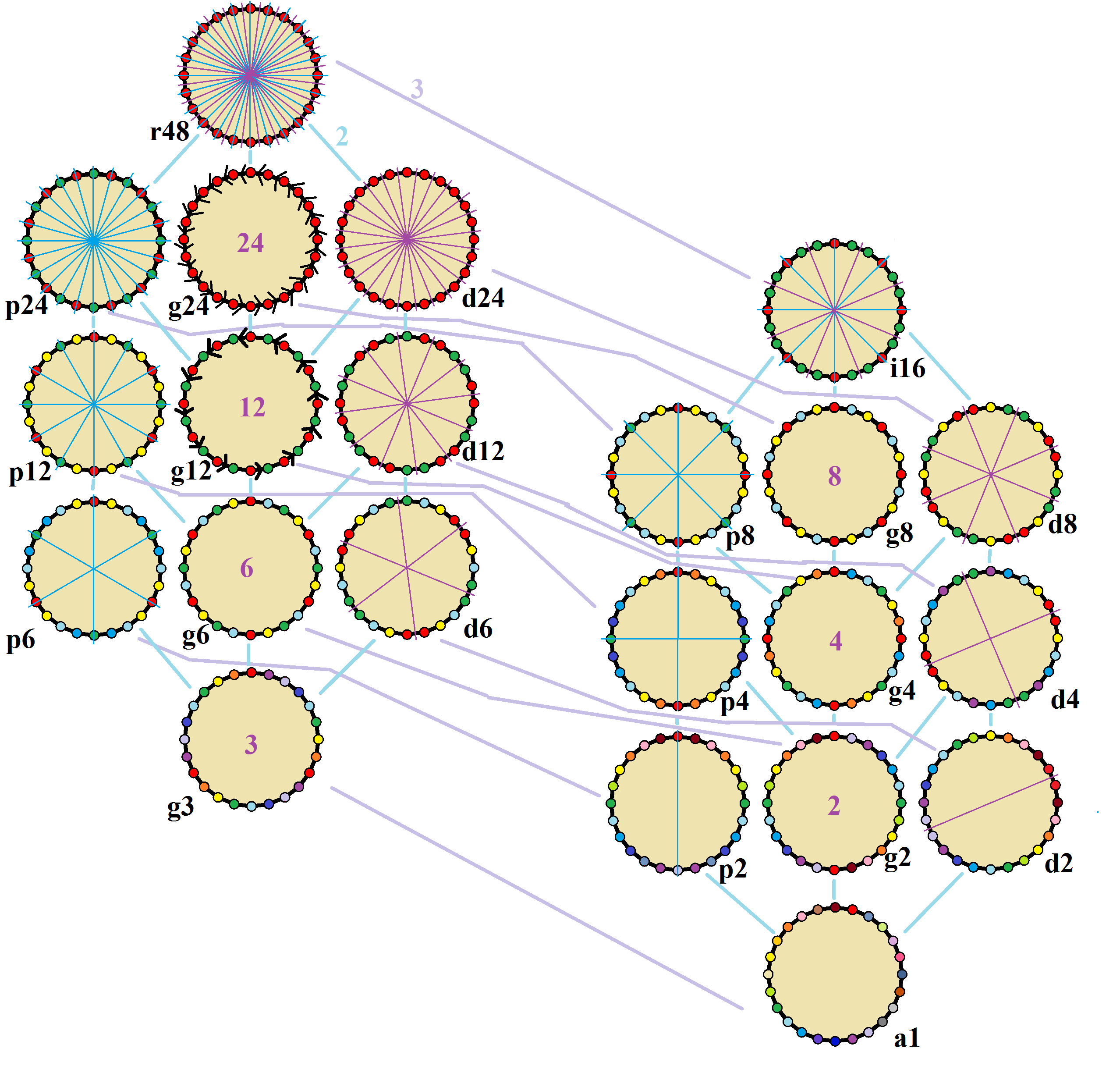
The regular icositetragon has Dih24 symmetry, order 48. There are 7 subgroup dihedral symmetries: (Dih12, Dih6, Dih3), and (Dih8, Dih4, Dih2 Dih1), and 8 cyclic group symmetries: (Z24, Z12, Z6, Z3), and (Z8, Z4, Z2, Z1).
These 16 symmetries can be seen in 22 distinct symmetries on the icositetragon. John Conway labels these by a letter and group order. The full symmetry of the regular form is r48 and no symmetry is labeled a1. The dihedral symmetries are divided depending on whether they pass through vertices (d for diagonal) or edges (p for perpendiculars), and i when reflection lines path through both edges and vertices. Cyclic symmetries in the middle column are labeled as g for their central gyration orders.
Each subgroup symmetry allows one or more degrees of freedom for irregular forms. Only the g24 subgroup has no degrees of freedom but can be seen as directed edges.
Dissection
| [[File:24-gon rhombic dissection-size2.svg | 160px]]regular | [[File:Isotoxal 24-gon rhombic dissection-size2.svg | 160px]]Isotoxal |
|---|
Coxeter states that every zonogon (a 2m-gon whose opposite sides are parallel and of equal length) can be dissected into m(m-1)/2 parallelograms. In particular this is true for regular polygons with evenly many sides, in which case the parallelograms are all rhombi. For the regular icositetragon, m=12, and it can be divided into 66: 6 squares and 5 sets of 12 rhombs. This decomposition is based on a Petrie polygon projection of a 12-cube.
| [[File:12-cube.svg | 140px]]12-cube | [[File:24-gon rhombic dissection.svg | 160px]] | [[File:24-gon rhombic dissection2.svg | 160px]] | [[File:24-gon rhombic dissectionx.svg | 160px]] | [[File:24-gon-dissection-random.svg | 160px]] |
|---|
Related polygons
An icositetragram is a 24-sided star polygon. There are 3 regular forms given by Schläfli symbols: {24/5}, {24/7}, and {24/11}. There are also 7 regular star figures using the same vertex arrangement: 2{12}, 3{8}, 4{6}, 6{4}, 8{3}, 3{8/3}, and 2{12/5}.
| Icositetragrams as star polygons and star figures | Form | Convex polygon | Compounds | Star polygon | Compound | Image | Interior angle | Form | Star polygon | Compounds | Star polygon | Compound | Image | Interior angle | ||||||
|---|---|---|---|---|---|---|---|---|---|---|---|---|---|---|---|---|---|---|---|---|
| [[File:Regular polygon 24.svg | 100px]]{24/1}={24} | [[File:Regular_star_figure_2(12,1).svg | 100px]]{24/2}=2{12} | [[File:Regular_star_figure_3(8,1).svg | 100px]]{24/3}=3{8} | [[File:Regular_star_figure_4(6,1).svg | 100px]]{24/4}=4{6} | [[File:Regular_star_polygon_24-5.svg | 100px]]{24/5} | [[File:Regular_star_figure_6(4,1).svg | 100px]]{24/6}=6{4} | |||||||||
| 165° | 150° | 135° | 120° | 105° | 90° | |||||||||||||||
| [[File:Regular_star_polygon_24-7.svg | 100px]]{24/7} | [[File:Regular_star_figure_8(3,1).svg | 100px]]{24/8}=8{3} | [[File:Regular_star_figure_3(8,3).svg | 100px]]{24/9}=3{8/3} | [[File:Regular_star_figure_2(12,5).svg | 100px]]{24/10}=2{12/5} | [[File:Regular_star_polygon_24-11.svg | 100px]]{24/11} | [[File:Regular_star_figure_12(2,1).svg | 100px]]{24/12}=12{2} | |||||||||
| 75° | 60° | 45° | 30° | 15° | 0° |
There are also isogonal icositetragrams constructed as deeper truncations of the regular dodecagon {12} and dodecagram {12/5}. These also generate two quasitruncations: t{12/11}={24/11}, and t{12/7}={24/7}.
| Isogonal truncations of regular dodecagon and dodecagram | Quasiregular | Isogonal | Quasiregular | ||||
|---|---|---|---|---|---|---|---|
| [[File:regular_polygon_truncation_12_1.svg | 100px]]t{12}={24} | [[File:regular_polygon_truncation_12_2.svg | 100px]] | [[File:regular_polygon_truncation_12_3.svg | 100px]] | [[File:regular_polygon_truncation_12_4.svg | 100px]] |
| [[File:regular_star_truncation_12-5_1.svg | 100px]]t{12/5}={24/5} | [[File:regular_star_truncation_12-5_2.svg | 100px]] | [[File:regular_star_truncation_12-5_3.svg | 100px]] | [[File:regular_star_truncation_12-5_4.svg | 100px]] |
Skew icositetragon
| {12}#{ } | {12/5}#{ } | {12/7}#{ } | |||
|---|---|---|---|---|---|
| [[File:12-antiprism_skew_24-gon.png | 120px]] | [[File:12-5_antiprism.svg | 100px]] | [[File:12-7_antiprism.png | 120px]] |
| A regular skew icositetragon is seen as zig-zagging edges of a dodecagonal antiprism, a dodecagrammic antiprism, and a dodecagrammic crossed-antiprism. |
A skew icositetragon is a skew polygon with 24 vertices and edges but not existing on the same plane. The interior of such an icositetragon is not generally defined. A skew zig-zag icositetragon has vertices alternating between two parallel planes.
A regular skew icositetragon is vertex-transitive with equal edge lengths. In 3-dimensions it will be a zig-zag skew icositetragon and can be seen in the vertices and side edges of a dodecagonal antiprism with the same D12d, [2+,24] symmetry, order 48. The dodecagrammic antiprism, s{2,24/5} and dodecagrammic crossed-antiprism, s{2,24/7} also have regular skew dodecagons.
Petrie polygons
The regular icositetragon is the Petrie polygon for many higher-dimensional polytopes, seen as orthogonal projections in Coxeter planes, including:
| 2F4 | |
|---|---|
| [[File:24-cell t12 F4.svg | 180px]] |
| Bitruncated 24-cell |
| D13 | B12-- | E8 |
|---|---|---|
| [[File:13-cube_t6_B6.svg | 80px]] | |
| 13-orthoplex | [[File:13-demicube_t0_D7.svg | 80px]] |
| 13-demicube | [[File:12-cube_t11.svg | 80px]] |
| 12-orthoplex |
References
References
- [http://mathworld.wolfram.com/ConstructiblePolygon.html Constructible Polygon]
- [[John H. Conway]], [[Heidi Burgiel]], [[Chaim Goodman-Strauss]], (2008) The Symmetries of Things, {{ISBN. 978-1-56881-220-5 (Chapter 20, Generalized Schaefli symbols, Types of symmetry of a polygon pp. 275-278)
- [[Coxeter]], Mathematical recreations and Essays, Thirteenth edition, p.141
- The Lighter Side of Mathematics: Proceedings of the Eugène Strens Memorial Conference on Recreational Mathematics and its History, (1994), ''Metamorphoses of polygons'', [[Branko Grünbaum]]
This article was imported from Wikipedia and is available under the Creative Commons Attribution-ShareAlike 4.0 License. Content has been adapted to SurfDoc format. Original contributors can be found on the article history page.
Ask Mako anything about Icositetragon — get instant answers, deeper analysis, and related topics.
Research with MakoFree with your Surf account
Create a free account to save articles, ask Mako questions, and organize your research.
Sign up freeThis content may have been generated or modified by AI. CloudSurf Software LLC is not responsible for the accuracy, completeness, or reliability of AI-generated content. Always verify important information from primary sources.
Report