From Surf Wiki (app.surf) — the open knowledge base
Icarus
Greek mythological figure
Greek mythological figure
In the 2003 album Full Circle by Dan Fogelberg there is a song called Icarus Ascending proprietary services or sites. The links concerned should be carefully reviewed with a view to their replacement (if possible) with a reliable official or 'freely-licensed' alternatives. --
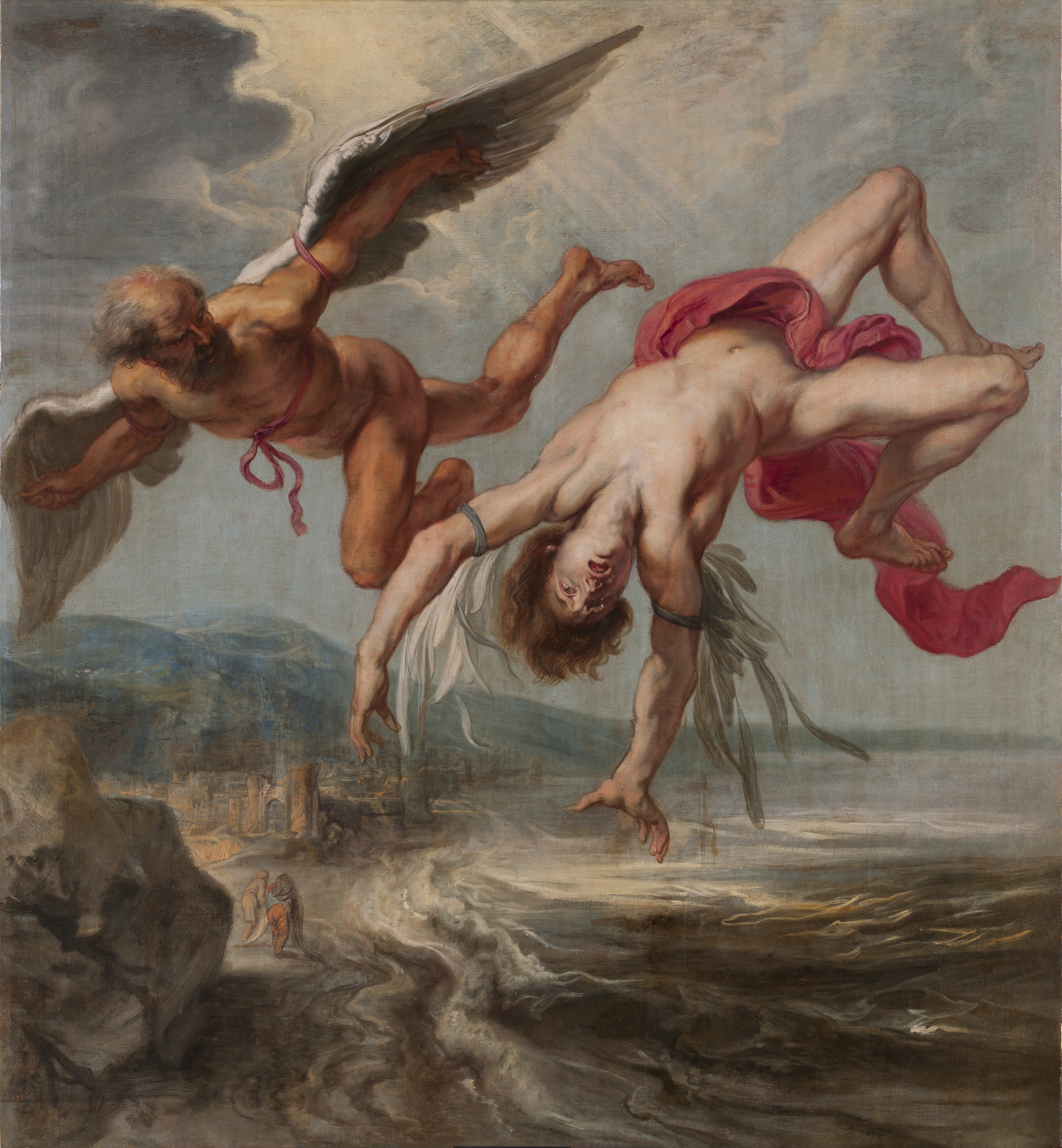
In Greek mythology, Icarus (; , ) was the son of the master craftsman Daedalus, the architect of the labyrinth of Crete, and his wife Naucrate. After Theseus, king of Athens and enemy of King Minos, escaped from the labyrinth, Minos suspected that Icarus and Daedalus had revealed the labyrinth's secrets and thus imprisoned them—either in a large tower overlooking the ocean or in the labyrinth itself, depending upon the account. Icarus and Daedalus escaped using wings Daedalus constructed from birds' molted feathers, threads from blankets, the leather straps from their sandals, and beeswax. Before escaping, Daedalus warned Icarus not to fly too low or the water would soak the feathers and not to fly too close to the sun or the heat would melt the wax. Icarus ignored Daedalus's instructions not to fly too close to the sun, causing the beeswax in his wings to melt. Icarus fell from the sky, plunged into the sea, and drowned. The myth gave rise to the idiom, "fly too close to the sun". In some versions of the tale, Daedalus and Icarus escape by ship.
The legend
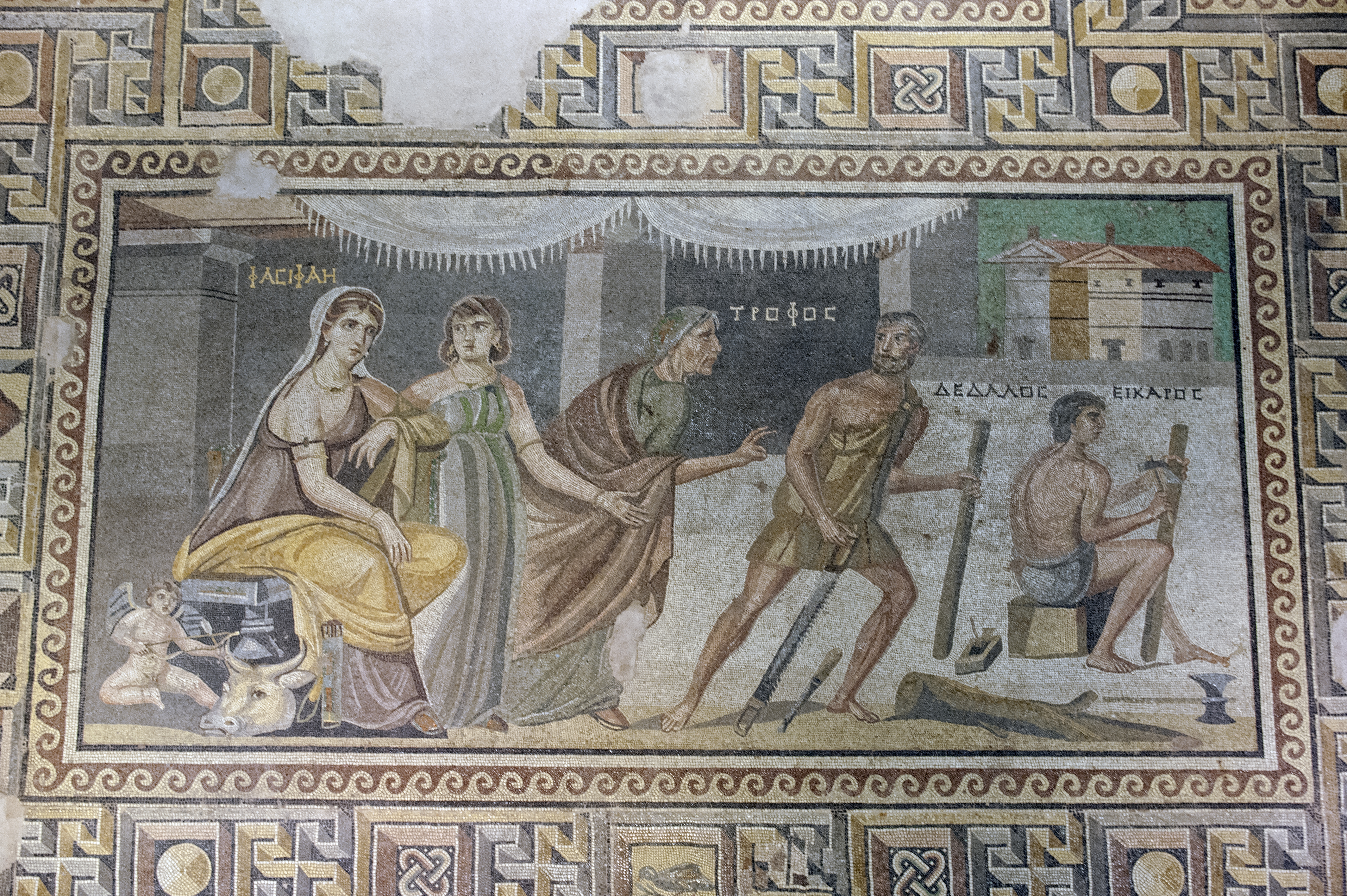


Icarus's father Daedalus, a very talented Athenian craftsman, built a labyrinth for King Minos of Crete near his palace at Knossos to imprison the Minotaur, a half-man, half-bull monster born of his wife and the Cretan bull. Minos imprisoned Daedalus himself in the labyrinth because he believed Daedalus gave Minos's daughter, Ariadne, a clew (or ball of string) in order to help Theseus escape the labyrinth and defeat the Minotaur.

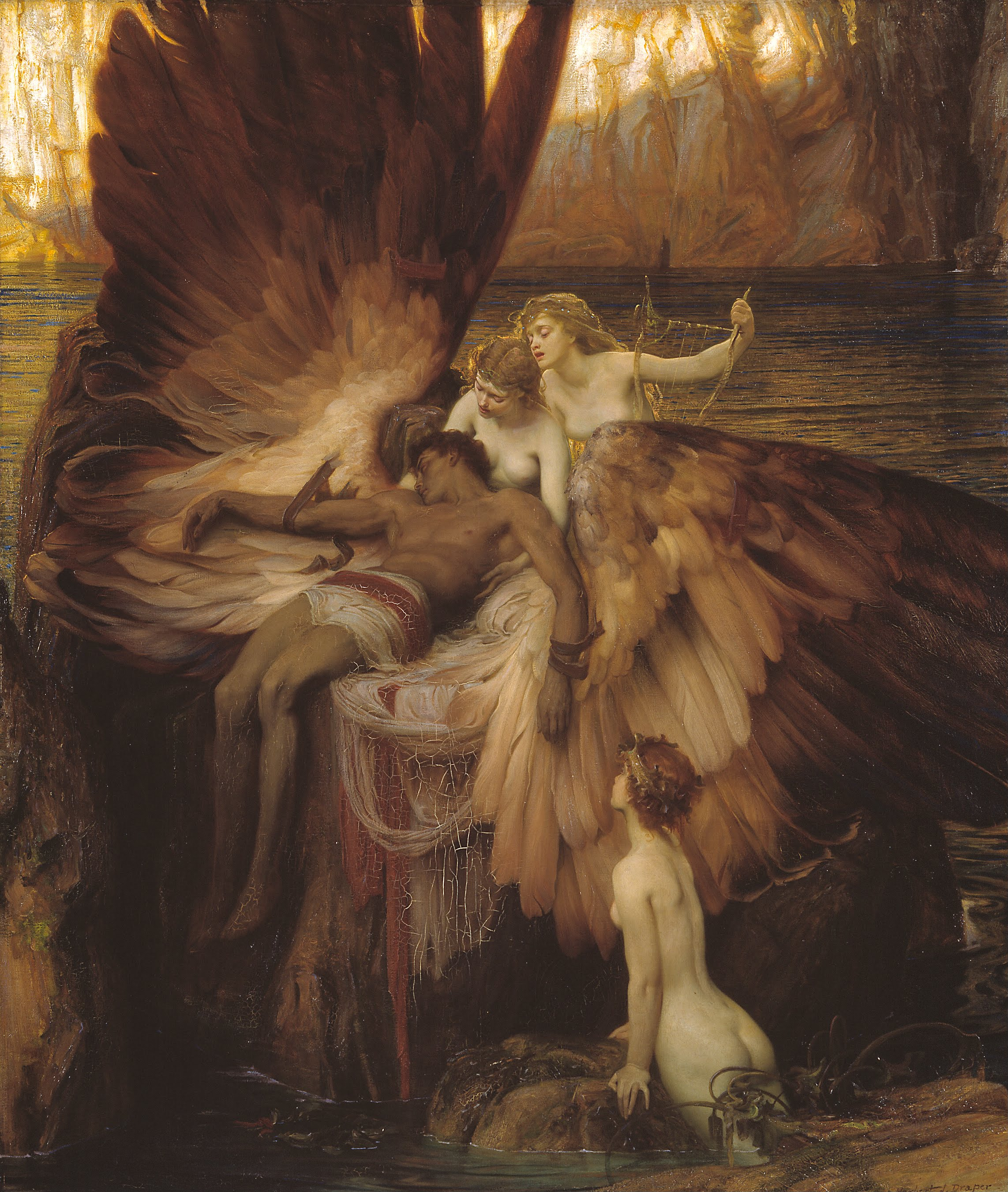
Daedalus fashioned two pairs of wings. One set for himself and the other for his son, made of metal feathers held to a leather frame by beeswax. Before trying to escape the island, he warned his son to follow his flight path and not fly too close to the sun or the sea. Overcome by giddiness while flying, Icarus disobeyed his father and soared higher into the sky. Without warning, the heat from the sun softened and melted the wax. Icarus could feel melted wax dripping down his arms. The feathers then fell one by one. Icarus kept flapping his "wings", trying to stay aloft. But he realized that he had no feathers left. He was only flapping his bare arms. He also saw loose feathers falling like snowflakes. Finally, he fell into the sea, sank to the bottom, and drowned. Daedalus wept for his son and called the nearest land Icaria (an island southwest of Samos) in the memory of him.
Today, the supposed site of his burial on the island bears his name, and the sea near Icaria in which he drowned is called the Icarian Sea. With much grief, Daedalus went to the temple of Apollo in Sicily, hung up his own wings as an offering, and promised to never attempt to fly again. According to scholia on Euripides, Icarus thought himself greater than Helios, the Sun himself, and the god punished him by directing his powerful rays at him, melting the beeswax. Afterwards, it was Helios who named the Icarian Sea after Icarus.
Hellenistic writers give euhemerising variants in which the escape from Crete was actually by boat, provided by Pasiphaë, for which Daedalus invented the first sails, to outstrip Minos's pursuing galleys, that Icarus fell overboard en route to Sicily and drowned, and that Heracles erected a tomb for him.
Classical literature
Accounts of Icarus's story are found in Pseudo-Apollodorus's Bibliotheca (Epitome i.12–13); Diodorus Siculus's Bibliotheca historica (4.77.5–9); Hyginus's Fabulae (40); Virgil's Aeneid (vi.14–33); and Ovid's Metamorphoses (viii.183–235). A number of other ancient writers allude to the story in passing, notably Lucian.
The account by Pseudo-Apollodorus is brief. Ovid's account in the Metamorphoses is among the lengthiest, and the Latin poet refers to Icarus's myth elsewhere. Hyginus, among the Augustan writers who wrote about it in Latin in his Fabulae, tells of the bovine love affair of Pasiphaë, daughter of the Sun, that resulted in the birth of the Minotaur.
Medieval, Renaissance, and modern literature
Ovid's version of the Icarus myth and its connection to Phaethon influenced the mythological tradition in English literature reflected in the writings of Chaucer, Marlowe, Shakespeare, Milton, and Joyce.
In Renaissance iconography, the significance of Icarus depends on context: in the Orion Fountain at Messina, he is one of many figures associated with water; but he is also shown on the Bankruptcy Court of the Amsterdam Town Hall – where he symbolizes high-flying ambition. The 16th-century painting Landscape with the Fall of Icarus,) attributed to Pieter Bruegel the Elder, was the inspiration for two of the 20th century's most notable ekphrastic English-language poems, "Musée des Beaux Arts" by W. H. Auden and "Landscape with the Fall of Icarus" by William Carlos Williams. Other English-language poems referring to the Icarus myth are "To a Friend Whose Work Has Come to Triumph" by Anne Sexton; "Icarus" by John Updike; "Icarus Again" by Alan Devenish; "Mrs Icarus" by Carol Ann Duffy; "Failing and Flying" by Jack Gilbert; "It Should Have Been Winter" by Nancy Chen Long, "Up like Icarus" by Mark Antony Owen, "Age 10, 3am" by Sheri Wright, and "Yesterday's Myth" by Jennifer Chang. While the myth is a major subtext throughout Hiromi Yoshida's full-length poetry book Green Roses Bloom for Icarus (2024), Icarus is a metaphor for troubled modern young men in the Norwegian Axel Jensen's novel Icarus: A Young Man in Sahara (1957). He is also the subject of the 2017 novel, Icarus, by Adam Wing. According to the New York Times Book Review, the hero of Andrew Boryga’s “Victim” is an “inner-city Icarus” who exaggerates his victimization narrative until it implodes. Icarus is the central character of a 2022 animated film by the same name, which reimagines the myth to give him a childhood friendship with the Minotaur.
File:Fall of Icarus Blondel decoration Louvre INV2624.jpg|The Sun, or the Fall of Icarus (1819) by Merry-Joseph Blondel, in the Rotunda of Apollo at the Louvre File:De val van Icarus.jpg|A 16th century print of Icarus falling. File:Pieter Bruegel de Oude - De val van Icarus.jpg|In Bruegel's Landscape with the Fall of Icarus () the fallen Icarus is a small detail at lower right. File:Ikaria and Ikarus graffiti at Evdilos, Ikaria island - Greece.jpg|Modern street art of Icaria island and falling Icarus just outside the village of Evdilos on Icaria, Greece
Interpretation

Literary interpretation has considered the myth of Icarus as a consequence of excessive ambition.Jacob E. Nyenhuis – Myth and the creative process: Michael Ayrton and the myth of Daedalus, the maze maker – 345 pages Wayne State University Press, 2003 Retrieved 24 January 2012 See also Harry Levin, The Overreacher, Harvard University Press, 1952 https://archive.org/details/overreacherstudy0000levi An Icarus-related study of the Daedalus myth was published by the French hellenist In psychology, there have been synthetic studies of the Icarus complex with respect to the alleged relationship between fascination for fire, high ambition, and Ascensionism. In the psychiatric mind, features of disease were perceived in the shape of the pendulous emotional ecstatic-high and depressive-low of bipolar disorder. Henry Murray having proposed the term Icarus complex, apparently found symptoms particularly in mania where a person is fond of heights, fascinated by both fire and water, narcissistic and observed with fantastical or far-fetched imaginary cognition. Seth Godin's 2012 The Icarus Deception, points to the historical change in how Western culture both propagated and interpreted the Icarus myth arguing that "We tend to forget that Icarus was also warned not to fly too low, because seawater would ruin the lift in his wings. Flying too low is even more dangerous than flying too high, because it feels deceptively safe."
References
References
- March, Jennifer R.. (2014). "Dictionary of Classical Mythology". Oxbow Books.
- "Metamorphoses (Kline) 8, the Ovid Collection, Univ. of Virginia E-Text Center".
- "CommonLit {{!}} The Myth of Daedalus and Icarus by Ovid".
- Elder, Pliny the. (21 May 2015). "Pliny the Elder: The Natural History Book VII (with Book VIII 1–34)". Bloomsbury Publishing.
- [[wiktionary:clew. clew]] – a ball of yarn or thread. The etymology of the word "[[wiktionary:clue. clue]]" is a direct reference to this story of the Labyrinth.
- [[Thomas Bullfinch]] - The Age of Fable Stories of Gods and Heroes [http://www.kundaliniawakeningsystems1.com/downloads/thomas-bulfinchs-mythology-age-of-fable-vols1&2.pdf ''KundaliniAwakeningSystem.com''] {{Webarchive. link. (24 January 2013 & The Internet Classics Archive by Daniel C. Stevenson : Ovid – [http://classics.mit.edu/Ovid/metam.8.eighth.html Metamorphoses – Book VIII] + Translated by [[Rolfe Humphries]] – [http://www.dl.ket.org/humanities/literature/litpacket/metamorphoses.htm KET Distance Learning] {{Webarchive). link. (14 June 2012 24 January 2012.)
- Translated by [[A. S. Kline]] – [[University of Virginia Library]][http://etext.lib.virginia.edu/latin/ovid/trans/Metamorph8.htm#_Toc482327661/ .edu] {{Webarchive. link. (17 February 2011 Retrieved 3 July 2005.)
- "Icarus and Daedalus.Pdf".
- (2017). "Preliminary Studies On the Scholia to Euripides". California Classical Studies.
- (1867). "A Dictionary of Greek and Roman Biography and Mythology".
- Pinsent, J.. (1982). "Greek Mythology". Peter Bedrick Books.
- In the ''{{Interlanguage link. Icaromenippus. fi. Ikaromenippos'' (about Menippus's Icarus-like flight), but also in ''The Dream'', 24; ''Essays in Portraiture'', 21; ''The Ship'', 46.
- ''[[Bibliotheca (Pseudo-Apollodorus). Epitome'' of the ''Biblioteca]]'' i.12–13.
- Gareth D. Williams, ''Banished voices: readings in Ovid's Exile Poetry'' (Cambridge University Press, 1994), p. 132 [https://books.google.com/books?id=LgvkDl59Av8C&dq=ovid+icarus+phaethon+OR+phaeton&pg=PA132 online].
- Peter Knox, ''A Companion to Ovid'' (Blackwell, 2009), p. 424 [https://books.google.com/books?id=zMMeWI2xbPkC&dq=%22The+figure+of+Ovid+is+never+far+from+the+scenes%22&pg=PA424 online].
- Jane Chance, ''The Mythographic Chaucer'' (University of Michigan Press, 1995), p. 65 [https://books.google.com/books?id=OGJcl_YyVPsC&dq=ovid+icarus+phaethon+OR+phaeton&pg=PA65 online].
- Troni Y. Grande, ''Marlovian Tragedy'' (Associated University Presses, 1990), pp. 14 [https://books.google.com/books?id=FINn3Y3IgW0C&dq=%22Icarus+and+Phaeton+as+types+of+the+Marlovian+%22over-reacher%22%22&pg=PA14 online], 40–42 ''et passim''; Frederic B. Tromly, ''Playing with Desire: Christopher Tantalization'' (University of Toronto Press, 1998), p. 181.
- Coppélia Kahn, ''Man's estate: Masculine Identity in Shakespeare'' (University of California Press, 1981), p. 53 [https://books.google.com/books?id=JzEnuYAt5rUC&dq=ovid+shakespeare+icarus+phaethon+OR+phaeton&pg=PA53 online].
- Su Fang Nu, ''Literature and the Politics of Family in Seventeenth-Century England'' (Cambridge University Press, 2007), p. 154 [https://books.google.com/books?id=XtHEgx0odbEC&dq=ovid+milton+icarus+phaethon+OR+phaeton&pg=PA154 online]; [[R.J. Zwi Werblowsky]], ''[[Lucifer and Prometheus]]'' (Routledge, 2001, reprinted from 1952), p. 32 [https://books.google.com/books?id=MsR909HjyGkC&dq=%22such+hubris+legends+as%22&pg=PA32 online].
- R. J. Schork, ''Latin and Roman Culture in Joyce'' (University Press of Florida, 1997), p. 160 [https://books.google.com/books?id=HWS8zlRxZ48C&q=Icarus+Phaethon&pg=PA160 online].
- E. H. Gombrich, ''Symbolic Images; Studies in the Art of the Renaissance'' (London, 1972); p. 8.
- "On doute que l'exécution soit de Pieter I Bruegel mais la conception Lui est par contre attribuée avec certitude", [[Royal Museums of Fine Arts of Belgium]]. [https://web.archive.org/web/20120327082944/http://www.fine-arts-museum.be/fabritiusweb/FullBBBody.csp?SearchMethod=Find_1&Profile=Default&OpacLanguage=fre&RequestId=352686_1&RecordNumber=0CSPCHD=000100030001318j79f5000821052062 "Description détaillée"] (in French). Archived from the original on 27 March 2012. Retrieved 3 September 2011.
- de Vries, Lyckle (2003). "Bruegel's "Fall of Icarus": Ovid or Solomon?". Simiolus: Netherlands Quarterly for the History of Art. Stichting voor Nederlandse Kunsthistorische Publicaties. 30 (1/2): 4–18. {{JSTOR. 3780948.
- (14 November 2009). "Ten of the best: examples of ekphrasis".
- Askaripour, Mateo. (2024-03-09). "Book Review: 'Victim,' by Andrew Boryga".
- "De val van Icarus".
- Frontisi-Ducroux, Françoise. (1975). "Dédale: Mythologie de l'artisan en Grèce Ancienne". François Maspero.
- Wiklund, Nils. (1978). "The icarus complex". Doxa.
- 0-7618-4993-9
- Pendulum – ''The BiPolar Organisation's'' quarterly journal [http://www.mdf.org.uk/?o=56962 Bipolar UK] Retrieved 24 January 2012.
- Godin, Seth. (2012). "The Icarus Deception: How High Will You Fly?". Portfolio.
- Comparison noted by W.H.Ph. Römer, "Religion of Ancient Mesopotamia", in ''Historia Religionum: Religions of the Past'' (Brill, 1969), vol. 1, p. 163.
This article was imported from Wikipedia and is available under the Creative Commons Attribution-ShareAlike 4.0 License. Content has been adapted to SurfDoc format. Original contributors can be found on the article history page.
Ask Mako anything about Icarus — get instant answers, deeper analysis, and related topics.
Research with MakoFree with your Surf account
Create a free account to save articles, ask Mako questions, and organize your research.
Sign up freeThis content may have been generated or modified by AI. CloudSurf Software LLC is not responsible for the accuracy, completeness, or reliability of AI-generated content. Always verify important information from primary sources.
Report