From Surf Wiki (app.surf) — the open knowledge base
Ibn Zaydun
11th-century Andalusian poet and writer
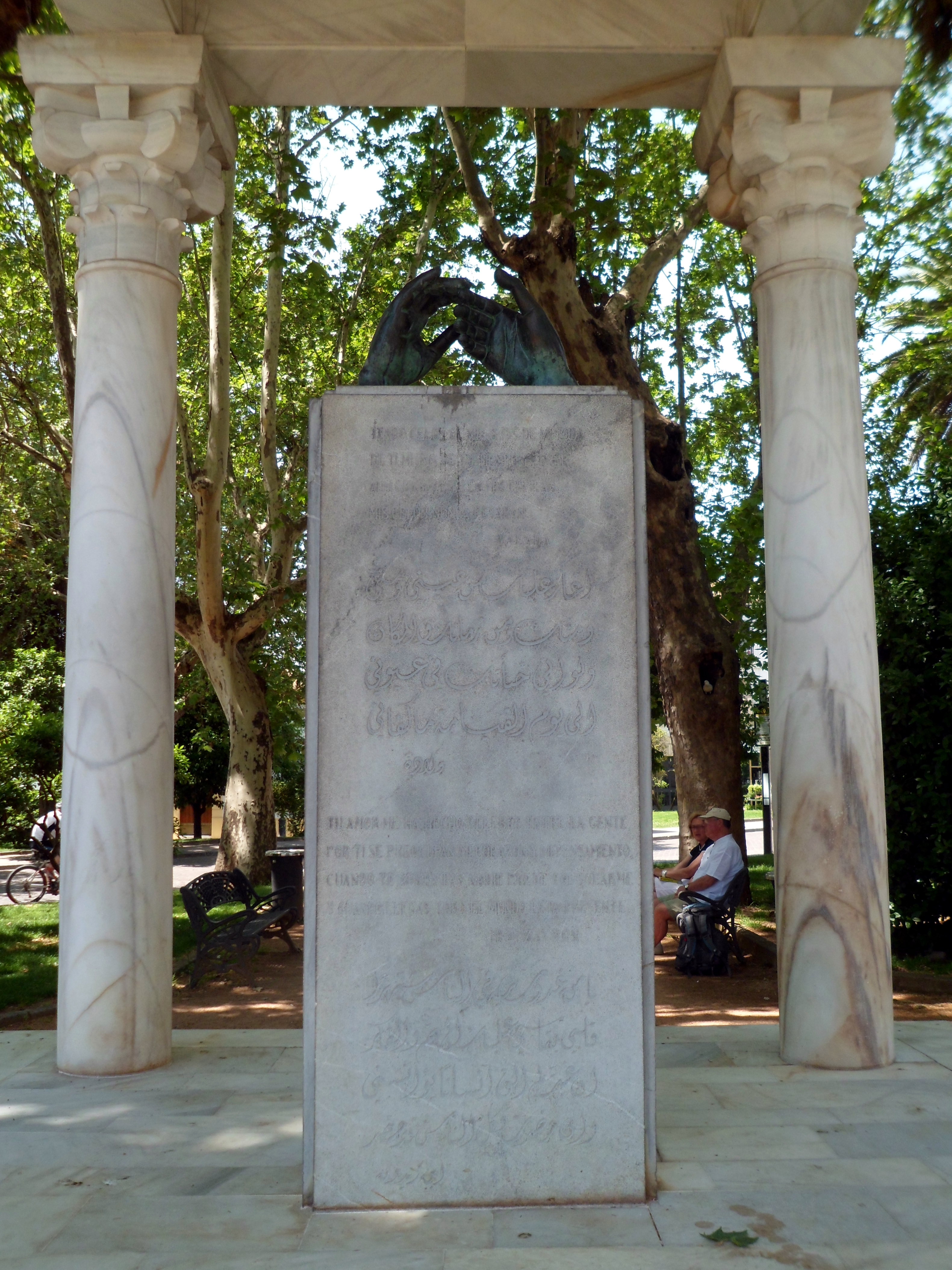
11th-century Andalusian poet and writer
| Field | Value |
|---|---|
| name | Ibn Zaydun |
| ابن زيدون | |
| caption | Monument made for Ibn Zaydun |
| birth_date | 1003 |
| birth_place | Cordoba, Caliphate of Córdoba |
| death_date | 1071 |
| death_place | Seville, Taifa of Seville |
| occupation | Poet |
| period | Islamic Golden Age |
ابن زيدون Abū al-Walīd Aḥmad Ibn Zaydouni al-Makhzūmī (; 1003–1071), or simply known as Ibn Zaydoun () or Abenzaidun, was an Arab Andalusian poet of Cordoba and Seville. He was considered the greatest neoclassical poet of al-Andalus.
He reinvigorated the impassioned lyrics in Arabic by infusing it with more personal and sensual tones of experience. This supposed him to be considered the best of the loving poets of the Muslim Hispania and to become a model for all subsequent Western Arabic poetry. His love affair with the princess and poet Wallada bint al-Mustakfi and his exile inspired many of his poems.
Life and work
Ibn Zayduni was born in 1003 in Cordoba to an aristocratic Andalusian Arab family descended from the Banu Makhzum. He grew up during the decline of the Caliphate of Córdoba and was involved in the political life of his age. He joined the court of the Jahwarid Abu al-Hazm of Cordoba, but then was imprisoned by him after accusations that Ibn Zaydun conspired against him and his patrons.
His relationship with the Umayyad princess Wallada was quickly terminated by Wallada herself. Some attributed this change of heart to Ibn Zayduni's early anti-Umayyad activities, while others mention his rivalry with the rich minister Ibn Abdus, a former friend of Ibn Zayduni, who supposedly gains Wallada's favor and supported her. It is suggested that Ibn Abdus himself was the one who instigated Abu al-Hazm ibn Jahwar against Ibn Zaydun.
He sought refuge with Abbad II of Seville and his son al-Mu'tamid. He was able to return home for a period after the ruler of Seville conquered Cordoba. Much of his life was spent in exile and the themes of lost youth and nostalgia for his city are present in many of his poems. In a poem about Cordoba he remembers his city and his youth:
God has sent showers upon abandoned dwelling places of those we loved. He has woven upon them a striped many-coloured garment of flowers, and raised among them a flower like a star. How many girls like images trailed their garmets among such flowers, when life was fresh and time was at our service...How happy were, those days that have passed, days of pleasure, when we lived with those who had back flowing hair and white shoulders His romantic and literary life was dominated by his relations with the poet Wallada bint al-Mustakfi, the daughter of the Umayyad Caliph Muhammad III of Cordoba. According to Jayyusi in her book The Legacy of Muslim Spain, "Ibn Zayduni brought into Andalusi poetry something of balance, the rhetorical command, the passionate power and grandeur of style that marked contemporary poetry in the east...he rescued Andalusi poetry from the self-indulgence of the poets of externalized description."
==Notes==
==Bibliography== *Ahmad ibn Abd Allāh Ibn Zaydūn, Mahmūd Subh. (1979). Poesias, Instituto Hispano-Árabe de Cultura, ed. University of Virginia. *Concha Lagos. (1984). Con el arco a punto Instituto Hispano-Arabe de Cultura. University of California. . *Sieglinde Lug. (1982). Poetic Techniques and Conceptual Elements in Ibn Zaydūn's Love Poetry, University Press of America (based on the author's thesis).
- Devin J. Stewart, 'Ibn Zaydūn', in The Cambridge History of Arabic Literature: The Literature of Al-Andalus, ed. by Maria Rosa Menocal, Raymond P. Scheindlin and Michael Sells (Cambridge: Cambridge University Press, 2000), pp. 306–17. *S. Jayyusi. (1992). The Legacy of Muslim Spain. pp. 343–351.
[[Category:1003 births]] [[Category:1071 deaths]] [[Category:11th-century people from al-Andalus]] [[Category:11th-century Arab people]] [[Category:Poets from al-Andalus]] [[Category:Writers from Córdoba, Spain]] [[Category:Banu Makhzum]] [[Category:11th-century Arabic-language poets]]
References
- (2000). "The Literature of Al-Andalus". Cambridge University Press.
- L. Alavarez. (1998) Ibn Zayduni. In ''Encyclopedia of Arabic Literature'' (Vol. 1, pp. 384–385). Taylor & Francis. {{ISBN. 0-415-18571-8.
- Jayyusi, 1992, p. 347.
- L. Alavarez, 1998
- Tr. by [[Albert Hourani]]. (1992). ''[[History of the Arab Peoples]]''. pp. 193–194. {{ISBN. 0-446-39392-4.
- Emeri van Donzel. (1994) ''Islamic Desk Reference''. p. 163. BRILL. {{ISBN. 90-04-09738-4.
- S. Jayyusi et al. (1992). ''The Legacy of Muslim Spain''. pp. 343–347. BRILL. {{ISBN. 978-90-04-09599-1
This article was imported from Wikipedia and is available under the Creative Commons Attribution-ShareAlike 4.0 License. Content has been adapted to SurfDoc format. Original contributors can be found on the article history page.
Ask Mako anything about Ibn Zaydun — get instant answers, deeper analysis, and related topics.
Research with MakoFree with your Surf account
Create a free account to save articles, ask Mako questions, and organize your research.
Sign up freeThis content may have been generated or modified by AI. CloudSurf Software LLC is not responsible for the accuracy, completeness, or reliability of AI-generated content. Always verify important information from primary sources.
Report