From Surf Wiki (app.surf) — the open knowledge base
IAE V2500
High-bypass turbofan engine

High-bypass turbofan engine
| Field | Value |
|---|---|
| name | V2500 |
| image | File:IAE V2500 engine cutaway model 2010 The Sky and Space.jpg |
| caption | The V2500-A5/D5/E5 has one fan, four low- and ten high-pressure compressor stages, and two high- and five low-pressure turbine stages. |
| engine_type | Turbofan |
| manufacturer | International Aero Engines |
| first_run | 1987 |
| major_applications | |
| number_built | Over 7,600 (June 2018) |
The IAE V2500 is a two-shaft high-bypass turbofan engine built by International Aero Engines (IAE) which powers the Airbus A320 family, the McDonnell Douglas MD-90, and the Embraer C-390 Millennium.
The engine's name is a combination of the Roman numeral V, symbolizing the five original members of the International Aero Engines consortium, formed in 1983 to produce the engine, and 2500, which represents the 25000 lbf thrust produced by the original engine model, the V2500-A1. FAA type certification for the V2500 was granted in 1988.
The maintenance, repair, and operations market for the V2500 is close to as of 2015.
Development
Rolls-Royce based the ten-stage high-pressure compressor on an eight-stage run in the RB401 in the mid 1970s followed by a nine-stage run in the RJ.500. The V.2500 would use ten stages, with the first four with variable stators, giving a pressure ratio of 20:1. A single-stage booster was also part of the original configuration. Serious handling problems (inability to accelerate without surging) with this arrangement resulted in a redesigned compression system. The pressure ratio was reduced to 16:1 which needed a fifth variable stage and revised blading in the rear stages. Two extra booster stages were required to restore the original overall pressure ratio. A fourth booster stage would be added after the initial variant entered service. Pratt & Whitney developed the combustor and the two-stage air-cooled high-pressure turbine, while the Japanese Aero Engine Corporation provided the low-pressure compression system. MTU Aero Engines were responsible for the five-stage low-pressure turbine and Fiat Avio designed the gearbox.
In 1989, its unit cost was US$ million. The 4,000th V2500 was delivered in August 2009 to the Brazilian flag carrier TAM and installed on the 4,000th Airbus A320 family aircraft, an A319. In early 2012, the 5,000th V2500 engine was delivered to SilkAir, and IAE achieved 100 million flying hours.
Variants
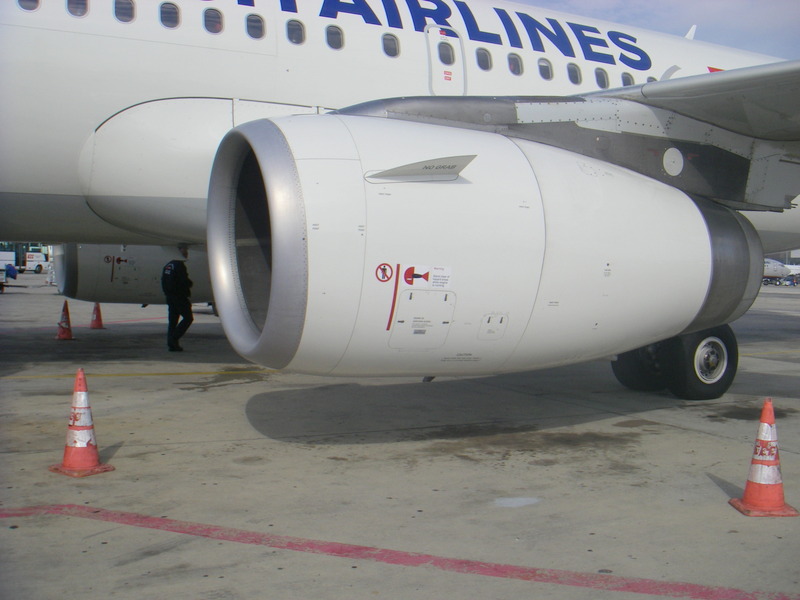
V2500-A1
The original version, has one fan stage, three low- and ten high-pressure compression stages, and two high- and five low-pressure turbine stages. This engine promised better fuel burn on the Airbus A320 than the competing CFM56-5A; however, initial reliability issues, coupled with insufficient thrust for the larger A321, prompted the development of the improved V2500-A5 variant. It first entered service with Cyprus Airways.
V2500-A5
A fourth booster stage was introduced into the engine basic configuration to increase core flow. This, together with a minor fan diameter and airflow increase, helped to increase the maximum thrust to 33,000 lbf (147 kN) thrust, to meet the requirements of the larger Airbus A321. Soon, Airbus offered derated versions of the V2500-A5 on the Airbus A319 and Airbus A320, enabling the same engine hardware to be used across all Airbus A320 family aircraft, with the exception of the Airbus A318. The vast majority of V2500s are of the A5 variety.
V2500-D5
This engine retains the configuration of the V2500-A5 but is fitted with different mounting hardware and accessory gearboxes to facilitate installation on the McDonnell Douglas MD-90.
V2500-E5
This engine retains the configuration of the V2500-A5 but is fitted with different mounting hardware and accessory gearboxes to facilitate installation on the Embraer KC-390.
De-rated and increased-thrust variants
.jpg)
A number of de-rated engines compliant with Stage 4 noise regulations have been produced from the -A5 configuration, as well as two variants with significant increase in thrust, thus expanding the thrust range from 23,500 lbf to 33,000 lbf:
- The 23500 lbf thrust V2524-A5 for the Airbus A319
- The 24800 lbf thrust V2527-A5 for the Airbus A320
- The 25000 lbf thrust V2525-D5 for the McDonnell Douglas MD-90-30. Engine accessories are mounted on the side instead of bottom to accommodate lateral mounting.
- The 28000 lbf thrust V2528-D5 for the McDonnell Douglas MD-90-30. Same as V2525-D5 but with 3,000 pounds (13 kN) more thrust.
- The 33000 lbf thrust V2533-A5 for the Airbus A321
- The 31330 lbf thrust V2531-E5 for the Embraer C-390 Millennium
V2500SelectOne
On October 10, 2005, IAE announced the launch of the V2500Select—later called V2500SelectOne—with a sale to IndiGo Airlines to power 100 A320-series aircraft. The V2500SelectOne is a combination performance improvement package and aftermarket agreement. In February 2009, Pratt & Whitney upgraded the first V2500-A5 to the SelectOne Retrofit standard; the engine was owned by US Airways and had been in use since 1998.
V2500SelectTwo
On March 15, 2011, IAE announced an upgrade option of V2500 SelectOne Engines to the SelectTwo Program. It offers reduced fuel consumption due to a software upgrade and Reduced Ground Idle (RGI), and is available since 2014 for the V2500-A5 variants.
Applications
- Airbus A320ceo family (excluding A318)
- Embraer C-390 Millennium
- McDonnell Douglas MD-90
Specifications
|thrust/weight=4.18–5.73
- Rotor speed: low pressure: 5,650 RPM, high pressure: 14,950 RPM
- Control: Dual channel FADEC
| Variant | Certification | Take-Off Thrust | Weight | T/W | BPR | Comp. | Application | V2500-A1 | V2527E-A5 | V2527-A5 | V2527M-A5 | V2522-A5 | V2524-A5 | V2530-A5 | V2533-A5 | V2531-E5 | V2525-D5 | V2528-D5 |
|---|---|---|---|---|---|---|---|---|---|---|---|---|---|---|---|---|---|---|
| 1 June 1988 | 110.31 kN | 2404 kg | 4.68 | 5.4:1 | 35.8:1 | Airbus A320 | ||||||||||||
| 14 August 1995 | 4.50 | 4.8:1 | 32.8:1 | |||||||||||||||
| 21 November 1992 | 108.89 kN | 4.44 | ||||||||||||||||
| 24 May 1999 | 133.00 kN | 5.43 | ||||||||||||||||
| 10 June 1996 | 102.48 kN | 4.18 | 4.9:1 | Airbus A319 | ||||||||||||||
| 29 November 1992 | 133.30 kN | 5.73 | 4.6:1 | 35.2:1 | Airbus A321 | |||||||||||||
| 14 August 1996 | 140.56 kN | 4.5:1 | ||||||||||||||||
| 20 June 2015 | 139.36 kN | 5.68 | 4.7:1 | 36.2:1 | Embraer KC-390 | |||||||||||||
| 29 November 1992 | 111.20 kN | 2595 kg | 4.20 | 4.8:1 | 34.5:1 | McDonnell Douglas MD-90 | ||||||||||||
| 124.55 kN | 4.71 | 4.7:1 | 35.2:1 |
Notes
References
References
- "IAE Statement on KC-390 Rollout". IAE International Aero Engines.
- (2016-12-12). "V2500 Engine Overhauls On The Rise As Fleet Matures".
- "V.2500 orderbook opens", Flight International,16 February 1985, p.17
- Flight International,13 June 1987, p.102
- "Flow Matching of the Stages of Axial Compressors", Rolls-Royce Heritage Trust, Technical Series No 4,{{ISBN. 1 872922 14 7, p.67
- "History". International Aero Engines.
- (24 June 1989). "V2500 gets major boost from ILFC".
- (August 28, 2009). "IAE celebrates delivery of 4,000th V2500 to TAM on the 4,000th A320 family aircraft". International Aero Engines.
- "V2500 Engine".
- "International Aero Engines / IAE V2500".
- (June 20, 2011). "International Aero Engines Launches SelectTwo Program". International Aero Engines.
- "V2500 SelectTwo". International Aero Engines.
- (20 December 2022). "Type Certificate Data Sheet No. IM.E.069". EASA.
- (June 7, 2016). "V2500 Product Card". IAE.
- [https://prattwhitney.com/products-and-services/products/commercial-engines/v2500 V2500-E5 Product Card]
This article was imported from Wikipedia and is available under the Creative Commons Attribution-ShareAlike 4.0 License. Content has been adapted to SurfDoc format. Original contributors can be found on the article history page.
Ask Mako anything about IAE V2500 — get instant answers, deeper analysis, and related topics.
Research with MakoFree with your Surf account
Create a free account to save articles, ask Mako questions, and organize your research.
Sign up freeThis content may have been generated or modified by AI. CloudSurf Software LLC is not responsible for the accuracy, completeness, or reliability of AI-generated content. Always verify important information from primary sources.
Report