From Surf Wiki (app.surf) — the open knowledge base
I-35W Saint Anthony Falls Bridge
Bridge in Minneapolis, Minnesota
Bridge in Minneapolis, Minnesota
| Field | Value |
|---|---|
| bridge_name | Saint Anthony Falls Bridge |
| image | Saint Anthony (35W) Bridge river view 2008-09-18.JPG |
| image_size | 300px |
| caption | Opening day, September 18, 2008, from south end. |
| official_name | I-35W Saint Anthony Falls Bridge |
| crosses | Mississippi River |
| carries | 10 Lanes of ; light-rail or bus-way-ready |
| locale | Minneapolis, Minnesota, U.S. |
| design | Post-tensioned precast box girder bridge |
| mainspan | 504 ft |
| length | 1216 ft |
| width | 180 ft |
| height | 120 ft (estimated) |
| below | 70 ft |
| begin | October 30, 2007 |
| open | September 18, 2008 |
| maint | Minnesota Department of Transportation (Mn/DOT) |
| id | NBI 27410 (Northbound), 27409 (Southbound) |
| coordinates | |
| traffic | 168,000 |
the bridge completed in 2008
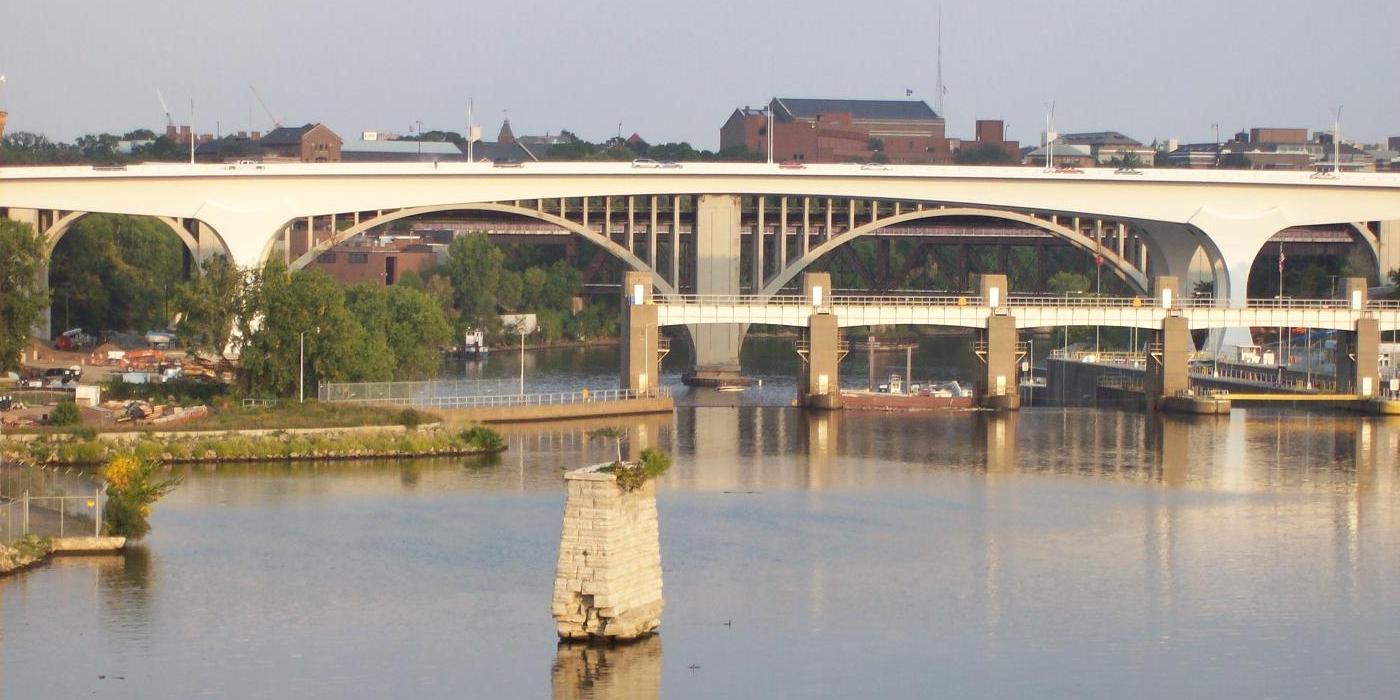
The I-35W Saint Anthony Falls Bridge crosses the Mississippi River one-half mile (875 m) downstream from the Saint Anthony Falls in Minneapolis, Minnesota in the U.S., carrying north–south traffic on Interstate 35W. The ten-lane bridge replaced the I-35W Mississippi River bridge, which collapsed on August 1, 2007. It was planned and is maintained by the Minnesota Department of Transportation (MnDOT). The planning, design, and construction processes were completed more quickly than normal because Interstate 35W is a critical artery for commuters and truck freight. The bridge opened September 18, 2008, well ahead of the original goal of December 24.
Collapse of the previous bridge
Main article: I-35W Mississippi River bridge#Collapse
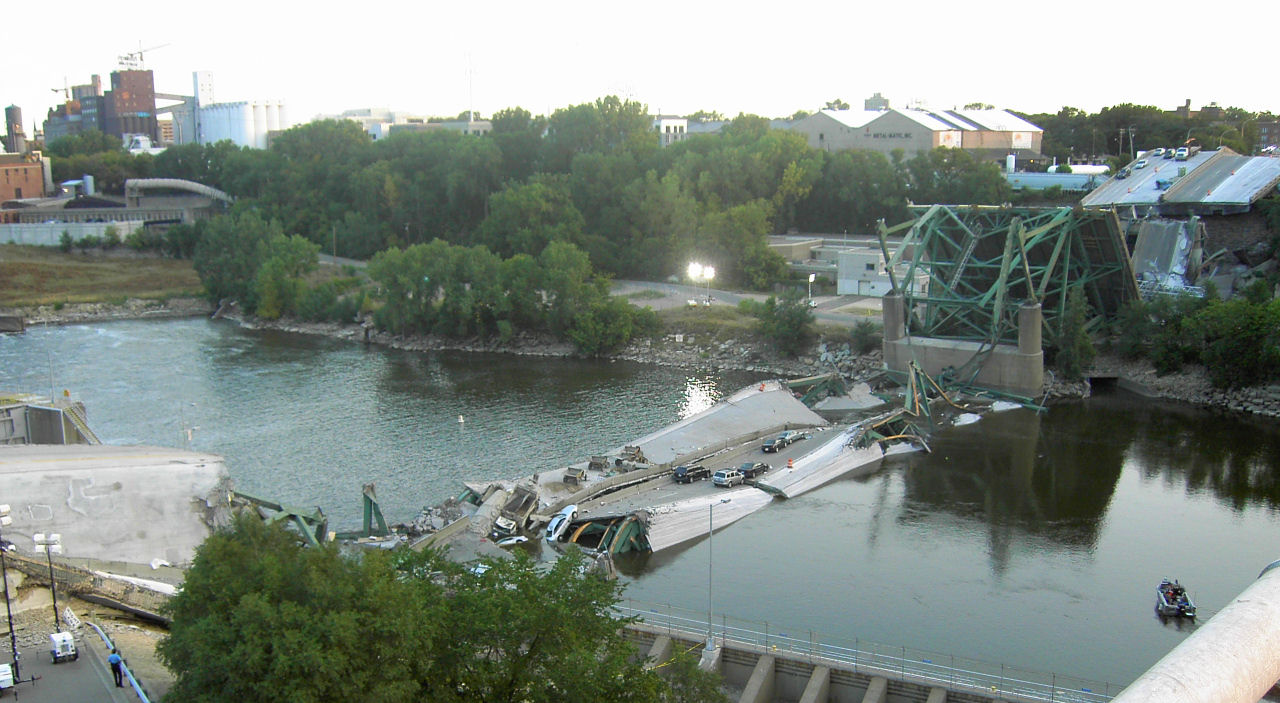
During the evening rush hour at 6:05 pm on August 1, 2007, the main spans of the I-35W Mississippi River bridge in Minneapolis collapsed and fell into the river and onto its banks, killing 13 people and injuring 145. The bridge opened in 1967, and was expected to carry 66,000 vehicles per day. Though intended to last fifty years, it collapsed after forty – approximately ten years short of the end of its useful life.
Originally, the bridge was striped for two lanes in each direction. In 1988, the four shoulders were converted to traffic lanes, accommodating four lanes in each direction. This allowed an increase in traffic flow. By 2004, an estimated 141,000 vehicles crossed the bridge each day.
Funding
Design debate
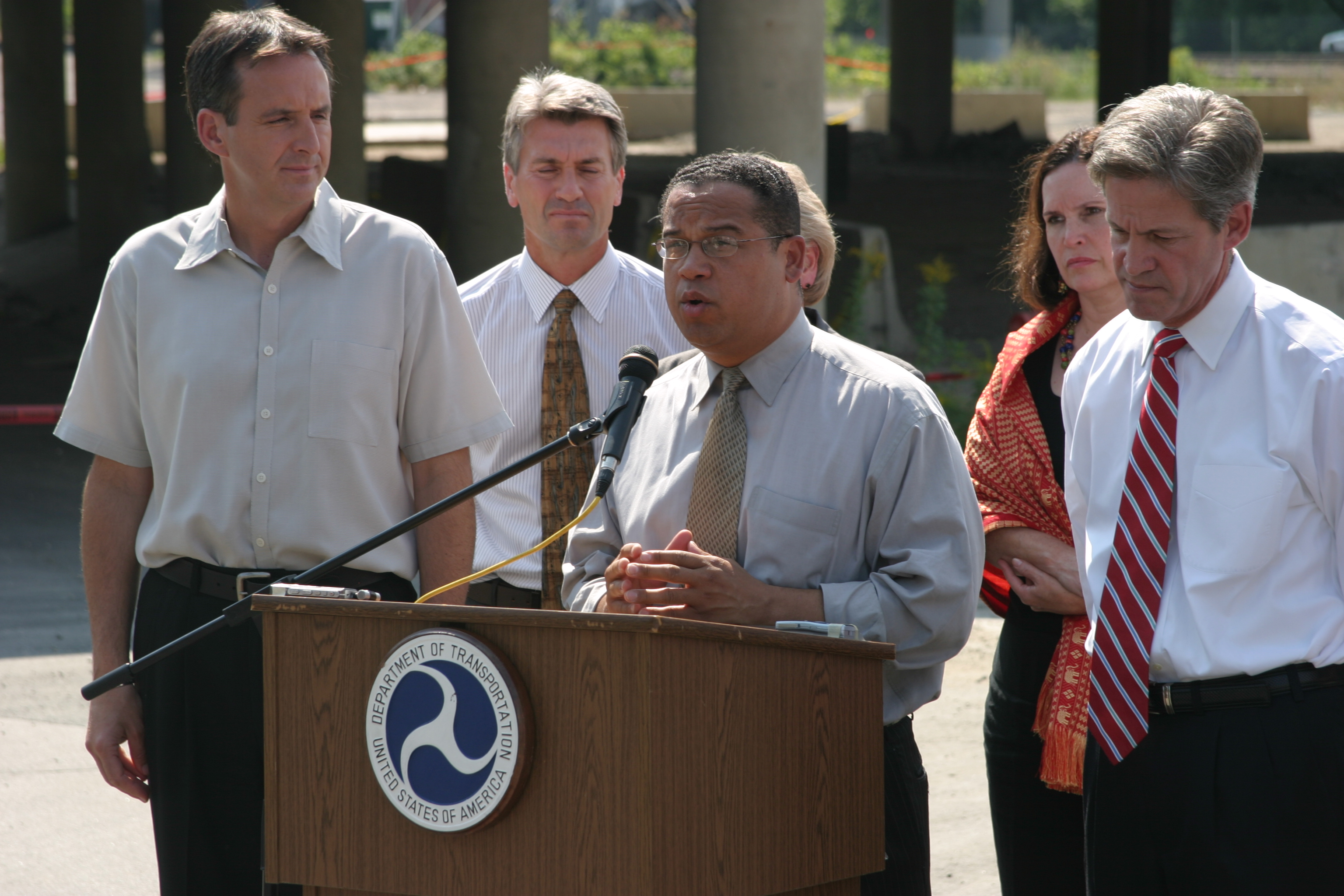
Minneapolis Mayor R. T. Rybak (DFL) said that future needs and policy considerations shouldn't be ignored in the rush to build a replacement and sought a new bridge able to handle increased traffic as well as mass transit. Meetings between state transportation officials (MnDOT), Rybak, State Transportation Commissioner Carol Molnau, and Governor Tim Pawlenty yielded a desire to build a 10 lane bridge that will last 100 years, with the possibility of bus rapid transit or light rail lines. Rybak said, "Transit needs to play some role in this or otherwise we would need to build a much wider bridge in the future." Commissioner Molnau, in conjunction with Metropolitan Council Chairman Peter Bell, recommended that light rail not be incorporated in the new bridge design. But Pawlenty, responding to constituents and the mayor, directed MnDOT to design the bridge to be light rail-ready. He said the estimated additional $20 to $35 million would be paid for by the state.
Award of contract
After the collapse of the bridge's predecessor, MnDOT announced to potential contractors that they should express their intention to bid on the project by August 8, 2007. A typical bridge project of this scale in Minnesota would be expected to take three years to complete, but state transportation officials hoped to open this replacement bridge in 15 months by using a design/build contract that allowed design and construction of the bridge to proceed concurrently. MnDOT announced on August 9 that five companies/consortia had been approved to bid on the project and requested that the bids be submitted by September 18, 2007.
Flatiron Construction, Inc. and Manson Construction Co. were awarded the contract on September 19, 2007; Flatiron's was the highest-priced and longest schedule of the bids submitted. with Ayres Associates providing hydraulic and scour analyses. TKDA of Saint Paul was the engineer of record for the approach highways, second street bridges, retaining walls, lighting, and water resource engineering services on the project. While the total cost was expected to be between USD $300 million and $350 million for the 1,900-foot (579 m) multi-span bridge, including financial incentives for accelerating the schedule,
Construction
_Bridge-north.JPG)
MnDOT maintained a project page that tracked all activities associated with the construction of the bridge including weekly updates, traffic impacts, construction photos, animations, and virtual walk tours. On December 17, 2007, the first slab of concrete, 200 ft long, 13.5 ft wide, and 4.5 ft thick, was poured off-site, which began to shape the bridge. Pilings sunk 100 ft into the earth support the ends of the bridge, which contains 50000 cuyd of concrete.
The bridge construction progressed more quickly than expected. Construction work was performed in shifts with as many as 400 workers during the day, and 200 at night. On April 8, 2008 MnDOT announced the halfway point of construction had been reached, and predicted that completion might be ahead of schedule by as much as three months.
This prediction was borne out by events, as the Minnesota Department of Transportation opened the bridge to traffic at 5:00 in the morning on September 18, 2008. Minnesota State Patrol cars had been positioned at both the north and south ends, and allowed rush hour traffic to build up behind them. Once the construction barricades were removed at 5:00, first responders, state troopers, and MnDOT trucks slowly crossed the bridge, followed by the rush hour traffic, officially opening the bridge. The $234 million bridge was completed three months ahead of schedule and on budget, with no lost time due to safety accidents. Flatiron-Manson was expected to earn $27 million in bonuses for accelerated performance.
Image:sabridgefootings.jpg|Support posts in construction on the north bank in January 2008 Image:35W Bridge Casting Yard.jpg|Box girder sections formed in the casting yard (a closed section of the Interstate roadway) in May 2008 Image:I35W St Anthony Bridge oblique 20080705 7815.JPG|Last segment of northbound lanes in place July 5, 2008. Image:I-35W new 080830 25.JPG|Bridge nearing completion, August 30, 2008.
Technology
The bridge is equipped with anti-icing sprayers and was constructed with high-strength concrete. There are 323 sensors that regularly measure bridge conditions such as deck movement, stress, and temperature. The data will be compiled and analyzed by University of Minnesota personnel. The bridge is illuminated with LED lights. Although LED lighting is not generally approved for such highways, this bridge roadway illumination is a test project. The bridge also incorporates multichromatic decorative lighting, which is used to illuminate the structure at night.
The bridge includes two decorative sculptures resembling the symbol for water used on maps, which are built using a special photocatalytic concrete called TX Active. This material reacts with ultraviolet light and pulls pollutant particles of carbon monoxide, sulfur dioxide, and nitrous oxide out of the air and converts them to less harmful substances. The sculptures contain a compound that makes them self-cleaning, so they should stay white for as long as they stand.
In the concrete comprising the drilled shafts, piers and footings, a significant proportion of the Portland cement was replaced with slag, fly ash and other pozzolans. These materials reduce the embodied energy of the structure and allow the concrete to resist the ingress of water and dissolved solids such as chloride ions. This allowed the structure to be designed to resist deterioration for much longer than structures made with conventional concrete.
Awards
The project has won over 20 awards for excellence, including the Federal Highway Administration's Award of Excellence, the FIATECH Celebration of Engineering and Technology Innovation Award, the 2010 Award of Excellence from the Portland Cement Association, and the National Council of Structural Engineers Association's Excellence in Structural Engineering Award. The bridge has been named a project of the year by the American Public Works Association.
The bridge won the 2009 America's Transportation Awards, a prize sponsored by AASHTO, for "representing the best in innovative management, accountability and timeliness".
References
- Patrick Nunnally, ed. The City, the River, The Bridge: Before and After the Minneapolis Bridge Collapse (University of Minnesota Press; 2011) 183 pages; studies by civil engineers, geographers, and others on the events and aftermath of the collapse of the bridge in August 2007. Based on work presented at a conference of the same name held at the University of Minnesota in October 2008.
References
- "I-35 Saint Anthony Falls Bridge". Minnesota Department of Transportation.
- Scheck, Tom. (August 7, 2007). "Rebuild may begin in September". Minnesota Public Radio.
- Hoppin, Jason. (October 9, 2007). "The design for the I-35W replacement bridge is unveiled". Pioneer Press.
- (September 15, 2008). "Engineer: Mn/DOT to open I-35W St. Anthony Falls Bridge to traffic at 5 a.m. Thursday, Sept. 18". MnDot.
- (2020). "LTBP InfoBridge Data for structures 27409 and 27410". U.S. Federal Highway Administration.
- (September 18, 2008). "Drivers, Businesses Celebrate 35W Bridge Reopening". WCCO.
- Stachura, Sea. (August 6, 2007). "Too much stress on I-35W bridge?". Minnesota Public Radio.
- Davey, Monica. (August 3, 2007). "At Bridge Site, Search of River Moves Slowly". The New York Times.
- Jenks, Paul. (September 27, 2007). "CongressLine by GalleryWatch.com: The Earmark Reality". [[LLRX]].
- (August 2, 2007). "House Panel Approves $250M Fund Request For Bridge". WCCO.
- (August 6, 2007). "Minnesota sets ambitious goal for bridge fix". NBC News.
- Gardner, Amy. (December 27, 2007). "Bush Signs Domestic Spending Bill but Criticizes Pet Projects". Washington Post.
- Scheck, Tom. (August 5, 2007). "I-35W bridge reconstruction could delay other projects". Minnesota Public Radio.
- Mador, Jessica. (August 16, 2007). "Residents have plenty to say about bridge replacement". Minnesota Public Radio.
- Lohn, Martiga. (August 11, 2007). "Dive resumes at bridge site after delay for fast-running river". Minnesota Public Radio.
- (August 10, 2007). "Letter from MnDOT Commissioner Carol Molnau and Metropolitan Council Chair Peter Bell to Governor Tim Pawlenty". MnDOT.
- Foti, Jim. (2007). "State's plans for new I-35W bridge include light rail". MSNBC.
- (August 2007). "I35W Bridge Replacement – Rebuild Plans". Mn/DOT.
- (August 28, 2007). "Contractor drops bid to build replacement I-35 bridge". Minnesota Public Radio.
- Scheck, Tom. (August 9, 2007). "MnDOT chooses five finalists for 35W rebuild". Minnesota Public Radio.
- (2007). "I-35W Contract Awarded, Conceptual Design Unveiled". Architectural Record, Mc-Graw Hill Construction.
- [http://www.allbusiness.com/construction/heavy-civil-construction-energy-utility-water/11782910-1.html allbusiness.com — Colorado Engineering Awards]
- Martiga Lohn, Martiga Lohn. (September 19, 2007). "Rich contract awarded for I-35W bridge replacement". Minnesota Public Radio.
- Scheck, Tom. (August 24, 2007). "State offers bonus for quick bridge replacement". Minnesota Public Radio.
- "project page".
- Foti, Jim. (December 18, 2007). "35W bridge rebuilding gets underway in earnest". Star Tribune.
- Fountain, Henry. (March 30, 2009). "Concrete Is Remixed With Environment in Mind". The New York Times.
- "wcco.com — Reality Check: Speedy Road Construction".
- "KSTP.com – Bridge milestone, halfway done".
- Vitasek, K. and K. Manrodt. Vested: How P&G, McDonald's and Microsoft are Redefining Winning in Business Relationships. New York: Palgrave Macmillan, 2012
- (June 18, 2008). "Collapsed bridge may be rebuilt by September". NBC News.
- Mador, Jessica. (September 16, 2009). "Cutting-edge technology makes new 35W bridge a model for future". Minnesota Public Radio.
- Foti, Jim. (October 19, 2009). "Low-tech freeway light replacements, courtesy stimulus funds". Star Tribune.
- Kinzey, B.R.. "Demonstration Assessment of Light-Emitting Diode (LED) Roadway Lighting (PNNL- 18687)". Pacific Northwest National Laboratory.
- Vitasek, K., and K. Manrodt. Vested: How P&G, McDonald's, and Microsoft are Redefining Winning in Business Relationships. New York: Palgrave Macmillan, 2012
- "HpcbRidgeViews.com".
- Vitasek, K. and K. Manrodt. Vested:How P&G, McDonald's, and Microsoft are Redefining Winning in Business Relationships. New York:Palgrave MacMillan, 2012
- [http://www.myfoxtwincities.com/dpp/news/minnesota/35W_Bridge_Public_Works_Award_July_2_2009 35W Bridge Named Project of the Year]
- (2010). "Americas Transportation Awards Winners - 2009". America's Transportation Awards.
This article was imported from Wikipedia and is available under the Creative Commons Attribution-ShareAlike 4.0 License. Content has been adapted to SurfDoc format. Original contributors can be found on the article history page.
Ask Mako anything about I-35W Saint Anthony Falls Bridge — get instant answers, deeper analysis, and related topics.
Research with MakoFree with your Surf account
Create a free account to save articles, ask Mako questions, and organize your research.
Sign up freeThis content may have been generated or modified by AI. CloudSurf Software LLC is not responsible for the accuracy, completeness, or reliability of AI-generated content. Always verify important information from primary sources.
Report