From Surf Wiki (app.surf) — the open knowledge base
Hypsometer
Instrument for measuring height or elevation

Instrument for measuring height or elevation
A hypsometer is an instrument for measuring height or elevation. Two different principles may be used: trigonometry and atmospheric pressure.
Etymology
The English word hypsometer originates from the Ancient Greek words ὕψος (húpsos, "height") and μέτρον (métron, "measure").
Scale hypsometer
A simple scale hypsometer allows the height of a building or tree to be measured by sighting across a ruler to the base and top of the object being measured, when the distance from the object to the observer is known. Modern hypsometers use a combination of laser rangefinder and clinometer to measure distances to the top and bottom of objects, and the angle between the lines from the observer to each to calculate height.
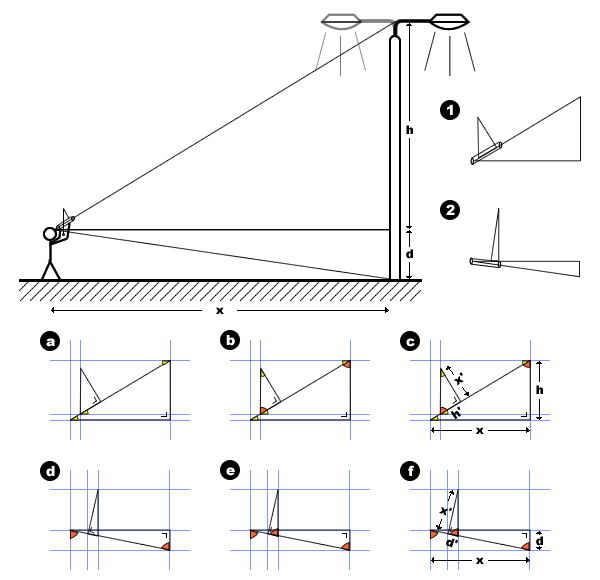
Looking at the geometry involved in step 1 results in sketch a: two right angled triangles, shown here with the identical small angles in yellow. Next in sketch b we see that the two triangles have identical angles - each has a right angle, the same small angle shown in yellow, and the same larger angle shown in orange. Therefore in sketch c we see that using the principle of similar triangles, given that each triangle has identical angles, the sides will be in proportion: x the distance to the object in proportion to x', the height set on the vertical scale of the hypsometer, and h the height of the object above the observers eye-line in proportion to h', the reading from the horizontal scale of the hypsometer.
Given that Tan (small yellow angle) = Opposite Side / Adjacent Side, therefore Tan (small yellow angle) = h / x = h' / x'. Therefore h = h'x / x'.
Likewise the geometry involved in step 2 results in sketch d: two right angled triangles. Next in sketch e we see that the two triangles again have identical angles - each has a right angle, the same small angle shown in yellow, and the same larger angle shown in orange. Therefore in sketch f we see that using the principle of similar triangles, given that each triangle has identical angles, the sides will be in proportion: x the distance to the object in proportion to x', the height set on the vertical scale of the hypsometer, and d the depth of the object below the observers eye-line in proportion to d', the reading from the horizontal scale of the hypsometer.
Given that Tan (small angle) = Opposite Side / Adjacent Side, therefore Tan (small angle) = d / x = d' / x'. Therefore d = d'x / x'.
Thus the overall height of the object is x (d' + h') / x'
Pressure hypsometer
Main article: Pressure altimeter
.png)
The instrument consists of a cylindrical vessel in which the liquid, usually water, is boiled, surmounted by a jacketed column, in the outer partitions of which the vapour circulates, while in the central one a thermometer is placed. To deduce the height of the station from the observed boiling point, it is necessary to know the relation existing between the boiling point and pressure, and also between the pressure and height of the atmosphere.
References
References
- {{EB1911
This article was imported from Wikipedia and is available under the Creative Commons Attribution-ShareAlike 4.0 License. Content has been adapted to SurfDoc format. Original contributors can be found on the article history page.
Ask Mako anything about Hypsometer — get instant answers, deeper analysis, and related topics.
Research with MakoFree with your Surf account
Create a free account to save articles, ask Mako questions, and organize your research.
Sign up freeThis content may have been generated or modified by AI. CloudSurf Software LLC is not responsible for the accuracy, completeness, or reliability of AI-generated content. Always verify important information from primary sources.
Report