From Surf Wiki (app.surf) — the open knowledge base
Hypsilophodon
Extinct genus of dinosaurs

Extinct genus of dinosaurs
Hypsilophodon (; meaning "high-crested tooth") is a neornithischian dinosaur genus from the Early Cretaceous period of England. It has traditionally been considered an early member of the group Ornithopoda, but recent research has put this into question.
The first remains of Hypsilophodon were found in 1849; the type species, Hypsilophodon foxii, was named in 1869. Abundant fossil discoveries were made on the Isle of Wight, giving a good impression of the build of the species. It was a small, agile bipedal herbivore, measuring 1.5 - long and weighing 20 kg. It had a pointed head equipped with a sharp beak used to bite off plant material, much like modern-day parrots.
Some outdated studies have given rise to a number of misconceptions about Hypsilophodon, including that it was an armoured, arboreal animal, and that it could be found in areas outside of the Isle of Wight. However, research from the following years has shown these ideas to be incorrect.
Discovery and history
First specimens and the debate of distinctiveness
The first specimen of Hypsilophodon was recovered in 1849, when workers dug up the soon-called Mantell-Bowerbank block from an outcrop of the Wessex Formation, part of the Wealden Group, about one hundred yards west of Cowleaze Chine, on the south-west coast of Isle of Wight. The larger half of the block (including seventeen vertebrae, parts of ribs and a coracoid, some of the pelvis, and assorted hindleg remains) was given to naturalist James Scott Bowerbank, and the remainder (including eleven caudal vertebrae and most of the rest of hindlegs) to Gideon Mantell. After his death, Mantell's portion was acquired by the British Museum; Bowerbank's was acquired later, bringing both halves back together. Richard Owen studied both halves and, in 1855, published a short article on the specimen, considering it to be a young Iguanodon rather than a new taxon. This was unquestioned until 1867, when Thomas Henry Huxley compared the vertebrae and metatarsals of the specimen more closely to those of known Iguanodon, and concluded that it must be a different animal entirely. The next year, he saw a fossil skull discovered by William Fox on exhibition at the Norwich Meeting of the British Associations. Fox, who had also found his fossil in the Cowleaze Chine area, along with several other specimens, considered it to belong to a juvenile Iguanodon, or to represent a new, small species in the genus. Huxley noticed its unique dentition and edentulous premaxilla, reminiscent of but obviously distinct from that of Iguanodon. He concluded this specimen, too, represented a distinct animal from Iguanodon. After losing track of the specimen for some months, Huxley requested Fox grant him permission to study the specimen to a more extensive degree. The request was granted, and Huxley began work on his new species.

Huxley first announced the new species in 1869 in a lecture; the text of this, published the same year, forms the official naming article, because it contained a sufficient description. The species was named Hypsilophodon foxii, and the holotype was the Fox skull (which today has the inventory number NHM NHMUK PV R 197). The next year, Huxley published the expanded full description article. There would later be a persistent misunderstanding as to the meaning of the generic name, which is often translated directly from the Greek as "high-ridged tooth". In reality Huxley, analogous to the way the name of the related genus Iguanodon ("iguana-tooth") had been formed, intended to name the animal after an extant herbivorous lizard, choosing for this role Hypsilophus and combining its name with Greek ὀδών, odon, "tooth". Hypsilophodon thus means "Hypsilophus-tooth". The Greek ὑψίλοφος, hypsilophos, means "high-crested" and refers to the back frill of the lizard, not to the teeth of Hypsilophodon itself, which are not high-ridged in any case. The specific name foxii honours Fox.
Immediate reception to Huxley's proposal of a new genus, distinct from Iguanodon, was mixed. The issue of distinctiveness was seen as important as more information on the form of Iguanodon was in demand, and the cranial anatomy in particular was of importance. If the Cowleaze Chine material was a distinct genus, it ceased being useful in this respect. Whilst some palaeontologists such as William Boyd Dawkins and Harry Seeley supported distinction, Fox rejected Huxley's proposal of a distinct genus and subsequently took back his skull and gave it to Owen to study.
Later research

Later, the number of specimens was increased by Reginald Walter Hooley. In 1905, Baron Franz Nopcsa dedicated a study to Hypsilophodon, and in 1936 William Elgin Swinton did the same, on the occasion of the mounting of two restored skeletons in the British Museum of Natural History. Most known Hypsilophodon specimens were discovered between 1849 and 1921 and are in the possession of the Natural History Museum that acquired the collections of Mantell, Fox, Hulke and Hooley. These represent about twenty individual animals. Apart from the holotype and paratype, the most significant specimens are: NHM R5829, the skeleton of a large animal; NHMUK PV R 5830 and NHMUK PV R 196/196a, both skeletons of juvenile animals; and NHMUK PV R R2477, a block with a skull together with two separate vertebral columns. Although this was the largest find, new ones continue to be made.
Modern research of Hypsilophodon began with the studies of Peter Malcolm Galton, starting with his thesis of 1967. He and James Jensen briefly described a left femur, AMNH 2585, in 1975, and in 1979 formally coined a second species, Hypsilophodon wielandi, for the specimen. The femur was diagnosed with two supposed minor differences from that of H. foxii. The specimen was found in 1900 in the Black Hills of South Dakota, United States, by George Reber Wieland, who the species was named after. Geologically, it comes from the Lakota Sandstone. This species was seen at the time as indicative of a probable late land bridge between North America and Europe, and of the dinosaur fauna of both continents being similar. Spanish Palaeontologist José Ignacio Ruiz-Omeñaca proposed that H. wielandi was not a species of Hypsilophodon but instead related to or synonymous with "Camptosaurus" valdensis from England, both species being dryosaurids. Galton refuted this in his contribution to a 2012 book, noting the femurs of the two species to be quite different, and that of H. wielandi to be unlike those of dryosaurs. He, as well as other studies before and after Ruiz-Omeñaca's proposal, considered H. wielandi a dubious basal ornithopod, with H. foxii the only species in the genus. Galton elaborated on the invalidity of the species in 2009, noting that the two supposed diagnostic characters were variable in both H. foxii and Orodromeus makelai, making the species dubious. He speculated that it may belong to Zephyrosaurus, from a similar time and place, as no femur was known from that taxon.

Fossils from other locations, especially from the mainland of southern Great Britain, Portugal and Spain, have once been referred to Hypsilophodon. However, in 2009 Galton concluded that the specimens from Great Britain proper were either indeterminable or belonged to Valdosaurus, and that the fossils from the rest of Europe were those of related but different species. This leaves the finds on Isle of Wight, off the south coast of England, as the only known authentic Hypsilophodon fossils. The fossils have been found in the Hypsilophodon Bed, a one-metre thick marl layer surfacing in a 1200 metre long strip along the Cowleaze Chine parallel to the southwest coast of Wight, part of the upper Wessex Formation and dating to the late Barremian, about 126 million years old. Reports that Hypsilophodon would be present in the later Vectis Formation, Galton in 2009 considered as unsubstantiated.
Description

Hypsilophodon was a relatively small dinosaur, though not quite as small as, for example, Compsognathus. For Hypsilophodon often a maximum length of 2.3 m is stated. This has its origin in a study of 1974 by Galton, in which he extrapolated a length of 2.28 m based on specimen BMNH R 167, a thigh bone. However, in 2009, Galton concluded that this femur in fact belonged to Valdosaurus and downsized Hypsilophodon to a maximum known length of 1.8 m,
Like most small dinosaurs, Hypsilophodon was bipedal: it ran on two legs. Its entire body was built for running. Numerous anatomical features aided this, such as: light-weight, minimized skeleton, low, aerodynamic posture, long legs, and stiff tail — immobilized by ossified tendons for balance. In light of this, Galton in 1974 concluded it would have been among the ornithischians best adapted to running. Despite living in the last of the periods in which non-avian dinosaurs walked the earth, the Cretaceous, Hypsilophodon had a number of seemingly "primitive" features. For example, there were five digits on each hand and four on each foot. With Hypsilophodon the fifth finger had gained a specialised function: being opposable it could serve to grasp food items.
Cranial anatomy


In an example of primitive anatomy, although it had a beak like most ornithischians, Hypsilophodon still had five pointed triangular teeth in the front of the upper jaw, the premaxilla. Most herbivorous dinosaurs had, by the Early Cretaceous, become sufficiently specialized that the front teeth had been altogether lost (although there is some debate as to whether these teeth may have had a specialized function in Hypsilophodon). More to the back, the upper jaw carried up to eleven teeth in the maxilla; the lower jaw had up to sixteen teeth. The number was variable, depending on the size of the animal. The teeth to the back were fan-shaped.
The skull of Hypsilophodon was short and relatively large. The snout was triangular in outline and sharply pointed, ending in an upper beak of which the cutting edge was markedly lower than the maxillary tooth row. The eye socket was very large. A palpebral with a length equal to half the diameter of the eye socket overshadowed its top section. A sclerotic ring of fifteen small bone plates supported the outer eye surface. The back of the skull was rather high, with a very large and high jugal and quadratojugal closing off a highly positioned small infratemporal fenestra.
Postcranial anatomy
The vertebral column consisted of nine cervical vertebrae, fifteen or sixteen dorsal vertebrae, six or five sacral vertebrae and about forty-eight vertebrae of the tail. Much of the back and the tail was stiffened by long ossified tendons connecting the spines on top of the vertebrae. The processes on the underside of the tail vertebrae, the chevrons, were also connected by ossified tendons, which however were of a different form: they were shorter and split and frayed at one end, with the point of the sharp other end laying within the diverging end of the subsequent tendon. Furthermore, there were several counterdirectional rows of these, resulting in a herring-bone pattern completely immobilising the tail end.
A long-lived misconception concerning the anatomy of Hypsilophodon has been that it was armoured. This was first suggested by Hulke in 1874, after the find of a bone plate in the neck region. If so, Hypsilophodon would have been the only known armoured ornithopod.
Phylogeny

Huxley originally assigned Hypsilophodon to the Iguanodontidae. In 1882 Louis Dollo named a separate Hypsilophodontidae. By the middle of the twentieth century that had become the accepted classification but in the early twenty-first century it became clear through cladistic analysis that hypsilophodontids formed an unnatural, paraphyletic group of successive off-shoots from throughout Neornithischia. Hypsilophodon in the modern view thus simply is a basal ornithopod.
In 2014, Norman resolved a monophyletic Hypsilophodontia (avoiding the name "Hypsilophodontidae" due to its complicated history). Hypsilophodon was recovered as the sister taxon to the clade containing Tenontosaurus and Rhabdodontidae.
In 2017, Daniel Madzia, Clint Boyd, and Martin Mazuch reassessed Hypsilophodon outside of Ornithopoda altogether, placing it in a more basal position, as the sister taxon to the Cerapoda; several other "hypsilophodontids" have undergone similar reclassifications. The following cladogram is reproduced from this study:

In one analysis in her 2022 review of iguanodontian phylogenetic relationships, Karen E. Poole recovered a large Hypsilophodontidae as the sister taxon of Iguanodontia, which consisted of several "traditional" hypsilophodontids, as well as Thescelosauridae. The Bayesian topology of her phylogenetic analyses is shown in the cladogram below:
In 2023, Longrich et al. described Vectidromeus as a new coeval genus of ornithopod closely related to Hypsilophodon. They suggested that Vectidromeus and Hypsilophodon represented the only members of the Hypsilophodontidae, since other taxa previously assigned to the group had subsequently been moved to other clades.
Paleobiology
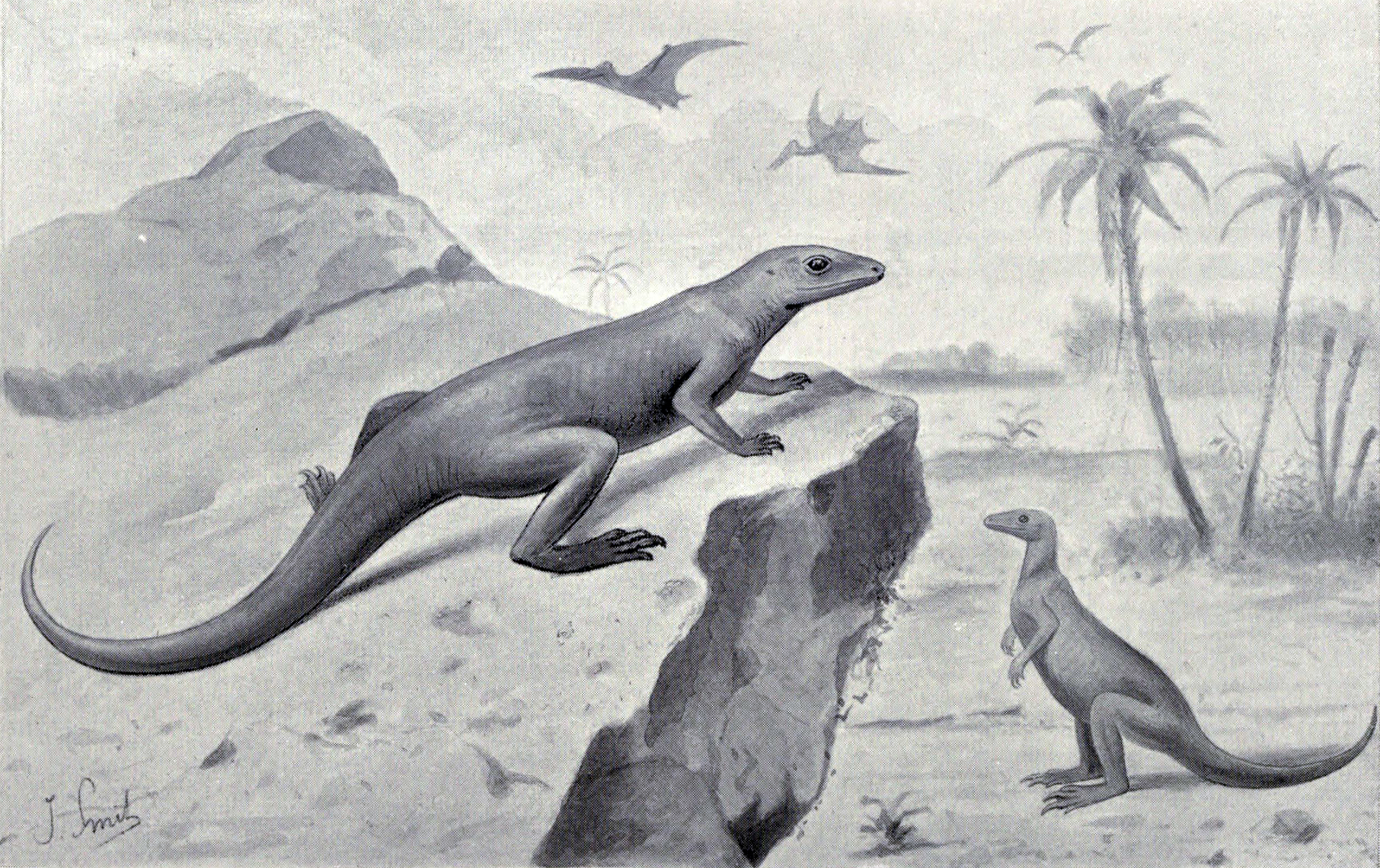
Due to its small size, Hypsilophodon fed on low-growing vegetation, in view of the pointed snout most likely preferring high quality plant material, such as young shoots and roots, in the manner of modern deer. The structure of its skull, with the teeth set far back into the jaw, strongly suggests that it had cheeks, an advanced feature that would have facilitated the chewing of food. There were twenty-three to twenty-seven maxillary and dentary teeth with vertical ridges in the animal's upper and lower jaws which, due to the fact that the tooth row of the lower jaw, its teeth curving outwards, fitted within that of the upper jaw, with its teeth curving inwards, appear to have been self-sharpening, the occlusion wearing down the teeth and providing for a simple chewing mechanism. As in almost all dinosaurs and certainly all the ornithischians, the teeth were continuously replaced in an alternate arrangement, with the two replacement waves moving from the back to the front of the jaw. The Zahnreihen-spacing, the average distance in tooth position between teeth of the same eruption stage, was rather low with Hypsilophodon, about 2,3. Such a dentition would have allowed to process relatively tough plants.

Early paleontologists modelled the body of this small, bipedal, herbivorous dinosaur in various ways. In 1882 Hulke suggested that Hypsilophodon was quadrupedal but also, in view of its grasping hand, able to climb rocks and trees in order to seek shelter. In 1912 this line of thought was further pursued by Austrian paleontologist Othenio Abel. Concluding that the first toe of the foot could function as an opposable hallux, Abel stated that Hypsilophodon was a fully arboreal animal and even that an arboreal lifestyle was primitive for the dinosaurs as a whole. Though this hypothesis was doubted by Nopcsa, it was adopted by the Danish researcher Gerhard Heilmann who in 1916 proposed that a quadrupedal Hypsilophodon lived like the modern tree-kangaroo Dendrolagus. In 1926 Heilmann had again changed his mind, denying that the first toe was opposable because the first metatarsal was firmly connected to the second, but in 1927 Abel refused to accept this. In this he was in 1936 supported by Swinton who claimed that even a forward pointing first metatarsal might carry a movable toe. As Swinton was a very influential populariser of dinosaurs, this remained the accepted view for over three decades, most books typically illustrating Hypsilophodon sitting on a tree branch. However, Peter M. Galton in 1969 performed a more accurate analysis of the musculo-skeletal structure, showing that the body posture was horizontal. In 1971 Galton in detail refuted Abel's arguments, showing that the first toe had been incorrectly reconstructed and that neither the curvature of the claws, nor the level of mobility of the shoulder girdle or the tail could be seen as adaptations for climbing, concluding that Hypsilophodon was a bipedal running form. This convinced the paleontological community that Hypsilophodon remained firmly on the ground.
The level of parental care in this dinosaur has not been defined, nests not having been found, although neatly arranged nests are known from related species, suggesting that some care was taken before hatching. so it has been considered likely that the animals moved in large groups. For these reasons, the hypsilophodonts, particularly Hypsilophodon, have often been referred to as the "deer of the Mesozoic". Some indications about the reproductive habits are provided by the possibility of sexual dimorphism: Galton considered it likely that exemplars with five instead of six sacral vertebrae — with some specimens the vertebra that should normally count as the first of the sacrum has a rib not touching the pelvis — represented female individuals.
References==
Bibliography
References
- Owen, Richard. (1855). "Monograph on the fossil Reptilia of the Wealden and Purbeck formations. Part II. Dinosauria (''Iguanodon''). [Wealden]". Palaeontographical Society Monographs.
- (1873). "Contribution to the Anatomy of Hypsilophodon Foxii". Quarterly Journal of the Geological Society of London.
- (1870). "On ''Hypsilophodon Foxii'', a new Dinosaurian from the Wealden of the Isle of Wight". Quarterly Journal of the Geological Society of London.
- Fox, William. (1868). "On the skull and bones of an ''Iguanodon''". British Association for the Advancement of Science, Annual Report for 1867.
- Huxley, Thomas H.. (1869). "On ''Hypsilophodon'', a new genus of Dinosauria". Geological Society of London, Abstracts of Proceedings.
- (1870). "On the Classification of the Dinosauria, with observations on the Dinosauria of the Trias". Quarterly Journal of the Geological Society of London.
- P.M. Galton, 2009, "Notes on Neocomian (Lower Cretaceous) ornithopod dinosaurs from England - ''Hypsilophodon'', ''Valdosaurus'', "Camptosaurus", "Iguanodon" - and referred specimens from Romania and elsewhere", ''Revue de Paléobiologie'', Genève '''28'''(1): 211-273
- Owen, Richard. (1874). "Monograph on the fossil Reptilia of the Wealden and Purbeck formations. Supplement No. 5. Dinosauria (''Iguanodon''). [Wealden and Purbeck].". Palaeontographical Society Monographs.
- Hulke, John W.. (1874). "Supplemental Note on the Anatomy of ''Hypsilophodon Foxii''". Quarterly Journal of the Geological Society.
- Nopcsa, F., 1905, "Notes on British dinosaurs. Part I. ''Hypsilophodon''", ''Geological Magazine'', London, (5) 2: 203-208
- Swinton, W.E., 1936, "Notes on the osteology of ''Hypsilophodon'', and on the family Hypsilophodontidae", ''Zoological Society of London, Proceedings'', 1936: 555-578
- Swinton, W.E., 1936, "A new exhibit of ''Hypsilophodon''", ''Natural History Magazine'', London, '''5''': 331-336
- Galton, P.M., 1967, ''On the anatomy of the ornithischian dinosaur ''Hypsilophodon foxii'' from the Wealden (Lower Cretaceous) of the Isle of Wight, England''. unpublished Ph.D. Thesis, University of London, King's College, UK, 513 pp
- (1975). "Hypsilophodon and Iguanodon from the Lower Cretaceous of North America". Nature.
- (1979). "Galton, P. M., & Jensen, J. A. (1979). Remains of ornithopod dinosaurs from the Lower Cretaceous of North America". Brigham Young University Geology Studies.
- Godefroit, Pascal. (2012). "Bernissart Dinosaurs and Early Cretaceous Terrestrial Ecosystems". Indiana University Press.
- (2004). "The Dinosauria". University of California Press.
- (1994). "Neonate dinosaurian remains and dinosaurian eggshell from the Cloverly Formation, Montana". Journal of Vertebrate Paleontology.
- Galton, P.M., 1974, ''The ornithischian dinosaur ''Hypsilophodon'' from the Wealden of the Isle of Wight''. British Museum (Natural History), Bulletin, Geology, London, '''25''': 1‑152c
- Hulke, J.W., 1874, "Supplemental note on the anatomy of ''Hypsilophodon foxii''", ''Geological Society of London, Quarterly Journal'', '''30''': 18-23
- (2008). "The 'dermal armour' of the ornithopod dinosaur ''Hypsilophodon'' from the Wealden (Early Cretaceous: Barremian) of the Isle of Wight: a reappraisal". Cretaceous Research.
- L. Dollo, 1882, "Première note sur les dinosaures de Bernissart", ''Bulletin du Musée Royale d'Histoire Naturelle de Belgique'' '''1''': 1-18
- Norman, D.B.. (2014). "On the history, osteology, and systematic position of the Wealden (Hastings group) dinosaur ''Hypselospinus fittoni'' (Iguanodontia: Styracosterna)". Zoological Journal of the Linnean Society.
- (2017). "A basal ornithopod dinosaur from the Cenomanian of the Czech Republic". Journal of Systematic Palaeontology.
- Poole KE. (2022). "Phylogeny of iguanodontian dinosaurs and the evolution of quadrupedality". Palaeontologia Electronica.
- (2023-09-13). "''Vectidromeus insularis'', a new hypsilophodontid dinosaur from the Lower Cretaceous Wessex Formation of the Isle of Wight, England". Cretaceous Research.
- Abel, O., 1912, ''Grundzüge der Palaeobiologie der Wirbeltiere'', E. Schweizerbart'sche Verlagsbuchhandlung Nägele und Dr Sproesser, Stuttgart
- V. Pietschinann (ed), 1914, ''Verhandlungen der Kaiserlich-Königlichen Zoologisch-Botanischen Gesellschaft in Wien'', Vienna, pp 380
- Heilmann., G., 1916, ''Vor nuværende Viden om Fuglenes Afstamning'', Copenhagen
- Heilmann, Gerhard, 1926, ''The Origin of Birds''. London, Witherby
- Abel, O., 1927, ''Lebensbilder aus der Tierwelt der Vorzeit'', Fisher, Jena
- Galton, P.M., 1969, "The pelvic musculature of the dinosaur ''Hypsilophodon'' (Reptilia : Ornithischia)", ''Postilla'', '''131''': 1-64
- Galton, P.M., 1971, "''Hypsilophodon'', the cursorial nonarboreal dinosaur", ''Nature'', '''231''': 159-161
- Galton, P.M., 1971, "The mode of life of ''Hypsilophodon'', the supposedly arboreal ornithopod dinosaur", ''Lethaia'', '''4''': 453-465
This article was imported from Wikipedia and is available under the Creative Commons Attribution-ShareAlike 4.0 License. Content has been adapted to SurfDoc format. Original contributors can be found on the article history page.
Ask Mako anything about Hypsilophodon — get instant answers, deeper analysis, and related topics.
Research with MakoFree with your Surf account
Create a free account to save articles, ask Mako questions, and organize your research.
Sign up freeThis content may have been generated or modified by AI. CloudSurf Software LLC is not responsible for the accuracy, completeness, or reliability of AI-generated content. Always verify important information from primary sources.
Report