From Surf Wiki (app.surf) — the open knowledge base
Hyperpolarization (biology)
Change in a cell membrane potential causing it to become more negative

Change in a cell membrane potential causing it to become more negative
In excitable cells, activation is typically achieved through depolarization, i.e., the membrane potential deviating towards less negative values. Thus, hyperpolarization, as an opposite process, makes the cell more difficult to activate. When the membrane potential is more negative, a stronger stimulus is needed to surpass the activation threshold.
Neurons naturally become hyperpolarized at the end of an action potential, which is often referred to as the relative refractory period. Relative refractory periods typically last 2 milliseconds, during which a stronger stimulus is needed to trigger another action potential. Cells can also become hyperpolarized depending on channels and receptors present on the membrane, which can have an inhibitory effect.
Hyperpolarization is often caused by efflux of K+ (a cation) through K+ channels, or influx of Cl– (an anion) through Cl– channels. On the other hand, influx of cations, e.g. Na+ through Na+ channels or Ca2+ through Ca2+ channels, inhibits hyperpolarization. If a cell has Na+ or Ca2+ currents at rest, then inhibition of those currents will also result in hyperpolarization. This voltage-gated ion channel response is how the hyperpolarization state is achieved.
Voltage-gated ion channels and hyperpolarization

At resting potential, both the voltage gated sodium and potassium channels are closed but as the cell membrane becomes depolarized the voltage gated sodium channels begin to open up and the neuron begins to depolarize, creating a current feedback loop known as the Hodgkin cycle. However, potassium ions naturally move out of the cell and if the original depolarization event was not significant enough then the neuron does not generate an action potential. If all the sodium channels are open, however, then the neuron becomes ten times more permeable to sodium than potassium, quickly depolarizing the cell to a peak of +40 mV. At this level the sodium channels begin to inactivate and voltage gated potassium channels begin to open. This combination of closed sodium channels and open potassium channels leads to the neuron re-polarizing and becoming negative again. The neuron continues to re-polarize until the cell reaches ~ –75 mV, which is the equilibrium potential of potassium ions. This is the point at which the neuron is hyperpolarized, between –70 mV and –75 mV. After hyperpolarization the potassium channels close and the natural permeability of the neuron to sodium and potassium allows the neuron to return to its resting potential of –70 mV. During the refractory period, which is after hyper-polarization but before the neuron has returned to its resting potential the neuron is capable of triggering an action potential due to the sodium channels ability to be opened, however, because the neuron is more negative it becomes more difficult to reach the action potential threshold.
HCN channels are activated by hyperpolarization.
Recent research has shown that neuronal refractory periods can exceed 20 milliseconds where the relation between hyperpolarization and the neuronal refractory was questioned.
Experimental technique
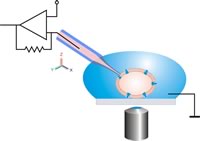
Hyperpolarization is a change in membrane potential. Neuroscientists measure it using a technique known as patch clamping that allows them to record ion currents passing through individual channels. This is done using a glass micropipette, also called a patch pipette, with a 1 micrometer diameter. There is a small patch that contains a few ion channels and the rest is sealed off, making this the point of entry for the current. Using an amplifier and a voltage clamp, which is an electronic feedback circuit, allows the experimenter to maintain the membrane potential at a fixed point and the voltage clamp then measures tiny changes in current flow. The membrane currents giving rise to hyperpolarization are either an increase in outward current or a decrease in inward current.
Examples

GABA receptors are commonly known to downregulate neuronal activity by various means.
- GABAA can induce hyperpolarization through an influx of Cl– ions. GABAA itself is a chloride ion channel. This process of hyperpolarization is highly dependent on which direction Cl– flows. If Cl– travels into the cell, the flow of ions increases the voltage gradient. If Cl– flows out of the cell, the voltage gradient will decrease.
- GABAB induces hyperpolarization through K+ ion influx into the neuron. Unlike GABAA, GABAB is a G-Protein Coupled Receptor that activates potassium channels via Protein Kinase A (PKA) activation. Potassium typically has a higher concentration inside the cell, while sodium typically has a higher concentration outside. When potassium channels open, K+ ions flow out of the cell and cause the cell's internal potential to become more negative. GABAB activation of PKA also leads to Ca channel inactivation in presynaptic neurons. This likely leads to inhibited synaptic transmission. Hyperpolarization-activated cyclic nucleotide-gated (HCN) channels have been identified as channels that mediate hyperpolarization. They were initially discovered in pacemaker cells of the heart. These channels are controlled by cAMP, and activated by a hyperpolarized membrane. They allow the flow of Na+ and K+ ions, typically leading to a slight depolarization.
References
References
- Alberts, Bruce. (2022). "Molecular biology of the cell". W. W. Norton & Company.
- (2012). "Neuroscience". Sinauer Associates.
- Pack, Phillip E. "Cliffs AP Biology 3rd Edition"
- Becker, W. M., Kleinsmith, L. J., Hardin, J., & Bertoni, G. P. (2009). Signal Transduction Mechanisms: I. Electrical and Synaptic Signaling in Neurons. The World of the Cell (7th ed., ). San Francisco: Pearson/Benjamin Cummings.
- (2021-06-01). "Significant anisotropic neuronal refractory period plasticity". EPL (Europhysics Letters).
- (2022-01-03). "Long anisotropic absolute refractory periods with rapid rise times to reliable responsiveness". Physical Review E.
- Luscher B, Fuchs T, Kilpatrick CL. (2011). "GABAA receptor trafficking-mediated plasticity of inhibitory synapses.". Neuron.
- Bowery NG, Bettler B, Froestl W, Gallagher JP, Marshall F, Raiteri M. (2002). "International Union of Pharmacology. XXXIII. Mammalian gamma-aminobutyric acid(B) receptors: structure and function.". Pharmacol Rev.
- DiFrancesco D. (1993). "Pacemaker mechanisms in cardiac tissue.". Annu Rev Physiol.
This article was imported from Wikipedia and is available under the Creative Commons Attribution-ShareAlike 4.0 License. Content has been adapted to SurfDoc format. Original contributors can be found on the article history page.
Ask Mako anything about Hyperpolarization (biology) — get instant answers, deeper analysis, and related topics.
Research with MakoFree with your Surf account
Create a free account to save articles, ask Mako questions, and organize your research.
Sign up freeThis content may have been generated or modified by AI. CloudSurf Software LLC is not responsible for the accuracy, completeness, or reliability of AI-generated content. Always verify important information from primary sources.
Report