From Surf Wiki (app.surf) — the open knowledge base
Hyperbolic equilibrium point
Fixed point that does not have any center manifolds
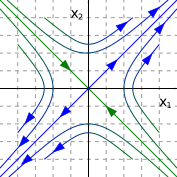
Fixed point that does not have any center manifolds
In the study of dynamical systems, a hyperbolic equilibrium point or hyperbolic fixed point is a fixed point that does not have any center manifolds. Near a hyperbolic point the orbits of a two-dimensional, non-dissipative system resemble hyperbolas. This fails to hold in general. Strogatz notes that "hyperbolic is an unfortunate name—it sounds like it should mean 'saddle point'—but it has become standard." Several properties hold about a neighborhood of a hyperbolic point, notably
- A stable manifold and an unstable manifold exist,
- Shadowing occurs,
- The dynamics on the invariant set can be represented via symbolic dynamics,
- A natural measure can be defined,
- The system is structurally stable.
Maps
If T \colon \mathbb{R}^{n} \to \mathbb{R}^{n} is a C1 map and p is a fixed point then p is said to be a hyperbolic fixed point when the Jacobian matrix \operatorname{D} T (p) has no eigenvalues on the complex unit circle.
One example of a map whose only fixed point is hyperbolic is Arnold's cat map:
:\begin{bmatrix} x_{n+1}\ y_{n+1} \end{bmatrix} = \begin{bmatrix} 1 & 1 \ 1 & 2\end{bmatrix} \begin{bmatrix} x_n\ y_n\end{bmatrix}
Since the eigenvalues are given by
:\lambda_1=\frac{3+\sqrt{5}}{2} :\lambda_2=\frac{3-\sqrt{5}}{2}
We know that the Lyapunov exponents are:
:\lambda_1=\frac{\ln(3+\sqrt{5})}{2}1 :\lambda_2=\frac{\ln(3-\sqrt{5})}{2}
Therefore it is a saddle point.
Flows
Let F \colon \mathbb{R}^{n} \to \mathbb{R}^{n} be a C1 vector field with a critical point p, i.e., F(p) = 0, and let J denote the Jacobian matrix of F at p. If the matrix J has no eigenvalues with zero real parts then p is called hyperbolic. Hyperbolic fixed points may also be called hyperbolic critical points or elementary critical points.
The Hartman–Grobman theorem states that the orbit structure of a dynamical system in a neighbourhood of a hyperbolic equilibrium point is topologically equivalent to the orbit structure of the linearized dynamical system.
Example
Consider the nonlinear system : \begin{align} \frac{dx}{dt} & = y, \[5pt] \frac{dy}{dt} & = -x-x^3-\alpha y,~ \alpha \ne 0 \end{align}
(0, 0) is the only equilibrium point. The Jacobian matrix of the linearization at the equilibrium point is
:J(0,0) = \left[ \begin{array}{rr} 0 & 1 \ -1 & -\alpha \end{array} \right].
The eigenvalues of this matrix are \frac{-\alpha \pm \sqrt{\alpha^2-4}}{2}. For all values of α ≠ 0, the eigenvalues have non-zero real part. Thus, this equilibrium point is a hyperbolic equilibrium point. The linearized system will behave similar to the non-linear system near (0, 0). When α = 0, the system has a nonhyperbolic equilibrium at (0, 0).
Comments
In the case of an infinite dimensional system—for example systems involving a time delay—the notion of the "hyperbolic part of the spectrum" refers to the above property.
Notes
References
References
- Strogatz, Steven. (2001). "Nonlinear Dynamics and Chaos". Westview Press.
- Ott, Edward. (1994). "Chaos in Dynamical Systems". Cambridge University Press.
- Abraham, Ralph. (1978). "Foundations of Mechanics". Benjamin/Cummings.
This article was imported from Wikipedia and is available under the Creative Commons Attribution-ShareAlike 4.0 License. Content has been adapted to SurfDoc format. Original contributors can be found on the article history page.
Ask Mako anything about Hyperbolic equilibrium point — get instant answers, deeper analysis, and related topics.
Research with MakoFree with your Surf account
Create a free account to save articles, ask Mako questions, and organize your research.
Sign up freeThis content may have been generated or modified by AI. CloudSurf Software LLC is not responsible for the accuracy, completeness, or reliability of AI-generated content. Always verify important information from primary sources.
Report