From Surf Wiki (app.surf) — the open knowledge base
Hydrophilic-lipophilic balance
Measure of degree to which a surface active agents is hydrophilic or lipophilic
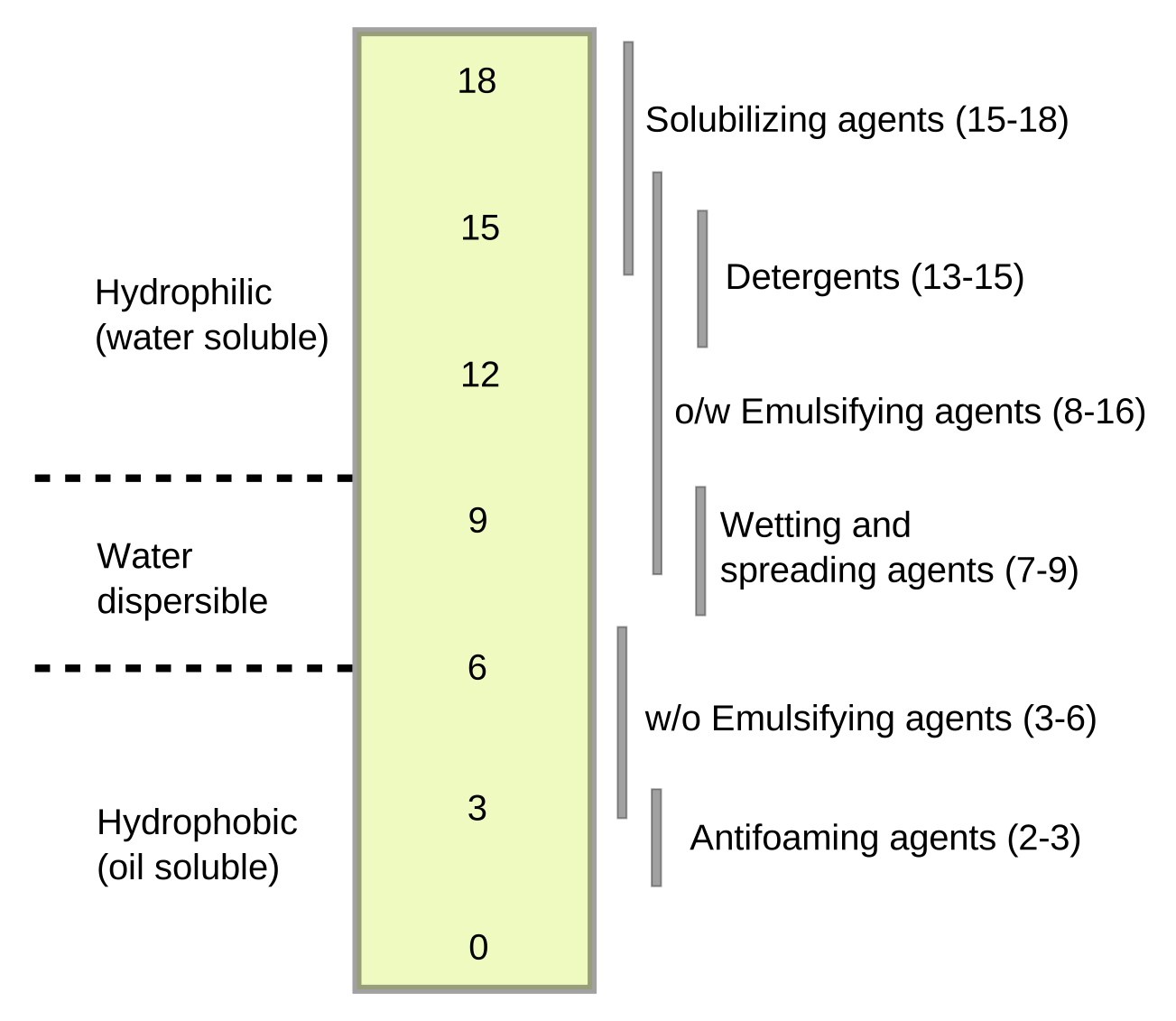
Measure of degree to which a surface active agents is hydrophilic or lipophilic
The hydrophilic–lipophilic balance (HLB) of a surfactant is a measure of its degree of hydrophilicity or lipophilicity, determined by calculating percentages of molecular weights for the hydrophilic and lipophilic portions of the surfactant molecule, as described by Griffin in 1949 and 1954. Other methods have been suggested, notably in 1957 by Davies.
Griffin's method
Griffin's method for non-ionic surfactants as described in 1954 works as follows:
\mathrm{HLB} = 20 \times M_h / M
where M_h is the molecular mass of the hydrophilic portion of the molecule, and M is the molecular mass of the whole molecule, giving a result on a scale of 0 to 20. An HLB value of 0 corresponds to a completely lipophilic/hydrophobic molecule, and a value of 20 corresponds to a completely hydrophilic/lipophobic molecule.
The HLB value can be used to predict the surfactant properties of a molecule:
- 10 : Water-soluble (lipid-insoluble)
- 1 to 3: anti-foaming agent
- 3 to 6: W/O (water in oil) emulsifier
- 7 to 9: wetting and spreading agent
- 13 to 16: detergent
- 8 to 16: O/W (oil in water) emulsifier
- 16 to 18: solubiliser or hydrotrope
Davies' method
In 1957, Davies suggested a method based on calculating a value based on the chemical groups of the molecule. The advantage of this method is that it takes into account the effect of stronger and weaker hydrophilic groups. The method works as follows:
\mathrm{HLB} = 7 + \sum_{i \mathop{=} 1}^{m}{H_i} - 0.475 \times n
where:
;m : Number of hydrophilic groups in the molecule
;H_i : Value of the ith hydrophilic groups (see tables)
;n : Number of lipophilic groups in the molecule
| Hydrophilic Groups | Group Number |
|---|---|
| 38.6 | |
| 21.1 | |
| 19.1 | |
| N (tertiary amine) | 9.4 |
| Ester (sorbitan ring) | 6.8 |
| Ester (free) | 2.4 |
| 2.1 | |
| Hydroxyl (free) | 1.9 |
| 1.3 | |
| Hydroxyl (sorbitan ring) | 0.5 |
| Lipophilic Groups | Group Number |
|---|---|
| −0.475 | |
| −0.475 | |
| −0.475 | |
| −0.475 |
References
References
- (2005). "Soft Colloids".
- (1949). "Classification of Surface-Active Agents by 'HLB'". Journal of the Society of Cosmetic Chemists.
- (1954). "Calculation of HLB Values of Non-Ionic Surfactants". Journal of the Society of Cosmetic Chemists.
- Davies JT. (1957). "A quantitative kinetic theory of emulsion type, I. Physical chemistry of the emulsifying agent". Proceedings of the International Congress of Surface Activity.
This article was imported from Wikipedia and is available under the Creative Commons Attribution-ShareAlike 4.0 License. Content has been adapted to SurfDoc format. Original contributors can be found on the article history page.
Ask Mako anything about Hydrophilic-lipophilic balance — get instant answers, deeper analysis, and related topics.
Research with MakoFree with your Surf account
Create a free account to save articles, ask Mako questions, and organize your research.
Sign up freeThis content may have been generated or modified by AI. CloudSurf Software LLC is not responsible for the accuracy, completeness, or reliability of AI-generated content. Always verify important information from primary sources.
Report