From Surf Wiki (app.surf) — the open knowledge base
Hwasong-10
North Korean mobile intermediate-range ballistic missile

North Korean mobile intermediate-range ballistic missile
| Field | Value |
|---|---|
| is_missile | yes |
| name | Hwasong-10 |
| origin | North Korea |
| image | Hwasong-10.png |
| image_size | 50 |
| caption | Artist rendition of the missile |
| type | Intermediate-range ballistic missile |
| used_by | Korean People's Army Strategic Force |
| Iran (possible) | |
| manufacturer | North Korea |
| propellant | UDMH and [](nitrogen-tetroxide) |
| service | Successful test on 22 June 2016 |
| engine | Liquid-propellant rocket (same or derived from R-27) |
| length | 12 m |
| diameter | 1.5 m |
| vehicle_range | 2500-4000 km (estimated) |
| filling_weight | 500-1200 kg (estimated) |
| guidance | Inertial guidance |
| accuracy | 1600 m circular error probable |
| launch_platform | MAZ-based transporter erector launcher (TEL) |
Iran (possible)
- Conventional
- Possibly nuclear Infobox Korean name The Hwasong-10 () is a mobile intermediate-range ballistic missile developed by North Korea. Hwasong-10 was unveiled in October 2010 during a military parade and was tested several times in 2016, but only the test on 22 June 2016 was successful.
Description
Hwasong-10 is a missile that is based on R-27 Zyb submarine-launched ballistic missile, but is slightly longer. It used a hypergolic combination of unsymmetrical dimethylhydrazine (UDMH) as fuel and nitrogen tetroxide (NTO) as oxidizer, which is similar to the liquid-fueled 4D10 engine of R-27. These propellants are much more advanced than the kerosene compounds used in North Korea's Scud and Hwasong-7 (Nodong) missiles. Once the fuel/oxidizer combination are fed into the missile, it could maintain a 'ready to launch' condition for several days, or even weeks, like the R-27 SLBM, in moderate ambient temperatures. A fueled Hwasong-10 would not have the structural strength to be safely land-transported, so the missile would have to be fueled at the launch site.
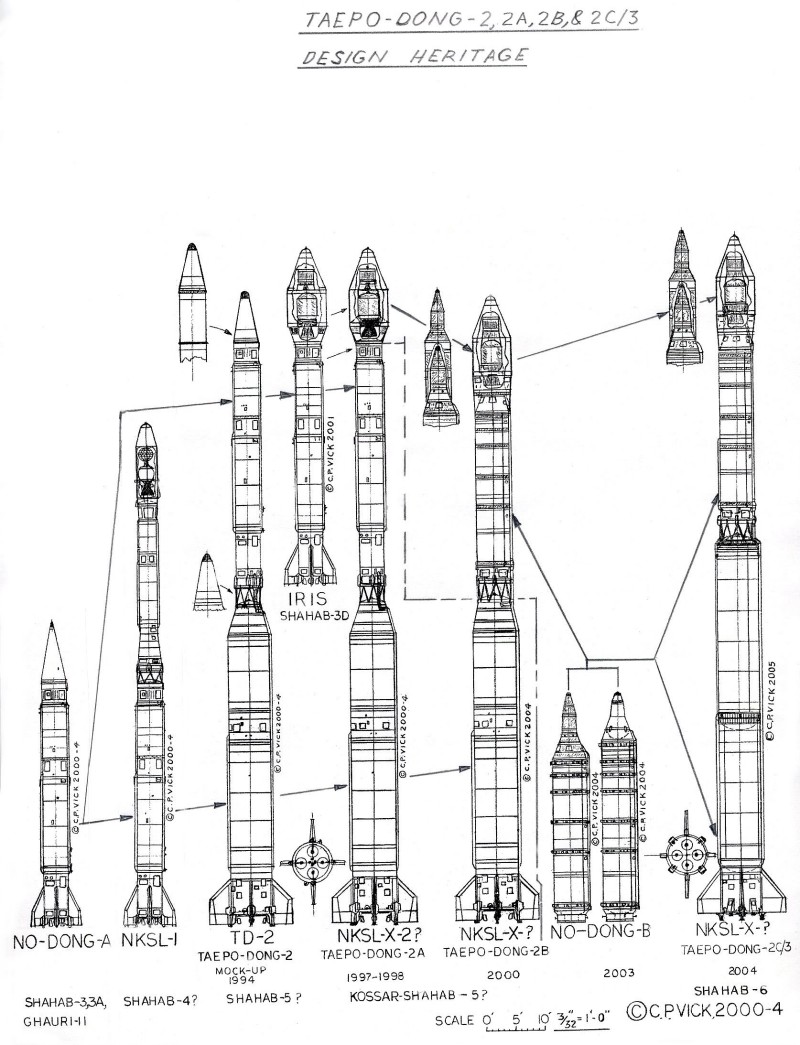
It was originally believed that the rocket motors of Hwasong-10 were the same as those within the second stage of the Taepodong-2, which North Korea unsuccessfully test fired in 2006. However analysis of the Unha-3 launch, believed to be based on the Taepodong-2, showed that the second stage did not use the same fuel as the R-27, and is probably based on Hwasong-7 rocket technology.
Before its test flight, it was believed that there was a possibility that the Hwasong-10 would use the Nodong's kerosene and corrosion inhibited red fuming nitric acid (IRFNA) propellants, reducing the missile's range by about half. However, it is unlikely that North Korea uses IRFNA propellants which would reduce its range by about half, after the experts acknowledged that the 22 June 2016 test could have had a range of 3150 km if the missile was not launched in the lofted trajectory.
It was also decided that, as the Korean People's Army's MAZ-547A/MAZ-7916 transporter erector launcher could carry 20 tonnes, and the R-27 Zyb was only 14.2 tonnes, the R-27 Zyb's fuel/oxidizer tank could be extended by approximately 2 m.
The Hwasong-10's estimated range is 2500-4000 km. Assuming a range of 3200 km, the Hwasong-10 could hit any target in East Asia (including US military bases in Guam and Okinawa). The North Korean inventory of the missile is less than 50 launchers.
The missile has a circular error probable of 1600 m and is capable of carrying a 500-1200 kg warhead. Warhead can be high-explosive fragmentation, cluster, nuclear or chemical.
Naming
Hwasong-10 is also known as Musudan (), named after a village near where North Korea test-fires missile. The missile also has several external names, including BM-25, KN-07, Mirim and Nodong-B.
History
In the mid-1990s, after the collapse of the Soviet Union, North Korea invited the Makeyev Design Bureau's ballistic missile designers and engineers to develop this missile, based on the R-27 Zyb. In 1992, a large contract between Korea Yon’gwang Trading Company and Makeyev Rocket Design Bureau of Miass, Russia was signed. The agreement stated that Russian engineers would go to the DPRK and assist in the development of the Zyb Space Launch Vehicle (SLV).
Hwasong-10 was first revealed to the international community at a military parade on 10 October 2010 celebrating the Workers' Party of Korea's 65th anniversary, although experts believe these were mock-ups of the missile.
In April 2013, North Korea was reported to deploy two Hwasong-10 missiles to Wonsan in preparation for a test-fire. Two moblie launchers were reported to continuously moved in and out of a facility. Four to five wheeled vehicles, appear to be TELs, were also spotted to travel around South Hamgyong Province. These actions aimed at making difficult to US and South Korea. A month later, North Korea removed two missiles from launchers.
Since April 2016, the Hwasong-10 has been tested a number of times, with two apparent partial successes and a number of failures. In May 2017, North Korea successfully tested a new missile, the Hwasong-12, with a similar range to the Hwasong-10. It had been displayed in the April 2017 military parade on the Hwasong-10 mobile launcher, and the Hwasong-12 may be intended to replace the Hwasong-10 which has been shown unreliable during its test programme.
In an interview for Difesa Online, a military-focused website, on 27 November 2017, German analyst Norbert Brügge claimed that Hwasong-10, along with Hwasong-13, was likely cancelled due to unresolved engine problems. The Hwasong-10 was not shown in the February 2018 military parade, suggesting that the design had not been deployed. However, in 2020, according to United States intelligence, Hwasong-10 was still classified as deployed.
List of Hwasong-10 tests
| Attempt | Date | Location | Pre-launch announcement / detection | Outcome | Additional notes | Reference(s) | 1 | 2 | 3 | 4 | 5 | 6 | 7 (Alleged) | 8 (Alleged) | |||||
|---|---|---|---|---|---|---|---|---|---|---|---|---|---|---|---|---|---|---|---|
| 15 April 2016 5:30 am Pyongyang Standard Time (PST) | Wonsan | South Korea detected one or two Hwasong-10 missile(s) near Wonsan a day before the test. | Both United States and South Korea "detected and tracked" the missile followed by the confirmation of launch failure. South Korea further claims the missile in this test deviated from a "normal" trajectory. | {{Cite news | author=Anna Fifield | title=North Korea's missile launch has failed, South's military says | access-date=2025-02-08 | newspaper=The Washington Post | date=14 April 2016}} | ||||||||||
| 28 April 2016 6:10am PST | Northeastern coast | None | The missile crashed a few seconds after liftoff. North Korea kept silent on the test. | {{Cite web | author=Hyung-Jin Kim | title=North Korea's missile launch has failed, South's military says | access-date=2025-02-08 | website=Associated Press | date=29 April 2016}} | ||||||||||
| 28 April 2016 6:56pm PST | Wonsan | None | According to United States sources, the missiles went an estimated 200 m off the launchpad. North Korea kept silent on the test. | ||||||||||||||||
| 31 May 2016 5:20am PST | Wonsan | None | Missile exploded on site. North Korea kept silent on the test. | url=https://defense-update.com/20160531_musudan-2.html | title=North Korean Musudan IRBM Failed - Again | author=Tamir Eshel | publisher=Defense Update | date=31 May 2016 | access-date=23 June 2016}} | ||||||||||
| 22 June 2016 5:58am PST | Wonsan | A day before the test, South Korea spotted a Hwasong-10 near east coast. | The missile crashed at 150 km away from the site. It is the first successful Hwasong-10 test that safely launched from the launch site, however, the missile still exploded in midair. It is possible that North Korea could have launched the missile at a normal angle, and intentionally terminated its flight early to keep it from overflying Japan at 150 km. | author=John G. Grisafi | title=North Korea deploys Musudan missile near east coast | url=https://www.nknews.org/2016/06/north-korea-deploys-musudan-missile-near-east-coast/ | access-date=2025-02-08 | website=NK News | date=21 June 2016}} | ||||||||||
| 22 June 2016 5:58am PST | Wonsan | According to South Korea, US and Japan, the missile achieved 1000 km apogee, flew 400 km and landed in Sea of Japan. | date=2016-06-22 | url=https://www.bbc.com/news/world-asia-36595113 | title=North Korea missiles 'a serious threat' after new tests | website=BBC News | access-date=2025-02-09}} | ||||||||||||
| 15 October 2016 12:03pm PST | Kusong | None | Initially, the US military identified these tests as failed tests of Hwasong-10, without specifying details. North Korea kept silent on these reports. Five days after the first test, a second launch took place just hours before the start of the final 2016 US presidential election debate. | {{Cite web | title=North Korea conducted failed ballistic missile test, US military says | date=2016-10-15 | url=https://www.theguardian.com/world/2016/oct/15/north-korea-failed-ballistic-missile-test-us-military | website=The Guardian}} | |||||||||||
| 20 October 2016 7:00am PST | Kusong | None |
Operators
Current operators
- North Korea: According to one source, more than 200; other source claims 12 deployed. 16 were seen at once during the 10 October 2010 military parade, although experts contacted by the Washington Post believed these were mock-ups of the missile. In 2020, according to United States intelligence, North Korea has fewer than 50 Hwasong-10 launchers.
Suspected operators
- Iran: 19, according to a leaked, classified U.S. State Department cable. The Khorramshahr, which was first publicly displayed on 22 September 2017, is likely derived from Hwasong-10.
References
References
- Markus Schiller. (2012). "Characterizing the North Korean Nuclear Missile Threat". [[RAND Corporation]].
- C. P. Vick. (2000–2004). "2nd 3rd Right Side".
- Markus Schiller, Robert H. Schmucker. (31 May 2012). "Explaining the Musudan". Arms Control Wonk.
- Emmanuelle Maitre. (10 March 2023). "Le Musudan : quels progrès techniques et stratégiques pour Pyongyang ?".
- Defense Intelligence Ballistic Missile Analysis Committee. (June 2017). "Ballistic and Cruise Missile Threat".
- (June 2015). "The Changing Military Balance in the Koreas and Northeast Asia".
- Hoàng Lê. (2013-04-07). "Truy ra nguồn gốc tên lửa Triều Tiên sắp bắn thử".
- Hữu Tuyên. (2013-04-11). "Thực lực tên lửa Musudan sắp phóng của Triều Tiên".
- (2016-08-08). "BM-25 Musudan (Hwasong-10)".
- Joseph S. Bermudez Jr.. (2017-04-03). "Possible Evidence of the Failed March 22 Missile Test".
- An Bình. (2013-04-11). "Triều Tiên liên tục di chuyển tên lửa, radar Mỹ sẵn sàng “trực chiến”".
- Lệ Chi. (2013-05-07). "CHDCND Triều Tiên tháo dỡ tên lửa khỏi bệ phóng".
- John Schilling. (14 May 2017). "North Korea's Latest Missile Test: Advancing towards an Intercontinental Ballistic Missile (ICBM) While Avoiding US Military Action".
- Panda, Ankit. (15 May 2017). "North Korea's New Intermediate-Range Ballistic Missile, the Hwasong-12: First Takeaways". [[The Diplomat (magazine).
- (2017-11-27). "Missili nordcoreani, parla l'ingegnere tedesco...". Difesa Online.
- Elleman, Michael. (8 February 2018). "North Korea's Army Day Military Parade: One New Missile System Unveiled". U.S.-Korea Institute, Johns Hopkins University School of Advanced International Studies.
- JH Ahn. (14 April 2016). "North Korea deploys missile for possible launch: Yonhap".
- (29 April 2016). "North Korea launches two midrange missiles; both tests fail".
- Tamir Eshel. (31 May 2016). "North Korean Musudan IRBM Failed - Again". Defense Update.
- Lim Jeong-yo. (2016-05-31). "N. Korea's 4th Musudan missile launch ends in failure".
- John G. Grisafi. (21 June 2016). "North Korea deploys Musudan missile near east coast".
- (2016-06-22). "(3rd LD) N. Korea botches fifth Musudan missile test-launch".
- (22 June 2016). "North Korean missiles fall in Sea of Japan- Pentagon". [[Reuters]].
- (2016-06-29). "N. Korea's fifth Musudan test might not have been failure: US expert".
- (2016-06-22). "North Korea missiles 'a serious threat' after new tests".
- (2016-06-23). "Kim Jong Un Guides Test-fire of SSM Hwasong-10".
- Ankit Panda. (2016-06-23). "North Korea's Musudan Missile Test Actually Succeeded. What Now?".
- (2016-10-15). "US military detects 'failed ballistic missile launch' in North Korea after state media vows revenge for 'hostile acts'".
- (2016-10-20). "(LEAD) N. Korea's launch of Musudan missile ends in failure again: military".
- Anna Fifield. (2016-10-26). "Did North Korea just test missiles capable of hitting the U.S.? Maybe.". [[The Washington Post]].
- (2016-10-27). "(LEAD) N. Korea's failed missile tests could have involved KN-08: U.S. expert".
- [[Jonathan McDowell]]. "''Tests of Hwasong-12 missile family''". Planet4589.org.
- "The CNS North Korea Missile Test Database".
- Richard Finney. (2010-10-13). "North's Missiles Raise Concerns".
- (2010-10-13). "North Korea Rolls Out Ballistic Missiles".
- John Pomfret and Walter Pincus. (1 December 2010). "Experts question North Korea-Iran missile link from WikiLeaks document release". [[The Washington Post]].
- William J. Broad. (28 November 2010). "Iran Fortifies Its Arsenal With the Aid of North Korea". The New York Times.
- (2017-09-29). "Khorramshahr".
This article was imported from Wikipedia and is available under the Creative Commons Attribution-ShareAlike 4.0 License. Content has been adapted to SurfDoc format. Original contributors can be found on the article history page.
Ask Mako anything about Hwasong-10 — get instant answers, deeper analysis, and related topics.
Research with MakoFree with your Surf account
Create a free account to save articles, ask Mako questions, and organize your research.
Sign up freeThis content may have been generated or modified by AI. CloudSurf Software LLC is not responsible for the accuracy, completeness, or reliability of AI-generated content. Always verify important information from primary sources.
Report