From Surf Wiki (app.surf) — the open knowledge base
Huskisson Dock
British dock
British dock
| Field | Value |
|---|---|
| name | Huskisson Dock |
| image | Huskisson Dock (geograph 2065191).jpg |
| caption | Huskisson Dock seen from the north side |
| location | Kirkdale, Liverpool, Merseyside, United Kingdom |
| coordinates | |
| grid_ref_UK | SJ333932 |
| owner | The Peel Group |
| operator | Mersey Docks and Harbour Company |
| opened | 1852 |
| type | Wet dock |
| joins | |
| area | 15 acre, 993 sqyd |
| width_entrance | 90 ft |
| quay_length | 1122 yd |
History
The dock was designed by Jesse Hartley and opened in 1852. It is named after a former MP and Treasurer of the Navy, William Huskisson. Initially dealing in timber, it later traded in grain and provided berthing facilities for passenger ships on North American routes. The main basin was enlarged and a branch dock created in the 1860s to accommodate larger ships. The dock was expanded again at the turn of the twentieth century when two further branch docks were added by Anthony George Lyster.
World War II
On 3 May 1941 Huskisson Branch Dock Number 2 was the site of the explosion during Liverpool's May Blitz, when 1,000 tons of explosives on board the ship were ignited during an air raid. Four people were killed and debris from the ship was strewn up to 2.5 miles away. The two ton anchor stock from the ship landed outside Bootle General Hospital, Derby Road, 1.5 miles from the scene.
Late 20th century
Largely destroyed by the Malakand explosion, Huskisson Dock was rebuilt after the War. The Tate & Lyle Sugar Silo was built nearby, but on the opposite side of the Dock Road, and so was linked by an overhead conveyor.
Huskisson Branch Dock Number 2 was subsequently filled in and is now the site of a timber yard. Huskisson Dock remains in use, handling general bulk cargoes.
Up to the 1960s Cunard liners would berth mainly in Huskisson Dock.
Throughout the late 1970s the Nigerian 'river' ships (named after Nigerian rivers) were regular visitors to Huskisson Dock. The Nigerian sailors were veritable traders, loading locally purchased, second hand household appliances onto ships for sale in ports of call in Africa, en route to Nigeria.
Impounding station
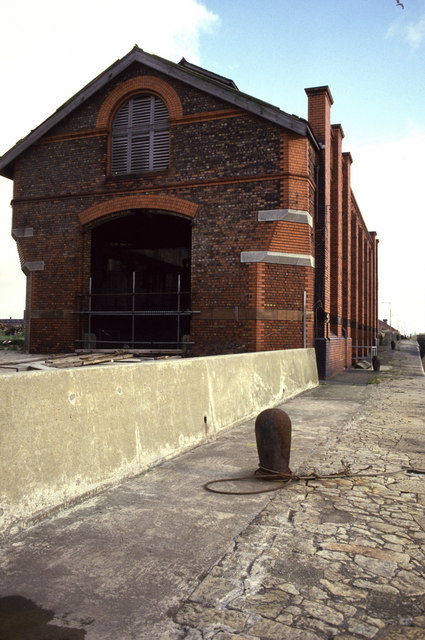
The impounding station alongside Huskisson Dock was a pumping station used to maintain water levels in these 'floating' docks.
References
Sources
- {{cite book
- {{cite book
References
- {{harvnb. Baines. 1859
- {{harvnb. Baines. 1859
- "Trading Places: Huskisson Dock history". Liverpool Museums.
- {{harvnb. Pollard. Pevsner. 2006
- "The 'May Blitz' 1941". E. Chambré Hardman Archive.
- "Liverpool Blitz: Attacks on the docks (SS ''Malakand'' Incident)". Liverpool Museums.
- "Huskisson Dock". Level 2: Urban exploration.
- "When Liverpool ruled the waves".
This article was imported from Wikipedia and is available under the Creative Commons Attribution-ShareAlike 4.0 License. Content has been adapted to SurfDoc format. Original contributors can be found on the article history page.
Ask Mako anything about Huskisson Dock — get instant answers, deeper analysis, and related topics.
Research with MakoFree with your Surf account
Create a free account to save articles, ask Mako questions, and organize your research.
Sign up freeThis content may have been generated or modified by AI. CloudSurf Software LLC is not responsible for the accuracy, completeness, or reliability of AI-generated content. Always verify important information from primary sources.
Report