From Surf Wiki (app.surf) — the open knowledge base
Hungarian Regional Autonomy
Proposed territorial autonomy for Hungarians in Serbia
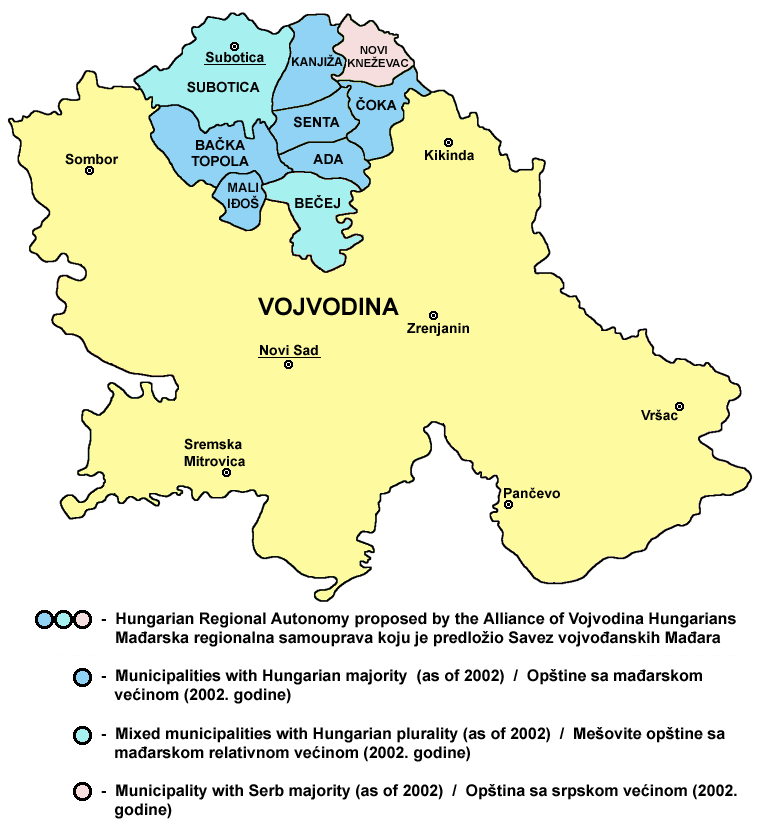
Proposed territorial autonomy for Hungarians in Serbia
The Hungarian Regional Autonomy (; ) is a proposed territorial autonomy for ethnic Hungarians in Serbia, located in the northern part of Vojvodina province.
Proposals and initiatives
The creation of territorial autonomy for ethnic Hungarians in Serbia was proposed by the Alliance of Vojvodina Hungarians political party and is largely based on the autonomy model of South Tyrol in Italy. The Hungarian Regional Autonomy would be a territorial unit with the area of 3,813 km² and population of 253,977 inhabitants. It would include nine municipalities in northern part of Vojvodina: Subotica, Bačka Topola, Mali Iđoš, Kanjiža, Senta, Ada, Bečej, Čoka, and Novi Kneževac. The administrative centre of the region would be Subotica, while the territorial unit itself would be part of Vojvodina province.
Some proposals advocate excluding the municipality of Novi Kneževac, which has a Serb ethnic majority. Contrary to this, the proposal of the 64 Counties Movement advocates creation of Hungarian territorial autonomy on a much larger territory, which would include not only municipalities with Hungarian majority or plurality, but also sizable neighboring municipalities with ethnic Serb majority.
Demographics
According to data from the 2022 census, the proposed territorial unit would include 61% of all Hungarians living in Serbia and 62% of all Hungarians living in Vojvodina province. Ethnic structure would be as follows: 44.4% Hungarians, 29% Serbs, 4.3% Croats, 3.6% Bunjevci, 3.2% Roma, and others.
The municipalities with ethnic Hungarian majority are: Kanjiža (83.1%), Senta (75.7%), Ada (72.7%), Bačka Topola (55.6%), and Mali Iđoš (51.8%). Hungarians make plurality of the population in Čoka (44.8%).
The municipality of Novi Kneževac has ethnic Serb majority (58%); Serbs make plurality of the population in Bečej (42.3%) and Subotica (34.3%).
Political parties
The Hungarian Regional Autonomy is a part of the political program of the Alliance of Vojvodina Hungarians, major Hungarian ethnic minority political party, and is also supported by other Hungarian ethnic minority political party, the Hungarian Civic Alliance.
In the 2024 local elections, the Alliance of Vojvodina Hungarians won the largest number of seats in the municipal assemblies of Kanjiža, Senta, Bačka Topola, and Mali Iđoš. Serbian Progressive Party won the most votes in Čoka, which has ethnic Hungarian relative majority.
References
References
- https://publikacije.stat.gov.rs/G2023/Pdf/G20234001.pdf {{Bare URL PDF. (July 2025)
- https://www.rtv.rs/sr_lat/vojvodina/banat/najvise-glasova-u-coki-osvojila-lista-aleksandar-vucic-coka-sutra_1544967.html {{Bare URL inline. (July 2025)
This article was imported from Wikipedia and is available under the Creative Commons Attribution-ShareAlike 4.0 License. Content has been adapted to SurfDoc format. Original contributors can be found on the article history page.
Ask Mako anything about Hungarian Regional Autonomy — get instant answers, deeper analysis, and related topics.
Research with MakoFree with your Surf account
Create a free account to save articles, ask Mako questions, and organize your research.
Sign up freeThis content may have been generated or modified by AI. CloudSurf Software LLC is not responsible for the accuracy, completeness, or reliability of AI-generated content. Always verify important information from primary sources.
Report