From Surf Wiki (app.surf) — the open knowledge base
Hundred twenty-eighth note
Musical note duration
Musical note duration


In music, a hundred twenty-eighth note (North American) or semihemidemisemiquaver or quasihemidemisemiquaver (British) is a note played for of the duration of a whole note. It lasts half as long as a sixty-fourth note. It has a total of five flags or beams.
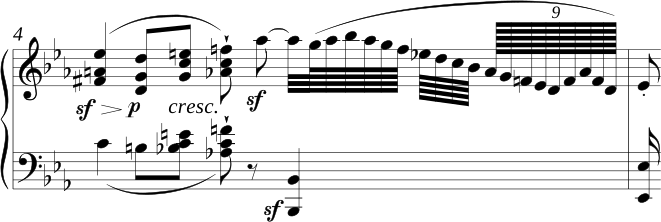
A single 128th note is always stemmed with flags, while two or more are usually beamed in groups. Notes this short are very rare in printed music, but not unknown. One reason that notes with many beams are rare is that, for instance, a thirty-second note at = 50 lasts the same amount of time as a sixteenth note at = 100; every note in a piece may be notated as twice as long but last the same amount of time if the tempo is also doubled. They are principally used for brief, rapid sections in slow movements. For example, they occur in the first movement of Beethoven's Pathétique Piano Sonata (Op. 13), to notate rapid scales. Another example is in Mozart's Variations on Je suis Lindor, where many of them are used in the slow twelfth variation. Likewise, 128th notes are used in the explicitly notated ornamental runs in the opening *Adagio'' of Bach's g minor Sonata for Unaccompanied Violin (BWV 1001).
These five-beamed notes also appear occasionally where a passage is to be performed rapidly, but where the actual tempo is at the discretion of the performer rather than being a strict division of the beat. In such cases, the aggregate time of the notes may not add up exactly to a full measure, and the phrase may be marked with an odd time division to indicate this. Sometimes such notation is made using smaller notes, sized like grace notes. One rare instance where such five-beamed notes occur as acciaccaturas occurs in the final measures of No. 2 of Charles-Valentin Alkan's Trois grandes études, Op. 76.
Hundred twenty-eighth rests are also rare, but again not unknown. One is used in Beethoven's Piano Sonata No. 13 "Quasi una fantasia" (bar 24 in the adagio movement) where it is followed by an ascending run of 128th notes, as well as in the finale of Charles-Valentin Alkan's Grande sonate 'Les quatre âges'.
References
References
- [[Gardner Read. Read, Gardner]] (1979). ''Music Notation'', p.65. 2nd edition. Crescendo Taplinger. {{ISBN. 0-8008-5453-5.
- Haas, David. (December 2016). "The Cambridge Companion to Shostakovich". Cambridge University Press.
- Miller, RJ. (2015). "Contemporary Orchestration: A Practical Guide to Instruments, Ensembles, and Musicians". Routledge.
- Gerou, Tom (1996). ''Essential Dictionary of Music Notation'', p.211. Alfred. {{ISBN. 0-88284-730-9
- Mozart, Wolfgang Amadeus. ''12 Variations on 'Je suis Lindor''', K.354. p. 10, fourth system, last bar. Wolfgang Amadeus Mozarts Werke, Serie 21. Leipzig: Breitkopf & Härtel, 1877-1910. Plate W.A.M. 354. [http://imslp.org/wiki/12_Variations_on_'Je_suis_Lindor',K.354(Mozart,_Wolfgang_Amadeus)]
- Thomas Bushnell BSG. (8 November 2007). "Re: GPD: official shortest note in lilypond". mail-archive.com.
- Joel., Lester. (1999). "Bach's works for solo violin : style, structure, performance". Oxford University Press.
- {{IMSLP. Piano Sonata No.13, Op.27 No.1 (Beethoven, Ludwig van)
- "Grande Sonate 'Les Quatre Ages', Op.33 (Alkan, Charles-Valentin) - IMSLP".
This article was imported from Wikipedia and is available under the Creative Commons Attribution-ShareAlike 4.0 License. Content has been adapted to SurfDoc format. Original contributors can be found on the article history page.
Ask Mako anything about Hundred twenty-eighth note — get instant answers, deeper analysis, and related topics.
Research with MakoFree with your Surf account
Create a free account to save articles, ask Mako questions, and organize your research.
Sign up freeThis content may have been generated or modified by AI. CloudSurf Software LLC is not responsible for the accuracy, completeness, or reliability of AI-generated content. Always verify important information from primary sources.
Report