From Surf Wiki (app.surf) — the open knowledge base
Humboldt Botanical Gardens
Gardens near Eureka, California, United States
_5863.JPG)
Gardens near Eureka, California, United States
| Field | Value |
|---|---|
| name | Humboldt Botanical Garden |
| image | Humboldt Botanical Garden - Eureka, California - DSC02551.JPG |
| type | Botanical Gardens |
| location | 7707 Tompkins Hill Road, Eureka, California (garden); 402 E Street, Eureka, California (business office) |
| nearest_city | Eureka, California |
| nearest_town | Loleta, California |
| coordinates | |
| coords_ref | Near highway 101 and adjacent to the College of the Redwoods campus |
| area | 44.5 acres |
| elevation | 100 feet; varying |
| established | 2003 |
| opened | 2006 |
| designer | Ron Lutsko |
| operator | Humboldt Botanical Garden Foundation |
| open | Daily 10:00 am until 5:00 with no entrance after 4:00 pm (November 1 through March 31, 10:00 am until 4:00 pm with no entrance after 3:00 pm). Dogs allowed on leash for an additional fee. Gardens may be booked as an events venue. |
| camp_sites | No |
| hiking_trails | 5 miles of hiking trails |
| terrain | Mediterranean and Pacific Marine hill and dale allows for an arid Native Plant Garden, fern glade, woodlands, etc. |
| water | Streams |
| collections | Native conifer, Iris, and western lily (Lilium occidental) |
| parking | Free parking at the entrance |
| other_info | Member of the American Public Gardens Association, the American Rhododendron Society, and the American Horticultural Society Reciprocal Admissions program |
| website |
The Humboldt Botanical Garden is a 44.5 acres (18 ha) botanical garden located four miles south of Eureka, California, United States. The Garden is near the South Bay portion of Humboldt Bay on the north side of the College of the Redwoods. Grading and site preparation began in August 2003. Featuring views of Humboldt Bay and the Pacific Ocean, the garden opened in 2006, with more development completed by 2008.
The Humboldt Botanical Garden (HBG) business office is located in downtown Eureka and is operated by the nonprofit Humboldt Botanical Garden Foundation which had over 1000 members in 2020. HBG is a member of the American Public Gardens Association, the American Rhododendron Society, and the American Horticultural Society Reciprocal Admission program.
The garden is "a repository for many rare and hard to grow rhododendrons and their companion plants" according to a local office of the American Rhododendron Society. HBG is listed by the California Native Plant Society as one of the 17 California gardens with notable California native plant collections.[[File:Humboldt Botanical Garden - Eureka, California - DSC02579.JPG|left|thumb|upright=1.4|One of the wild areas of the gardens, 2013.]]
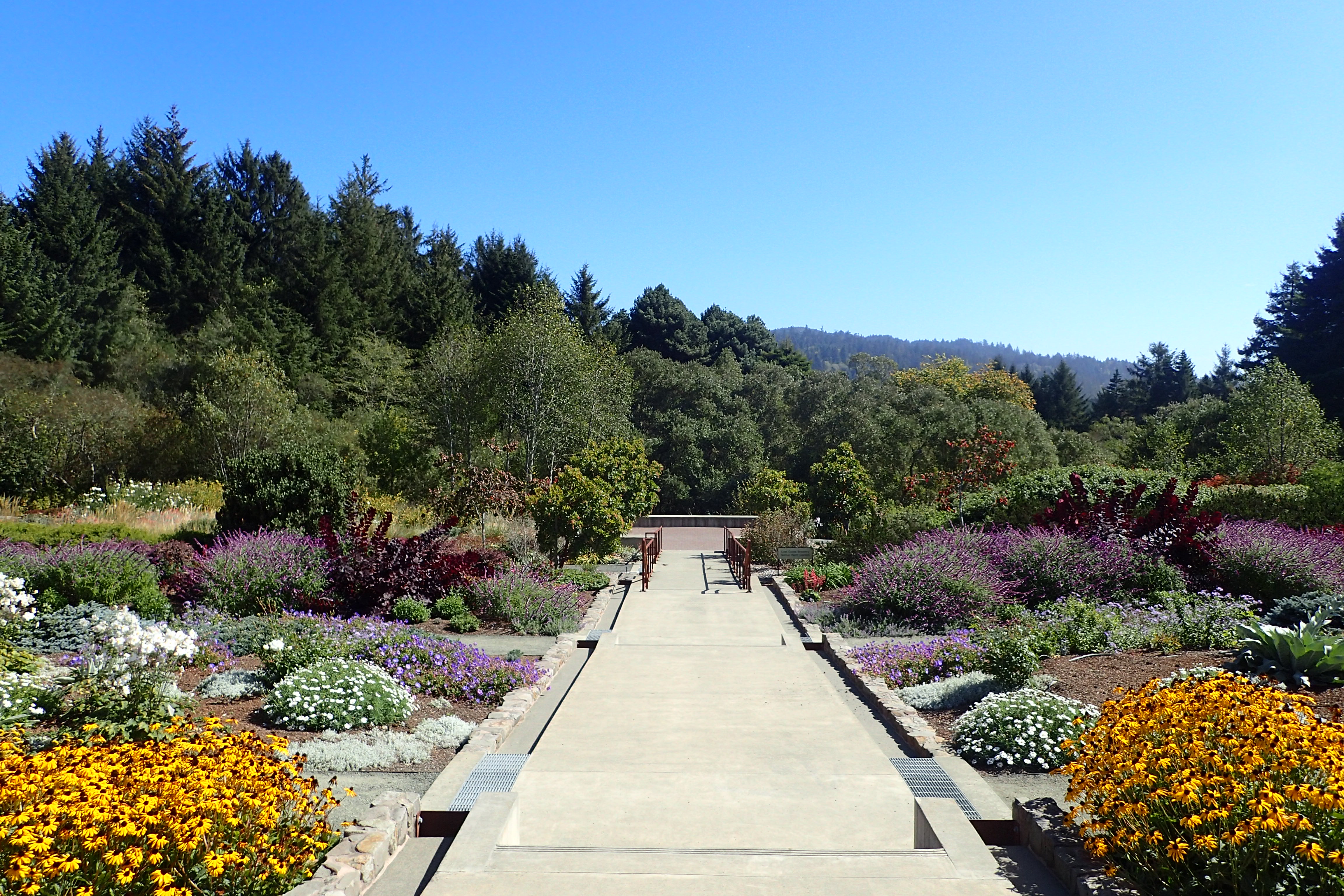
The Gardens were first organized in 1991. Originally a farm, the site is a grassy escarpment with meadows and woodland, and a year-round stream. The area's climate, which straddles Mediterranean and Pacific Marine allows for a diverse group of plants. Its Native Plant Garden has an emphasis on the Humboldt region, but includes plants from other geographic areas. Other gardens are: "All Happy Now" earth sculpture, meant to be walked in the way of meditation labyrinths; Riparian Area; Greenhouse; the Temperate Woodland Garden; the Ornamental Terrace Garden; Rose Garden; Heather Garden; Pollinator Garden; Mediterranean Allee and Native Tree garden; plus five miles of hiking trails.
The Humboldt Botanical Garden is particularly interested in maintaining complete native conifer, Iris and western lily (Lilium occidental) collections. Its Mission Statement is: To cultivate a garden that provides an enjoyable discovery into the botanical world through education, participation and community service.
A summer music series and an annual native plant sale are held in the gardens. The gardens are available as a special events venue.
Endangered Species Protection
In October 2019, six "Point Saint George" junipers (Juniperus communis) were planted. These originated from a cliff in Del Norte County at the tip of Point Saint George north of Crescent City, California and is now extinct in the wild and uncommon in cultivation.
In March 2023, HBG became the northernmost site for safeguarding the state-listed endangered species Vine Hill manzanita (Arctostaphylos densiflora) which is native to Sebastopol, Sonoma County, California.
Another critically endangered species is the Wollemi pine (Wollemia nobilis), a native of Australia which has been planted at HBG. It was known only from fossils until found near Sydney, Australia in 1994.
Research
Active research in support of conservation, general research, and education is supported. As of 2024, this has included research into Monterey Pines (Pinus radiata), habitats for native pollinators and their flower selection, removal of invasive species, and studying the effects of potential predation on foraging habits of bumblebees.
Research has included collaborations with Wright State University, Academy of the Redwoods Environmental Club, and California Polytechnic University Humboldt.
References
References
- Goodwin, Mary Lou. (2020-08-04). "Volunteers still active at botanical garden". Times Standard (Eureka).
- "Humboldt Botanical Garden {{!}} American Public Gardens Association".
- Gardener, The Daily. (2020-01-27). "The Humboldt Botanical Garden".
- "Humboldt Botanical Garden".
- "Activities – Visit Humboldt".
- (Summer 2023). "The Botanical Guardian". Humboldt Botanical Garden.
- (2020). "AMERICAN HORTICULTURAL SOCIETY, 2020 RECIPROCAL ADMISSIONS PROGRAM". American Horticultural Society.
- (September 2025). "Tim Walsh Earns ARS Gold".
- "California Native Botanic Gardens".
- Wilbur, Mary. "Pacific Horticulture {{!}} Humboldt Botanical Gardens".
- "Humboldt Botanical Garden".
- Shelton, Heather. (2022-08-21). "'Gala' benefits Humboldt Botanical Garden".
- "Humboldt Botanical Garden {{!}} American Public Gardens Association".
- "HBC Mission Statement". Humboldt Botanical Garden.
- Giddings, Evelyn. (Summer 2024). "Humboldt Botanical Garden's Summer Music Series; and HBG's Annual Plant Sale". The Botanical Garden.
- Roof. James. (1973). "". The Four Seasons. Regional Parks Botanical Garden
- Moore, Mark. (Spring 2025). "'Point Saint George' Juniper (Juniperus communis)". Humboldt Botanical Garden.
- Moore, Mark. (Summer 2023). "Vine Hill Manzanita at the Humboldt Botanical Garden". Humboldt Botanical Garden.
- Baker, M. S.. (2009-08-19). "National Collection of Imperiled Plants". Center for Plant Conservation.
- York, R. P.. (1987). "California's most endangered plants. In: Conservation and management of rare and endangered plants". California Native Plant Society.
- "Pacific Horticulture {{!}} Humboldt Botanical Gardens".
- Crain, Dr., Benjamin J.. (Summer 2024). "Research at Humboldt Botanical Garden". Humboldt Botanical Garden.
This article was imported from Wikipedia and is available under the Creative Commons Attribution-ShareAlike 4.0 License. Content has been adapted to SurfDoc format. Original contributors can be found on the article history page.
Ask Mako anything about Humboldt Botanical Gardens — get instant answers, deeper analysis, and related topics.
Research with MakoFree with your Surf account
Create a free account to save articles, ask Mako questions, and organize your research.
Sign up freeThis content may have been generated or modified by AI. CloudSurf Software LLC is not responsible for the accuracy, completeness, or reliability of AI-generated content. Always verify important information from primary sources.
Report