From Surf Wiki (app.surf) — the open knowledge base
Human overpopulation
Proposed condition wherein human numbers exceed the carrying capacity of the environment

Proposed condition wherein human numbers exceed the carrying capacity of the environment

Human overpopulation (or human population overshoot) is the idea that human populations may become too large to be sustained by their environment or resources in the long term. The topic is usually discussed in the context of world population, though it may concern individual nations, regions, and cities.
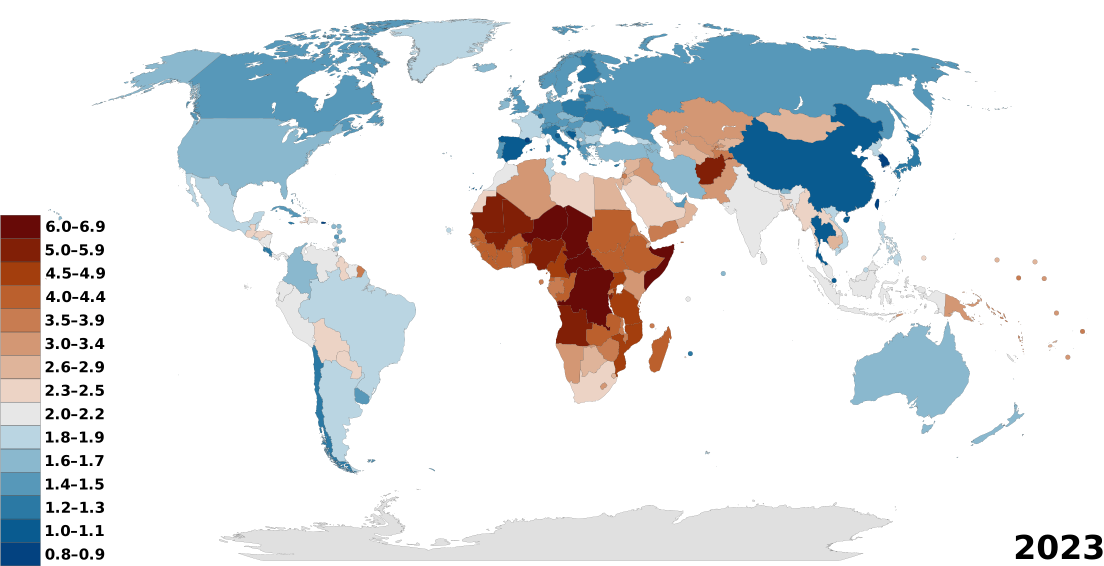
Since 1804, the global living human population has increased from 1 billion to 8 billion due to medical advancements and improved agricultural productivity. Annual world population growth peaked at 2.1% in 1968 and has since dropped to 1.1%. According to the most recent United Nations' projections, the global human population is expected to reach 9.7 billion in 2050 and would peak at around 10.4 billion people in the 2080s, before decreasing, noting that fertility rates are falling worldwide. Other models agree that the population will stabilize before or after 2100. Conversely, some researchers analyzing national birth registries data from 2022 and 2023—which cover half the world's population—argue that the 2022 UN projections overestimated fertility rates by 10 to 20% and were already outdated by 2024. They suggest that the global fertility rate may have already fallen below the sub-replacement fertility level for the first time in human history and that the global population will peak at approximately 9.5 billion by 2061. The 2024 UN projections report estimated that world population would peak at 10.29 billion in 2084 and decline to 10.18 billion by 2100, which was 6% lower than the UN had estimated in 2014.
Early discussions of overpopulation in English were spurred by the work of Thomas Malthus. Discussions of overpopulation follow a similar line of inquiry as Malthusianism and its Malthusian catastrophe, a hypothetical event where population exceeds agricultural capacity, causing famine or war over resources, resulting in poverty and environmental collapses. More recent discussion of overpopulation was popularized by Paul Ehrlich in his 1968 book The Population Bomb and subsequent writings. Ehrlich described overpopulation as a function of overconsumption, arguing that overpopulation should be defined by a population being unable to sustain itself without depleting non-renewable resources.
The belief that global population levels will become too large to sustain is a point of contentious debate. Those who believe global human overpopulation to be a valid concern, argue that increased levels of resource consumption and pollution exceed the environment's carrying capacity, leading to population overshoot. The population overshoot hypothesis is often discussed in relation to other population concerns such as population momentum, biodiversity loss, hunger and malnutrition, resource depletion, and the overall human impact on the environment.
Critics of the belief note that human population growth is decreasing and the population will likely peak, and possibly even begin to decrease, before the end of the century. They argue the concerns surrounding population growth are overstated, noting that quickly declining birth rates and technological innovation make it possible to sustain projected population sizes. Other critics claim that overpopulation concerns ignore more pressing issues, like poverty or overconsumption, are motivated by racism, or place an undue burden on the Global South, where most population growth happens.
Overview
),_OWID.svg)
Modern proponents of the concept have suggested that overpopulation, population growth and overconsumption are interdependent and collectively are the primary drivers of human-caused environmental problems such as climate change According to the Intergovernmental Panel on Climate Change (IPCC) Sixth Assessment Report (2022), both GDP per capita and population growth remained the strongest drivers of CO₂ emissions from fossil fuel combustion during 2010–2019; population growth increased emissions by about 1.2% per year and GDP per capita by about 2.3% per year. and biodiversity loss. Many scientists have expressed concern about population growth, and argue that creating sustainable societies will require decreasing the current global population. Advocates have suggested implementation of population planning strategies to reach a proposed sustainable population.
Overpopulation hypotheses are controversial, with many demographers and environmentalists disputing the core premise that the world cannot sustain the current trajectory of human population. Additionally, many economists and historians have noted that sustained shortages and famines have historically been caused by war, price controls, political instability, and repressive political regimes (often employing central planning) rather than overpopulation. They also note that population growth has historically led to greater technological development and the advancement of scientific knowledge. This has enabled the engineering of substitute goods and technology that better conserve and more efficiently use natural resources, increase agricultural output with less land and water, and address human impacts on the environment. These advancements result from increasing numbers of scientists, engineers, and inventors across generations, alongside increasing and continuous revision of scientific thinking. Instead, social scientists argue that disputes between themselves and biologists about human overpopulation are over the appropriateness of definitions being used (and often devolve into social scientists and biologists simply talking past each other).
Annual world population growth peaked at 2.1% in 1968, has since dropped to 1.1%, and could drop even further to 0.1% by 2100. Based on this, the United Nations projects the world population, which is 7.8 billion , to level out around 2100 at 10.9 billion with other models proposing similar stabilization before or after 2100. Some experts believe that a combination of factors (including technological and social change) would allow global resources to meet this increased demand, avoiding global overpopulation. The debate is further complicated by a growing focus on the consequences of rapidly declining fertility rates in many nations, which presents risks of economic contraction and aging populations, offering a balanced perspective on global demographic challenges. Additionally, some critics dismiss the idea of human overpopulation as a science myth connected to attempts to blame environmental issues on overpopulation, oversimplify complex social or economic systems, or place blame on developing countries and poor populations—reinscribing colonial or racist assumptions and leading to discriminatory policy. These critics often suggest overconsumption should be treated as an issue separate from population growth.
History of world population
Main article: World population milestones, Population growth


World population has been rising continuously since the end of the Black Death, around the year 1350. The fastest doubling of the world population happened between 1950 and 1986: a doubling from 2.5 to 5 billion people in 37 years, mainly due to medical advancements and increases in agricultural productivity. Due to its impact on the human ability to grow food, the Haber process enabled the global population to increase from 1.6 billion in 1900 to 7.7 billion by November 2018 and, according to the United Nations, eight billion as of November 2022. Some researchers have analyzed this growth in population like other animal populations, human populations predictably grow and shrink according to their available food supply as per the Lotka–Volterra equations, including agronomist and insect ecologist David Pimentel, behavioral scientist Russell Hopfenberg, and anthropologist Virginia Abernethy.
| Year | 1806 | 1850 | 1900 | 1940 | 1950 | 1960 | 1970 | 1980 | 1990 | 2000 | 2010 | 2020 | Billions |
|---|---|---|---|---|---|---|---|---|---|---|---|---|---|
| 1.01 | 1.28 | 1.65 | 2.33 | 2.53 | 3.03 | 3.68 | 4.43 | 5.28 | 6.11 | 6.92 | 7.76 |
World population has experienced several periods of growth since the dawn of civilization in the Holocene period, around 10,000 BCE. The rise of civilization roughly coincided with the retreat of glacial ice following the end of the Last Glacial Period. The advent of farming enabled population growth in many regions of the world, including Europe, the Americas, and China, continuing through the 1600s, though occasionally interrupted by plagues or other crises. For example, the Black Death is thought to have reduced the world's population, then at an estimated 450 million in 1350, to between 350 and 375 million by 1400.
After the start of the Industrial Revolution, during the 18th century, the rate of population growth began to increase. By the end of the century, the world's population was estimated at just under 1 billion. At the turn of the 20th century, the world's population was roughly 1.6 billion. By 1940, this figure had increased to 2.3 billion. Even more dramatic growth beginning in 1950 (above 1.8% per year) coincided with greatly increased food production as a result of the industrialization of agriculture brought about by the Green Revolution. The rate of human population growth peaked in 1964, at about 2.1% per year. Recent additions of a billion humans happened very quickly: 33 years to reach three billion in 1960, 14 years for four billion in 1974, 13 years for five billion in 1987, 12 years for six billion in 1999, 11 years for seven billion in 2010, and 12 years for 8 billion toward the end of 2022.
Future projections
Main article: Projections of population growth


Population projections are attempts to show how the human population might change in the future. These projections help to forecast the population's impact on this planet and humanity's future well-being. Models of population growth take trends in human development, and apply projections into the future to understand how they will affect fertility and mortality, and thus population growth.
The most recent report from the United Nations Population Division issued in 2022 (see chart) projects that global population will peak around the year 2086 at about 10.4 billion, and then start a slow decline (the median line on the chart). As with earlier projections, this version assumes that the global average fertility rate will continue to fall, but even further from 2.5 births per woman during the 2015–2020 period to 1.8 by the year 2100.
However, other estimates predict additional downward pressure on fertility (such as more education and family planning) which could result in peak population during the 2060–2070 period rather than later.
According to the UN, of the predicted growth in world population between 2020 and 2050, all of that change will come from less developed countries, and more than half will come from just 8 African countries. It is predicted that the population of sub-Saharan Africa will double by 2050. The Pew Research Center predicts that 50% of births in the year 2100 will be in Africa. As an example of uneven prospects, the UN projects that Nigeria will gain about 340 million people, about the present population of the US, to become the 3rd most populous country, and China will lose almost half of its population.
Some scholars have argued that a form of "cultural selection" may be occurring due to significant differences in fertility rates between cultures, and it can therefore be expected that fertility rates and rates of population growth may rise again in the future. An example is certain religious groups that have a higher birth rate that is not accounted for by differences in income. In his book Shall the Religious Inherit the Earth?, Eric Kaufmann argues that demographic trends point to religious fundamentalists greatly increasing as a share of the population over the next century. From the perspective of evolutionary psychology, it is expected that selection pressure should occur for whatever psychological or cultural traits maximize fertility.
History of overpopulation hypotheses
Concerns about population size or density have a long history: Tertullian, a resident of the city of Carthage in the second century CE, criticized population at the time: "Our numbers are burdensome to the world, which can hardly support us... In very deed, pestilence, and famine, and wars, and earthquakes have to be regarded as a remedy for nations, as the means of pruning the luxuriance of the human race." Despite those concerns, scholars have not found historic societies that have collapsed because of overpopulation or overconsumption.

By the early 19th century, intellectuals such as Thomas Malthus predicted that humankind would outgrow its available resources because a finite amount of land would be incapable of supporting a population with limitless potential for increase. During the 19th century, Malthus' work, particularly An Essay on the Principle of Population, was often interpreted in a way that blamed the poor alone for their condition and helping them was said to worsen conditions in the long run. This resulted, for example, in the English poor laws of 1834 and a hesitating response to the Irish Great Famine of 1845–52.
The first World Population Conference was held in 1927 in Geneva, organized by the League of Nations and Margaret Sanger.
Paul R. Ehrlich's book The Population Bomb became a bestseller upon its release in 1968 and created renewed interest in overpopulation. The book predicted population growth would lead to famine, societal collapse, and other social, environmental and economic strife in the coming decades, and advocated for policies to curb it. The Club of Rome published the influential report The Limits to Growth in 1972, which used computer modeling to similarly argue that continued population growth trends would lead to global system collapse. The idea of overpopulation was also a topic of some works of English-language science fiction and dystopian fiction during the latter part of the 1960s. The United Nations held the first of three World Population Conferences in 1974. Human population and family planning policies were adopted by some nations in the late 20th century in an effort to curb population growth, including in China and India. Albert Allen Bartlett gave more than 1,742 lectures on the threat of exponential population growth starting in 1969.

However, many predictions of overpopulation during the 20th century did not materialize. In The Population Bomb, Ehrlich stated, "In the 1970s hundreds of millions of people will starve to death in spite of any crash programs embarked upon now," with later editions changing to "in the 1980s". Despite admitting some of his earlier predictions did not come to pass, Ehrlich continues to advocate that overpopulation is a major issue.
As the profile of environmental issues facing humanity increased during the end of the 20th and the early 21st centuries, some have looked to population growth as a root cause. In the 2000s, E. O. Wilson and Ron Nielsen discussed overpopulation as a threat to the quality of human life. In 2011, Pentti Linkola argued that human overpopulation represents a threat to Earth's biosphere. A 2015 survey from Pew Research Center reports that 82% of scientists associated with the American Association for the Advancement of Science were concerned about population growth. In 2017, more than one-third of 50 Nobel prize-winning scientists surveyed by the Times Higher Education at the Lindau Nobel Laureate Meetings said that human overpopulation and environmental degradation are the two greatest threats facing mankind. In November that same year, the World Scientists' Warning to Humanity: A Second Notice, signed by 15,364 scientists from 184 countries, indicated that rapid human population growth is "a primary driver behind many ecological and even societal threats." Ehlrich and other scientists at a conference in the Vatican on contemporary species extinction linked the issue to population growth in 2017, and advocated for human population control, which attracted controversy from the Catholic church. In 2019, a warning on climate change signed by 11,000 scientists from 153 nations said that human population growth adds 80 million humans annually, and "the world population must be stabilized—and, ideally, gradually reduced—within a framework that ensures social integrity" to reduce the impact of "population growth on GHG emissions and biodiversity loss."
In 2020, a quote from David Attenborough about how humans have "overrun the planet" was shared widely online and became his most popular comment on the internet.
Key concepts
Overconsumption

The World Wide Fund for Nature (WWF) and Global Footprint Network have argued that the annual biocapacity of Earth has exceeded, as measured using the ecological footprint. In 2006, WWF's Living Planet Report stated that in order for all humans to live with the current consumption patterns of Europeans, we would be spending three times more than what the planet can renew. According to these calculations, humanity as a whole was using by 2006 40% more than what Earth can regenerate. Another study by the WWF in 2014 found that it would take the equivalent of 1.5 Earths of bio-capacity to meet humanity's current levels of consumption. However, Roger Martin of Population Matters states the view: "the poor want to get rich, and I want them to get rich," with a later addition, "of course we have to change consumption habits,... but we've also got to stabilize our numbers". By 2023, the Global Footprint Network estimated that humanity's ecological footprint had increased to 1.71 Earths, indicating that human demand for ecological resources and services exceeded what Earth can regenerate in that year by 71%. This level of overconsumption underscores the significant environmental pressures associated with population growth and resource use. Additionally, Earth Overshoot Day in 2023 fell on 2 August, marking the date when humanity's resource consumption for the year surpassed Earth's capacity to regenerate those resources.
Critics have questioned the simplifications and statistical methods used in calculating ecological footprints. Therefore, Global Footprint Network and its partner organizations have engaged with national governments and international agencies to test the results—reviews have been produced by France, Germany, the European Commission, Switzerland, Luxembourg, Japan and the United Arab Emirates. Some point out that a more refined method of assessing Ecological Footprint is to designate sustainable versus non-sustainable categories of consumption.
Carrying capacity
Main article: Sustainable population
Attempts have been made to estimate the world's carrying capacity for humans; the maximum population the world can host. A 2004 meta-analysis of 69 such studies from 1694 until 2001 found the average predicted maximum number of people the Earth would ever have was 7.7 billion people, with lower and upper meta-bounds at 0.65 and 98 billion people, respectively. They conclude: "recent predictions of stabilized world population levels for 2050 exceed several of our meta-estimates of a world population limit".
A 2012 United Nations report summarized 65 different estimated maximum sustainable population sizes and the most common estimate was 8 billion. Advocates of reduced population often put forward much lower numbers. Paul R. Ehrlich stated in 2018 that the optimum population is between 1.5 and 2 billion. In 2022 Ehrlich and other contributors to the "Scientists' warning on population", including Eileen Crist, William J. Ripple, William E. Rees and Christopher Wolf, stated that environmental analysts put the sustainable level of human population at between 2 and 4 billion people. Geographer Chris Tucker estimates that 3 billion is a sustainable number.
Proposed impacts
Poverty and infant and child mortality
Main article: Demographic transition, Income and fertility

Although proponents of human overpopulation have expressed concern that growing population will lead to an increase in global poverty and infant mortality, both indicators have declined over the last 200 years of population growth thanks to the agricultural and technological revolutions.
Environmental impacts
Main article: Human impact on the environment
A number of scientists have argued that human impacts on the environment and accompanying increase in resource consumption threatens the world's ecosystems and the survival of human civilization. The InterAcademy Panel Statement on Population Growth, which was ratified by 58 member national academies in 1994, states that "unprecedented" population growth aggravates many environmental problems, including rising levels of atmospheric carbon dioxide, global warming, and pollution. Indeed, some analysts claim that overpopulation's most serious impact is its effect on the environment. Some scientists suggest that the overall human impact on the environment during the Great Acceleration, particularly due to human population size and growth, economic growth, overconsumption, pollution, and proliferation of technology, has pushed the planet into a new geological epoch known as the Anthropocene.

Some studies and commentary link population growth with climate change. Critics have stated that population growth alone may have less influence on climate change than other factors, such as greenhouse gas emissions per capita. The global consumption of meat is projected to rise by as much as 76% by 2050 as the global population increases, with this projected to have further environmental impacts such as biodiversity loss and increased greenhouse gas emissions. A July 2017 study published in Environmental Research Letters argued that the most significant way individuals could mitigate their own carbon footprint is to have fewer children, followed by living without a vehicle, forgoing air travel, and adopting a plant-based diet. However, even in countries that have both large population growth and major ecological problems, it is not necessarily true that curbing the population growth will make a major contribution towards resolving all environmental problems that can be solved simply with an environmentalist policy approach.
Continued population growth and overconsumption, particularly by the wealthy, have been posited as key drivers of biodiversity loss and contemporary species extinction, with some researchers and environmentalists specifically suggesting this indicates a human overpopulation scenario. The Global Assessment Report on Biodiversity and Ecosystem Services, released by IPBES in 2019, states that human population growth is a factor in biodiversity loss. IGI Global has uncovered the growth of the human population caused encroachment in wild habitats which have led to their destruction, "posing a potential threat to biodiversity components".
Some scientists and environmentalists, including Jared Diamond, E. O. Wilson, Jane Goodall and David Attenborough, contend that population growth is devastating to biodiversity. Wilson for example, has expressed concern when Homo sapiens reached a population of six billion their biomass exceeded that of any other large land dwelling animal species that had ever existed by over 100 times. Inger Andersen, the executive director of the United Nations Environment Programme, stated in December 2022 as the human population reached a milestone of 8 billion and as delegates were meeting for the 2022 United Nations Biodiversity Conference, that "we need to understand that the more people there are, the more we put the Earth under heavy pressure. As far as biodiversity is concerned, we are at war with [the rest of] nature."
Human overpopulation and continued population growth are also considered by some, including philosopher Steven Best and the animal protection organization In Defense of Animals, to be an animal rights issue, as more human activity means the destruction of animal habitats, more direct killing of animals and more animals used as food. Recent research has expanded on the environmental consequences of overpopulation in developing regions. A 2024 study published in Scientific Reports found that in South Asia, population density and energy consumption are significantly correlated with rising CO₂ emissions, while higher investment in human capital (education and health) helps reduce environmental degradation. The authors conclude that overpopulation and fossil fuel dependence continue to hinder progress toward sustainable development goals.
Resource depletion
Main article: Resource depletion, overconsumption
Some commentary has attributed depletion of non-renewable resources, such as land, food and water, to overpopulation and suggested it could lead to a diminished quality of human life. Ecologist David Pimentel was one such proponent, saying "with the imbalance growing between population numbers and vital life sustaining resources, humans must actively conserve cropland, freshwater, energy, and biological resources. There is a need to develop renewable energy resources. Humans everywhere must understand that rapid population growth damages the Earth's resources and diminishes human well-being."

Although food shortages have been warned as a consequence of overpopulation, according to the Food and Agriculture Organization, global food production exceeds increasing demand from global population growth. Food insecurity in some regions is attributable to the globally unequal distribution of food supplies.
The notion that space is limited has been decried by skeptics, who point out that the Earth's population of roughly 6.8 billion people could comfortably be housed an area comparable in size to the state of Texas in the United States (about 269000 sqmi). Critics and agricultural experts suggest changes to policies relating to land use or agriculture to make them more efficient would be more likely to resolve land issues and pressures on the environment than focusing on reducing population alone.
Water scarcity, which threatens agricultural productivity, represents a global issue that some have linked to population growth. Colin Butler wrote in The Lancet in 1994 that overpopulation also has economic consequences for certain countries due to resource use.
Political systems and social conflict
It was speculated by Aldous Huxley in 1958 that democracy is threatened by overpopulation, and could give rise to totalitarian style governments. Physics professor Albert Allen Bartlett at the University of Colorado Boulder warned in 2000 that overpopulation and the development of technology are the two major causes of the diminution of democracy. However, over the last 200 years of population growth, the actual level of personal freedom has increased rather than declined. John Harte has argued population growth is a factor in numerous social issues, including unemployment, overcrowding, bad governance and decaying infrastructure. Daron Acemoglu and others suggested in a 2017 paper that since the Second World War, countries with higher population growth rates experienced the most social conflict.
Scholars such as Thomas R. Malthus, Paul R. Ehrlich have argued that rapid population growth can lead to societal challenges, such as worldwide famines and mass unemployment. For example, researcher Goran Miladinov found that in low and middle-income countries, urban and rural population growth is frequently associated with undernourishment. However, Ehrlich's predictions in The Population Bomb have been criticised by academic journals. For example, a review by Science (journal) outlined that his predictions of mass famine never occurred.
According to anthropologist Jason Hickel, the global capitalist system creates pressures for population growth: "more people means more labour, cheaper labour, and more consumers." He and his colleagues have also demonstrated that capitalist elites throughout recent history have "used pro-natalist state policies to prevent women from practicing family planning" in order to grow the size of their workforce. Hickel has however argued that the cause of negative environmental impacts is resource extraction by wealthy countries. He concludes that "we should not ignore the relationship between population growth and ecology, but we must not treat these as operating in a social and political vacuum."
Epidemics and pandemics
A 2021 article in Ethics, Medicine and Public Health argued in light of the COVID-19 pandemic that epidemics and pandemics were made more likely by overpopulation, globalization, urbanization and encroachment into natural habitats.
They both play a significant role impacting human populations, including widespread illness, death, and social disruption. While they can leave a temporary loss of population, it is followed by significant loss and suffering. These events are not the sole reason for overpopulation; other significant factors are lack of access to family planning and reproductive contraptions, poverty, and resource depletion.
Proposed solutions and mitigation measures
Several strategies have been proposed to mitigate overpopulation.
Population planning
Main article: Human population planning
Several scientists (including Paul Ehrlich, Gretchen Daily and Tim Flannery) proposed that humanity should work at stabilizing its absolute numbers, as a starting point towards beginning the process of reducing the total numbers. They suggested several possible approaches, including:
- Improved access to contraception and comprehensive sex education
- Reducing infant mortality, so that parents do not need to have many children to ensure at least some survive to adulthood.
- Improving the status of women in order to facilitate a departure from traditional sexual division of labour.
- Family planning
- Creating small family "role models"
- Secular cultures and societies.
There is good evidence from many parts of the world that when women and couples have the freedom to choose how many children to have, they tend to have smaller families.
Some scientists, such as Corey Bradshaw and Barry Brook, suggest that, given the "inexorable demographic momentum of the global human population," sustainability can be achieved more rapidly with a short term focus on technological and social innovations, along with reducing consumption rates, while treating population planning as a long-term goal.
However, most scientists believe that achieving genuine sustainability is a long-term project, and that addressing population and consumption levels are both essential to achieving it.
In 1992, more than 1700 scientists from around the world signed onto a "World Scientists' Warning to Humanity," including a majority of the living Nobel prize-winners in the sciences. "The earth is finite," they wrote. "Its ability to absorb wastes and destructive effluent is finite. Its ability to provide food and energy is finite. Its ability to provide for growing numbers of people is finite. And we are fast approaching many of the earth's limits." The warning noted:Pressures resulting from unrestrained population growth put demands on the natural world that can overwhelm any efforts to achieve a sustainable future. If we are to halt the destruction of our environment, we must accept limits to that growth. Two of the five areas where the signatories requested immediate action were "stabilize population" and "ensure sexual equality, and guarantee women control over their own reproductive decisions."
In a follow-up message 25 years later, William Ripple and colleagues issued the "World Scientists' Warning to Humanity: A Second Notice." This time more than 15,000 scientists from around the world signed on. "We are jeopardizing our future by not reining in our intense but geographically and demographically uneven material consumption and by not perceiving continued rapid population growth as a primary driver behind many ecological and even societal threats," they wrote. "By failing to adequately limit population growth, reassess the role of an economy rooted in growth, reduce greenhouse gases, incentivize renewable energy, protect habitat, restore ecosystems, curb pollution, halt defaunation, and constrain invasive alien species, humanity is not taking the urgent steps needed to safeguard our imperilled biosphere." This second scientists' warning urged attention to both excessive consumption and continued population growth. Like its predecessor, it did not specify a definite global human carrying capacity. But its call to action included "estimating a scientifically defensible, sustainable human population size for the long term while rallying nations and leaders to support that vital goal."
Subsequent scientists' calls to action have also included calls for population planning. The 2020 "World Scientists' Warning of a Climate Emergency" stated: "Economic and population growth are among the most important drivers of increases in CO2 emissions from fossil fuel combustion." "Therefore," the study noted: "we need bold and drastic transformations regarding economic and population policies." "The world population must be stabilized—and, ideally, gradually reduced," it concluded, implying that humanity is overpopulated given current and expected levels of resource use and waste generation.
A follow-up scientists' warning on climate change in 2021 reiterated the need to plan and limit human numbers to achieve sustainability, proposing as a goal "stabilizing and gradually reducing the [global] population by providing voluntary family planning and supporting education and rights for all girls and young women, which has been proven to lower fertility rates."
Family planning
Main article: Family planning, Reproductive rights, Birth control
.jpg)
Education and empowerment of women and giving access to family planning and contraception have a demonstrated impact on reducing birthrates. Many studies conclude that educating girls reduces the number of children they have. One option according to some activists is to focus on education about family planning and birth control methods, and to make birth-control devices like condoms, contraceptive pills and intrauterine devices easily available. Worldwide, nearly 40% of pregnancies are unintended (some 80 million unintended pregnancies each year). An estimated 350 million women in the poorest countries of the world either did not want their last child, do not want another child or want to space their pregnancies, but they lack access to information, affordable means and services to determine the size and spacing of their families. In the developing world, some 514,000 women die annually of complications from pregnancy and abortion, with 86% of these deaths occurring in the sub-Saharan Africa region and South Asia. Additionally, 8 million infants die, many because of malnutrition or preventable diseases, especially from lack of access to clean drinking water.

Women's rights and their reproductive rights in particular are issues regarded to have vital importance in the debate. Anthropologist Jason Hickel asserts that a nation's population growth rapidly declines - even within a single generation - when policies relating to women's health and reproductive rights, children's health (to ensure parents they will survive to adulthood), and expanding education and economic opportunities for girls and women are implemented.
A 2020 paper by William J. Ripple and other scientists argued in favor of population policies that could advance social justice (such as by abolishing child marriage, expanding family planning services and reforms that improve education for women and girls) and at the same time mitigate the impact of population growth on climate change and biodiversity loss. In a 2022 warning on population published by Science of the Total Environment, Ripple, Ehrlich and other scientists appealed to families around the world to have no more than one child and also urged policy-makers to improve education for young females and provide high-quality family-planning services.
Extraterrestrial settlement
Urbanization

Despite the increase in population density within cities (and the emergence of megacities), UN Habitat Data Corp. states in its reports that urbanization may be the best compromise in the face of global population growth. Cities concentrate human activity within limited areas, limiting the breadth of environmental damage. UN Habitat says this is only possible if urban planning is significantly improved.
Paul R. Ehrlich proposed in The Population Bomb that rhetoric supporting the increase of city density is a means of avoiding dealing with what he views as the root problem of overpopulation and has been promoted by what he views as the same interests that have allegedly profited from population increase (such as property developers, the banking system which invests in property development, industry, and municipal councils). Subsequent authors point to growth economics as driving governments seek city growth and expansion at any cost, disregarding the impact it might have on the environment.
Criticism
The concept of human overpopulation, and its attribution as a cause of environmental issues, are controversial.
Some critics, including Nicholas Eberstadt, Fred Pearce, Dominic Lawson and Betsy Hartmann, refer to overpopulation as a myth. Predicted exponential population growth or any "population explosion" did not materialise; instead, population growth slowed. Critics suggest that enough resources are available to support projected population growth, and that human impacts on the environment are not attributable to overpopulation.
According to libertarian think tank the Fraser Institute, both the idea of overpopulation and the alleged depletion of resources are myths; most resources are now more abundant than a few decades ago, thanks to technological progress. The institute also questions the sincerity of advocates of population control in poor countries.
Nicholas Eberstadt, a political economist, has criticised the idea of overpopulation, saying that "overpopulation is not really overpopulation. It is a question of poverty".
A 2020 study in The Lancet concluded that "continued trends in female educational attainment and access to contraception will hasten declines in fertility and slow population growth", with projections suggesting world population would peak at 9.73 billion in 2064 and fall by 2100. Media commentary interpreted this as suggesting overconsumption represents a greater environmental threat as an overpopulation scenario may never occur.
Some human population planning strategies advocated by proponents of overpopulation are controversial for ethical reasons. Those concerned with overpopulation, including Paul Ehrlich, have been accused of influencing human rights abuses including forced sterilisation policies in India and under China's one-child policy, as well as mandatory or coercive birth control measures taken in other countries.
Surveys of members of the American Economic Association have found that general agreement among professional economists in the United States with the statement that "The economic benefits of an expanding world population outweigh the economic costs" has grown from 36 percent in 2000, to 50 percent in 2011, and to 58 percent in 2021.
Besides the economic risks of declining populations, some analyses discuss the non-economic consequences, such as the weakening of social capital. This results from fewer parents, smaller families, and a potential reduction in community engagement and the familial support networks.
Women's rights
Influential advocates such as Betsy Hartmann consider the "myth of overpopulation" to be destructive as it "prevents constructive thinking and action on reproductive rights," which acutely affects women and communities of women in poverty. The 1994 International Conference on Population and Development (ICPD) defines reproductive rights as "the basic right of all couples and individuals to decide freely and responsibly the number, spacing, and timing of their children and to have the information to do so." This oversimplification of human overpopulation leads individuals to believe there are simple solutions and the creation of population policies that limit reproductive rights.
In response, philosopher Tim Meijers asks the question: "To what extent is it fair to require people to refrain from procreating as part of a strategy to make the world more sustainable?" Meijers rejects the idea that the right to reproduce can be unlimited, since this would not be universalizable: "in a world in which everybody had many children, extreme scarcity would arise and stable institutions could prove unsustainable. This would lead to violation of (rather uncontroversial) rights such as the right to life and to health and subsistence." In the actual world today, excessive procreation could also undermine our descendants' right to have children, since people are likely to refrain (and perhaps should refrain) from bringing children into an insecure and dangerous world. Meijers, Sarah Conly, Diana Coole, and other ethicists conclude that people have a right to found a family, but not to unlimited numbers of children.
Coercive population control policies
Ehrlich advocated in The Population Bomb that "various forms of coercion", such as removing tax benefits for having additional children, be used in cases when voluntary population planning policies fail. Some nations, like China, have used strict or coercive measures such as the one-child policy to reduce birth rates.{{cite news |access-date = 20 May 2010 |archive-url = https://web.archive.org/web/20080119183753/http://news.independent.co.uk/world/politics/article2201090.ece |archive-date = 19 January 2008}} Compulsory or semi-compulsory sterilization, such as for token material compensation or easing of penalties, has also been implemented in many countries as a form of population control.
Another choice-based approach is financial compensation or other benefits by the state offered to people who voluntarily undergo sterilization. Such policies have been introduced by the government of India.
The Indian government of Narendra Modi introduced population policies in 2019, including offering incentives for sterilization by citing the risks of a "population explosion" although demographers have criticized that basis, with India thought to be undergoing demographic transition and its fertility rate falling. The policies have also received criticism from human and women's rights groups. The ethical and legal evaluation of these policies views them as violations of reproductive rights and human autonomy. This criticism reflects the evolution of population policy from older, coercive control models to a modern focus on gender equality and rights-based family planning. In developing countries, such policies frequently face sociocultural resistance and ethical dilemmas due to a lack of consideration for local moral values.
Racism
The concept of human overpopulation has been criticized by some scholars and environmentalists as being racist and having roots in colonialism and white supremacy, since control and reduction of human population is often focused on the global south, instead of on overconsumption and the global north, where it occurs. Paul Ehrlich's Population Bomb begins with him describing first knowing the "feel of overpopulation" from a visit to Delhi, which some critics have accused of having racial undertones. George Monbiot has said "when affluent white people wrongly transfer the blame for their environmental impacts on to the birthrate of much poorer brown and black people, their finger-pointing reinforces [Great Replacement and white genocide conspiracy] narratives. It is inherently racist." Overpopulation is a common component of ecofascist ideology.
Scholar Heather Alberro rejects the overpopulation argument, stating that the human population growth is rapidly slowing down, the underlying problem is not the number of people, but how resources are distributed and that the idea of overpopulation could fuel a racist backlash against the population of poor countries.
In response, population activists argue that overpopulation is a problem in both rich and poor countries, and arguably a worse problem in rich countries, where residents' higher per capita consumption ratchets up the impacts of their excessive numbers. Feminist scholar Donna Haraway notes that a commitment to enlarging the moral community to include nonhuman beings logically entails people's willingness to limit their numbers and make room for them. Ecological economists like Herman Daly and Joshua Farley believe that reducing populations will make it easier to achieve steady-state economies that decrease total consumption and pollution to manageable levels. Finally, as Karin Kuhlemann observes, "that a population's size is stable in no way entails sustainability. It may be sustainable, or it may be far too large."
According to the writer and journalist Krithika Varagur, myths and misinformation about overpopulation of Rohingya people in Myanmar is thought to have driven their genocide in the 2010s.
Advocacy organizations
Main article: List of population concern organizations
The following organizations advocate for a limit to human population growth, although their focus may be on related issues such as environmental protection:
- Global Footprint Network, a coalition of NGOs that calculates the annual Earth Overshoot Day
- Population Balance
- Millennium Alliance for Humanity and the Biosphere (MAHB)
- Negative Population Growth
- Population Matters
- Voluntary Human Extinction Movement
- Population Media Center
- Church of Euthanasia
Organization advocate against limits to human population growth.
- Population Research Institute (organization)
References
References
- (13 May 2024). "Suddenly There Aren't Enough Babies. The Whole World Is Alarmed.". News Corp.
- Shan, Lee Ying. (11 July 2024). "Global population to peak within this century as birth rates fall, United Nations report says". CNBC.
- Dougherty, Danny. (11 July 2024). "Earth's Population Should Peak Before the End of the Century". News Corp.
- (11 July 2024). "World Population Prospects 2024: Summary of Results". United Nations Department of Economic and Social Affairs, Population Division.
- "Human Overpopulation: Still an Issue of Concern?".
- (9 August 2014). "Barbarian hordes: the overpopulation scapegoat in international development discourse". Third World Quarterly.
- (2013). "Can a collapse of global civilization be avoided?". Proceedings of the Royal Society B: Biological Sciences.
- (4 August 2008). "Too Many People, Too Much Consumption". Yale School of the Environment.
- (1990). "The population explosion". Hutchinson.
- (2004). "One with Nineveh: Politics, Consumption, and the Human Future". Island Press/Shearwater Books.
- (1991). "Healing the Planet: Strategies for Resolving the Environmental Crisis". Addison-Wesley Books.
- (2001). "Human demography and reserve size predict wildlife extinction in West Africa". Proceedings of the Royal Society of London. Series B: Biological Sciences.
- (2022). "Overpopulation is a major cause of biodiversity loss and smaller human populations are necessary to preserve what is left". [[Biological Conservation (journal).
- (1994). "Optimum human population size". Population and Environment.
- Dasgupta, Partha. (2019). "Time and the Generations: Population Ethics for a Diminishing Planet". Columbia University Press.
- (2021). "Response: Commentary: Underestimating the Challenges of Avoiding a Ghastly Future". Frontiers in Conservation Science.
- Dasgupta, Partha. (2021). "The Economics of Biodiversity: The Dasgupta Review Headline Messages". UK government.
- Carrington, Damian. (2 February 2021). "Economics of biodiversity review: what are the recommendations?". [[The Guardian]].
- (2022). "Climate Change 2022: Mitigation of Climate Change. Working Group III Contribution to the IPCC Sixth Assessment Report — Chapter 2: Emissions trends and drivers". Intergovernmental Panel on Climate Change (IPCC).
- (10 February 2015). "Plausible reductions in future population growth and implications for the environment". Proceedings of the National Academy of Sciences.
- (12 October 2010). "Global demographic trends and future carbon emissions". Proceedings of the National Academy of Sciences.
- Beebee, Trevor J. C.. (9 June 2022). "Impacts of Human Population on Wildlife". Cambridge University Press.
- (2023). "Mutilation of the tree of life via mass extinction of animal genera". [[Proceedings of the National Academy of Sciences of the United States of America]].
- (2021). "Protecting Half the Planet and Transforming Human Systems Are Complementary Goals". Frontiers in Conservation Science.
- Coole, Diana. (8 August 2018). "Should we control world population?". John Wiley & Sons.
- Nove, Alec. (1992). "An Economic History of the USSR, 1917–1991". [[Penguin Books]].
- (1979). "Forty Centuries of Wage and Price Controls: How Not to Fight Inflation". [[The Heritage Foundation]].
- Sen, Amartya. (1982). "Poverty and Famines: An Essay on Entitlement and Deprivation". [[Oxford University Press]].
- Rockoff, Hugh. (2004). "Drastic Measures: A History of Wage and Price Controls in the United States". [[Cambridge University Press]].
- Becker, Jasper. (1998). "Hungry Ghosts: Mao's Secret Famine". [[Henry Holt and Company]].
- (1999). "The Black Book of Communism: Crimes, Terror, Repression". [[Harvard University Press]].
- Sen, Amartya. (2001). "Development As Freedom". Oxford University Press.
- (2004). "The Years of Hunger: Soviet Agriculture, 1931–1933". [[Palgrave Macmillan]].
- Dikötter, Frank. (2017). "Mao's Great Famine: The History of China's Most Devastating Catastrophe, 1958–1962". [[Bloomsbury Publishing.
- (7 December 2017). "Famines". Global Change Data Lab.
- (1960). "Demographic and Economic Change in Developed Countries". [[Princeton University Press]].
- Kuhn, Thomas. (2012). "The Structure of Scientific Revolutions". [[University of Chicago Press]].
- Simon, Julian L.. (2019). "The Economics of Population Growth". Princeton University Press.
- Simon, Julian L.. (1981). "The Ultimate Resource". Princeton University Press.
- Kremer, Michael. (1993). "Population Growth and Technological Change: One Million B.C. to 1990". [[MIT Press]].
- (1996). "The Ultimate Resource 2". Princeton University Press.
- (2013). "Peak Farmland and the Prospect for Land Sparing". [[Population and Development Review]].
- Ritchie, Hannah. (22 August 2017). "Yields vs. Land Use: How the Green Revolution enabled us to feed a growing population". Global Change Data Lab.
- (2019). "Land Use". Global Change Data Lab.
- (2019). "Does Science Advance One Funeral at a Time?". [[American Economic Association]].
- Scudellari, Megan. (1 December 2015). "The science myths that will not die". Nature.
- Roser, Max. (18 June 2019). "Two centuries of rapid global population growth will come to an end". Our World in Data.
- (2019). "World Population Prospects 2019".
- (2019). "World Population Prospects 2019, Population Data, File: Total Population Both Sexes, Medium Variant tab".
- (2019). "World Population Prospects 2019, Dept of Economic and Social Affairs, File: Total Fertility".
- (17 October 2020). "Fertility, mortality, migration, and population scenarios for 195 countries and territories from 2017 to 2100: a forecasting analysis for the Global Burden of Disease Study". The Lancet.
- (14 September 2014). "World population stabilization unlikely this century". AAAS.
- "The Debate over Falling Fertility".
- (7 December 2009). "The spectre of "overpopulation"".
- Piper, Kelsey. (20 August 2019). "We've worried about overpopulation for centuries. And we've always been wrong.".
- Pearce, Fred. (8 March 2010). "The Overpopulation Myth".
- (October 2022). "2022 World Population Data Sheet". [[Population Reference Bureau]].
- (11 July 2023). "Population Growth". Our World in Data.
- (29 January 2008). "Black death 'discriminated' between victims".
- (9 May 2013). "World Population Growth". Our World in Data.
- Pimentel, David. "Overpopulation and sustainability." Petroleum Review 59 (2006): 34–36.
- Hayami, Yujiro, and Vernon W. Ruttan. "Population growth and agricultural productivity." Technological Prospects and Population Trends. Routledge, 2020. 11–69.
- (1999). "Detonator of the population explosion". Nature.
- United Nations Department of Economic and Social Affairs, Population Division (2022). ''World Population Prospects 2022: Summary of Results''. UN DESA/POP/2022/TR/NO. 3, p. 1
- Hopfenberg, Russell and Pimentel, David, "[http://www.bioinfo.rpi.edu/bystrc/pub/pimentel.pdf Human Population Numbers as a Function of Food Supply]", ''Environment, Development and Sustainability'', vol. 3, no. 1, March 2001, pp. 1–15
- "Human Carrying Capacity is Determined by Food Availability". Population media center.
- Hopfenberg, Russel. "A Summary of Human Population Dynamics". Population institute of Canada.
- Abernathy, Virginia, ''Population Politics'' {{ISBN. 0-7658-0603-7
- Max Roser. (2013). "World Population Growth". Our World in Data.
- (2019). "World Population Prospects 2019, Volume II: Demographic Profiles". United Nations, Department of Economic and Social Affairs, Population Division.
- "Population, total". World Bank Open Data.
- "A Brief Introduction to the History of Climate". Lawrence Berkeley National Laboratories.
- "Plague, Plague Information, Black Death Facts, News, Photos". National Geographic.
- 1-85109-658-2
- "Historical Estimates of World Population". Census.gov.
- "International Programs".
- "modelling exponential growth".
- "[http://news.bbc.co.uk/2/hi/in_depth/6496585.stm The limits of a Green Revolution?]". BBC News. 29 March 2007.
- "United Nations, United Nations, Department of Economic and Social Affairs, Population Division (2011): World Population Prospects: The 2010 Revision".
- Benatar, David. (2008). "Better Never to Have Been: The Harm of Coming into Existence". [[Oxford University Press]].
- (2022). "World Population Prospects 2022: Summary of Results". United Nations Department of Economic and Social Affairs, Population Division.
- "Population by age group".
- "Population Projections".
- Kaneda, Toshiko. (June 2014). "Understanding Population Projections: Assumptions Behind the Numbers".
- Roser, Max. (9 May 2013). "Future Population Growth". Our World in Data.
- (2022). "World Population Prospects 2022: Summary of Results". United Nations Department of Economic and Social Affairs, Population Division.
- Nations, United. "Population".
- (17 June 2019). "World population growth is expected to nearly stop by 2100".
- (29 January 2014). "Correlations in fertility across generations: can low fertility persist?". Proceedings of the Royal Society B: Biological Sciences.
- (28 March 2016). "What if fertility decline is not permanent? The need for an evolutionarily informed approach to understanding low fertility". Philosophical Transactions of the Royal Society B: Biological Sciences.
- (9 August 2008). "Population paradox: Europe's time bomb". The Independent.
- (6 April 2010). "Shall the religious inherit the earth?".
- McClendon, David. (Autumn 2013). "Shall the Religious Inherit the Earth? Demography and Politics in the Twenty-First Century, by ERIC KAUFMANN". Sociology of Religion.
- (2001). "Testing evolutionary hypotheses with demographic data". Population and Development Review.
- (26 June 1998). "Human evolutionary psychology and animal behaviour". Department of Psychology, McMaster University.
- [https://www.bbc.co.uk/news/technology-19923200 Can we be sure the world's population will stop rising?], BBC News, 13 October 2012
- "Population explosion is over".
- Joseph A. Tainter. (2006). "Archaeology of Overshoot and Collapse". Annual Review of Anthropology.
- (1798). "An Essay on the Principle of Population". J. Johnson.
- Gregory Claeys: The "Survival of the Fittest" and the Origins of Social Darwinism, in Journal of the History of Ideas, Vol. 61, No. 2, 2002, p. 223–240
- Cormac Ó Gráda: Famine. A Short History, Princeton University Press 2009, {{ISBN. 978-0-691-12237-3 (pp. 20, 203–206)
- Carr-Saunders, A. M.. (1927). "The Population Conference at Geneva". The Economic Journal.
- C. -S., A. M.. (1 October 1927). "The World Population Conference". Nature.
- Connelly, Matthew. (November 2006). "To inherit the Earth. Imagining world population, from the yellow peril to the population bomb". Journal of Global History.
- Webb, Richard. (21 October 2021). "The population debate: Are there too many people on the planet?".
- (8 January 2020). "The Unrealized Horrors of Population Explosion – The New York Times".
- "United Nations Population Division {{!}} Department of Economic and Social Affairs".
- (1994). "Leaders from the 1960s: A Biographical Sourcebook of American Activism". Greenwood Press, 1994.
- Wilson, E.O. (2002). ''The Future of Life''. pp. xxiii, 39, 43, 76. Vintage {{ISBN. 0-679-76811-4
- Pentti Linkola, "Can Life Prevail?", Arktos Media, 2nd Revised ed. 2011. pp. 120–121. {{ISBN. 1907166637
- Gao, George. (8 June 2015). "Scientists more worried than public about world's growing population". [[Pew Research Center]].
- Moody, Oliver. (31 August 2017). "Overpopulation is the biggest threat to mankind, Nobel laureates say". [[The Times]].
- (13 November 2017). "World Scientists' Warning to Humanity: A Second Notice". [[BioScience]].
- McKie, Robin. (25 January 2017). "Biologists think 50% of species will be facing extinction by the end of the century". The Observer.
- (5 November 2019). "World Scientists' Warning of a Climate Emergency". [[BioScience]].
- Carrington, Damian. (5 November 2019). "Climate crisis: 11,000 scientists warn of 'untold suffering'". [[The Guardian]].
- Morales, Alex. (24 October 2006). "Canada". Bloomberg.
- "WWF – Living Planet Report 2006". Panda.org.
- "WWF Living planet report". Panda.org.
- "Data and Methodology".
- Carrington, Damian. (30 September 2014). "Earth has lost half of its wildlife in the past 40 years, says WWF". [[The Guardian]].
- (2010). "Stopping at two children is better for the planet". BBC HARDtalk.
- "Footprint in world 2023".
- "In Just 7 Months, the World Used an Entire Year's Worth of Planetary Resources".
- "Publications – Global Footprint Network".
- Jeroen C.J.M. van den Bergh. (1999). "Spatial sustainability, trade and indicators: an evaluation of the 'ecological footprint'". Ecological Economics.
- "Planning and Markets: Peter Gordon and Harry W. Richardson". Pam.usc.edu.
- Cohen, J.E. (1995). ''How many people can the earth support?'' W.W. Norton & Company, New York, NY, USA.
- (2004). "Reconsidering the Limits to World Population: Meta-analysis and Meta-prediction". BioScience.
- [https://na.unep.net/geas/archive/pdfs/geas_jun_12_carrying_capacity.pdf One Planet, How Many People? A Review of Earth's Carrying Capacity] United Nations, June 2012
- Carrington, Damian. (22 March 2018). "Paul Ehrlich: 'Collapse of civilisation is a near certainty within decades'". [[The Guardian]].
- "A PLANET OF 3 BILLION {{!}} Kirkus Reviews".
- (7 December 2017). "Does population growth lead to hunger and famine?".
- (14 December 2016). "The short history of global living conditions and why it matters that we know it".
- "Industrial Revolution and Technology". National Geography.
- (23 September 2009). "Planetary Boundaries: Specials". Nature.
- (2020). "Deforestation and world population sustainability: a quantitative analysis". [[Scientific Reports]].
- (2025). "The Environmental Impacts of Overpopulation". [[Encyclopedia (journal).
- "IAP (login required)". InterAcademies.net.
- (26 October 2011). "Overpopulation's Real Victim Will Be the Environment".
- Subramanian, Meera. (2019). "Anthropocene now: influential panel votes to recognize Earth's new epoch". [[Nature (journal).
- (2020). "Extraordinary human energy consumption and resultant geological impacts beginning around 1950 CE initiated the proposed Anthropocene Epoch". Communications Earth & Environment.
- Ritchie, Hannah. (April 20, 2021). "Wild mammals have declined by 85% since the rise of humans, but there is a possible future where they flourish".
- link. (3 May 2016 ''". [[Cambridge University Press]]. p.326. {{ISBN). 0-521-52874-7
- (5 December 2009). "Once taboo, population enters climate debate".
- Agencies. (6 January 2006). "Population control 'vital' to curbing climate change".
- (2021). "Human population, social justice, and climate policy". Sustainability Science.
- Laubichler, Manfred. (3 November 2022). "8 billion humans: How population growth and climate change are connected as the 'Anthropocene engine' transforms the planet". [[The Conversation (website).
- Stone, Lyman. (12 December 2017). "Why you shouldn't obsess about "overpopulation"".
- Best, Steven. (2014). "The Politics of Total Liberation: Revolution for the 21st Century". [[Palgrave Macmillan]].
- Devlin, Hannah. (19 July 2018). "Rising global meat consumption 'will devastate environment'". The Guardian.
- (2018). "Meat consumption, health, and the environment". Science.
- Perkins, Sid. (11 July 2017). "The best way to reduce your carbon footprint is one the government isn't telling you about". [[Science (journal).
- "UN World Population Report 2001".
- (30 May 2014). "The biodiversity of species and their rates of extinction, distribution, and protection". Science.
- (2015). "Accelerated modern human–induced species losses: Entering the sixth mass extinction". [[Science Advances]].
- (2021). "Underestimating the Challenges of Avoiding a Ghastly Future". Frontiers in Conservation Science.
- (23 May 2017). "Biological annihilation via the ongoing sixth mass extinction signaled by vertebrate population losses and declines". [[Proceedings of the National Academy of Sciences of the United States of America.
- (2012). "Life on the Brink: Environmentalists Confront Overpopulation". [[University of Georgia Press]].
- (August 2022). "Overpopulation is a major cause of biodiversity loss and smaller human populations are necessary to preserve what is left". [[Biological Conservation (journal).
- Watts, Jonathan. (6 May 2019). "Human society under urgent threat from loss of Earth's natural life". [[The Guardian]].
- Stokstad, Erik. (5 May 2019). "Landmark analysis documents the alarming global decline of nature". [[American Association for the Advancement of Science.
- (2017). "Environmental issues surrounding human overpopulation". Information Science Reference.
- "The Worst Mistake of the Human Race". Jared Diamond, UCLA School of Medicine.
- (15 January 2020). "David Attenborough warns 'human beings have overrun the world' in new film".
- Greenfield, Patrick. (6 December 2022). "'We are at war with nature': UN environment chief warns of biodiversity apocalypse". The Guardian.
- "How Human Population Affects Animals & the Environment". In Defense of Animals.
- Rahman, M.M., Husnain, M.I.U., & Azimi, M.N. (2024). An environmental perspective of energy consumption, overpopulation, and human capital barriers in South Asia. ''Scientific Reports'', 14, 4420. https://doi.org/10.1038/s41598-024-53950-z
- link. (25 December 2013 ". [[Scientific American]] (2 October 2009).)
- Ron Nielsen, ''The Little Green Handbook: Seven Trends Shaping the Future of Our Planet'', Picador, New York (2006) {{ISBN. 978-0-312-42581-4
- David Pimentel, et al. [http://dieoff.org/page174.htm "Will Limits of the Earth's Resources Control Human Numbers?"] {{webarchive. link. (10 July 2016 , Dieoff.org)
- Lester R. Brown, Gary Gardner, Brian Halweil (September 1998). [http://www.worldwatch.org/system/files/EWP143.pdf Worldwatch Paper #143: Beyond Malthus: Sixteen Dimensions of the Population Problem] {{webarchive. link. (3 March 2016 , [[Worldwatch Institute]], {{ISBN). 1-878071-45-9
- (1 July 2010). "Food: The growing problem". Nature.
- (1999). "Is there Really Spare Land? A Critique of Estimates of Available Cultivable Land in Developing Countries". Environment, Development and Sustainability.
- "Overpopulation: The Making of a Myth".
- Brown, Lester R. and Halweil, Brian (23 September 1999). [https://web.archive.org/web/20090314104500/http://www.worldwatch.org/node/1661 Population Outrunning Water Supply as World Hits 6 Billion]. Worldwatch Institute.
- Fred Pearce. (2007). "When the Rivers Run Dry: Water—The Defining Crisis of the Twenty-first Century". Beacon Press.
- Worldwatch, The. (27 April 2012). "Outgrowing the Earth: The Food Security Challenge in an Age of Falling Water Tables and Rising Temperatures: Books: Lester R. Brown". Taylor & Francis.
- (5 March 1994). "Overpopulation, overconsumption, and economics". The Lancet.
- "Brave New World Revisited: overpopulation".
- (2000). "Democracy Cannot Survive Overpopulation". [[Population and Environment]].
- Harte, John. (2007). "Human population as a dynamic factor in environmental degradation". [[Population and Environment]].
- (2017). "Population and Civil War".
- "Thomas Malthus {{!}} Biography, Theory, Overpopulation, Poverty, & Facts {{!}} Britannica Money".
- "Quotations (10-Aug-2007)".
- Miladinov, Goran. (19 June 2023). "Impacts of population growth and economic development on food security in low-income and middle-income countries". Frontiers in Human Dynamics.
- Balter, Michael. (30 June 2006). "The Bomb That Wasn't". Science.
- Hickel, Jason. (2021). "Less is More: How Degrowth Will Save the World". Windmill Books.
- (2023). "Capitalism and extreme poverty: A global analysis of real wages, human height, and mortality since the long 16th century". [[World Development (journal).
- Hickel, Jason. (2021). "Less is More: How Degrowth will Save the World".
- (19 December 2021). "Epidemics and pandemics: Is human overpopulation the elephant in the room?". Ethics, Medicine, and Public Health.
- Spernovasilis N, Markaki I, Papadakis M, Tsioutis C, Markaki L. (19 December 2021). "Epidemics and pandemics: Is human overpopulation the elephant in the room?". Ethics Med Public Health.
- (19 November 2009). "Flannery calls for population inquiry".
- (2004). "One with Nineveh: Politics, Consumption, and the Human Future". Island Press/Shearwater Books.
- (1995). "The Stork and the Plow: The Equity Answer to the Human Dilemma". Grosset/Putnam Books.
- Lifeblood: How to Change the World One Dead Mosquito at a Time, Alex Perry p9
- (2010). "The Post Carbon Reader: Managing the 21st Century's Sustainability Crises, "Ch.12: Population: The Multiplier of Everything Else"". Watershed Media.
- (16 July 2021). "Secularism and Fertility Worldwide". Socius.
- Engelman, R., 2012. Trusting women to end population growth. In: Cafaro, P., Crist, E. (Eds.), Life on the Brink: Environmentalists Confront Overpopulation. The University of Georgia Press, Athens and London, pp. 223–239.
- Engelman, R., 2016. Nine population strategies to stop short of 9 billion. In: Washington, H., Twomey, P. (Eds.), A Future beyond Growth: Toward a Steady State Economy. Routledge, London, pp. 32–42.
- Crist, Eileen. (2019). "Abundant Earth". University of Chicago Press.
- McGrath, Matt. (27 October 2014). "Population controls 'will not solve environment issues'". BBC.
- (2014). "Human population reduction is not a quick fix for environmental problems". [[Proceedings of the National Academy of Sciences of the United States of America]].
- "1992 World Scientists' Warning to Humanity {{!}} Union of Concerned Scientists".
- (13 November 2017). "World Scientists' Warning to Humanity: A Second Notice". BioScience.
- (7 March 2018). "The Role of Scientists' Warning in Shifting Policy from Growth to Conservation Economy". BioScience.
- (13 November 2017). "World Scientists' Warning to Humanity: A Second Notice". BioScience.
- (13 November 2017). "World Scientists' Warning to Humanity: A Second Notice". BioScience.
- (2020). "World Scientists' Warning of a Climate Emergency". BioScience.
- (2020). "World Scientists' Warning of a Climate Emergency". BioScience.
- (28 July 2021). "World Scientists' Warning of a Climate Emergency 2021". BioScience.
- (2 February 2019). "Thanks to education, global fertility could fall faster than expected". The Economist.
- "[https://www.google.com/hostednews/afp/article/ALeqM5gevGOq7Vctd1FmJkzO3gapTqX4ZA Population growth driving climate change, poverty: experts] {{webarchive. link. (23 May 2012 ". [[Agence France-Presse]] (21 September 2009).)
- "[https://web.archive.org/web/20030625081927/http://www.unfpa.org/news/news.cfm?ID=85&Language=1 Netherlands Again Number One Donor to United Nations Population Fund]". United Nations Population Fund (UNFPA).
- "[https://www.who.int/mediacentre/news/releases/2007/pr56/en/index.html Maternal mortality ratio falling too slowly to meet goal] {{webarchive. link. (31 October 2013 ". [[WHO]] (12 October 2007).)
- Fornos, Werner. (10 December 2001). "Q: should the United Nations support more family-planning services for poor countries?". Insight on the News.
- Hickel, Jason. (2021). "Less is More: How Degrowth Will Save the World". Windmill Books.
- (2022). "Scientists' warning on population". Science of the Total Environment.
- (27 June 2007). "UN Habitat calling urban living 'a good thing". BBC News.
- (29 September 2011). "National Geographic Magazine; Special report 2008: Changing Climate (Village Green-article by Michelle Nijhuis)". Michellenijhuis.com.
- "UN Habitat calling to rethink urban planning". Unhabitat.org.
- Ehrlich, Population Bomb 1968 p.152-p.53
- (5 March 2018). "David Suzuki fires off from the 'death zone' at Trudeau, Weaver and a broken system".
- "What fewer people on the planet would mean for the environment {{!}} DW {{!}} 31 August 2020".
- (18 January 2019). "Overpopulation Discourse: Patriarchy, Racism, and the Specter of Ecofascism". Perspectives on Global Development and Technology.
- Roberts, David. (26 September 2017). ""I'm an environmental journalist, but I never write about overpopulation. Here's why."".
- (4 November 2020). "David Attenborough's claim that humans have overrun the planet is his most popular comment".
- Hartmann, Betsy. (2016). "Reproductive Rights and Wrongs: The Global Politics of Population Control". [[Haymarket Books]].
- Rao, Mohan. (1994). "An Imagined Reality: Malthusianism, Neo-Malthusianism and Population Myth". Economic and Political Weekly.
- (18 January 2011). "Dominic Lawson: The population timebomb is a myth The doom-sayers are becoming more fashionable just as experts are coming to the view it has all been one giant false alarm". The Independent.
- (October 1995). "Exploding Population Myths". The Fraser Institute.
- [https://www.cato.org/commentary/reverse-handmaids-tale-just-horrifying-get-facts-straight-population-growth A Reverse 'Handmaid's Tale' Is Just as Horrifying — Get the Facts Straight on Population Growth] cato.org, Chelsea Follett, 24 April 2018.
- (17 October 2020). "Fertility, mortality, migration, and population scenarios for 195 countries and territories from 2017 to 2100: a forecasting analysis for the Global Burden of Disease Study". The Lancet.
- (10 September 2020). "The best news of 2020? Humanity may never hit the 10 billion mark".
- Follett, Chelsea. (21 July 2020). "Neo-Malthusianism and Coercive Population Control in China and India: Overpopulation Concerns Often Result in Coercion".
- (Fall 2003). "Consensus Among Economists: Revisited". [[Journal of Economic Education.
- (2014). "Consensus Among Economists – An Update". [[Taylor & Francis]].
- (2024). "Consensus among economists 2020—A sharpening of the picture". [[Taylor & Francis]].
- Republicans, JEC. (2022). "The Consequences of Declining Fertility for Social Capital".
- UNFPA. (1994). "Programme of Action: Adopted at the International Conference of Population and development, Cairo, 5–13 September 1994.". UN Population Fund.
- Meijers, Tim. (2016). "Human Rights and Sustainability". Routledge.
- Conly, Sarah. (2016). "One child: do we have a right to more?". Oxford University Press.
- Hedberg T (2021) [https://www.ecologicalcitizen.net/pdfs/epub-048.pdf The moral imperative to reduce global population]. ''The Ecological Citizen'' '''5'''(1): 47–54.
- (6 October 2018). "The legacy of India's quest to sterilise millions of men". G/O Media.
- Vinay Lal. [http://www.sscnet.ucla.edu/southasia/History/Independent/Indira.html Indira Gandhi] {{webarchive. link. (29 July 2016 , UCLA College of Letters and Science)
- Mann, Charles C.. "The Book That Incited a Worldwide Fear of Overpopulation".
- (1 July 2011). "'Cars for sterilisation' campaign". BBC News.
- (17 May 2020). "The forgotten roots of India's mass sterilization program – The Washi…".
- "'Population Explosion': The Myth that Refuses to Go".
- (13 July 2021). "Uttar Pradesh bill: The myth of India's population explosion". BBC News.
- Mather, Victoria. (1 January 2019). "Population Law and Policy: From Control and Contraception to Equity and Equality". St. Mary's Law Journal.
- (3 August 2015). "Family planning and population control in developing countries: Ethical and sociocultural dilemmas.". Journal of Health Ethics.
- (25 March 2021). "At the Intersection of Eco-Crises, Eco-Anxiety, and Political Turbulence: A Primer on Twenty-First Century Ecofascism". Perspectives on Global Development and Technology.
- Kashwan, Prakash. (13 September 2020). "How American Environmentalism's Racist Roots Shaped Our Thoughts on Conservation".
- (19 March 2018). "Is the way we think about overpopulation racist? {{!}} Fred Pearce".
- (26 August 2020). "Population panic lets rich people off the hook for the climate crisis they are causing {{!}} George Monbiot".
- (29 January 2020). "'Eco-fascist' Arm of Neo-Nazi Terror Group, The Base, Linked to Swedish Arson".
- Alberro, Heather. (28 January 2020). "Why we should be wary of blaming 'overpopulation' for the climate crisis".
- Haraway, Donna Jeanne. (2016). "Staying with the trouble: making kin in the Chthulucene". Duke University Press.
- (2011). "Ecological economics: principles and applications". Island press.
- Kuhlemann, K. (2018). Any size population will do?': The fallacy of aiming for stabilization of human numbers. ''The Ecological Citizen'', ''1''(2), 181-189.
- Varagur, Krithika. (14 November 2017). "The Muslim Overpopulation Myth That Just Won't Die".
- "Mathis Wackernagel Population Voice".
- "Population Research Institute Inc - Company Profile and News".
This article was imported from Wikipedia and is available under the Creative Commons Attribution-ShareAlike 4.0 License. Content has been adapted to SurfDoc format. Original contributors can be found on the article history page.
Ask Mako anything about Human overpopulation — get instant answers, deeper analysis, and related topics.
Research with MakoFree with your Surf account
Create a free account to save articles, ask Mako questions, and organize your research.
Sign up freeThis content may have been generated or modified by AI. CloudSurf Software LLC is not responsible for the accuracy, completeness, or reliability of AI-generated content. Always verify important information from primary sources.
Report