From Surf Wiki (app.surf) — the open knowledge base
Human Friendly Transmission
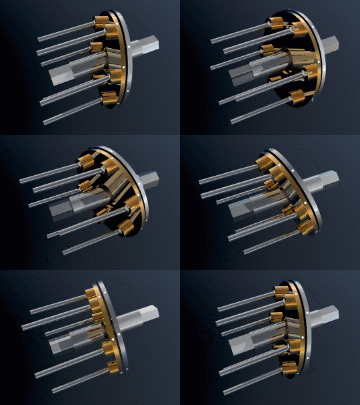
The Human Friendly Transmission is the marketing name of a proprietary continuously variable transmission (CVT) made by Honda for its motorcycles, including the Honda DN-01 and EVO6 concept motorcycle.
The electronically controlled automatic transmission system is unlike more familiar belt-driven CVT systems used on scooters, nor does it have a torque converter, typical of automotive applications. Instead it is a hydrostatic drive that employs a variable displacement axial piston pump with a variable-angle swashplate. Prior to the DN-01, this type of system had not been used in road-going consumer motor vehicles, though it is familiar in industrial applications and heavy equipment such as forklifts and the US Air Force's MJ-1 bomb lift truck, in use since the 1950s. Honda has also dabbled in this technology since the 1950s. It appeared on their 2001 FourTrax Rubicon 4-wheel, off-road ATV.

The electronic controls allow the motorcycle to be operated in three modes: Drive, Sport and Manual. In Drive and Sport, it functions much like a CVT scooter, with infinitely variable gearing upshifted and downshifted automatically for what the system determines to be optimal performance. Unlike a scooter, engine braking is always available when decelerating. The difference between Drive and Sport modes is that Drive is optimized for economy while Sport is more responsive. It is also possible to switch into neutral while stopped, unlike a scooter.
Notes
References
References
- {{harvtxt. Rousseau. 2009
- {{harvtxt. US Air Force
- {{harvtxt. Bivas. 2002
- {{harvtxt. Duke. 2009
- Hoyer. 2009
This article was imported from Wikipedia and is available under the Creative Commons Attribution-ShareAlike 4.0 License. Content has been adapted to SurfDoc format. Original contributors can be found on the article history page.
Ask Mako anything about Human Friendly Transmission — get instant answers, deeper analysis, and related topics.
Research with MakoFree with your Surf account
Create a free account to save articles, ask Mako questions, and organize your research.
Sign up freeThis content may have been generated or modified by AI. CloudSurf Software LLC is not responsible for the accuracy, completeness, or reliability of AI-generated content. Always verify important information from primary sources.
Report