From Surf Wiki (app.surf) — the open knowledge base
Hudson's Bay point blanket
Wool blanket traded by Hudson's Bay Company
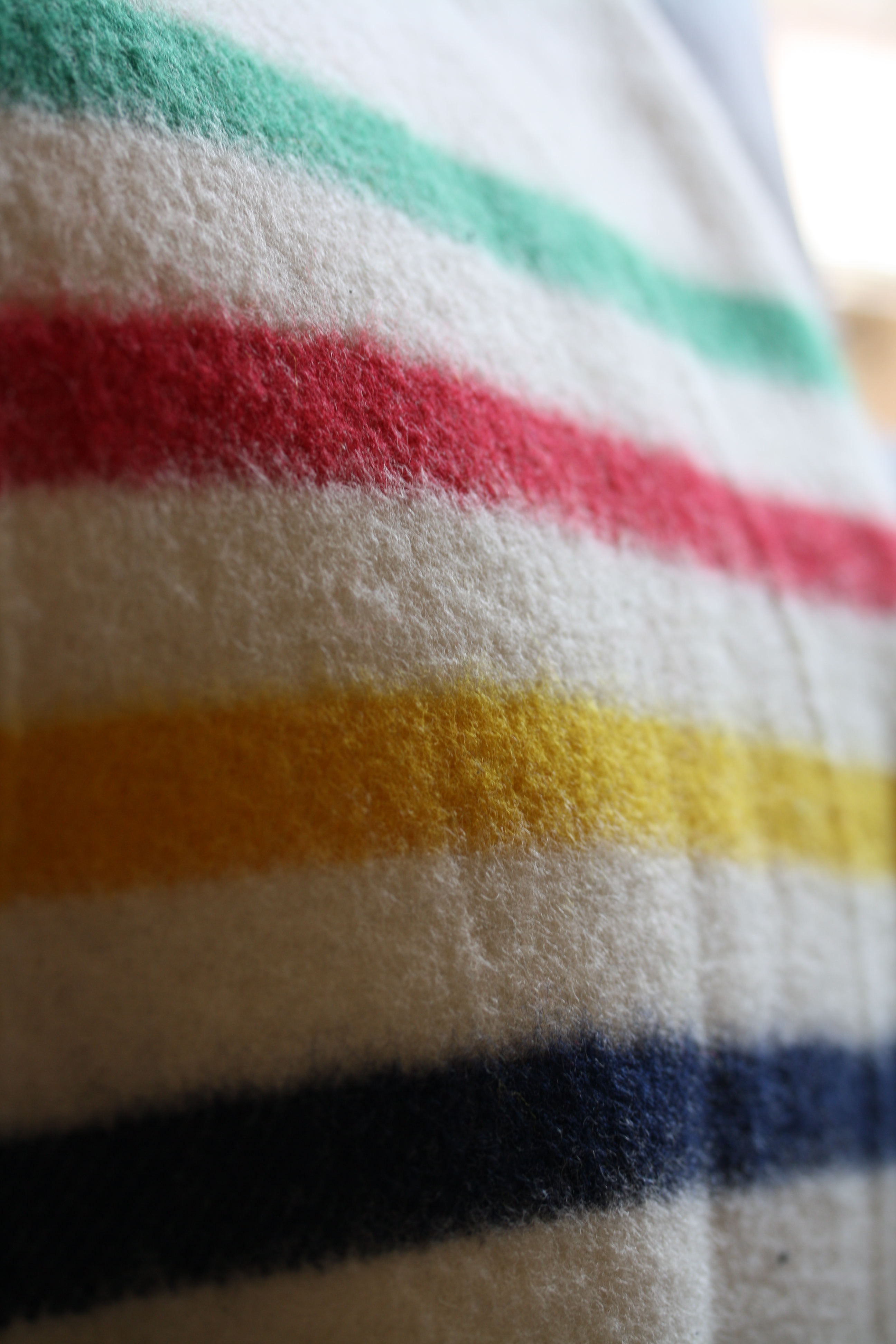
Wool blanket traded by Hudson's Bay Company
A Hudson's Bay point blanket is a type of wool blanket traded by the Hudson's Bay Company (HBC) in British North America, now Canada and the United States, from 1779 to present. The blankets were typically traded to First Nations in exchange for beaver pelts as an important part of the North American fur trade. They were used as bedding and clothing (specifically capotes or greatcoats). In the latter half of the 19th century the blanket coat was popularized amongst the European-descended population of Canada to the extent that it was looked on as national dress.
The point blanket is considered a premier luxury item and Canadian cultural icon. The colour scheme has expanded into fashion, and lifestyle products, including a clothing line, and home decor. These "Bay 'stripes' products" were exclusively sold by the Hudson's Bay department stores and affiliates until the Hudson's Bay Company brand assets were purchased by Canadian Tire. The Blanket Fund, an Indigenous charity started in 2022, receives 100% of the net proceeds from Hudson’s Bay Point Blanket sales.
History

In the North American fur trade, by 1700, wool blankets accounted for more than 60 per cent of traded goods. French fur trader Germain Maugenest is thought to have advised the HBC to introduce point blankets. Originally point blankets had a single stripe across each end, usually in blue or red. In 1798, a mill owner received a purchase order for "30 pair[s] of 3 points to be striped with four colours (red, blue, green, yellow) according to your judgement."
In the 1820s, a relatively few four-stripe, four-colour blankets began to be imported, but most trade blankets continued to have a single stripe, or bar, at each end. In the mid-19th century, more blankets began to be produced with a green stripe, red stripe, yellow stripe and indigo stripe on a white background; the four stripe colours were popular and easily produced using good colourfast dyes at that time. By the early 20th century, long after the fur trade era, the four-stripe, four-colour design became popular as a marker of Canadian national identity.
Point system
- HBC History Foundation (3:56 min) Points are short black lines woven into the selvage of the blanket along the edge just above the bottom set of stripes. About 4 in in length (except in the case of half points, which are 2 in), they indicate the finished overall size (area) of a blanket and allow easy determination of the size of a blanket even when folded. French weavers invented the point system in the mid-1700s since then, as now, blankets were shrunk as part of the manufacturing process. The word point derives from the French empointer, meaning "to make threaded stitches on cloth".
Over the centuries the sizes of blankets have shifted, particularly during the twentieth century as beds became larger. Blankets of 2.5, 3, 3.5 and 4 point were most common during the fur-trade era. Today, Hudson's Bay blankets are commonly found in point sizes of 3.5 (twin bed), 4 (double), 6 (queen) and 8 (king).
The misconception persists that originally the points were an indication of a blanket's price in beaver pelts or even its weight. The number of pelts required to buy a blanket ranged widely by time and location, regardless of its size. Thickness and quality are the same blanket to blanket, and a larger blanket will naturally weigh more.
Coats
Main article: Capote (garment), Mackinaw jacket

From the early days of the fur trade, wool blankets were made into hooded coats called capotes by both Indigenous and French Canadian voyageurs, which were well-suited to Canada's cold winters. The Hudson's Bay Company sold capotes, called 'blanket coats, made out of the company's "point" blankets.{{cite web
In 1811, at Fort St. Joseph there was a shortage of greatcoats for the King's soldiers. The date was November 20, 1811, and British Army Captain Charles Roberts, wrote a letter to Captain Evans, Adjutant General in Quebec, making a requisition for heavy blankets.
Roberts requisitioned HBC 3.5-point blankets from the British Indian Department to manufacture greatcoats for his troops. John Askin Jr., a Métis and keeper of the King's stores at the fort, hired local women to design and manufacture forty woollen greatcoats. Everyone was in agreement that the newly tailored greatcoats were of better quality than the British Army standard-issue greatcoats and helped to increase the morale of the King's soldiers.
At the beginning of the War of 1812, Roberts and his men occupied Fort Michilimackinac located at the present-day Mackinaw City, Michigan. Roberts ordered a new supply of Hudson's Bay point blankets for the upcoming winter to manufacture more greatcoats. This time Roberts had enlisted the aid of professional tailors and seamstresses to produce the greatcoats.
Modern use

Versions of the blanket were available at Hudson's Bay stores throughout Canada. Solid colours are available, as is the classic pattern featuring the green, red, yellow, and indigo stripes. The blankets have always been made in England; today they are made by John Atkinson, a sub brand of A.W. Hainsworth & Sons Ltd. Wools from Britain and New Zealand are used in the manufacture of blankets.
In 2025, Canadian Tire announced the acquisition of the Hudson's Bay Company brands and its intellectual property for $30 million CAD, and in October, Canadian Tire announced they will be marketing Hudson's Bay Point Blankets and related "Bay 'stripes"' products at their stores.
Blanket Fund
Oshki Wupoowane, also known as The Blanket Fund, started on September 30, 2022, with an initial investment of $1M from the Hudson’s Bay Foundation. The fund will receive 100% of net proceeds from Hudson’s Bay Point Blanket sales. After Canadian Tire Corporation acquired Hudson’s Bay Company’s intellectual property in June 2025, they pledged to continue supporting The Blanket Fund. Canadian Tire will continue to donate all net proceeds from Point Blanket sales, ensuring at least $1M annually. The fund supports Indigenous cultural, artistic, and educational activities through two grant streams, benefiting Indigenous-led initiatives and organizations in Canada.
Collectibility
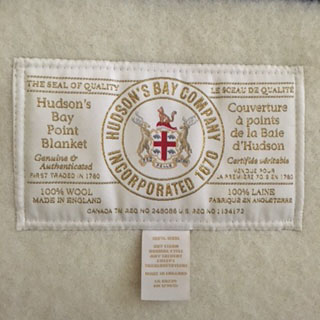
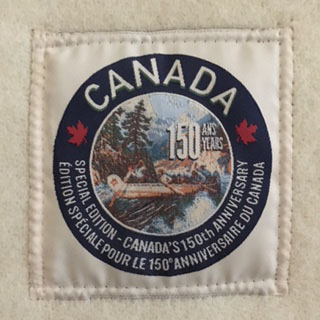
Genuine point blankets have become very collectible and could fetch prices up to thousands of dollars. The main determinants of value include age, size, colour, pattern rarity and condition. Particularly collectible point blankets are the Coronation blankets: the one produced for the 1953 coronation of Queen Elizabeth II and the rarer 1937 coronation blanket.
In 1890, HBC began adding labels to their blankets because point blankets of similar quality were being sold by HBC competitors from such manufacturers as Early's of Witney.
Harold Lee Tichenor, point blanket collector and consultant to Hudson's Bay Company, has written two books on point blankets and their collectability.
In April 2017, HBC updated the label, rotating it from vertical to horizontal, making it easy to display English and French on either side of the crest, which has been enhanced with red on the flag. To celebrate the 150th anniversary of Canada in 2017, HBC added an additional label to the blanket: a picture of voyageurs in a canoe, with "Canada" printed at the top.
On 2 May 2020, HBC celebrated its 350th anniversary. It re-released a series of special, limited-edition blankets in a variety of historic colourways and patterns. It added a 'Special Edition' label with a picture of the sailing vessel Nonsuch and the words 'Celebrating HBC's 350th Anniversary'.
- The Sky Blue Hudson's Bay Point Blanket February
- The Camel Hudson's Bay Point Blanket March
- The Ice Cream Hudson's Bay Point Blanket April
- The 350th Commemorative Hudson's Bay Point Blanket (Grey) May
- The Gold Hudson's Bay Point Blanket June
- The Scarlet Hudson's Bay Point Blanket July
Name in First Nations languages
The Hudson's Bay blanket is called by different names in First Nations languages. Some examples are:
- Baahlaads gyaa'adaay, Haida language{{cite web | access-date = July 10, 2012
- p̓a̱lx̱a̱lasǥa̱m, Kwakʼwala{{cite web | access-date = July 10, 2012
- ʔa·q̓unaq, Kutenai language{{cite web | access-date = July 10, 2012
Gallery
0R9A7651a (47363011331).jpg|Historic point blankets at Valley Forge National Hist Park Hudson's Bay point blankets on display at the Tamástslikt Cultural Institute on the Umatilla Indian Reservation near Pendleton, OR.jpg|Hudson's Bay point blankets on display at the Tamástslikt Cultural Institute on the Umatilla Indian Reservation near Pendleton, OR NativeAmericanLockedHair.jpg|Poundmaker carrying a Hudson's Bay point blanket capote.jpg|Traditional capote made with a Hudson's Bay point blanket
References
Bibliography
- Bown, S. (2020). The Company: The Rise and Fall of the Hudson's Bay Empire. Anchor Canada.
- Bryce, G. (1900). 1st ed. The Remarkable History of the Hudson's Bay Company.
- Forest, Alison and Jill Oakes. “The Blanket Coat: Unique Canadian Dress.” Canadian Home Economics Journal, 41 (3), Summer 1991, pp. 121-127.
- Hanson, C. “Some Additional Notes on Trade Blankets.” The Museum of the Fur Trade Quarterly, 24 (4), Winter 1988, pp. 5-11.
- Hudson’s Bay Point Blankets. Moccasin Telegraph, Spring 1963, pp. 10 & 15.
- Hudson’s Bay Point Blankets. Moccasin Telegraph, Summer 1979, pp. 60-61.
- Mackay, D. “Blanket Coverage.” The Beaver, June 1935, pp. 44-52.
- McIntosh, Andrew. "Blanket Statement — How a Canadian icon is woven into the country's shameful past". November 25, 2021. Ottawa Citizen.
- The Manufacturing Process of HBC Point Blankets. Moccasin Telegraph, Spring 1963, pp. 11-13.
- Olsen, S. (2010). Working with Wool: A Coast Salish Legacy and the Cowichan Sweater. Sono Nis Press.
- Ostroff, J. (2017). How a Smallpox Epidemic Forged Modern British Columbia. Maclean's.
- Plummer, A., Early, R. E. (1969). The Blanket Makers, 1669-1969: A History of Charles Early & Marriott (Witney) Ltd. United Kingdom: Augustus M. Kelley.
- Ross, Lester A. Hudson’s Bay Company Suppliers: An Illustrated Directory of British Commercial Suppliers who provided Manufacturers, Products and Provisions shipped to the Hudson’s Bay Company Columbia Department, 1821-52. Parks Canada, Manuscript Report Number 381, Volume 1.
- Rich, E.E., ed. McLouglin’s Fort Vancouver Letters, First Series, 1825-38. Volume IV, Hudson’s Bay Record Society, London, 1941.
- Rich, E.E., ed. McLoughlin’s Fort Vancouver Letters, Second Series, 1839-44. Volume VI, Hudson’s Bay Record Society, London, 1941.
- Swagerty, W.R. (2002). Indian Trade Blankets in the Pacific Northwest: History and Symbolism of a Unique North American Tradition. Columbia: The Magazine of Northwest History.
- Tichenor, H. (2002). The Blanket: An Illustrated History of the Hudson’s Bay Blanket A Quantum Book.
- Tichenor, H. (2002). The Collector's Guide to Point Blankets of the Hudson's Bay Company and Other Companies Trading in North America. Cinetel Film Productions Ltd.
References
- [https://www.thecanadianencyclopedia.ca/en/article/hudson-s-bay-point-blanket The Canadian Encyclopedia: Hudson’s Bay Point Blanket]
- Eileen Stack. (2004). ""Very picturesque and very Canadian: the blanket coat and Anglo-Canadian identity in the second half of the nineteenth century", in "Fashion--A Canadian Perspective" edited by Alexandra Palmer". University of Toronto Press.
- McLaughlin, Erin. (2020-09-17). "How The Hudson's Bay Point Blankets Became a Canadian Icon".
- Gallagher, Jake. (2013-02-07). "Dropping Knowledge: The Hudson's Bay Company Point Blanket".
- The Canadian Press. (2025-11-05). "Your first look at what Canadian Tire is doing with the Hudson's Bay stripes".
- Harris, Sophia. (2025-05-15). "Canadian Tire to take over Hudson's Bay's iconic stripes, logos".
- (2022-09-30). "The Blanket Fund".
- "Germain Maugenest".
- Clare Sumner. "history Witney Blanket Story – A brief history of the wool trade in the Witney area". Witneyblanketstory.org.uk.
- Greenbaum, Hilary. (September 19, 2011). "Who Made That Hudson's Bay Blanket?". [[The New York Times]].
- "the native canadian". Nativecanadian.ca.
- [https://www.hbcheritage.ca/things/fashion-pop/hudsons-bay-point-blanket-coat HBC Heritage: Hudson's Bay Point Blanket Coat]
- "Hudson's Bay Point Blanket Coat".
- Wooley, H. J. L. (1911). The ''Sword of Old St. Joe''. Chp V, pg 17-21.
- [https://www.pc.gc.ca/en/lhn-nhs/on/stjoseph/info/bulletin/02 Parks Canada: The mackinaw coat{{snd a Canadian invention]
- (2002). "Tracks that speak". Houghton Mifflin Harcourt.
- (February 26, 2018). "History of the Blanket | England's Finest Blankets".
- (March 2025). "Hudson's Bay Point Blanket". HBC.
- (2025-05-15). "Hudson's Bay to sell name, stripes, brands to Canadian Tire for $30 million".
- (2025-10-16). "Canadian Tire will start selling iconic Hudson's Bay blankets, donating proceeds to Indigenous fund". [[CBC News]].
- (2025-10-14). "The Blanket Fund".
- Rajala, Nikki. (2024-10-06). "A short course on point blankets".
- "Point blankets and North America".
- (2002). "The Blanket: An Illustrated History of the Hudson's Bay Point Blanket". Hudson's Bay Company.
- (2002). "The Collector's Guide to Point Blankets of the Hudson's Bay Company and Other Companies Trading in North America". Cinetel Film Productions Limited.
- "colours".
This article was imported from Wikipedia and is available under the Creative Commons Attribution-ShareAlike 4.0 License. Content has been adapted to SurfDoc format. Original contributors can be found on the article history page.
Ask Mako anything about Hudson's Bay point blanket — get instant answers, deeper analysis, and related topics.
Research with MakoFree with your Surf account
Create a free account to save articles, ask Mako questions, and organize your research.
Sign up freeThis content may have been generated or modified by AI. CloudSurf Software LLC is not responsible for the accuracy, completeness, or reliability of AI-generated content. Always verify important information from primary sources.
Report