From Surf Wiki (app.surf) — the open knowledge base
Hubert Humphrey 1968 presidential campaign
American political campaign
American political campaign
| Field | Value |
|---|---|
| name | Hubert Humphrey for President 1968 |
| logo | {{Switcher |
| campaign | 1968 U.S. presidential election |
| candidate | Hubert Humphrey |
| 38th Vice President of the United States | |
| (1965–1969) | |
| Edmund Muskie | |
| U.S. Senator from Maine | |
| (1959–1980) | |
| affiliation | Democratic Party |
| status | Announced: April 27, 1968 |
| Official nominee: August 29, 1968 | |
| Lost election: November 5, 1968 | |
| slogan | Some People Talk Change, Others Cause It |
| Humphrey-Muskie, Two You Can Trust |
|[[File:Humphrey Muskie '68.svg|250px]] |General election logo |[[File:Humphrey HHH '68.svg|250px]] |Initial campaign logo}} 38th Vice President of the United States (1965–1969) Edmund Muskie U.S. Senator from Maine (1959–1980) Official nominee: August 29, 1968 Lost election: November 5, 1968 Humphrey-Muskie, Two You Can Trust
The 1968 presidential campaign of Hubert Humphrey began when Hubert Humphrey, the 38th and incumbent Vice President of the United States, decided to seek the Democratic Party nomination for President of the United States on April 27, 1968, after incumbent President Lyndon B. Johnson withdrew his bid for reelection to a second full term on March 31, 1968, and endorsed him as his successor. Johnson withdrew after an unexpectedly strong challenge from anti-Vietnam War presidential candidate, Senator Eugene McCarthy of Minnesota, in the early Democratic primaries. McCarthy, along with Senator Robert F. Kennedy of New York, became Humphrey's main opponents for the nomination. Their "new politics" contrasted with Humphrey's "old politics" as the increasingly unpopular Vietnam War intensified.
Humphrey entered the race too late to participate in the Democratic primaries. He relied on "favorite son" candidates to win delegates and lobbied for endorsements from powerful bosses to obtain slates of delegates. The other candidates, who strove to win the nomination through popular support, criticized Humphrey's traditional approach. The June 1968 assassination of Robert Kennedy left McCarthy as Humphrey's only major opponent. That changed at the 1968 Democratic National Convention when Senator George McGovern of South Dakota entered the race as the successor of Kennedy. Humphrey won the party's nomination at the convention on the first ballot, amid protests in Chicago. He selected little-known Senator Edmund Muskie of Maine as his running mate. Humphrey was the last nominee who did not participate in the primaries until Vice President Kamala Harris in 2024.
During the general election, Humphrey faced former Vice President Richard Nixon of California, the Republican Party nominee, and Governor of Alabama George Wallace, the American Independent Party nominee. Nixon led in most polls throughout the campaign, and successfully criticized Humphrey's role in the Vietnam War, connecting him to the unpopular president and the general disorder in the nation. Humphrey experienced a surge in the polls in the days prior to the election, largely due to incremental progress in the peace process in Vietnam and a break with the Johnson war policy. On Election Day, Humphrey narrowly fell short of Nixon in the popular vote, but lost, by a large margin, in the Electoral College. Had Humphrey been elected, he would have been the first U.S. president from Minnesota, the first born in South Dakota, and the first incumbent vice president since Martin Van Buren to be elected; this feat would be eventually accomplished 20 years later by George H. W. Bush. Muskie would have been the second vice president from Maine, after Hannibal Hamlin, and the first Catholic vice president; this feat would be eventually accomplished 40 years later by Joe Biden, who would become the first Catholic vice president.
Background
Hubert Humphrey was first elected to public office in 1945 as Mayor of Minneapolis. He served two, two-year terms, and gained a reputation as an anti-Communist and ardent supporter of the Civil Rights Movement. He gave a rousing speech at the 1948 Democratic National Convention arguing for the adoption of a pro-Civil Rights plank, exclaiming "The time has arrived in America for the Democratic Party to get out of the shadow of states' rights and to walk forthrightly into the bright sunshine of human rights." That same year, Minnesota voters elected him to the United States Senate, where he worked closely with Senate Majority Leader Lyndon Johnson. Humphrey's persona and tactics in the Senate led colleagues to nickname him "The Happy Warrior". Contemporaries attributed his success in politics to his likable personality and ability to connect with voters on a personal level.
Humphrey first entered presidential politics in 1952, running as a favorite son candidate in Minnesota. In 1960, he mounted a full-scale run, winning primaries in South Dakota and Washington D.C.; ultimately losing the Democratic nomination to Massachusetts Senator and future President John F. Kennedy. In 1964, with Lyndon Johnson now as president following the assassination of Kennedy, Johnson tapped Humphrey as his running mate and went on to win in a landslide victory over Republican Barry Goldwater. As vice president, Humphrey oversaw turbulent times in America, including race riots and growing frustration and anger over the large number of casualties in the Vietnam War. President Johnson's popularity plummeted as the election grew closer.{{Citation
Lyndon B. Johnson campaign
Main article: Lyndon B. Johnson#1968 presidential election, Withdrawal of Lyndon B. Johnson from the 1968 United States presidential election
Prior to Humphrey's run, President Lyndon B. Johnson began a campaign for re-election, placing his name in the first-in-the-nation New Hampshire primary. Late in 1967, building upon anti-war sentiment, Senator Eugene McCarthy of Minnesota entered the race with heavy criticism of the President's Vietnam War policies.{{Citation | author-link= Robert S. Allen
Johnson assigned Humphrey the task of campaigning for re-election. In this role, the Associated Press described him as the "administration's strongest advocate on Vietnam" policy.{{Citation | author-link=Drew Pearson (journalist) | archive-url=https://web.archive.org/web/20070712085546/http://www.time.com/time/magazine/article/0,9171,828460,00.html | url-status=dead | archive-date=July 12, 2007
In late March, opinion polls suggested McCarthy would likely win the Wisconsin Primary. With defeat looming, Johnson decided to drop out of the race. When he informed Humphrey of his decision, Humphrey urged Johnson to reconsider. Johnson argued it betrayed the best interests of the nation to mix the partisan politics of a presidential election with the ongoing Vietnam crisis. Furthermore, Johnson said that if elected, he probably would not be able to complete the term since the men in his family usually died in their early sixties. A week prior to the primary, on March 31, the President publicly announced he would not seek or accept the Democratic Party nomination,{{Citation
Announcement
After Johnson's withdrawal, Humphrey was hit with a barrage of media interest and fanfare. His aides Max Kampelman and Bill Connell began to set up an organization and held meetings with Humphrey and his advisors, encouraging him to start a campaign. Humphrey set up offices for preparation, and unsuccessfully courted Larry O'Brien as campaign manager. O'Brien explained that his loyalties lay with the Kennedy family, leaving Humphrey undecided on whom to hire. Connell added lawyer and former DNC Treasurer Richard Maguire, who established the temporary campaign headquarters at his law firm. Eventually, Humphrey decided to embrace the youth of politics, adding Senators Fred R. Harris and Walter Mondale, who agreed to lead the Democrats United for Humphrey organization. Harris was put in charge of winning delegates, and Mondale prepared for the convention, helping to keep an organization in place. Kampelman, Connell and McGuire questioned Humphrey's decision to hire the Senators, explaining that they had no organizational experience. Humphrey worried about his organization in the state of Iowa, but Harris and Mondale assured him that what would be lost in the state would be made up in Maryland. The campaign believed they could build a coalition of southern and border state Democrats as well as Union and Civil rights leaders to win the nomination. Mondale and Harris also desired to add a few anti-war liberals to the coalition. Meanwhile, Humphrey's office constantly received calls urging him to announce. Congressman Hale Boggs and Senator Russell Long, both of Louisiana, warned Humphrey that if he did not declare his candidacy soon, Kennedy would secure the nomination. Labor leader George Meany also called for Humphrey to announce immediately, but when Humphrey explained that he did not want to rush into a campaign, Meany called President Johnson to demand that Humphrey announce. Johnson refused, and never explicitly asked Humphrey to run. Governors Harold Hughes of Iowa and Philip H. Hoff of Vermont, each advised Humphrey to resign as vice president to separate himself from Johnson, but he declined. Before the official announcement, Humphrey met with Johnson and discussed the future. The President advised Humphrey that his biggest obstacle as a candidate would be money and organization, and that he must focus on the Midwest and Rust Belt states in order to win.
After weeks of speculation, Humphrey finally announced his candidacy on April 27, 1968, in front of a crowd of 1,700 supporters in Washington D.C. chanting "We Want Hubert". He delivered a twenty-minute speech, broadcast throughout the nation on television and radio that had been in preparation for four days after Johnson's withdrawal. Labor Secretary W. Willard Wirtz, White House staffers Harry McPherson and Charles Murphy, and journalists Norman Cousins and Bill Moyers all contributed to the speech. In the speech, Humphrey proclaimed that the election would be about "common sense, and a time for maturity, strength and responsibility". He set his goals at not simply winning the nomination but winning in a way that would "unite [the] party" so he could then "unite and govern [the] nation". He argued that his campaign was "the way politics ought to be ... the politics of happiness, the politics of purpose, the politics of joy." His entrance occurred too late in the process to qualify for ballot access in the primaries.{{Citation
Campaign developments
As the campaign got underway, Humphrey tried to position himself as the conservative Democrat in the race, hoping to appeal to Southern delegates. Republicans, feeling that the Vice President might be the nominee, began to attack him, describing his positions as socialistic and reminding voters that Southern Democrats once considered him a "wild-eyed liberal". Democrats conceded this point but argued that compared to McCarthy and Kennedy, Humphrey was conservative.{{Citation | author-link=Louis Harris An internal struggle within the campaign between the new politics of Mondale and Harris, and the old politics of Connell, Kampelman and Maguire, sometimes disrupted the organization of staffers in different states. Humphrey ordered Connell to not circumvent Mondale and Harris on campaign decisions, but the clashing continued throughout the campaign. The older faction referred to Mondale and Harris as "boy scouts".
| title= The Pulchritude-Intellect Input | magazine= Time | date= May 31, 1968 | url=http://www.time.com/time/magazine/article/0,9171,844498,00.html | archive-url=https://web.archive.org/web/20101029102450/http://www.time.com/time/magazine/article/0,9171,844498,00.html | url-status=dead | archive-date=October 29, 2010 |
|---|
At the Indiana primary, Humphrey began the strategy of using "favorite son" candidates as surrogates for his campaign, and to weaken his opponents. Governor Roger Branigin stood in for Humphrey in Indiana, and placed second, in front of McCarthy but below Kennedy.{{Citation
Frank Sinatra performed at a fundraising rally for Humphrey's campaign at the Oakland Arena on 22 May.
The next month, Humphrey's rival Robert F. Kennedy was assassinated in Los Angeles, prompting the Vice President to return to his home in Minnesota and "think about the next stage".{{Citation | author-link=Joseph Alsop | author-link2= Jack Anderson (columnist) | author-link=Ralph McGill
In July, Humphrey criticized McCarthy for simply complaining about the war effort and offering no plan for peace.{{Citation | author-link=Clayton Knowles | author-link=Clayton Fritchey
As former Vice President Richard Nixon gained the Republican Party nomination, Humphrey held what he thought was a private meeting with 23 college students in his office. There, he candidly discussed his thoughts about the political climate, unaware that reporters were also in the room and that his statements would become public. Humphrey remarked that youths were using the Vietnam War as "escapism" and ignoring domestic issues. He stated that he had received thousands of letters from young people about the Vietnam War but received zero about Head Start as part of the program designed for poor preschool children began to expire, which he saved with a tie-breaking Senate vote.{{Citation | author-link=Joseph Kraft
Democratic National Convention
Main article: 1968 Democratic National Convention, 1968 Democratic Party vice presidential candidate selection

On August 10, just two weeks prior to the convention opening, South Dakota Senator George McGovern entered the race, casting himself as the standard-bearer of the Robert Kennedy legacy.{{Citation
Humphrey won the party's nomination on the first ballot after a two-hour debate among delegates the next day,{{Citation
General election
Main article: 1968 United States presidential election
As the general election got underway, the largest hurdle for the campaign was finances. Polling numbers showed Humphrey trailing Nixon, causing donations to decrease. President Johnson refused to use the power of his office to help raise money, although many speculated that the tardiness of the convention, scheduled to coincide with Johnson's birthday, contributed to the issue. To stay afloat, several loans were made, which eventually accounted for half of the $11.6 million used by Humphrey throughout the general election. Campaign workers decided that no money would be spent on radio or television advertising until the final three weeks of the election. In September, President Johnson showed his support for Humphrey by giving what was described as the strongest endorsement of the campaign when he asked Texas Democrats to throw their support behind the Vice President. However, Johnson did not give his official endorsement until an October 10 radio address. Meanwhile, Humphrey campaigned in New York where he labeled Nixon a "Hawk", stating that the former Vice President "wanted to go to war (in Vietnam) in 1954". At a later stop in Buffalo, Humphrey was met by protesters.{{Citation
Both campaigns began to use their running mates to attack the other candidate. Republican vice presidential nominee Spiro Agnew criticized the current Vice President for being "soft on communism" and "soft on inflation and soft on law and order". He then compared the nominee to former British Prime Minister Neville Chamberlain.{{Citation | archive-url=https://web.archive.org/web/20101029081002/http://www.time.com/time/magazine/article/0,9171,838729,00.html | url-status=dead | archive-date=October 29, 2010

On September 30, hoping to separate himself from the policies of the Johnson administration at the advice of O'Brien who noted that he needed the anti-war vote to win in New York and California, Humphrey delivered a televised speech in Salt Lake City to a nationwide audience, and announced that if he was elected, he would put an end to the bombing of North Vietnam, and called for a ceasefire. He labeled the new policy "as an acceptable risk for peace".{{Citation
A few days before the election, Humphrey gained the endorsement of his former rival Eugene McCarthy. During a stop in Pittsburgh, Humphrey stated that the endorsement made him a "happy man".{{Citation
Results
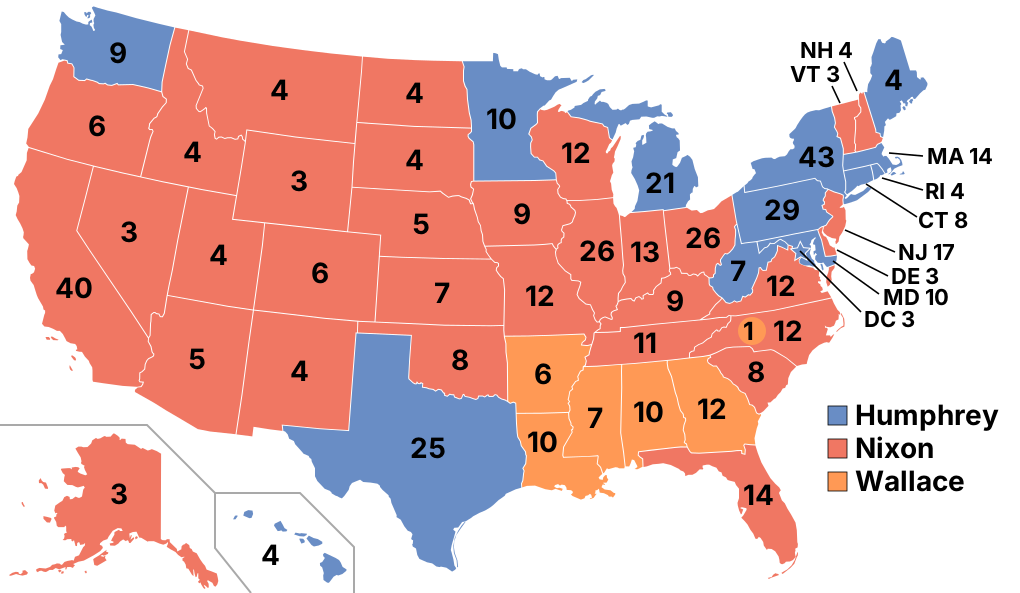
On Election Day, Humphrey was defeated by Nixon 301 to 191 in the electoral college. Wallace received 46, all in the Deep South. The popular vote was much closer as Nixon edged Humphrey 43.42% to 42.72%, with a margin of approximately 500,000 votes. Humphrey carried his home state of Minnesota and Texas, the home state of President Johnson (as well as Maine, running-mate Ed Muskie's home state). He also won most of the Northeast and Michigan, but lost the West to Nixon and the South to Wallace.{{Citation
Post election polls showed that Humphrey lost the white vote with 38%, nine points behind Nixon, but won the nonwhite vote solidly, 85% to 12%, including 85% of African-Americans. African-Americans favored Humphrey because of his record on civil rights, and their desire to quickly end the war in Vietnam, where blacks were overrepresented. The racial divide in the election had widened since 1964, and was attributed to civil rights protests and race riots. Humphrey won 45% of the female vote, two points ahead of Nixon, but lost to the Republican among males, 41% to 43%. Voters with only a grade school education supported Humphrey 52% to 33% over Nixon, while Nixon won among both those with no higher education than high school (43% to 42%) and those who graduated from college (54% to 37%). Occupation demographics mirrored these numbers with manual-labor workers supporting Humphrey 50% to 37%, and with white-collar (47% to 41%) and professionals (56% to 34%) favoring Nixon. Humphrey won among young voters (under 30 years old) by 47% to 38%, and also edged Nixon among those between 30 and 49 years, with 44% to 41%. Nixon won among voters over 50 years, 47% to 41%. Catholics backed Humphrey with 59%, twelve points ahead of Nixon, but Protestants favored Nixon, 49% to 35%. Humphrey lost the Independent vote 31% to 44%, with 25% going to Wallace, and won a lower percentage among Democrats (74%) than Nixon won among Republicans (86%). This discrepancy was connected to the tough Democratic primary election that caused some former McCarthy, Kennedy or McGovern supporters to vote for Nixon or Wallace as a protest.
Aftermath

After the defeat, Humphrey suffered from depression. To stay active, his friends helped him get hired as a professor at Macalester College and the University of Minnesota. He also wrote a syndicated column and was added to the board of directors for the Encyclopædia Britannica. Augmented by paid speaking tours, he earned $200,000 in his first year of private life, the most he ever earned in a single year. He also remained loyal to the Democratic Party, and often attended party fundraising events. In 1970, Humphrey returned to politics and ran for the Senate seat vacated by Eugene McCarthy. During the campaign, he appeared refreshed. He had lost a dozen pounds and darkened his hair in preparation for the race, hoping to appear youthful. Humphrey easily won the election, and began his new term in 1971. He ran again for the Democratic presidential nomination in 1972, and won the most votes during the primary campaign, but lost to George McGovern at the convention. McGovern went on to be defeated by President Nixon in a landslide.{{Citation
Notes
References
Bibliography
References
- "The Living Room Candidate - Commercials - 1968 - The First Civil Right".
- Richardson, p. 76
- Atkins, p. 222
- Richardson, p. 78
- Sherman, Norman. (1992). "The political style of Hubert Humphrey". Perspectives on Political Science.
- Solberg, p. 319
- Small, Melvin. (2004). "The Election of 1968". Diplomatic History.
- Oberdorfer, p. 20
- Oberdorfer, p. 174
- Humphrey, p. 267
- Solberg, p. 324
- Solberg, p. 329
- Solberg, p. 331
- Solberg, p. 332
- Van Dyk, p. 67
- Solberg, p. 325
- Humphrey, p. 269
- Van Dyk, p. 65
- Solberg, p. 336
- ""1968 Presidential Race"".
- Solberg, p. 342
- Solberg, p. 343
- Nancy Sinatra. (1995). "Frank Sinatra: An American Legend". General Publishing Group.
- Solberg, p. 341
- Solberg, p. 340
- Van Dyk, p. 74
- Richardson, p. 403
- "All The Votes...Really". CNN.
- Van Dyk, p. 79
- Van Dyk, p. 80-81
- Van Dyk, p. 81-82
- Richardson, p. 404
- Richardson, p. 415
- Richardson, p. 405
- Richardson, p. 405-406
- (1969). "Polling in 1968". Public Opinion Quarterly.
- Van Dyk, p. 85
- Van Dyk, p. 86
- Van Dyk, p. 88
- Richardson, p. 409
- Richardson, p. 416
- Richardson, p. 418
- Richardson, p. 419
- Van Dyk, p. 89
- Van Dyk, p. 91
- Van Dyk, p. 90
- Richardson, p. 433
- (1969). "Continuity and Change in American Politics: Parties and Issues in the 1968 Election". The American Political Science Review.
- "Election Polls -- Vote by Groups, 1968-1972". Gallup.
- Light, Paul C.. (1992). "Hubert Humphrey and political science". Perspectives on Political Science.
- Richardson, p. 471
- Richardson, p. 472
- Richardson, p. 476
- Richardson, p. 489
- Hruban, Ralph H. (May 5, 1994). "Molecular Biology and the Early Detection of Carcinoma of the Bladder – The Case of Hubert H. Humphrey". Massachusetts Medical Society.
- Kalb, p. 20
This article was imported from Wikipedia and is available under the Creative Commons Attribution-ShareAlike 4.0 License. Content has been adapted to SurfDoc format. Original contributors can be found on the article history page.
Ask Mako anything about Hubert Humphrey 1968 presidential campaign — get instant answers, deeper analysis, and related topics.
Research with MakoFree with your Surf account
Create a free account to save articles, ask Mako questions, and organize your research.
Sign up freeThis content may have been generated or modified by AI. CloudSurf Software LLC is not responsible for the accuracy, completeness, or reliability of AI-generated content. Always verify important information from primary sources.
Report