From Surf Wiki (app.surf) — the open knowledge base
HP-34C
Continuous memory calculator
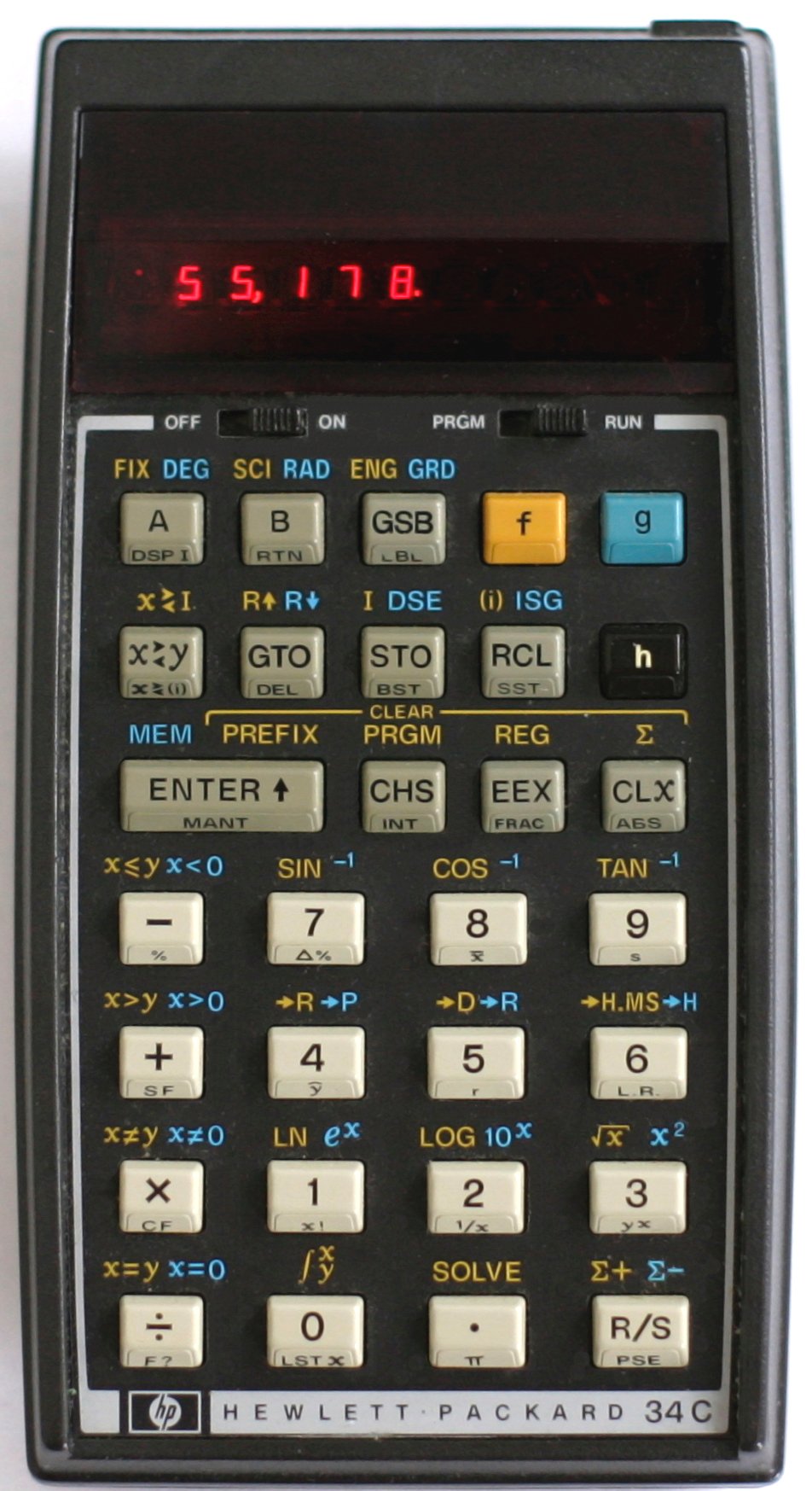
Continuous memory calculator
a Hewlett-Packard product
The HP-34C continuous memory calculator is an advanced scientific programmable calculator of the HP 30 series. It was produced between 1979 (cost US$150) and 1983 (cost US$100).
Features
Root-finding and integration
Significant to the HP-34C calculator is the capability for integration and root-finding (a first for any pocket calculator). Integration and root-finding works by having the user input a formula as a program. Multiple roots are found using the technique of first finding a root x=x_0, then dividing the equation by (x-x_0), thus driving the solution of the equation away from the root at that point. This technique for multiple root-finding is referred to as "deflation". The user would usually programmatically recall the root value from a storage register to improve its precision.
Programming
The common method of converting registers to program memory allowed the calculator a maximum of 210 program steps. Programming features such as indirect jumps provides substantial capability to the calculator's programmer.
The HP-34C shipped with an "applications" manual that included two games (Moon Rocket Lander and Nimb). The winner was announced via calculator spelling by turning the display upside down and the words BLISS or I'LOSE (55178 or 3507,1) were displayed. A game of blackjack was easily programmable by converting some of the registers to lines of program.
Pedigree
The calculator was superseded, in 1982, by the HP-15C.
Although it is argued the HP-41C (introduced late 1979 and only a matter of months after the HP-34C) was a replacement for the HP-34C, they were in fact differentiated as much by price (the HP-34C being 50% that of the HP-41C) as by functionality and performance (the HP-41C being the first HP LCD-based and module-expandable calculator, with its standard functionality lacking the root-finding and integration capabilities as well as the gamma-function implementation of the HP-34C though). This price difference allowed those with economic constraints to still buy a high-end HP (HP-34C) scientific programmable within a reasonable cost. As such they were sold side-by-side for a number of years.
Design
The HP-34C came in a number of variants, such as plastic- and metal-keyboard versions and those with soldered (later 1983 variants) vs pressure-mounted circuitry (earlier variants 1979–1983).
References
References
- "HP‐34". The Museum of HP Calculators.
- "HP-34C Owner's Handbook and Programming Guide". Hewlett‐Packard.
- "34CF". HP Museum.
- [http://www.hpmuseum.org/cgi-sys/cgiwrap/hpmuseum/archv021.cgi?read=216753 HP 34C display problem]
- [http://www.hpmuseum.org/tech30.htm 30 Series Technology And Packaging]
This article was imported from Wikipedia and is available under the Creative Commons Attribution-ShareAlike 4.0 License. Content has been adapted to SurfDoc format. Original contributors can be found on the article history page.
Ask Mako anything about HP-34C — get instant answers, deeper analysis, and related topics.
Research with MakoFree with your Surf account
Create a free account to save articles, ask Mako questions, and organize your research.
Sign up freeThis content may have been generated or modified by AI. CloudSurf Software LLC is not responsible for the accuracy, completeness, or reliability of AI-generated content. Always verify important information from primary sources.
Report