From Surf Wiki (app.surf) — the open knowledge base
House of Bernadotte
Royal house of Sweden

Royal house of Sweden
"By the Grace of God, King of the Swedes, the Goths and the Wends" (used until 1973)
Former titles
- King of Norway (1818–1905) "By the Grace of God, King of Norway" Prince of Pontecorvo Pontecorvo: 1810
The House of Bernadotte is the royal family of Sweden, founded there in 1818 by King Charles XIV John. It was also the royal family of Norway between 1818 and 1905. Its founder was born in Pau in southern France as Jean Bernadotte. Bernadotte, who had been made a General of Division and Minister of War for his service in the French Army during the French Revolution, and Marshal of the French Empire and Prince of Pontecorvo under Napoleon, was adopted by the elderly king of Sweden Charles XIII, who had no other heir and whose Holstein-Gottorp branch of the House of Oldenburg thus was soon to be extinct on the Swedish throne. The current king of Sweden, Carl XVI Gustaf, is a direct descendant of Charles XIV John.
History of the house
Following the conclusion of the Finnish War in 1809, Sweden lost possession of Finland, which had constituted roughly the eastern half of the Swedish realm for centuries. Resentment towards King Gustav IV Adolf precipitated an abrupt coup d'état. Gustav Adolf (and his son Gustav) was deposed and his uncle Charles XIII was elected King in his place. However, Charles XIII was 61 years old and prematurely senile. He was also childless; one child had been stillborn and another died after less than a week. It was apparent almost as soon as Charles XIII ascended the throne that the Swedish branch of the House of Holstein-Gottorp would die with him. In 1810 the Riksdag of the Estates, the Swedish parliament, elected a Danish prince, Prince Christian August of Augustenborg, as heir-presumptive to the throne. He took the name Charles August, but died later that same year.
At this time, Emperor Napoleon of France controlled much of continental Europe, and some of his client states were headed by his siblings. The Riksdag decided to choose a king of whom Napoleon would approve. On 21 August 1810, the Riksdag elected Jean Baptiste Jules Bernadotte, a Marshal of France, as heir presumptive to the Swedish throne.
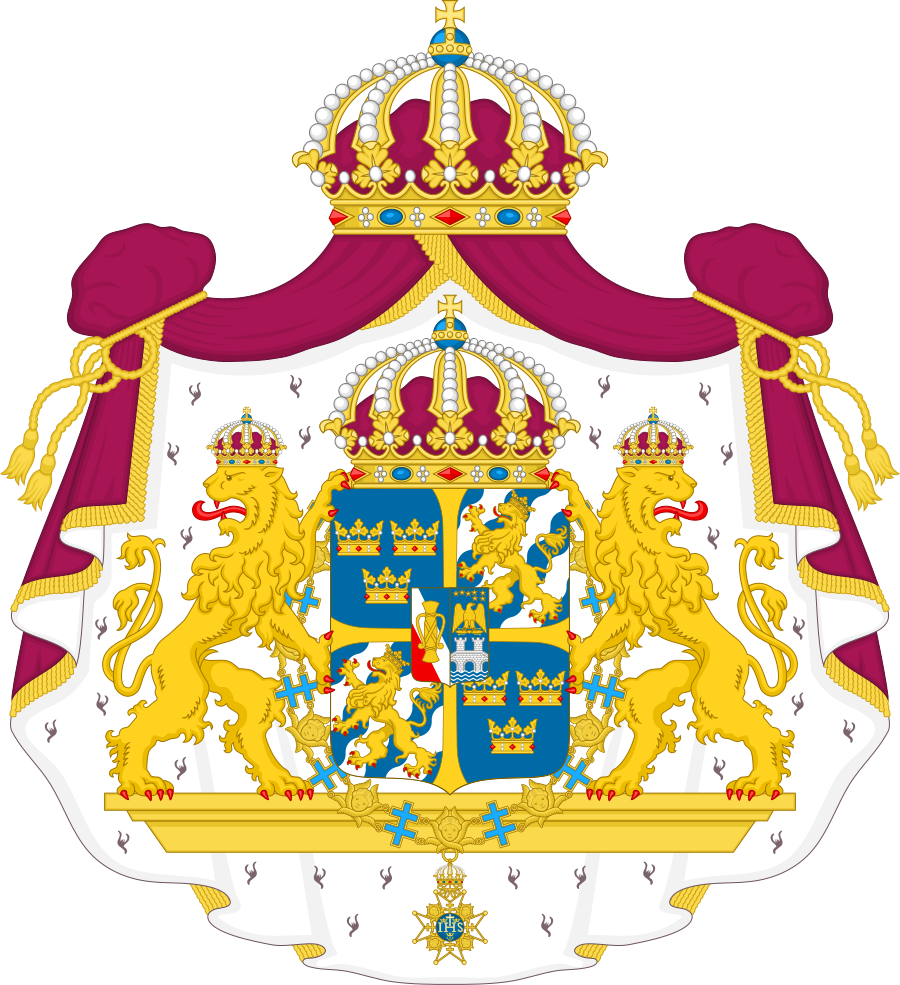
The coat of arms of the House of Bernadotte impales the coat of arms of the House of Vasa (heraldic right) and the coat of arms of Bernadotte as Prince of Pontecorvo (heraldic left; which has the Eagle of Zeus, that shares with the House of Bonaparte). It is visible as an inescutcheon in the Greater Coat of Arms of the Realm.
When elected to be Swedish royalty the new heir had been called Prince Bernadotte according to the promotions he received from Emperor Napoleon I, culminating in sovereignty over the Principality of Pontecorvo. Some Swedish experts have asserted that all of his male heirs have had the right to use that Italian title, since the Swedish government never made payments promised Charles John to get him to give up his position in Pontecorvo.
Some members of the house who lost their royal status and Swedish titles due to unapproved marriages have also been given the titles Prince Bernadotte and Count of Wisborg in the nobility of other countries.
Bernadotte

Bernadotte, born in the town of Pau, in the province of Béarn, France, had risen to the rank of general during the French Revolution. In 1798, he married Désirée Clary, whose sister was married to Joseph, Napoleon's elder brother. In 1804, Napoleon promoted Bernadotte to a Marshal of France. Napoleon also granted him the title "Prince of Pontecorvo".
As the Crown Prince of Sweden, he assumed the name Charles John () and acted as regent for the remainder of Charles XIII's reign. In 1813, he broke with Napoleon and led Sweden into the anti-Napoleon alliance. When Norway was awarded to Sweden by the Treaty of Kiel, Norway resisted and declared independence, triggering a brief war between Sweden and Norway. The war ended when Bernadotte persuaded Norway to enter into a personal union with Sweden. Instead of being merely a Swedish province, Norway remained an independent kingdom, though sharing a common monarch and foreign policy. Bernadotte reigned as Charles XIV John of Sweden and Charles III John of Norway from 5 February 1818 until his death on 8 March 1844.
The House of Bernadotte reigned in both countries until the dissolution of the union between Norway and Sweden in 1905. Prince Carl of Denmark was then elected as King Haakon VII of Norway. Carl was a grandson of King Charles XV of Sweden and a great-great-grandson of Charles XIV.
French origins

-- King Charles John's first known paternal ancestor was Joandou du Poey, who was a shepherd. He married Germaine de Bernadotte in 1615 in the southern French city of Pau and began using her surname. Through her the couple owned a building there called de Bernadotte, the surname theoretically meaning Young woman of Béarn in local dialect.
His son Henri Bernadotte (1711–1780) married Jeanne de Saint-Jean (1728–1809) and with her was the father of the future Swedish–Norwegian king. Henri was a local prosecutor, from a family of artisans, who had once been imprisoned for debt. This was a modest family which occupied only one floor of the house in a cross street in a popular and peripheral district of Pau.
Two branches of the French Bernadotte family survive. The elder descends from Andrew (André) Bernadotte, an older granduncle of Carl John's, with descendants today in the general population of France. The younger branch divided in two, one branch descending from the king's older brother John (Jean Évangéliste) Bernadotte (1754–1813), the heads of which were French barons as of 1810 with Louvie Palace in the south of Pau as their seat (branch extinct with the death of Baron Henri Bernadotte in 1966), and the other branch being the Swedish Royal House.
Kings of Sweden
- 1818–1844: Charles XIV John
- 1844–1859: Oscar I
- 1859–1872: Charles XV
- 1872–1907: Oscar II
- 1907–1950: Gustaf V
- 1950–1973: Gustaf VI Adolf
- 1973–present: Carl XVI Gustaf
Kings of Norway
- 1818–1844: Charles III John
- 1844–1859: Oscar I
- 1859–1872: Charles IV
- 1872–1905: Oscar II
Entire royal house
This is a list only of the royal house, not of the royal whole family. It excludes in-laws and living persons (2022) who were royal, i.e. born members of the royal house, who no longer are royal today. Royals currently alive are listed in italics. All are listed primarily as Swedish royalty unless otherwise noted.
- King Charles XIV & III John of Sweden and Norway (1763–1844)
- King Oscar I of Sweden and Norway (1799–1859)
- King Charles XV & IV of Sweden and Norway (1826–1872)
- Prince Carl Oscar, Duke of Södermanland (1852–1854)
- Queen Louise of Denmark (1851–1926)
- Prince Gustav, Duke of Uppland (1827–1852)
- King Oscar II of Sweden and Norway (1829–1907)
- King Gustaf V of Sweden (1858–1950)
- King Gustaf VI Adolf of Sweden (1882–1973)
- Prince Gustaf Adolf, Duke of Västerbotten (1906–1947)
- King Carl XVI Gustaf of Sweden (born 1946)
- Crown Princess Victoria of Sweden, Duchess of Västergötland (b. 1977)
- Princess Estelle, Duchess of Östergötland (b. 2012)
- Prince Oscar, Duke of Skåne (b. 2016)
- Prince Carl Philip, Duke of Värmland (b. 1979)
- Princess Madeleine, Duchess of Hälsingland and Gästrikland (b. 1982)
- Crown Princess Victoria of Sweden, Duchess of Västergötland (b. 1977)
- Princess Birgitta of Sweden (1937–2024)
- King Carl XVI Gustaf of Sweden (born 1946)
- Prince Sigvard, Duke of Uppland (1907–2002)
- Prince Bertil, Duke of Halland (1912–1997)
- Prince Carl Johan, Duke of Dalarna (1916–2012)
- Queen Ingrid of Denmark (1910–2000)
- Prince Gustaf Adolf, Duke of Västerbotten (1906–1947)
- Prince Wilhelm, Duke of Södermanland (1884–1965)
- Prince Lennart, Duke of Småland (1909–2004)
- Prince Erik, Duke of Västmanland (1889–1918)
- King Gustaf VI Adolf of Sweden (1882–1973)
- Prince Oscar, Duke of Gotland (1859–1953)
- Prince Carl, Duke of Västergötland (1861–1951)
- Prince Carl, Duke of Östergötland (1911–2003)
- Princess Margaretha of Sweden (1899–1977)
- Crown Princess Märtha of Norway (1901–1954)
- Queen Astrid of Belgium (1905–1935)
- Prince Eugen, Duke of Närke (1865–1946)
- King Gustaf V of Sweden (1858–1950)
- Prince August, Duke of Dalarna (1831–1873)
- Princess Eugenie of Sweden and Norway (1830–1889)
- King Charles XV & IV of Sweden and Norway (1826–1872)
- King Oscar I of Sweden and Norway (1799–1859)
(1763–1844) Elected Crown Prince by the Riksdag 1810
(1781–1824) (1788–1851) (1778–1837)
(1807–1876) (1799–1859)
(1801–1865) (1790–1852) (1799–1877)
(1829–1907)
(1826–1872)
Duke of Uppland (1827–1852) (1826–1907)
(1843–1912) Queen consort of Denmark (1851–1926) (1862–1930) (1858–1950)
Duke of Södermanland (1852–1854)
(1882–1973)
Duke of Västerbotten (1906–1947)
(b. 1946)
Duchess of Västergötland 1977– (Crown Princess from 1980) Duke of Värmland (b. 1979) (Crown Prince 1979–1980)
Duchess of Östergötland (b. 2012)
Bernadotte Arms
On , the Marshal of the Empire Jean-Baptiste Jules Bernadotte received from Napoleon the title of prince of Pontecorvo (Pontecorvo is an enclave of the Papal States within the Kingdom of Naples). He was granted these arms with his princedom :
On , Bernadotte, as crown prince of Sweden, adopted as his personal arms the blason Sweden ancient (Three Crowns) and Sweden modern (Arms of Birger Jarl). After the personal union of Sweden and Norway, Bernadotte became crown prince of Norway. On , he added to his arms the Coat of Arms of Norway.
On Bernadotte became King of Sweden–Norway under the name Charles XIV John, and Chalres III John in Norway. For his personal arms he joined the arms of the House of Vasa with his arms as prince of Pontecorvo:
In 1826, following the birth of his grandson prince Charles of Sweden and Norway, King Charles XIV John gave him with the title duke of Scania, with these arms :
The new feature of these arms was that the eagle of Napoleon was replaced by a black raven of Odin. Over this was a field of stars of gold in reference to the title of Marshal of France.
After the death of his father in 1844, prince Oscar became King Oscar I of Sweden and Norway, replaced the field of stars with the Big Dipper/Charles' Wain. In addition to the rules governing the arms of the kingdoms of Sweden-Norway, rules were established for the arms of the queen and the royal prince and princesses.
In 1885, King Oscar II of Sweden replaced the raven with the beak and talons of gold.
In 1908, King Gustav V of Sweden returned the color gold to the Napoleonic Eagle.
Prince Bernadotte, personal, and Count of Wisborg (, , ), hereditary, are titles of nobility granted by the Monarch of Luxembourg to four male-members of the Swedish royal family, including their spouses. Since 1892, the comital title has been borne by the male-line descendants of the four princes of Sweden who married without the consent of the King of Sweden, thereby losing their right of succession to the throne for themselves and their descendants, and thus had their royal titles prohibited.
File:Arms of Prince Bernadotte 1951 Luxembourg.jpg|Prince Bernadotte File:Bernadotte af Wisborg vapen.svg|Bernadotte af Wisborg
|Evolution of the Bernadotte Inescutcheon in the Swedish Royal Arms
Arms of Jean-Évangéliste Bernadotte, elder brother of Jean-Baptiste Bernadotte
Arms of the city of Pontecorvo
Arms of Sovereign Prince within the French Empire
Arms of the Royal Swedish House of Vasa
Arms of Jean-Baptiste Bernadotte as Prince of Pontecorvo
Viking Raven Banner showing one of the Ravens of Odin.
Inescutcheon Arms of Charles XIV (and III) John (since 1818), emphasizing his kinship with the Swedish Royal House of Vasa.
Arms of Charles XIV (and III) John as King of Sweden and Norway
Inescutcheon arms changed in 1826 to one of the Ravens of Odin against a star field symbolizing Marshal of the Empire
Big Dipper/Charles' Wain (in Swedish: Karlavagnen) to symbolize the northern sky.
Eagle of Jupiter with Lighting Bolt
Inescutcheon Arms of the Bernadottes 1844-1885 showing the Big Dipper
Napoleonic Eagle
In 1885, King Oscar II of Sweden replaced the raven with a black Napoleonic Eagle (Eagle of Jupiter) with the beak, talons, and lightning bolt of gold. Odin was believed to shapeshift to an eagle.
In 1908, King Gustav V of Sweden returned the color of the eagle to gold to match a Napoleonic Eagle.
|}
Notes
References
- Jean-Marc Olivier, "Bernadotte Revisited, or The Complexity of a Long Reign (1810–1844)", in Nordic Historical Review, number 2, October 2006, pp. 127–137.
References
- {{Cite American Heritage Dictionary. Bernadotte
- (September 2022). "Bernadotte, Folke". [[Oxford University Press]]}}{{dead link.
- (1990). "Tronrätt, bördstitel och hustillhörighet".
- ''Ätten Bernadotte : biografiska anteckningar'', [Andra tillökade uppl.], Johannes Almén, C. & E. Gernandts förlag, Stockholm 1893, p. 1
- Demitz, Jacob Truedson. (2020). "Centuries of Selfies: Portraits commissioned by Swedish kings and queens". Vulkan Förlag.
- (18 March 2011). "Bernadotte : un général de Napoléon devenu du Roi de Suède". ndf.fr.
- ''Bulletin du Musée Bernadotte'' volume 3–4, Pau 1958–1959, p. 57
- (27 August 2010). "Le fabuleux destin de Jean-Baptiste Bernadotte : de Pau à Marseille". lefrancofil.com.
- (28 September 2010). "Victoria de Suède sur les pas de son aïeul". larepubliquedespyrenees.fr.
- "Photo du Château Louvie, à Jurançon – Côté Est". J. Callizo, photographe (1909).
- ''Bulletin du Musée Bernadotte'' charts on ancestry
- François Velde. (26 August 2011). "LL".
- Berghman, Arvid. (1944). "Dynastien Bernadottes vapen och det svenska riksvapnet". Svensk Litteratur.
- Bramstång, Gunnar. (1990). "Tronrätt, bördstitel och hustillhörighet". Juristförlaget i Lund.
This article was imported from Wikipedia and is available under the Creative Commons Attribution-ShareAlike 4.0 License. Content has been adapted to SurfDoc format. Original contributors can be found on the article history page.
Ask Mako anything about House of Bernadotte — get instant answers, deeper analysis, and related topics.
Research with MakoFree with your Surf account
Create a free account to save articles, ask Mako questions, and organize your research.
Sign up freeThis content may have been generated or modified by AI. CloudSurf Software LLC is not responsible for the accuracy, completeness, or reliability of AI-generated content. Always verify important information from primary sources.
Report