From Surf Wiki (app.surf) — the open knowledge base
House of Ascania
German noble family originating from the 11th century, prominent in Saxony and Brandenburg

German noble family originating from the 11th century, prominent in Saxony and Brandenburg
| Field | Value | |||
|---|---|---|---|---|
| surname | House of Ascania | |||
| coat of arms | [[File:Arms of the house of Ascania (ancient).svg | 75px]] [[File:Arms of Heinrich I, Prince of Anhalt.svg | 75px]] [[File:Arms of the house of Anhalt (13th century).svg | 75px]] |
| country | Germany, Russia | |||
| founding year | ||||
| founder | Esiko, Count of Ballenstedt | |||
| current head | Eduard, Prince of Anhalt | |||
| final ruler | Joachim Ernst, Duke of Anhalt | |||
| titles | *Count/Prince/Duke of Anhalt | |||
| deposition | 1918 (Duchy of Anhalt) |
- Duke of Saxony
- Margrave of Brandenburg
- Duke of Saxe-Lauenburg
- Duke of Saxe-Wittenberg
- Elector of Saxony
- Prince of Lüneburg
- Empress and Autocrat of All the Russias
- Empress consort of All the Russias
The House of Ascania is an Old Saxon high noble family historically documented since the 11th century. It is also known as the House of Anhalt, which refers to its longest-held possession. Their ancestral seats, Ballenstedt, Anhalt, Aschersleben, and Bernburg, are located in the present-day Anhalt region in Saxony-Anhalt. The ruins of Anhalt Castle are situated in the Harz Mountains northeast of Harzgerode. The name "Askanier" derives from the Latinization of their seat at Aschersleben. Since the late 17th century, only the Anhalt branch has survived. Albert the Bear became Duke of Saxony in 1138 and, with the control of the Margraviate of Brandenburg in 1150, the first Margrave in the formerly Slavic settlement area. In 1180, eastern parts of the Stem Duchy of Saxony passed to the Askanier Bernhard of Saxony. As Dukes of Saxe-Wittenberg, the family received hereditary electoral dignity in 1356. The family ruled Anhalt-Dessau, Anhalt-Bernburg, Anhalt-Köthen, Anhalt-Zerbst, Anhalt-Plötzkau, and Anhalt-Aschersleben. Alexius Friedrich Christian of Anhalt-Bernburg was the first of the Anhalt princes to gain the title of Duke in April 1806. The ducal title was adopted in Anhalt-Köthen and Anhalt-Dessau in 1807. Since 1863, only the Dessau line has existed, with Aribert of Anhalt abdicating in 1918 due to the November Revolution in the Duchy of Anhalt. Since 1963, Eduard, Prince of Anhalt has been the head of the family.
History Overview
From the Beginnings to Before 1212

The Askanier are documented as Counts of Ballenstedt, originating from an area now part of the Harz district in Saxony-Anhalt. From the outset, the family held possessions in the present-day districts of Salzlandkreis and Anhalt-Bitterfeld. Ballenstedt, Aschersleben, and ultimately Anhalt Castle were the most significant ancestral seats, with Ballenstedt as the eponymous seat in the 11th and 12th centuries. These possessions, along with further holdings in present-day Anhalt, led to the emergence of several Anhalt principalities in the 13th century. Due to numerous land divisions, concentrated ownership in a single hand was the exception over the centuries.
The earliest known Askanier, Esico of Ballenstedt, is reported in older literature to have built Anhalt Castle. The ruins of Anhalt Castle are located on a spur of the Great Hausberg on the right bank of the Selke. The origins and earlier history of the Ballenstedt family are unknown.
The family name, derived from Anhalt Castle, is still used by members of the house today. The term "Askanier" became a common designation for the Counts of Aschersleben starting in the 14th century. The Margraves of Brandenburg, Dukes of Saxony, and all other lines are also referred to as Askanier.
Family history often begins in literature with an Askanier whose name is unknown. Traditionally, this figure is still referred to as Adalbert, though it is agreed that the name is merely speculative based on his grandson. He was married to Hidda, a daughter of Hodo I, Margrave of the Ostmark. Their children are typically listed as Esico, Theoderich, Ludolf, Uta, and Hazecha.
Esico of Ballenstedt is the first named ancestor and exercised comital rights. He is mentioned in contemporary documents, such as a diploma issued by Emperor Conrad II on October 26, 1036, at the Pfalz Tilleda (comitatu Esiconis, translated as "in the county of Esico"). His clan was based in the eastern Saxon Schwabengau, which is why they are classified in the Sachsenspiegel as part of the Swabian ancient nobility. The Schwabengau (Suavia) was a county located east of Quedlinburg.
The primary source for the genealogy of the early Askanier is the chronicle of the Annalista Saxo, written in the mid-12th century. According to it, Esico was maternally a grandson of Margrave Hodo († 993) and inherited several allodial estates in the Schwabengau and Serimuntgau after the death of his uncle Siegfried († c. 1030). The name of Esico's father is unknown; only in much later genealogies was he assigned the name Adalbert (I), as the Saxon annalist names the Count Adalbert (II), murdered around 1080, as Esico's son. On the present-day Schlossberg of Ballenstedt, Esico established the collegiate church St. Pancratius und Abundus, consecrated in 1046 in the presence of King Henry III. He was advocate of the monasteries Nienburg and Hagenrode.

Adalbert II of Ballenstedt, son of Esico and his wife Matilda, was a count in the Nordthüringgau and is mentioned in connection with the Nizizi and Serimunt counties. It is presumed that his mother was the daughter of Duke Herman of Swabia. He married Adelheid, daughter and heiress presumptive of Count Otto I of Weimar-Orlamünde, Margrave of Meissen, and had two sons, Otto the Rich and Siegfried. Adalbert was killed around 1080 by Egeno II of Konradsburg. While speculations about the motive exist, the reasons remain unclear. A seal depicting Adalbert exists, representing the earliest known stylized depiction of an Askanier.
The Saxon annalist referred to Esico, Adalbert II, and Otto the Rich as "Counts of Ballenstedt," but this title is historically verified only for Otto (Ottoni comiti de Ballenstide) in 1106. Thus, it is confirmed that he named himself after Ballenstedt Castle in the eastern Harz. Otto was briefly Duke of Saxony in 1112. He married Eilika, daughter of Duke Magnus of Saxony. Through this, he acquired Billung allodial estates and later received the Duchy of Saxony from the emperor. The count died in 1123 and was buried in Ballenstedt. His widow Eilika lived in Halle and Bernburg after his death. Otto the Rich and his son Albert the Bear converted the Ballenstedt collegiate church into a Benedictine monastery in 1123. His brother Siegfried was Count of Weimar-Orlamünde and Palatine of the Rhine.
Albert the Bear was the first significant family member and the most prominent Askanier in the Middle Ages. A contemporary and rival of Henry the Lion (Welfs) and Conrad the Great (Wettins), he significantly advanced the German settlement of Slavic border marks and founded the Margraviate of Brandenburg on the territory of the former Nordmark. He briefly served as Duke of Saxony before becoming Margrave of Brandenburg, establishing his family's power in the Saxon eastern marches. His extensive territorial possessions were divided among his sons Otto, Herman, Bernhard, and Adalbert. This created the four main Askanier branches at the time: Brandenburg (until 1320), Weimar-Orlamünde (until 1486), Saxe-Wittenberg (until 1422), Saxe-Lauenburg (until 1689), and Anhalt (to the present). Albert is referred to as a Count of Aschersleben, indicating that the title "Counts of Aschersleben" emerged in the 12th century. He was first documented as comes Asscherslovensis on August 8, 1147, during a court session he presided over. Whether Albert used this title himself is unclear, but he referred to himself as Margrave of Brandenburg in a document dated October 3, 1157 ("Adelbertus dei gratia marchio in Brandenborch"). The epithet "the Bear" was used in contemporary sources. Albert the Bear died in November 1170 and was almost certainly buried in the Ballenstedt house monastery. The bear is the heraldic animal of Anhalt. His son Bernhard used various Latin variants of Count of Aschersleben and later Duke of Saxony. The Gelnhausen Charter of 1180 included the division of the Stem Duchy of Saxony. In this arrangement, Bernhard was enfeoffed with the eastern part, which continued to bear the name Saxony. He received the ducal title the following year after the Erfurt Reichstag.
From 1212 to 1603
.jpg)
After the death of Bernhard III, Duke of Saxony, in February 1212 in Bernburg, his eldest son Henry received the Anhalt house estates between the Lower Harz and the lower Mulde River, while his brother Albert inherited the Duchy of Saxony. Their father Bernhard III inherited the County of Aschersleben from Adalbert, who had no male heirs. Although Albert held a higher title, Henry's possessions were securely in the family's hands. Part of the County of Anhalt was also allodial property. The division of 1212 marks the beginning of Anhalt's independent development, with Henry I as its first ruler. It is likely that he controlled a relatively cohesive area around Aschersleben, Ballenstedt, and Anhalt Castle, with a narrow connection to larger eastern complexes around Bernburg, Köthen, Wörbzig, Dessau, and Wörlitz, extending to the right bank of the Elbe around Coswig. Henry I of Anhalt appeared as Count of Askanien (comes Aschariae) in a document issued on November 4, 1213. Ascharia is a term used by the document's issuer. Henry I was also the first to be called Prince in or of Anhalt (comes Ascharie et princeps in Anahalt) and was also Count of Aschersleben. The prince was considered cruel, as he mistreated Abbot Gernot at Nienburg. In the early 14th century, family members used Anhalt as their designation, regardless of whether they held Anhalt Castle.
In the 13th century, the Anhaltiner were among the elite in their region, i.e., the Anhalt area. However, their significance declined sharply in the 14th and 15th centuries, as evidenced by their reduced imperial political influence and marriage alliances. Like other imperial princes, the Askanier benefited from the Statutum in favorem principum, enacted in 1231 at the Worms Hoftag, which regulated the sovereign rights of princes. The first formation of lines in the present-day Anhalt region occurred through the land division of 1252 among the sons of Henry I of Anhalt. Henry II founded the Aschersleben line, Bernhard I the Bernburg line, and Siegfried I the Köthen line. Alongside Köthen, Dessau and Coswig were part of this Principality. Dessau later gained significance as a residence. Ballenstedt belonged to Anhalt-Aschersleben and gave the Askanier their name as Counts of Ballenstedt. The family ruled the Principality of Anhalt-Aschersleben until 1315. The Askanier acquired the lordship of Zerbst in 1307 from the lords of Barby, which was last administered by Anhalt-Köthen; the Principality of Anhalt-Zerbst was established in 1396.
Anhalt-Köthen was divided among the sons of John II, son of Albert II of Anhalt-Zerbst. The brothers Sigmund I, Albert III, and Waldemar III initially ruled jointly. Waldemar III died soon after, and in 1396, the Sigmundian line (Zerbst) and Albertine line (Köthen) emerged. Sigmund I received the land on the right bank of the Elbe, while Albert III received the land on the left bank. Albert III's sons Waldemar IV, Adolf I, and Albert IV had significant disputes with their cousin George I of Anhalt-Zerbst regarding possessions. The possessions were later redistributed. The Sigmundian line eventually gained partial ownership of the Albertine line, which ended at the beginning of the 16th century. The Bernburg branch expired in 1468, and its possessions passed to the Sigmundian line.
The Sigmundian line split again in 1474 into the older Dessau line (Anhalt-Dessau; Ernestine-Dessau branch) and the so-called older Köthen line (Anhalt-Köthen), here used to refer to the Waldemarian-Köthen branch. The death date of George I is used, though some sources cite the earlier division by him in 1471. The latter line expired with Wolfgang of Anhalt-Köthen in 1566, and the possessions had already passed to the older Dessau line in 1562. Wolfgang was the son of Waldemar VI of Anhalt-Köthen and grandson of George I. The older Köthen line acquired part of the Zerbst lands in 1508, which also passed to the older Dessau line. Around 1500, the Magdeburg Archbishop attempted to subordinate the principality to his own sphere of influence, which would have meant the loss of imperial immediacy. Through the Imperial Reform starting in 1500, imperial circles were created in the Holy Roman Empire. The principalities were part of the Upper Saxon Circle. Wolfgang of Anhalt-Köthen introduced the Reformation in 1525 and was a leading figure among Protestant princes. He signed the Augsburg Confession in 1530, was a co-founder of the Schmalkaldic League in 1531, and participated in the Schmalkaldic War in 1546.
In the mid-16th century, progressive legislation modernized administration. The older Dessau line split in 1546 into the Zerbst, Dessau, and Plötzkau branches. John V received the Zerbst lands, Joachim Dessau, and George III Plötzkau.
Since Wolfgang of Anhalt-Köthen († 1566) from the older Köthen line died childless, his lands passed to Joachim Ernst of Anhalt, son of John IV and part of the older Dessau line. Joachim Ernst unified all possessions in 1570 and moved his seat of government to Dessau.
From 1603 to the present

In 1603, another division created the younger lines of Anhalt-Dessau, Anhalt-Bernburg, Anhalt-Köthen, and Anhalt-Zerbst. John George I became Prince of Anhalt-Dessau and received the town, office, and castle of Dessau with Schloss Lippene, the towns of Raguhn and Jeßnitz, and the offices of Wörlitz, Sandersleben, and Freckleben. Christian I ruled Anhalt-Bernburg with the town, office, and castle of Bernburg, Plötzkau, Hoym, Ballenstedt, Harzgerode, and Güntersberge. Rudolph founded the Anhalt-Zerbst line and held the town, office, and castle of Zerbst with Kermen, Lindau, Roßlau, and Coswig. Louis I established the Anhalt-Köthen branch and received the town, office, and castle of Köthen with Brambach, Wulfen, Nienburg, and the marks of Jeser, Baalberge, Warmsdorf with Kolbigh, and the Vorwerk Diebzig. August initially renounced land ownership for a settlement but, after renegotiations in 1611, received Plötzkau from the Bernburg share, though without sovereign rights.
The division of possessions was significant only within the overall principality. Externally, the principality spoke with one voice, remaining undivided. Anhalt-Plötzkau existed until the mid-17th century and then passed to Anhalt-Bernburg. Anhalt-Köthen expired in 1665. The Anhalt-Plötzkau line inherited this possession and renamed itself Anhalt-Köthen.
Emperor Francis II granted the Prince of Anhalt-Bernburg the right to be called "Duke" in 1806. In 1807, Anhalt-Dessau and Anhalt-Köthen were also elevated to duchies by Napoleon Bonaparte. The Zerbst branch died out in 1793, the Köthen line in 1847, and the Bernburg line in 1863. Thus, in 1863, the Duchy of Anhalt (Anhalt-Dessau line) was formed with Dessau as its residence, remaining the sole ruling territory until the abdication in 1918.
Less significant lines included Anhalt-Köthen-Pless (1755 to mid-19th century), Anhalt-Bernburg-Schaumburg (1707–1812), and Anhalt-Harzgerode (1635–1709).
After the Askanier's abdication, Ballenstedt Castle remained the family's residence. Joachim Ernst, the last duke, married Elisabeth Strickrodt in March 1927; the marriage was dissolved in 1929. In October 1929, he married Edda-Charlotte von Stephani-Marwitz, producing the children Marie Antoinette, Anna Luise, Leopold Friedrich, Edda, and Eduard. Joachim Ernst was arrested by the Nazis in January 1944 and held for three months in Dachau near Munich. In September 1945, he was arrested by Soviet occupation forces and taken to NKVD special camp Nr. 2 near Weimar, where he died in February 1947. His rehabilitation by the Russian state occurred in 1992. From 1947, his son Leopold Friedrich was head of the house, and since 1963, his son Eduard has been.
The House of Anhalt today

Since 1963, Eduard has served as the head of the family. Born in 1941 in Ballenstedt, he succeeded his older brother Leopold Friedrich, who died in a traffic accident. Both are sons of Joachim Ernst, who was the last duke, still a minor in 1918. The family uses the traditional nobiliary particle "Highness," applied to both the head and other family members. Eduard, Prince of Anhalt, is the last male Askanier; the family will become extinct in the male line upon his death. The current head of the family and his three daughters are the only legitimate descendants of the Askanier in the agnatic line. Two morganatic lines, the Counts of Westarp and of Waldersee, descend from non-house-law-compliant marriages of two Anhalt princes. Eduard, Prince of Anhalt, is related to the British King Charles III and had initial contact with the Windsors in 1947 when his mother was invited to Buckingham Palace in London. Familial ties exist through his great-uncle Aribert of Anhalt, who was married to a granddaughter of Queen Victoria.
In January 2010, the head of the house issued the "Dessau Declaration," amending the house law to introduce female succession. Thus, his eldest daughter, Julia Katharina, is designated as the future head of the House of Anhalt. This is a novelty within the German high nobility. Due to the unconventional nature of absolute primogeniture allowing a female successor, the non-noble marriage of the designated heiress, and questions about whether monarchical house laws can be amended after the monarchy's abolition, this decision is controversial among conservative representatives of so-called noble associations, and the daughters' descendants are not yet included in the Gotha Genealogical Handbook.
Heads of the House of Anhalt
- 1947–1963 Leopold Friedrich (* 1938; † 1963), son of Joachim Ernst
- Since 1963 Eduard (* 1941), brother
Territories of rule
General overview
Overview of land divisions
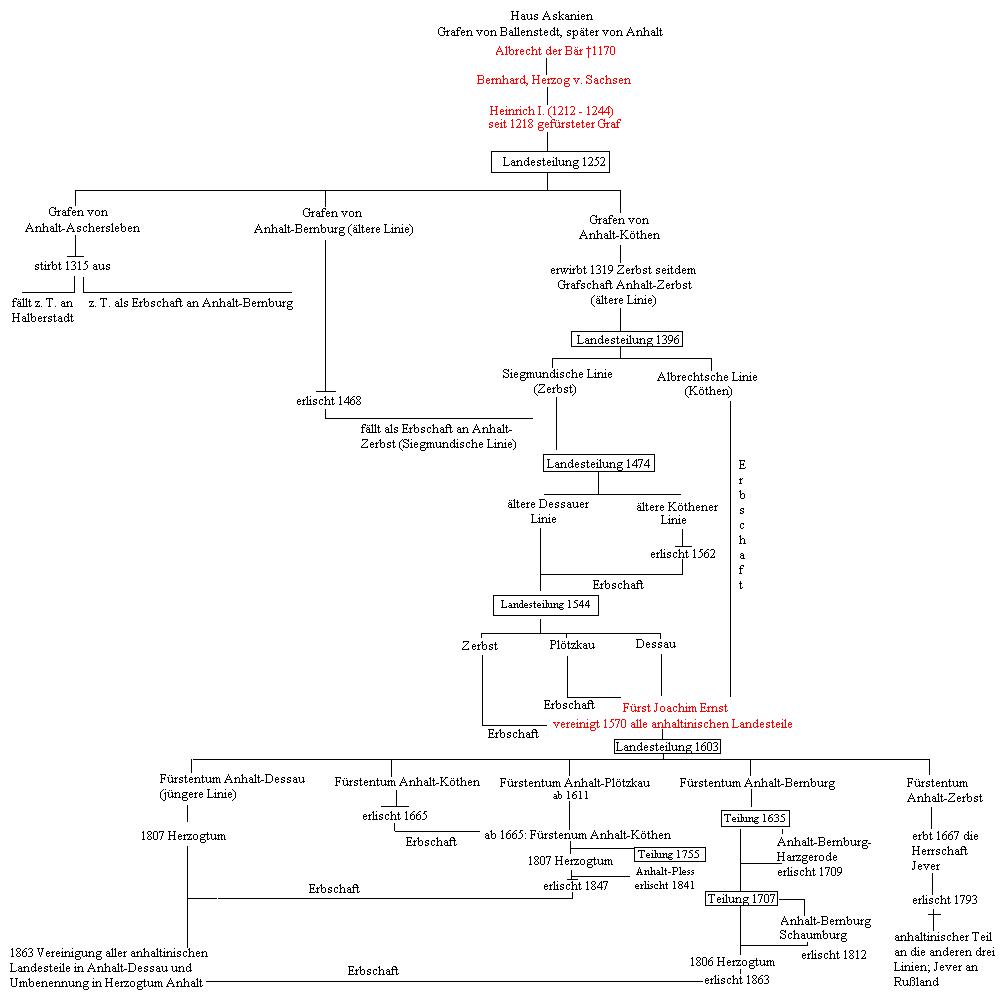
Note: The Albertine line expired with Adolph II of Anhalt-Köthen and Magnus of Anhalt, who renounced governance in 1508.
Rule in Anhalt
Anhalt-Aschersleben
Main article: Anhalt-Aschersleben
.jpg)
The allodial estates of the Ascanians between the Harz and Elbe remained with the Anhalt line after the 1212 division. Henry II. was the son of Henry I. of Anhalt and founded the Anhalt-Aschersleben line in 1252. He received the territories of Aschersleben, Gernrode, Hecklingen, Ermsleben, and Wörbzig. The Anhalt-Aschersleben region also included Ballenstedt and Anhalt Castle. The Ascanians originated from this area. The principality passed to the Diocese of Halberstadt in 1315, and with it, to the Margraviate of Brandenburg in 1648. The Bishop of Halberstadt enfeoffed Bernhard II. of Anhalt-Bernburg in December 1316, transferring Anhalt-Aschersleben as a fief to Anhalt-Bernburg.
Rulers of Anhalt-Aschersleben
Principality of Anhalt-Bernburg
Main article: Anhalt-Bernburg

Bernhard I. (* 1218; † 1287) was born as the son of Henry I. of Anhalt and founded the old Bernburg line. Prince Bernhard III. of Anhalt was the first in 1320 to call himself comes Ascanie. Nineteenth-century historiography then applied this term to all members of the family of the Counts of Ballenstedt and Aschersleben since the 11th century. After the death of Bernhard VI in 1468, George I. of Anhalt-Zerbst inherited the possessions. A castle complex in Bernburg is mentioned in 961 and 1138, though the former date is uncertain. Under Wolfgang of Anhalt-Köthen, the Wolfgangsbau was constructed at Bernburg Castle in 1538/1539, located at the site of the former hillfort.
Christian I. of Anhalt-Bernburg became the governor of the Upper Palatinate in 1595 in the service of Elector Frederick IV. of the Palatinate and resided in Amberg. He represented Frederick IV at the founding of the Protestant Union. In 1619, he had significant influence in the election of his employer Frederick V. of the Palatinate as King of Bohemia.
Emperor Francis II. elevated Prince Alexius Frederick Christian to Duke in April 1806. Anhalt-Bernburg passed to Leopold IV of Anhalt-Dessau after the reign of Alexander Charles (* 1805; † 1863).
Rulers of Anhalt-Bernburg
Principality of Anhalt-Köthen
Main article: Anhalt-Köthen

Siegfried I. († 1298) was the son of Henry I of Anhalt and received Köthen; his territory was to the right of the Saale and partly to the right of the Elbe. In 1272, he founded the Augustinian nunnery at Coswig, whose collegiate church was St. Nicolai. In older literature, the Anhalt-Köthen line is sometimes referred to as the old Zerbst line. Siegfried's sons were Albert I., Henry, Siegfried II, and Hermann.
The Anhalt-Köthen line adopted the ducal title from 1807. Henry (* 1778; † 1847) was the last Duke of Anhalt-Köthen. The land passed to the lines of Anhalt-Bernburg (administered by Anhalt-Dessau) and Anhalt-Dessau. No division occurred due to the anticipated extinction of the Bernburg line and the subsequent inheritance by Anhalt-Dessau.
Rulers of Anhalt-Köthen
Principality of Anhalt-Zerbst
Main article: Anhalt-Zerbst
The possessions were administered jointly with Köthen and Dessau before 1396. John VI. publicly introduced the Lutheran confession in 1644, and Calvinist preachers were subsequently replaced. In May 1681, the foundation stone was laid for the main part of Zerbst Castle. The Zerbst line ceased in 1793, and the possessions passed to the other brothers in 1797. The Köthen line ended in 1847, and Köthen was unified with Dessau in 1853. After the Bernburg line also became extinct in 1863, the Duchy of Anhalt was formed under Leopold IV († 1871). Anhalt-Zerbst acquired the Lordship of Jever through inheritance in 1667.
Until 1797, Roßlau was a Quedlinburg fief held by the Prince of Anhalt-Zerbst, then passed to Anhalt-Köthen, where it formed the "New Köthen" part, and finally to Anhalt-Dessau in 1847. File:Zerbst Schloss vor Zerstörung.JPG|Zerbst Castle (historical photograph) File:Joachim ernst von anhalt 2a.jpg|Joachim Ernest ruled all of Anhalt from 1570. File:Coswig(Anhalt),Schloss.jpg|Coswig Castle, built 1667–1677 as a widow's residence File:Schloss Dornburg Hofseite.jpg|Dornburg Castle, built from 1750 as a widow's residence for the dowager princess Joanna Elisabeth, mother of Catherine the Great
Rulers of Anhalt-Zerbst
Principality of Anhalt-Dessau
Main article: Anhalt-Dessau
.svg)
A separate cadet line of the princely house in Dessau emerged in 1474. Ernest († 1516) was born as the son of George I. of Anhalt-Zerbst and founded the Ernestine-Dessau line (Anhalt-Dessau). His brother Sigismund III. died in 1487 and was also a Prince of Anhalt-Dessau. The construction of the Dessau Palace is generally believed to have begun around 1530.
In 1660, John George II. succeeded his father John Casimir as regent. Under his rule, Großalsleben was added to the possessions. For his wife Henriette Catherine from the House of Orange-Nassau, Oranienbaum Palace was built east of Dessau from 1681. John George II was a brother-in-law of Elector Frederick William of Brandenburg.
Leopold III created the Wörlitz Park, an English landscape garden. File:Dessau Schloss 1900.jpg|Dessau Palace, photograph c. 1900 File:Schloss Oranienbaum2.JPG|Oranienbaum Palace, from 1683 summer residence of Henriette Catherine of Orange-Nassau, wife of Prince John George II File:Wörlitz Schloss.jpg|Wörlitz Palace in the Wörlitz Park, built from 1769 to 1773 by Leopold III Frederick Franz File:Schloss Mosigkau.JPG|Mosigkau Palace, built 1752–57 for Princess Anna Wilhelmine
Rulers of Anhalt-Dessau
Anhalt-Plötzkau
Main article: Anhalt-Plötzkau

Anhalt-Harzgerode
Main article: Anhalt-Harzgerode
Anhalt-Harzgerode emerged in 1635 from the division of Anhalt-Bernburg and reverted to it in 1709.
Duchy of Anhalt
The Zerbst line ceased in 1793, and its possessions passed to the other brothers in 1797. The Köthen line ended in 1847, and Köthen was unified with Dessau in 1853. When the Bernburg line became extinct in 1863, the Duchy of Anhalt was established under Duke Leopold IV Frederick († 1871). From this year, he held the title Duke of Anhalt, no longer Duke of Anhalt-Dessau.
In the federal resolution of June 14, 1866, the Duchy of Anhalt sided with Prussia, joined the North German Confederation in 1867, and the German Empire in 1871. The state parliament consisted of 36 deputies. The Duke appointed 2 deputies, 8 represented the highest-taxed landowners, 2 the highest-taxed merchants and industrialists, 14 represented the cities, and 10 represented rural areas.
The Duchy existed until the November Revolution in 1918, when workers and soldiers in Anhalt demonstrated and demanded change, which occurred peacefully. The Social Democrats called for the abdication of the ducal family. Prince Regent Aribert of Anhalt declared the abdication of the Ascanians on November 12, 1918, on behalf of the minor Duke Joachim Ernst.
On December 30, 1918, Aribert of Anhalt established the Joachim-Ernst Foundation, renamed the Dessau-Wörlitz Cultural Foundation in 1947. The foundation manages most of the Dessau-Wörlitz Garden Realm with several landscape parks.
Heads of State and Dukes
State Ministers or Chairmen of the State Ministry
- 1863–1868 Karl Friedrich Ferdinand Sintenis (* 1804; † 1868)
- 1868–1875 Alfred von Larisch (* 1819; † 1897)
- 1875–1892 Anton von Krosigk (* 1820; † 1892)
- 1892–1903 Kurt von Koseritz (* 1838; † 1916)
- 1903–1909 Johann (Hans) Nikolaus Michael Louis von Dallwitz (* 1855; † 1919)
- 1910–1918 Eduard Hermann Ernst von Laue (* 1855; † 1923)
- 1918 Max Gutknecht (* 1876; † 1935)
Rule Outside of Anhalt
The Anhalters also ruled outside their ancestral lands. At the beginning of the family history, the Ascanians were significant in the Margraviate of Brandenburg and the Duchy of Saxony.
Margraviate of Brandenburg
Main article: Margraviate of Brandenburg

The noble family shaped the history of Brandenburg, as it is credited with the Formation of the Margraviate of Brandenburg. When the Slavic prince Pribislav died in 1150, his widow Petrissa handed over the land of the Hevelli around Brandenburg Castle to Albrecht the Bear, Count of Ballenstedt. In 1157, Albrecht definitively took possession of Brandenburg. He participated in Lothair of Supplinburg's Italian campaign in 1132/1133, where Lothair was crowned emperor by Pope Innocent II. In gratitude, Albrecht received the Nordmark, which later gave him power over the Margraviate of Brandenburg. Despite Albrecht's rule over the Margraviate of Brandenburg, only three visits by the margrave (1150, 1157, and 1170) have been documented in the mark. Otto I. († 1184) became the new Margrave of Brandenburg in 1170, and his descendants expanded the territory through an expansionist eastern policy. In connection with the Ascanians, a founding myth also emerged.
At the beginning of the 14th century, the mark extended to the later Prussian Province of Brandenburg and even into Pomerania. With Henry II the Child, the Brandenburg line became extinct in 1320. Emperor Louis IV of the House of Wittelsbach, an uncle of Henry II, reclaimed Brandenburg as a lapsed fief and granted it to his son Louis V in 1323, concluding the Brandenburg Interregnum. In 1348, a pretender known as the False Waldemar was enfeoffed with the Margraviate of Brandenburg.
Rulers of Brandenburg
Duchy of Saxony
The old Duchy of Saxony was transferred to Henry the Lion of the House of Welf in 1143. It was divided into the three provinces of Westphalia, Angria, and Eastphalia and lay mostly in the area of present-day Lower Saxony, Westphalia, and the western part of Saxony-Anhalt. The Ascanians briefly held the title of Duke of Saxony with Otto the Rich in 1112 and Albrecht the Bear from 1138 to 1142. Albrecht's mother, Eilika of Saxony, was the daughter of the Saxon Duke Magnus Billung of Saxony. This fact supported a claim to Saxony, just as the Welfs could present their own arguments. Thus, the family can also be considered a Saxon noble house.
The title of Duke of Saxony passed in 1180, after the deposition of Henry the Lion at the Diet of Gelnhausen, documented in the Gelnhausen Charter of April 13, 1180, to Bernhard III. of Saxony, the youngest son of Albrecht the Bear. However, he received only the eastern part, excluding Westphalia and Angria, which went to the Archbishop of Cologne Philipp I. von Heinsberg. Bernhard also held the counties of Aschersleben and Ballenstedt as well as Anhalt Castle, the ancestral lands. In the retained eastern part of the Duchy, he could only exercise actual power in parts of it. Bernhard divided his territories among his sons: the elder son Albert I. († 1261) received the Saxon Duchy, while the younger son Henry I. († 1252) received the Anhalt ancestral lands.
Albert II., son of Albert I, and the sons of his brother John I. conducted a division of the Ascanian Duchy of Saxony in 1296. Saxony-Wittenberg went to Albrecht II, and John II., Albrecht III, and Eric I. received Saxony-Lauenburg. The Saxony-Wittenberg line was significant, receiving the hereditary electoral dignity in 1356 through the Golden Bull. However, it became extinct in 1422, and Saxony-Wittenberg ("Electoral Saxony") was granted to the Wettins, causing the Ascanians to lose their status as electors. File:Karte Stammesherzogtum Sachsen um 1000.png|The Duchy of Saxony around the year 1000. File:The Saxon duchies circa 1235.jpg|Territory of the Ascanian Duchy of Saxony around 1235 (highlighted in green), consisting of parts of the former Duchy of Saxony around Wittenberg and at Lauenburg and the Hadeln area File:Saxe-Lauenburg around 1400 (134037786).jpg|The Duchy of Saxe-Lauenburg around 1400.
Rulers of the Duchy of Saxony
Saxe-Wittenberg
Main article: Electorate of Saxony
Saxony-Lauenburg
Main article: Saxe-Lauenburg
The branch of John II., Duke of Saxe-Lauenburg in Bergedorf, now near Hamburg, and Mölln, ended in 1401 with his grandson Eric III.. Eric IV. received his lands, being Duke of Saxe-Lauenburg in Lauenburg and Ratzeburg. He thus held all the possessions and was a descendant of Eric I., who was Duke of Saxe-Lauenburg in Lauenburg and, after his brother Albrecht III's death in 1308, also in Ratzeburg. The Saxe-Lauenburg line ended with Julius Francis in 1689. The Welfs (from the neighboring Principality of Lüneburg line) succeeded them.
Weimar-Orlamünde
.jpg)
Siegfried I became the first Ascanian Count of Weimar-Orlamünde in 1112 after Ulrich II, Margrave of Carniola from the Weimar-Orlamünde house. He was the son of Adalbert II of Ballenstedt and his wife Adelaide, a daughter of Otto I, Margrave of Meissen . Albert I the Bear received the County of Weimar-Orlamünde in 1140. Hermann I († 1176) continued the Weimar-Orlamünde line. Following the inheritance division of 1264/65, Hermann III received the area around Orlamünde, and Otto III received the area around Weimar.
Orlamünde was sold to the Wettins on April 25, 1344. By 1467, the Ascanians no longer held any possessions, as the Wettins took over everything.
Rulers of Weimar-Orlamünde
Principality of Lüneburg
After the older House of Lüneburg died out with William II of Brunswick-Lüneburg in 1369, the Lüneburg War of Succession began in 1370. In the same year, the Principality of Lüneburg was granted to Albrecht and Wenceslaus I of the Saxony-Wittemberg line by decree of Emperor Charles IV. Albrecht was the maternal grandson of William II of Brunswick-Lüneburg, while Wenceslaus I was Albrecht's uncle. The Ascanians were replaced in 1388 by Albrecht's stepsons from the House of Welf.
The rulers of the Principality of Lüneburg
- 1370–1385: Albrecht († 1385), son of Otto of Saxony-Wittenberg, ruled together with Wenzel I.
- 1370–1388: Wenceslaus I (* 1337; † 1388), son of Rudolf I of Saxony-Wittenberg, also Elector
Rulers of the House of Ascania
House of Ascania
| [[File:Coat of Arms of the Duchy of Anhalt.svg | 50px]] |
|---|---|
| Duchy of Anhalt | |
| *(Dessau line)* | |
| (1863–1918) |
| Ruler | Born | Reign | Ruling part | Consort | Death | Notes |
|---|---|---|---|---|---|---|
| Adalbert I | c.970 | |||||
| ? | c.1000–1036 | County of Ballenstedt | Hidda | |||
| four children | 1036 | |||||
| aged 65–66 | ||||||
| Esico | c.1000 | |||||
| Son of Adalbert I and Hidda | 1036–1060 | County of Ballenstedt | Matilda of Swabia | |||
| 1026 | ||||||
| three children | 1060 | |||||
| aged 59–60 | ||||||
| Adalbert II | [[File:Heinemann CDA1, Tafel II.jpg | 100px]] | c.1030 | |||
| Ballenstedt | ||||||
| Son of Esico and Matilda of Swabia | 1060–1080 | County of Ballenstedt | Adelaide of Weimar-Orlamünde | |||
| c.1070 | ||||||
| two children | c.1080 | |||||
| Westdorf | ||||||
| aged c.49-50 | ||||||
| Otto I the Rich | c.1065 | |||||
| First son of Adalbert II and Adelaide of Weimar-Orlamünde | 1080 – 9 February 1123 | County of Ballenstedt | Eilika of Saxony | |||
| c.1095 | ||||||
| two children | 9 February 1123 | |||||
| aged 57–58? | ||||||
| Siegfried I | c.1070 | |||||
| Second son of Adalbert II and Adelaide of Weimar-Orlamünde | 1080 – 9 March 1113 | Gertrude of Northeim | ||||
| 1026 | ||||||
| three children | 9 March 1113 | |||||
| aged 42–43? | ||||||
| Regencies of Gertrude of Northeim (1113–1115) and Otto I, Count of Salm (1115–1121) | Left no descendants. The county went to his brother. | |||||
| [[File:Epiorlamuende1.JPG | 100px]] | 1107 | ||||
| First son of Siegfried I and Gertrude of Northeim | 9 March 1113 – 19 March 1124 | Irmgard of Henneberg | ||||
| no children | 19 March 1124 | |||||
| aged 16–17 | ||||||
| Albert I the Bear | [[File:Albrecht der Bär.jpg | 100px]] | c.1100 | |||
| Son of Otto I and Eilika of Saxony | 9 February 1123 – 18 November 1170 | County of Ballenstedt | ||||
| (with Brandenburg from 1157) | Sophie of Winzenburg | |||||
| 1124 | ||||||
| thirteen children | 18 November 1170 | |||||
| Stendal (possibly) | ||||||
| aged 69–70 | ||||||
| Regency of Otto I, Count of Salm (1124-1126) | Also ascended as a minor Left no descendants. The county went to his cousin, Albert the Bear, from Ballenstedt. | |||||
| William | 1112 | |||||
| Worms | ||||||
| Second son of Siegfried I and Gertrude of Northeim | 19 March 1124 – 13 February 1140 | Adelaide | ||||
| no children | 13 February 1140 | |||||
| Cochem | ||||||
| aged 27–28 | ||||||
| Weimar-Orlamünde briefly annexed to Ballenstedt (1140-70) | ||||||
| Otto I | [[File:OttoI.JPG | 100px]] | 1128 | |||
| First son of Albert I and Sophie of Winzenburg | 18 November 1170 – 8 July 1184 | Margraviate of Brandenburg | Judith of Poland | |||
| 1148 | ||||||
| two children | ||||||
| Ada of Holland | ||||||
| 1175 | ||||||
| one child | 8 July 1184 | |||||
| aged 55–56 | ||||||
| 1130 | ||||||
| Second son of Albert I and Sophie of Winzenburg | 18 November 1170 – 19 October 1176 | Irmgard | ||||
| two children | 19 October 1176 | |||||
| aged 45–46 | ||||||
| 1136 | ||||||
| Fourth son of Albert I and Sophie of Winzenburg | 18 November 1170 – 1171 | County of Ballenstedt | ||||
| (at Aschersleben) | Unmarried | 1171 | ||||
| aged 34–35 | ||||||
| 1137 | ||||||
| Fifth son of Albert I and Sophie of Winzenburg | 18 November 1170 – 1183 | County of Ballenstedt | ||||
| (at Burgwerben) | 1183 | |||||
| aged 45–46 | ||||||
| Bernard (I) | [[File:Bernhard Herzog von Sachsen.jpg | 100px]] | 1140 | |||
| Sixth son of Albert I and Sophie of Winzenburg | 18 November 1170 – 2 February 1212 | County of Anhalt | ||||
| (with Ballenstedt and Saxony) | Brigitte of Denmark | |||||
| one child | ||||||
| c.1173 | ||||||
| five children | ||||||
| Sophia of Thuringia | ||||||
| one child | 2 February 1212 | |||||
| Bernburg | ||||||
| aged 71–72 | ||||||
| Aschersleben and Burgwerben annexed to Anhalt | ||||||
| Siegfried III | 1155 | |||||
| Son of and Irmgard | 19 October 1176 – 1206 | |||||
| c.1180 | ||||||
| three children | 1206 | |||||
| aged 50–51 | ||||||
| Otto II the Generous | [[File:Otto II. (Brandenburg) Siegesallee Zitadelle.JPG | 100px]] | c.1150 | |||
| First son of Otto I and Judith of Poland | 8 July 1184 – 4 July 1205 | Margraviate of Brandenburg | Unmarried | 4 July 1205 | ||
| aged 54–55 | ||||||
| c.1150? | ||||||
| Second son of Otto I and Judith of Poland | 8 July 1184 – 1192 | Margraviate of Brandenburg | ||||
| (at Gardelegen) | Unmarried | 1192 | ||||
| aged 41–42? | ||||||
| Albert II | [[File:AlbrechtII Siegesallee.JPG | 100px]] | 1177 | |||
| Son of Otto I and Ada of Holland | 4 July 1205 – 25 February 1220 | Margraviate of Brandenburg | ||||
| 1205 | ||||||
| four children | 25 February 1220 | |||||
| aged 42–43 | ||||||
| 1182 | ||||||
| First son of Siegfried III and | 1206 – 22 October 1245 | |||||
| (at Nordhalben) | Unmarried | 22 October 1245 | ||||
| aged 62–63 | ||||||
| Herman II | [[File:Grafschaft Orlamünde, Hermann II. (1206-1248), Brakteat, mcsearch (2).JPG | 100px]] | 1184 | |||
| Second son of Siegfried III and | 1206 – 27 December 1247 | |||||
| (at Orlamünde) | Beatrix of Andechs-Merania | |||||
| c.1230 | ||||||
| six children | 27 December 1247 | |||||
| aged 62–63 | ||||||
| Otto II | c.1185 | |||||
| Third son of Siegfried III and | 1206–1211 | |||||
| (at Weimar) | Unmarried | 1211 | ||||
| aged 25–26 | ||||||
| Nordhalben and Weimar rejoined Orlamünde | ||||||
| Henry I | [[File:Heinrich von Anhalt (1170 - 1252).jpg | 100px]] | c.1173 | |||
| First son of Bernard (I) and | 2 February 1212 – 1252 | County of Anhalt | ||||
| (until 1218) | ||||||
| Principality of Anhalt | ||||||
| (from 1218) | Irmgard of Thuringia | |||||
| 1211 | ||||||
| eleven children | 1252 | |||||
| aged 78–79 | ||||||
| Albert I | [[File:Albrecht I Herzog von Sachsen.jpg | 100px]] | c.1175 | |||
| Second son of Bernard (I) and | 2 February 1212 – 7 October 1260 | Duchy of Saxony | ||||
| 1222 | ||||||
| five children | ||||||
| 1238 | ||||||
| three children | ||||||
| 1247 | ||||||
| five children | 7 October 1260 | |||||
| aged 84–85 | ||||||
| Regencies of Henry I, Count of Anhalt (1220–1225), Albert I, Archbishop of Magdeburg (1220–1221) and (1221–1225) | Children of Albert II, ruled jointly, but their children divided the margraviate. | |||||
| John I | [[File:Johann Otto Siegesallee3.JPG | 100px]] | 1213 | |||
| First son of Albert II and | 25 February 1220 – 4 April 1266 | Margraviate of Brandenburg | ||||
| 1230 | ||||||
| six children | ||||||
| 1255 | ||||||
| four children | 4 April 1266 | |||||
| Stendal | ||||||
| aged 52–53 | ||||||
| Otto III the Pious | 1215 | |||||
| Second son of Albert II and | 25 February 1220 – 9 October 1267 | Beatrice of Bohemia | ||||
| 1243 | ||||||
| six children | 9 October 1267 | |||||
| Brandenburg an der Havel | ||||||
| aged 51–52 | ||||||
| Herman III the Popular | c.1230 | |||||
| Second son of Herman II and Beatrix of Andechs-Merania | 27 December 1247 – 1283 | County of Orlamünde | Unknown | |||
| four children | 1283 | |||||
| aged 52–23 | ||||||
| Otto III the Magnificent | [[File:Epiorlamuende2.JPG | 100px]] | 1236 | |||
| Third son of Herman II and Beatrix of Andechs-Merania | 27 December 1247 – 13 May 1285 | County of Weimar | Agnes of Leiningen | |||
| (c. 1230/40-13 May 1285) | ||||||
| 1266 | ||||||
| four children | 13 May 1285 | |||||
| aged 48–49 | ||||||
| c.1240 | ||||||
| Fourth son of Herman II and Beatrix of Andechs-Merania | 27 December 1247 – 1283 | County of Weimar | Unmarried | 1283 | ||
| aged 42–43 | ||||||
| c.1240 | ||||||
| Daughter of Herman II and Beatrix of Andechs-Merania | 27 December 1247 – 1270 | |||||
| (at ) | ||||||
| 19 July 1258 | ||||||
| three children | c.1270 | |||||
| aged 29–30 | ||||||
| Henry II the Fat | [[File:Siegel Heinrich I und II (Anhalt).jpg | 100px]] | 1215 | |||
| First son of Henry I and Irmgard of Thuringia | 1252 – 12 June 1266 | Principality of Aschersleben | ||||
| 1245 | ||||||
| two children | 12 June 1266 | |||||
| aged 50–51 | ||||||
| Bernard I | [[File:Siegel Bernhard I (Anhalt).jpg | 100px]] | 1218 | |||
| Second son of Henry I and Irmgard of Thuringia | 1252–1287 | Principality of Bernburg | Sophia of Denmark | |||
| 3 February 1258 | ||||||
| Hamburg | ||||||
| six children | 1287 | |||||
| aged 68–69 | ||||||
| Siegfried I | 1230 | |||||
| Seventh son of Henry I and Irmgard of Thuringia | 1252 – 25 March 1298 | Principality of Zerbst | Catherine of Sweden | |||
| 17 October 1259 | ||||||
| ten children | 25 March 1298 | |||||
| Köthen | ||||||
| aged 67–68 | ||||||
| John I | 1249 | |||||
| Wittenberg | ||||||
| First son of Albert I and | 7 October 1260 – 1282 | Duchy of Saxony | ||||
| (Since 1296 in Saxe-Wittenberg) | Ingeborg Birgersdotter of Sweden | |||||
| 1270 | ||||||
| eight children | 30 July 1285 | |||||
| Wittenberg | ||||||
| aged 35–36 | ||||||
| Albert II | [[File:Albrecht II. von Sachsen.jpg | 100px]] | 1250 | |||
| Wittenberg | ||||||
| Second son of Albert I and | 7 October 1260 – 25 August 1298 | |||||
| 1282 | ||||||
| six children | 25 August 1298 | |||||
| Aken | ||||||
| aged 35–36 | ||||||
| In 1296 Albert II and his nephews (Albert III, Eric I, and John II) ended their joint rule and divided Saxony into the Lauenburg line, where Albert III, Eric I, and John II continued to rule jointly until 1303, and the Wittenberg line, where Albert II continued as sole ruler until 1298. Since the Duke of Saxony was considered one of the prince-electors electing a new Holy Roman Emperor, conflict arose between the lines of Lauenburg and Wittenberg over the issue of who should cast Saxony's vote. In 1314 both lines found themselves on different sides in a double election. Eventually, the Dukes of Saxe-Wittenberg succeeded in 1356 after the promulgation of the Golden Bull. To distinguish him from other rulers bearing the title Duke of Saxony, he was commonly called Elector of Saxony. | ||||||
| Regency of (1266–1270) | Children of Henry II, ruled jointly, first under their mother, who was elected Abbess of Gernrode in 1275. In 1283, Henry renounced his rights in Otto's favor, and later became Archbishop of Magdeburg. | |||||
| Otto I | [[File:Gemeinschaftliches Siegel Otto I und Heinrich III (Anhalt).jpg | 100px]] | c.1245 | |||
| First son of Henry II and | 12 June 1266 – 25 June 1304 | Principality of Aschersleben | Hedwig of Wrocław | |||
| 1283 | ||||||
| three children | 25 June 1304 | |||||
| aged 58–59 | ||||||
| Henry III | c.1245 | |||||
| Second son of Henry II and | 12 June 1266 – 1283 | Unmarried | 9 November 1307 | |||
| aged 61–62 | ||||||
| John II | [[File:Gedenktafel Mariendorfer Damm 30 (Mariendl) Johann II.JPG | 100px]] | 1237 | |||
| First son of John I and | 9 October 1267 – 10 September 1281 | Margraviate of Stendal | ||||
| (at Krossen) | Hedwig of Werle | |||||
| (1243–1287) | ||||||
| 1249 | ||||||
| two children | 10 September 1281 | |||||
| aged 43–44 | ||||||
| Otto IV of the Arrow | [[File:Meister der Manessischen Liederhandschrift 004.jpg | 100px]] | 1238 | |||
| Second son of John I and | 9 October 1267 – 27 November 1308 | Margraviate of Stendal | ||||
| (at Stendal) | Heilwig of Holstein-Kiel | |||||
| (d.1305) | ||||||
| 1279 | ||||||
| no children | ||||||
| Judith of Henneberg-Schleusingen | ||||||
| (d.1315) | ||||||
| 1308 | ||||||
| no children | 27 November 1308 | |||||
| aged 69–70 | ||||||
| Conrad I | [[File:Konrád Braniborský a choť.jpg | 100px]] | 1240 | |||
| Third son of John I and | 9 October 1267 – 1304 | Margraviate of Stendal | ||||
| (at Neumark) | Constance of Greater Poland | |||||
| 1260 | ||||||
| Santok | ||||||
| three children | 1304 | |||||
| Chorin | ||||||
| aged 63–64 | ||||||
| [[File:Ota VII. Braniborský.jpg | 100px]] | c.1265 | ||||
| Second son of Conrad I and Constance of Greater Poland | 1291–1297 | Unmarried | 1297 | |||
| aged 31–32 | ||||||
| John III of Prague | [[File:Johann IIIder Prager.jpg | 100px]] | 6 April 1244 | |||
| Prague | ||||||
| First son of Otto III and Beatrice of Bohemia | 9 October 1267 – 8 April 1268 | Margraviate of Salzwedel | ||||
| (at Salzwedel) | Unmarried | 8 April 1268 | ||||
| Merseburg | ||||||
| aged 24 | ||||||
| Otto V the Tall | 1246 | |||||
| Prague | ||||||
| Second son of Otto III and Beatrice of Bohemia | 9 October 1267 – July 1299 | |||||
| 22 October 1268 | ||||||
| Freiburg | ||||||
| four children | July 1299 | |||||
| aged 52–53 | ||||||
| Otto VI the Short | [[File:Otto VI.jpg | 100px]] | 3/17 November 1264 | |||
| Fourth son of Otto III and Beatrice of Bohemia | 9 October 1267 – 1286 | Hedwig of Austria | ||||
| February 1279 | ||||||
| Vienna | ||||||
| no children | 6 July 1303 | |||||
| Lehnin | ||||||
| aged 38 | ||||||
| Albert III | [[File:Albrecht III. (Brandenburg).jpg | 100px]] | c.1250 | |||
| Third son of Otto III and Beatrice of Bohemia | 9 October 1267 – 1300 | Margraviate of Salzwedel | ||||
| (at Stargard) | ||||||
| 1268 | ||||||
| four children | 1300 | |||||
| aged 49–50 | ||||||
| Conrad II | 1261 | |||||
| Son of John II and Hedwig of Werle | 10 September 1281 – 1308 | Margraviate of Stendal | ||||
| (at Krossen) | Unmarried | 1308 | ||||
| aged 46–47 | ||||||
| Krossen re-annexed to Stendal | ||||||
| First son of Herman III | 1283 – 26 March 1354 | County of Orlamünde | ||||
| 26 July 1313 | ||||||
| two children | 26 March 1354 | |||||
| aged 83–84? | ||||||
| Herman V | ||||||
| Second son of Herman III | 1283–1312 | Unmarried | 1312 | |||
| aged 41–42? | ||||||
| 1265 | ||||||
| Daughter of Herman III | 1283–1327 | County of Orlamünde | ||||
| (at Nordhalben) | Hartmann XI, Count of Lobdeburg-Arnshaugk | |||||
| one child | ||||||
| Albert II, Margrave of Meissen | ||||||
| 1 October 1290 | ||||||
| no children | 1327 | |||||
| aged 56–57 | ||||||
| [[File:Epiorlamuende5.JPG | 100px]] | |||||
| First son of Otto III and Agnes of Leiningen | 13 May 1285 – 1319 | County of Weimar | Matilda of Rabenswald | |||
| (d.1339) | ||||||
| 24 November 1290 | ||||||
| four children | 1319 | |||||
| aged 48–49 | ||||||
| [[File:HimmelkronUnbekannt008.JPG | 100px]] | 1279 | ||||
| Second son of Otto III and Agnes of Leiningen | 13 May 1285 – 1318 | County of Plassenburg | Adelaide of Kafernburg | |||
| (d.c.1305) | ||||||
| 14 December 1296 | ||||||
| one child | ||||||
| Catherine of Hesse | ||||||
| (1286–1322) | ||||||
| 1308 | ||||||
| one child | 1318 | |||||
| aged 38–39 | ||||||
| John I | 1258 | |||||
| First son of Bernard I and Sophia of Denmark | 1287 – 5 June 1291 | Principality of Bernburg | Unmarried | 5 June 1291 | ||
| aged 32–33 | ||||||
| Bernard II | [[File:Siegel Bernhard II (Anhalt).jpg | 100px]] | 1260 | |||
| Third son of Bernard I and Sophia of Denmark | 1287 – 1323 | Helena of Rügen | ||||
| 27 December 1302 | ||||||
| three children | 1323 | |||||
| aged 62–63 | ||||||
| John II | 1275 | |||||
| First son of John I and Ingeborg Birgersdotter of Sweden | 20 September 1296 – 22 April 1322 | Duchy of Mölln | ||||
| (in co-rulership in Lauenburg until 1303) | Elizabeth of Holstein-Rendsburg | |||||
| 1315 | ||||||
| one child | 22 April 1322 | |||||
| Mölln | ||||||
| aged 46–47 | ||||||
| Eric I | [[File:POSSE.jpg | 100px]] | 1280 | |||
| Second son of John I and Ingeborg Birgersdotter of Sweden | 20 September 1296 – 1338 | Duchy of Bergedorf | ||||
| (in co-rulership in Lauenburg until 1303; in Bergedorf 1303–1315) | ||||||
| Duchy of Ratzeburg | ||||||
| (from 1315) | ||||||
| 1316 or 1318 | ||||||
| four children | 1360 | |||||
| Nienburg | ||||||
| aged 79–80 | ||||||
| Albert III | 1281 | |||||
| Third son of John I and Ingeborg Birgersdotter of Sweden | 20 September 1296 – 1308 | Duchy of Ratzeburg | ||||
| (in co-rulership in Lauenburg until 1303) | Margaret of Brandenburg-Salzwedel | |||||
| 1302 | ||||||
| two children | 1308 | |||||
| aged 26–27 | ||||||
| Margaret of Brandenburg-Salzwedel | 1270 | |||||
| Second daughter of Albert III, Margrave of Brandenburg-Salzwedel and | 1308 – 1 May 1315 | Duchy of Ratzeburg | Przemysł II, King of Poland | |||
| 1302 | ||||||
| two children | ||||||
| Albert III | ||||||
| 1302 | ||||||
| two children | 1 May 1315 | |||||
| Ratzeburg | ||||||
| aged 44–45 | ||||||
| In 1315, after the death of Margaret of Brandenburg, the remaining brothers Eric and John redesigned the political division in Saxe-Lauenburg; Eric retained all of Margaret's part, but had to give part of his original domains to his brother. | ||||||
| Albert I | c.1260 | |||||
| Son of Siegfried I and Catherine of Sweden | 25 March 1298 – 17 August 1316 | Principality of Zerbst | Liutgard of Holstein-Itzehoe | |||
| after 1277 | ||||||
| two children | ||||||
| Agnes of Brandenburg-Stendal | ||||||
| 1300 | ||||||
| five children | 17 August 1316 | |||||
| aged 55–56 | ||||||
| Rudolph I | [[File:Rudolf I Herzog von Sachsen.jpg | 100px]] | 1284 | |||
| Wittenberg | ||||||
| Son of Albert II and | 25 August 1298 – 10 January 1356 | |||||
| 10 January 1356 – 12 March 1356 | Duchy of Wittenberg | |||||
| (until 1356) | ||||||
| Electorate of Saxony | ||||||
| (from 1356) | Judith of Brandenburg-Salzwedel | |||||
| 1298 | ||||||
| eight children | ||||||
| Kunigunde of Poland | ||||||
| 28 August 1328 | ||||||
| one child | ||||||
| 1333 | ||||||
| three children | 12 March 1356 | |||||
| Wittenberg | ||||||
| aged 71–72 | ||||||
| The Golden Bull of 1356 confirmed the right to participate in the election of a Holy Roman Emperor to the Duke of Saxony in the Saxe-Wittenberg line. | ||||||
| Herman the Tall | [[File:Herman, margrave of Brandenburg.jpg | 100px]] | 1275 | |||
| Son of Otto V and | July 1299 – 1 February 1308 | Margraviate of Salzwedel | ||||
| (at Salzwedel) | Anne of Austria | |||||
| 1295 | ||||||
| Graz | ||||||
| four children | 1 February 1308 | |||||
| Lübz | ||||||
| aged 32–33 | ||||||
| Beatrice (I) | 1270 | |||||
| Daughter of Otto V and | July 1299 – 1316 | Margraviate of Salzwedel | ||||
| (at Upper Lusatia) | Bolko I, Duke of Świdnica | |||||
| 4 October 1284 | ||||||
| Berlin | ||||||
| ten children | ||||||
| Władysław, Duke of Bytom | ||||||
| 21 September 1308 | ||||||
| two children | 1316 | |||||
| aged 45–46 | ||||||
| Upper Lusatia annexed to the Duchy of Świdnica-Jawor | ||||||
| Beatrice (II) | ||||||
| First daughter of Albert III and | 1300 – 22 September 1314 | Margraviate of Salzwedel | ||||
| (at Stargard) | Henry II, Lord of Mecklenburg | |||||
| 1292 | ||||||
| Stargard Castle | ||||||
| four children | 22 September 1314 | |||||
| aged 43–44 | ||||||
| Stargard annexed to the Duchy of Mecklenburg | ||||||
| [[File:Jan IV. Braniborský.jpg | 100px]] | 1261 | ||||
| First son of Conrad I and Constance of Greater Poland | 1304–1305 | Margraviate of Stendal | ||||
| (at Neumark) | Unmarried | 1305 | ||||
| aged 43–44 | ||||||
| Otto II | [[File:Siegel Otto I (Anhalt) - drittes Reitersiegel und Otto II (Anhalt) - Reitersiegel.jpg | 100px]] | c.1260 | |||
| Son of Otto I and Hedwig of Wrocław | 25 June 1304 – 24 July 1315 | Principality of Aschersleben | Elisabeth of Meissen | |||
| 24 August 1309 | ||||||
| two children | 24 July 1315 | |||||
| aged 54–55 | ||||||
| Henry I Lackland | 21 March 1256 | |||||
| Son of John I and | 27 November 1308 – 14 February 1318 | Margraviate of Stendal | ||||
| (at Delitzsch since 1297; at Stendal since 1308) | Agnes of Bavaria | |||||
| 1303 | ||||||
| three children | 14 February 1318 | |||||
| aged 61 | ||||||
| Regency of Valdemar, Margrave of Brandenburg-Stendal (1308–1316) | Children of Herman, divided the land: | |||||
| John V the Illustrious | August 1302 | |||||
| Son of Herman and Anne of Austria | 1 February 1308 – 26 March 1317 | Margraviate of Salzwedel | ||||
| (at Salzwedel) | Unmarried | 26 March 1317 | ||||
| Spandau | ||||||
| aged 14 | ||||||
| 1296 | ||||||
| First daughter of Herman and Anne of Austria | 1 February 1308 – 31 March 1329 | Margraviate of Salzwedel | ||||
| (at Lower Lusatia) | Henry IV, Duke of Żagań | |||||
| 5 January 1310 | ||||||
| four children | 31 March 1329 | |||||
| aged 32–33 | ||||||
| [[File:Agnes of Branderburg (1334).JPG | 100px]] | 1297 | ||||
| Second daughter of Herman and Anne of Austria | 1 February 1308 – 27 November 1334 | Margraviate of Salzwedel | ||||
| (at Altmark) | Valdemar, Margrave of Brandenburg-Stendal | |||||
| 1309 | ||||||
| no children | ||||||
| Otto, Duke of Brunswick-Lüneburg | ||||||
| 1319 | ||||||
| no children | 27 November 1334 | |||||
| Braunschweig | ||||||
| aged 36–37 | ||||||
| Judith | [[File:Jutta Branderburg.jpg | 100px]] | 1301 | |||
| Third daughter of Herman and Anne of Austria | 1 February 1308 – 1353 | Margraviate of Salzwedel | ||||
| (at Coburg) | Henry VI, Count of Henneberg-Coburg | |||||
| 1 January 1317 or 1 February 1319 | ||||||
| five children | 1353 | |||||
| aged 51–52 | ||||||
| Salzwedel and Altmark reunited with Stendal; Coburg returned to the House of Henneberg, and Lower Lusatia was inherited by the Duchy of Żagań | ||||||
| Elisabeth of Meissen | c.1280? | |||||
| Daughter of and Judith of Schwarzburg-Blankenburg | 24 July 1315 – 1332 | Principality of Aschersleben | ||||
| (in Aschersleben) | Otto II | |||||
| 24 August 1309 | ||||||
| two children | 1332 | |||||
| aged 51–52? | ||||||
| Regency of Bernard II, Prince of Anhalt-Bernburg (1315-1316) | ||||||
| Catharina | c.1310 | |||||
| First daughter of Otto II and Elisabeth of Meissen | 24 July 1315 – December 1316 | Principality of Aschersleben | ||||
| (in the remaining principality) | ||||||
| 1328 | ||||||
| two children | 1369 | |||||
| aged 58–59 | ||||||
| Elisabeth | c.1310 | |||||
| Second daughter of Otto II and Elisabeth of Meissen | Unmarried | 1319 | ||||
| aged 8–9 | ||||||
| The whole Principality was definitively annexed by the Bishopric of Halberstadt | ||||||
| Regency of Valdemar, Margrave of Brandenburg-Stendal (1316-1319) | Albert III and Valdemar I ruled jointly, as sons of Albert II. In 1359 Albert II associated his eldest son, Albert III, but he predeceased him. | |||||
| Albert II | c.1305 | |||||
| First son of Albert I and Agnes of Brandenburg-Stendal | 17 August 1316 – 17 July 1362 | Principality of Zerbst | Agnes of Rügen | |||
| 2 September 1324 | ||||||
| no children | ||||||
| c.1337 | ||||||
| five children | 17 July 1362 | |||||
| aged 56–57 | ||||||
| Valdemar I | c.1305 | |||||
| Second son of Albert I and Agnes of Brandenburg-Stendal | 17 August 1316 – 7 January 1368 | |||||
| 22 June 1344 | ||||||
| six children | ||||||
| Beatrice d'Este | ||||||
| 1365 | ||||||
| no children | 7 January 1368 | |||||
| aged 62–63 | ||||||
| Albert III | c.1337 | |||||
| First son of Albert II and | 1359 – 1 August 1359 | Unmarried | 1 August 1359 | |||
| aged 21–22 | ||||||
| Valdemar the Great | [[File:Waldemar Markgraf Unger.JPG | 100px]] | 1280 | |||
| Third son of Conrad I and Constance of Greater Poland | 1305 – 14 February 1318 | Margraviate of Stendal | ||||
| (at Neumark) | ||||||
| 1309 | ||||||
| no children | 14 August 1319 | |||||
| Mieszkowice | ||||||
| aged 38–39 | ||||||
| 14 February 1318 – 14 August 1319 | Margraviate of Brandenburg | |||||
| [[File:HimmelkronOrlamuende.JPG | 100px]] | 1297 | ||||
| Son of and Adelaide of Kafernburg | 1318 – 28 July 1340 | County of Plassenburg | Kunigunde of Leuchtenberg | |||
| 1321 | ||||||
| no children | 28 July 1340 | |||||
| aged 42–43 | ||||||
| Plassenburg annexed to the House of Hohenzollern | ||||||
| [[File:Epiorlamuende7.JPG | 100px]] | c.1290 | ||||
| First son of and Matilda of Rabenswald | 1319 – 25 July 1365 | County of Weimar | Elisabeth of Meissen | |||
| (d. 2 May 1347) | ||||||
| 1322 | ||||||
| three children | 25 July 1365 | |||||
| aged 74–75 | ||||||
| c.1290 | ||||||
| Third son of and Matilda of Rabenswald | 1319 – 12 March 1335 | County of | ||||
| 1321 | ||||||
| three children | 12 March 1335 | |||||
| aged 44–45 | ||||||
| Regency of Wartislaw IV, Duke of Pomerania (1319–1320) | Children of Henry I, divided their inheritance. Henry died as a minor, and the Brandenburg Ascanians were extinct in the male line. Their lands came under the control of the Emperor Louis IV of the House of Wittelsbach, who granted Brandenburg to his eldest son, Louis V of Bavaria. | |||||
| Henry II the Child | [[File:Heinrich II Siegesallee.JPG | 100px]] | 1302 | |||
| Son of Henry I and Agnes of Bavaria | 14 August 1319 – July 1320 | Margraviate of Brandenburg | Unmarried | July 1320 | ||
| Mieszkowice | ||||||
| aged 17–18 | ||||||
| Sophia | 1300 | |||||
| Daughter of Henry I and Agnes of Bavaria | 14 August 1319 – 1356 | Margraviate of Brandenburg | ||||
| (at Landsberg) | Magnus I, Duke of Brunswick-Lüneburg | |||||
| 1327 | ||||||
| eight children | 1356 | |||||
| aged 55–56 | ||||||
| Brandenburg definitively annexed to the House of Wittelsbach; Landsberg definitely annexed to the House of Welf | ||||||
| Regency of Elizabeth of Holstein-Rendsburg (1322–1330) | ||||||
| Albert IV | 1315 | |||||
| Son of John II and Elizabeth of Holstein-Rendsburg | 1322–1343 | Duchy of Mölln | Beata of Schwerin | |||
| 1334 | ||||||
| three child | ||||||
| Sophia of Werle-Güstrow | ||||||
| 1341 | ||||||
| no children | 1343 | |||||
| aged 27–28 | ||||||
| Bernard III | [[File:Siegel Bernhard III (Anhalt) - großes Reitersiegel.jpg | 100px]] | 1300 | |||
| Son of Bernard II and Helena of Rügen | 1323 – 20 August 1348 | Principality of Bernburg | ||||
| 1328 | ||||||
| five children | ||||||
| Matilda of Anhalt-Zerbst | ||||||
| 1339 | ||||||
| no children | ||||||
| Matilda of Brunswick-Wolfenbüttel | ||||||
| 1343 | ||||||
| two children | 20 August 1348 | |||||
| aged 47–48 | ||||||
| c.1321 | ||||||
| Son of and | 12 March 1335 – 14 October 1368 | County of | Sophia of Schwarzburg-Blankenburg | |||
| (d.1392) | ||||||
| 18 November 1357 | ||||||
| two children | 14 October 1368 | |||||
| aged 46–47 | ||||||
| Eric II | 1318 | |||||
| Ratzeburg | ||||||
| Son of Eric I and Elisabeth of Pomerania | 1338–1368 | Duchy of Ratzeburg | Agnes of Holstein-Plön | |||
| between 1342 and 1349 | ||||||
| four children | 1368 | |||||
| Ratzeburg | ||||||
| aged 49–50 | ||||||
| Regency of Sophia of Werle-Güstrow (1343-1349) | Left no descendants. He was succeeded by his brother, Albert. | |||||
| John III | c.1335 | |||||
| First son of Albert IV and Beata of Schwerin | 1343–1356 | Duchy of Mölln | Unmarried | 1356 | ||
| aged 20–21 | ||||||
| Bernard IV | [[File:Siegel Bernhard IV (Anhalt) - Secret.jpg | 100px]] | c.1330 | |||
| First son of Bernard III and | 20 August 1348 – 28 June 1354 | Principality of Bernburg | Unmarried | 28 June 1354 | ||
| aged 23–24 | ||||||
| c.1320 | ||||||
| First son of and | 26 March 1354 – 1379 | County of Orlamünde | ||||
| (at Schauenforst) | Unknown | |||||
| two children | 1379 | |||||
| aged 58–59 | ||||||
| c.1320 | ||||||
| Second son of and | 26 March 1354 – 1357 | County of Orlamünde | ||||
| (at Droyssig) | Richeza of Henneberg | |||||
| (d.1379) | ||||||
| 1357 | ||||||
| one child | 1357 | |||||
| aged 36–37 | ||||||
| Henry IV | c.1330 | |||||
| Second son of Bernard III and | 28 June 1354 – 7 July 1374 | Principality of Bernburg | Sophia of Stolberg | |||
| c.1345 | ||||||
| three children | 7 July 1374 | |||||
| aged 43–44 | ||||||
| Albert V | c.1335 | |||||
| Second son of Albert IV and Beata of Schwerin | 1356–1370 | Duchy of Mölln | Catherine of Werle-Güstrow | |||
| 25 January 1366 | ||||||
| no children | 1370 | |||||
| aged 34–35 | ||||||
| Rudolph II *the Blind* | [[File:Herzog Rudolf II von Sachsen-Wittenberg.jpg | 100px]] | 1307 | |||
| Wittenberg | ||||||
| Son of Rudolph I and Judith of Brandenburg-Salzwedel | 12 March 1356 – 6 December 1370 | Electorate of Saxony | Elisabeth of Hesse | |||
| (d.1354) | ||||||
| 1336 | ||||||
| three children | ||||||
| Elisabeth of Lindow-Ruppin | ||||||
| c.1355? | ||||||
| no children | 6 December 1370 | |||||
| Wittenberg | ||||||
| aged 62–63 | ||||||
| c.1290? | ||||||
| Second son of and Matilda of Rabenswald | 25 July 1365 – 1372 | County of Weimar | Catherine of Anhalt | |||
| (d. 15 April 1369) | ||||||
| 1328 | ||||||
| two children | 1372 | |||||
| aged 81–82? | ||||||
| Frederick IV the Younger | c.1325 | |||||
| Son of and Elisabeth of Meissen | Irmgard | |||||
| no children | 1381 | |||||
| aged 55–56 | ||||||
| Definitively annexed to the House of Wettin | ||||||
| [[File:Epiorlamuende6.JPG | 100px]] | c.1360 | ||||
| Son of and Sophia of Schwarzburg-Blankenburg | 14 October 1368 – 1405 | County of | Liutgard Reuss of Gera | |||
| (d.c.1410) | ||||||
| c.1390 | ||||||
| six children | 1405 | |||||
| Ludwigsstadt | ||||||
| aged 44–45 | ||||||
| John II | c.1340 | |||||
| Second son of Albert II and | 7 January 1368 – 11 April 1382 | Principality of Zerbst | Elisabeth of Henneberg-Schleusingen | |||
| 1366 | ||||||
| four children | 11 April 1382 | |||||
| aged 41–42 | ||||||
| Valdemar II | c.1345 | |||||
| Son of Valdemar I and | 7 January 1368 – 1371 | Unmarried | 1371 | |||
| aged 25–26 | ||||||
| Wenceslaus | [[File:Wenzel Herzog von Sachsen.jpg | 100px]] | 1337 | |||
| Wittenberg | ||||||
| Son of Rudolph I and | 6 December 1370 – 15 May 1388 | Electorate of Saxony | **** | |||
| 23 January 1376 | ||||||
| six children | 15 May 1388 | |||||
| Celle | ||||||
| aged 50–51 | ||||||
| Eric III | [[File:EricusDuxRatzeburg.JPG | 100px]] | c.1335 | |||
| Third son of Albert IV and Beata of Schwerin | 1370 – 25 May 1401 | Duchy of Mölln | Unmarried | 25 May 1401 | ||
| Ratzeburg | ||||||
| aged 65–66? | ||||||
| Mölln was annexed to Ratzeburg; Reunion of Lauenburg | ||||||
| Otto III | c.1345 | |||||
| Son of Bernard III and Matilda of Brunswick-Wolfenbüttel | 7 July 1374 – 27 February 1404 | Principality of Bernburg | Unknown | |||
| two children | ||||||
| Lutrudis | ||||||
| before 1391 | ||||||
| one child | 27 February 1404 | |||||
| aged 58–59 | ||||||
| c.1360? | ||||||
| Son of | 1379–1405 | County of Orlamünde | ||||
| (at Droyssig) | ||||||
| c.1380? | ||||||
| two children | c.1405 | |||||
| aged 44–45 | ||||||
| Sigismund I | c.1370 | |||||
| First son of John II and Elisabeth of Henneberg-Schleusingen | 11 April 1382 – 19 January 1405 | Principality of Dessau | ||||
| (in co-rulership in Zerbst until 1396) | Judith of Querfurt | |||||
| 1386 | ||||||
| eleven children | 19 January 1405 | |||||
| Coswig | ||||||
| aged 34–35 | ||||||
| Albert IV | c.1370 | |||||
| Second son of John II and Elisabeth of Henneberg-Schleusingen | 11 April 1382 – 24 November 1423 | Principality of Köthen | ||||
| (in co-rulership in Zerbst until 1396) | Elisabeth of Mansfeld (I) | |||||
| before 1398 | ||||||
| six children | ||||||
| Elisabeth of Querfurt | ||||||
| before 4 January 1419 | ||||||
| three children | 24 November 1423 | |||||
| Coswig | ||||||
| aged 52–53 | ||||||
| Valdemar III | c.1370 | |||||
| Third son of John II and Elisabeth of Henneberg-Schleusingen | 11 April 1382 – 1391 | Principality of Zerbst | Unmarried | 1391 | ||
| aged 20–21? | ||||||
| Zerbst divided between Kothen and Dessau | ||||||
| Rudolph III | [[File:Rudolf III Kurfürst von Sachsen (AT KHM GG4790).jpg | 100px]] | 1378 | |||
| Wittenberg | ||||||
| First son of Wenceslaus and | 15 May 1388 – 11 June 1419 | Electorate of Saxony | **** | |||
| 1387/89 | ||||||
| three children | ||||||
| **** | ||||||
| March 1396 | ||||||
| two children | 11 June 1419 | |||||
| in Bohemia (Prague (?)) | ||||||
| aged 40–41 | ||||||
| Eric IV | 1354 | |||||
| Ratzeburg | ||||||
| Son of Eric II and Agnes of Holstein-Plön | 1368 – 25 May 1401 | Duchy of Ratzeburg | ||||
| 8 April 1373 | ||||||
| ten children | 21 June 1412 | |||||
| Ratzeburg | ||||||
| aged 57–58 | ||||||
| 25 May 1401 – 21 June 1412 | Duchy of Lauenburg | |||||
| In 1401 the Ratzeburg line inherited the duchy of Mölln and reunited the Duchy of Lauenburg. | ||||||
| Bernard V | c.1350 | |||||
| Son of Henry IV and Sophia of Stolberg | 27 February 1404 – 24 June 1420 | Principality of Bernburg | Elisabeth of Hohnstein-Kelbra | |||
| 8 September 1396 | ||||||
| one child | 24 June 1420 | |||||
| aged 69–70? | ||||||
| Otto IV | c.1380? | |||||
| First son of Otto III | 27 February 1404 – 1 May 1415 | Unmarried | 1 May 1415 | |||
| aged 34–35? | ||||||
| Valdemar IV | c.1386 | |||||
| First son of Sigismund I and Judith of Querfurt | 19 January 1405 – 1417 | Principality of Dessau | Unmarried | 1417 | ||
| aged 30–31 | ||||||
| George I the Elder | 1390 | |||||
| Second son of Sigismund I and Judith of Querfurt | 19 January 1405 – 22 September 1474 | Matilda of Anhalt-Bernburg I | ||||
| after 1413 | ||||||
| no children | ||||||
| 1432 | ||||||
| six children | ||||||
| Sophia of Hohnstein | ||||||
| after 1442 | ||||||
| three children | ||||||
| Anna of Lindow-Ruppin | ||||||
| 7 September 1453 | ||||||
| nine children | 21 September 1474 | |||||
| Dessau | ||||||
| aged 83–84? | ||||||
| Sigismund II | c.1390 | |||||
| Fourth son of Sigismund I and Judith of Querfurt | 19 January 1405 – 1452 | Matilda of Anhalt-Bernburg II | ||||
| no children | 1452 | |||||
| aged 61–62 | ||||||
| Albert V | c.1390 | |||||
| Fifth son of Sigismund I and Judith of Querfurt | 19 January 1405 – 1469 | Sophie of Hadmersleben | ||||
| no children | 1469 | |||||
| aged 78–79 | ||||||
| c.1395 | ||||||
| First son of and Liutgard Reuss of Gera | 1405 – 3 March 1460 | County of | Catherine of Blankenhain | |||
| 1427 | ||||||
| two children | 3 March 1460 | |||||
| aged 64–65? | ||||||
| Elisabeth (II) | c.1395 | |||||
| Daughter of and Liutgard Reuss of Gera | 1405–1450 | |||||
| no children | c.1450 | |||||
| aged 54–55? | ||||||
| c.1395 | ||||||
| Second son of and Liutgard Reuss of Gera | 1405 – 30 March 1460 | County of | ||||
| (at Grafenthal) | Agnes of Beichlingen | |||||
| (d. 2 May 1347) | ||||||
| 1322 | ||||||
| three children | 30 March 1460 | |||||
| aged 64–65? | ||||||
| c.1395 | ||||||
| Third son of and Liutgard Reuss of Gera | 1405 – 2 July 1447 | County of | ||||
| (at Lichtenberg) | Unmarried | 2 July 1447 | ||||
| aged 51–52? | ||||||
| Definitively annexed to the House of Wettin | ||||||
| Henry III | c.1390? | |||||
| First son of and | 1405–1423 | County of Orlamünde | ||||
| (at Droyssig) | Unmarried | 1423 | ||||
| aged 32–33? | ||||||
| Martin | c.1390? | |||||
| Second son of and | 1405 | 1405 | ||||
| aged 14–15? | ||||||
| Definitively annexed to the House of Wettin | ||||||
| Eric V | c.1375 | |||||
| Ratzeburg | ||||||
| First son of Eric IV and | 21 June 1412 – 1436 | Duchy of Lauenburg | ||||
| 1404 | ||||||
| no children | ||||||
| Elisabeth of Weinsberg | ||||||
| before 1422 | ||||||
| one child | 1436 | |||||
| Ratzeburg | ||||||
| aged 60–61 | ||||||
| John IV | c.1375 | |||||
| Ratzeburg | ||||||
| Second son of Eric IV and | 21 June 1412 – 1414 | Unmarried | 1414 | |||
| Ratzeburg | ||||||
| aged 38–39 | ||||||
| Albert III | [[File:Albrecht III., Elector, son of Wenzeslaus, died 1422 (AT KHM GG4791).jpg | 100px]] | 1380 | |||
| Wittenberg | ||||||
| Second son of Wenceslaus and | 11 June 1419 – 1422 | Electorate of Saxony | **** | |||
| 14 January 1420 | ||||||
| no children | 1422 | |||||
| Wittenberg | ||||||
| aged 41–42 | ||||||
| The Ascanian Dynasty became extinct in Wittenberg in 1422. However, the dynasty's presence in Saxony continued, through the Duchy of Lauenburg, until 1689. After losing the Saxon Electorate to the Wittenberg line in 1356, and failing to obtain it again in 1422, the recognition of power of this Lauenburg line as Dukes of Saxony weakened. To follow the remnant House of Ascania in Saxe-Lauenburg, follow this table. For the following Electors of Saxony, see Rulers of Saxony. | ||||||
| Bernard VI | c.1390? | |||||
| Second son of Otto III | 24 June 1420 – 2 February 1468 | Principality of Bernburg | Matilda of Querfurt-Burgscheidungen | |||
| 21 October 1419 | ||||||
| two children | ||||||
| Hedwig of Żagań | ||||||
| 11 March 1434 | ||||||
| no children | 2 February 1468 | |||||
| aged 77–78? | ||||||
| Anhalt-Bernburg was annexed to Anhalt-Dessau | ||||||
| Adolph I | c.1400 | |||||
| First son of Albert IV and Elisabeth of Mansfeld (I) | 24 November 1423 – 28 August 1473 | Principality of Köthen | Cordula of Lindow-Ruppin | |||
| 2 November 1442 | ||||||
| Ruppin | ||||||
| seven children | 28 August 1473 | |||||
| Zerbst | ||||||
| aged 72–73? | ||||||
| Valdemar V | c.1400 | |||||
| Second son of Albert IV and Elisabeth of Mansfeld (I) | 24 November 1423 – 1436 | Sophie of Hadmersleben | ||||
| 1420 | ||||||
| no children | 1436 | |||||
| aged 35–36? | ||||||
| John III | c.1415? | |||||
| Son of Valdemar V and Sophie of Hadmersleben | 1436 | Unmarried | 1463 | |||
| aged 47–48? | ||||||
| Bernard II | 1385 | |||||
| Ratzeburg | ||||||
| Third son of Eric IV and | 1436 – 16 July 1463 | Duchy of Lauenburg | ||||
| 2 February 1429 | ||||||
| two children | 16 July 1463 | |||||
| Ratzeburg | ||||||
| aged 77–78 | ||||||
| John V | 18 July 1439 | |||||
| Ratzeburg | ||||||
| Son of Bernard II and | 16 July 1463 – 15 August 1507 | Duchy of Lauenburg | Dorothea of Brandenburg | |||
| 12 February 1464 | ||||||
| twelve children | 15 August 1507 | |||||
| Ratzeburg | ||||||
| aged 68 | ||||||
| Valdemar VI | 1450 | |||||
| Son of George I, Prince of Anhalt-Dessau and Sophia of Hohnstein | 28 August 1473 – 1 November 1508 | Principality of Köthen | Margaret of Schwarzburg-Arnstadt | |||
| 24 January 1485 | ||||||
| Köthen | ||||||
| four children | 1 November 1508 | |||||
| Köthen | ||||||
| aged 57–58 | ||||||
| Albert VI | c.1420 | |||||
| Son of Albert IV and Elisabeth of Querfurt | 28 August 1473 – 9 January 1475 | Elisabeth of Mansfeld (II) | ||||
| 27 March 1454 | ||||||
| Alsleben | ||||||
| seven children | 9 January 1475 | |||||
| aged 54–55 | ||||||
| Philip | 31 May 1468 | |||||
| Son of Albert VI and Elisabeth of Mansfeld (II) | 9 January 1475 – 13 November 1500 | Unmarried | 13 November 1500 | |||
| aged 32 | ||||||
| Magnus | 1455 | |||||
| Third son of Adolph I and Cordula of Lindow-Ruppin | 28 August 1473 – 1508 | 29 October 1524 | ||||
| aged 68–69 | ||||||
| Adolph II | 16 October 1458 | |||||
| Fifth son of Adolph I and Cordula of Lindow-Ruppin | 24 March 1526 | |||||
| Merseburg | ||||||
| aged 67 | ||||||
| Ernest I | 1454 | |||||
| First son of George I and Anna of Lindow-Ruppin | 21 September 1474 – 12 June 1516 | Principality of Dessau | Margaret of Münsterberg | |||
| 20 January 1494 | ||||||
| Cottbus | ||||||
| four children | 12 June 1516 | |||||
| Dessau | ||||||
| aged 61–62 | ||||||
| George II the Strong | 1454Second son of George I and Anna of Lindow-Ruppin | 1474 – 25 April 1509 | ||||
| 1478 | ||||||
| no children | 25 April 1509 | |||||
| aged 54–55 | ||||||
| Sigismund III | 1456 | |||||
| Third son of George I and Anna of Lindow-Ruppin | 21 September 1474 – 27 November 1487 | Unmarried | 27 November 1487 | |||
| Dessau | ||||||
| aged 30–31 | ||||||
| Rudolph the Valiant | 1466 | |||||
| Fourth son of George I and Anna of Lindow-Ruppin | 21 September 1474 – 7 September 1510 | 7 September 1510 | ||||
| aged 43–44 | ||||||
| Magnus I | [[File:MagnusISaLauenb.JPG | 100px]] | 1 January 1470 | |||
| Ratzeburg | ||||||
| Son of John V and Dorothea of Brandenburg | 15 August 1507 – 1 August 1543 | Duchy of Lauenburg | Catherine of Brunswick-Wolfenbüttel | |||
| 20 November 1509 | ||||||
| Wolfenbüttel | ||||||
| six children | 1 August 1543 | |||||
| Ratzeburg | ||||||
| aged 73 | ||||||
| Wolfgang the Confessor | [[File:WolfgangvonAnhalt.JPG | 100px]] | 1 August 1492 | |||
| Köthen | ||||||
| Son of Valdemar VI and Margaret of Schwarzburg-Arnstadt | 1 November 1508 – 23 March 1566 | Principality of Köthen | ||||
| (at Coswig only, since 1562) | Unmarried | 23 March 1566 | ||||
| Zerbst | ||||||
| aged 73 | ||||||
| Köthen (and later Coswig) annexed to Zerbst | ||||||
| Regency of Margaret of Münsterberg (1516–1524) | Children of Ernest I, ruled jointly, firstly under their mother. In 1544, the brothers divided the land. Joachim mainteined Dessau to himself; John took Zerbst and refounded Anhalt-Zerbst; George took Plotzkau. After George and Joachim's deaths without descendants, their lands were inherited by their nephews, sons of John III. | |||||
| John V | [[File:Lucas Cranach d.Ä. - Bildnis des Fürsten Johann (Anhaltische Gemäldegalerie).jpg | 100px]] | 4 September 1504 | |||
| Dessau | ||||||
| Second son of Ernest I and Margaret of Münsterberg | 12 June 1516 – 4 February 1551 | Principality of Zerbst | ||||
| (in co-rulership in Dessau until 1544)) | Margaret of Brandenburg | |||||
| 15 February 1534 | ||||||
| Dessau | ||||||
| six children | 4 February 1551 | |||||
| Zerbst | ||||||
| aged 46 | ||||||
| George III the Godly | [[File:GeorgeIII-Anhalt-Dessau.jpg | 100px]] | 15 August 1507 | |||
| Dessau | ||||||
| Third son of Ernest I and Margaret of Münsterberg | 12 June 1516 – 17 October 1553 | Principality of Dessau | ||||
| (in co-rulership until 1544; at Plotzkau since 1544) | Unmarried | 17 October 1553 | ||||
| Dessau | ||||||
| aged 46 | ||||||
| Joachim I | [[File:Lucas Cranach d.Ä. - Bildnis des Fürsten Joachim (Anhaltische Gemäldegalerie).jpg | 100px]] | 7 August 1509 | |||
| Dessau | ||||||
| Fourth son of Ernest I and Margaret of Münsterberg | 12 June 1516 – 6 December 1561 | Principality of Dessau | ||||
| (in co-rulership until 1544) | 6 December 1561 | |||||
| Dessau | ||||||
| aged 52 | ||||||
| Dessau and Plotzkau annexed to Zerbst | ||||||
| Francis I | 1510 | |||||
| Ratzeburg | ||||||
| Son of Magnus I and Catherine of Brunswick-Wolfenbüttel | 1 August 1543 – 1571 | |||||
| 1573 – 19 March 1581 | Duchy of Lauenburg | Sibylle of Saxony | ||||
| 8 February 1540 | ||||||
| Dresden | ||||||
| nine children | 19 March 1581 | |||||
| Buxtehude | ||||||
| aged 70–71 | ||||||
| Charles I | 17 November 1534 | |||||
| Dessau | ||||||
| First son of John V and Margaret of Brandenburg | 4 February 1551 – 4 May 1561 | Principality of Zerbst | ||||
| (in co-rulership) | ||||||
| 16 May 1557 | ||||||
| Zerbst | ||||||
| no children | 4 May 1561 | |||||
| Zerbst | ||||||
| aged 26 | ||||||
| Joachim Ernest | [[File:Lucas Cranach d.J. - Bildnis des Fürsten Joachim Ernst von Anhalt.jpg | 100px]] | 21 October 1536 | |||
| Dessau | ||||||
| Second son of John V and Margaret of Brandenburg | 4 February 1551 – 6 December 1586 | Principality of Anhalt | ||||
| (in co-rulership in Zerbst until 1562) | ||||||
| 3 March 1560 | ||||||
| Barby | ||||||
| six children | ||||||
| Eleonore of Württemberg | ||||||
| 9 January 1571 | ||||||
| Stuttgart | ||||||
| ten children | 6 December 1586 | |||||
| Dessau | ||||||
| aged 50 | ||||||
| Bernard VII | 17 March 1540 | |||||
| Dessau | ||||||
| Third son of John V and Margaret of Brandenburg | 4 February 1551 – 1 March 1570 | |||||
| 28 May 1565 | ||||||
| Dessau | ||||||
| one child | 1 March 1570 | |||||
| Dessau | ||||||
| aged 29 | ||||||
| Magnus II | 1543 | |||||
| Ratzeburg | ||||||
| Second son of Francis I and Sibylle of Saxony | 1571–1573 | Duchy of Lauenburg | Sophia of Sweden | |||
| 4 July 1568 | ||||||
| Stockholm | ||||||
| one child | 14 March 1603 | |||||
| Ratzeburg | ||||||
| aged 59–60 | ||||||
| Francis II | [[File:Franz der 2. Herzog von Sachsen-Lauenburg.JPG | 100px]] | 10 August 1547 | |||
| Ratzeburg | ||||||
| Third son of Francis I and Sibylle of Saxony | 19 March 1581 – 2 July 1619 | Duchy of Lauenburg | ||||
| 26 December 1574 | ||||||
| Wolgast | ||||||
| four children | ||||||
| Maria of Brunswick-Wolfenbüttel | ||||||
| 10 November 1582 | ||||||
| Wolfenbüttel | ||||||
| fourteen children | 2 July 1619 | |||||
| Lauenburg | ||||||
| aged 71 | ||||||
| Maurice | 1551 | |||||
| Ratzeburg | ||||||
| Fifth son of Francis I and Sibylle of Saxony | 19 March 1581 – 2 November 1612 | Katharina von Spörck | ||||
| 1581 | ||||||
| (annulled 1582) | ||||||
| no children | 2 November 1612 | |||||
| Buxtehude | ||||||
| aged 60–61 | ||||||
| John George I the Fragrant | [[File:Johano Georgo la 1-a (1567-1618).JPG | 100px]] | 9 May 1567 | |||
| Harzgerode | ||||||
| First son of Joachim Ernest and | 6 December 1586 – 24 May 1618 | Principality of Dessau | ||||
| (in co-rulership in the whole Anhalt until 1603) | ||||||
| 22 February 1588 | ||||||
| Hedersleben | ||||||
| five children | ||||||
| Dorothea of Palatinate-Simmern | ||||||
| 21 February 1595 | ||||||
| Heidelberg | ||||||
| eleven children | 24 May 1618 | |||||
| Dessau | ||||||
| aged 51 | ||||||
| Christian I the Longing | [[File:Christian I Anhalt Bernburg.jpg | 100px]] | 11 May 1568 | |||
| Bernburg | ||||||
| Second son of Joachim Ernest and | 6 December 1586 – 17 April 1630 | Principality of Bernburg | ||||
| (in co-rulership in the whole Anhalt until 1603) | Anna of Bentheim-Tecklenburg | |||||
| 2 July 1595 | ||||||
| Lorbach | ||||||
| sixteen children | 17 April 1630 | |||||
| Bernburg | ||||||
| aged 61 | ||||||
| Augustus the Victorious | 14 July 1575 | |||||
| Dessau | ||||||
| Second son of Joachim Ernest and | 6 December 1586 – 22 August 1653 | Principality of Plötzkau | ||||
| (in co-rulership in the whole Anhalt until 1603) | ||||||
| 25 January 1618 | ||||||
| Ansbach | ||||||
| eight children | 22 August 1653 | |||||
| Plötzkau | ||||||
| aged 78 | ||||||
| Rudolph the Sweet | [[File:Rudolf (Anhalt-Zerbst).jpg | 100px]] | 28 October 1576 | |||
| Harzgerode | ||||||
| Third son of Joachim Ernest and | 6 December 1586 – 30 July 1621 | Principality of Zerbst | ||||
| (in co-rulership in the whole Anhalt until 1603) | Dorothea Hedwig of Brunswick-Wolfenbüttel | |||||
| 29 December 1605 | ||||||
| Wolfenbüttel | ||||||
| four children | ||||||
| 31 August 1612 | ||||||
| Oldenburg | ||||||
| two children | 30 July 1621 | |||||
| Zerbst | ||||||
| aged 44 | ||||||
| Louis I the Nourishing | [[File:Ludwig I. von Anhalt-Köthen.jpg | 100px]] | 17 June 1579 | |||
| Dessau | ||||||
| Fifth son of Joachim Ernest and | 6 December 1586 – 7 January 1650 | Principality of Köthen | ||||
| (in co-rulership in the whole Anhalt until 1603) | ||||||
| 31 October 1606 | ||||||
| Rheda | ||||||
| two children | ||||||
| 12 September 1626 | ||||||
| Detmold | ||||||
| two children | 7 January 1650 | |||||
| Köthen | ||||||
| aged 70 | ||||||
| John Casimir the Penetrating | [[File:Johann Kasimir Fürst Anhalt-Dessau.jpg | 100px]] | 17 December 1596 | |||
| Dessau | ||||||
| Son of John George I and Dorothea of Palatinate-Simmern | 24 May 1618 – 15 September 1660 | Principality of Dessau | Agnes of Hesse-Kassel | |||
| 18 May 1623 | ||||||
| Dessau | ||||||
| six children | ||||||
| 14 July 1651 | ||||||
| Dessau | ||||||
| no children | 15 September 1660 | |||||
| Dessau | ||||||
| aged 63 | ||||||
| Augustus the Hundred-fold | [[File:August, 1577-1656, hertig av Sachsen-Lauenburg - Nationalmuseum - 14708.tif | 100px]] | 17 February 1577 | |||
| Ratzeburg | ||||||
| Son of Francis II and | 2 July 1619 – 18 January 1656 | Duchy of Lauenburg | ||||
| 5 March 1621 | ||||||
| Husum | ||||||
| six children | ||||||
| 4 June 1633 | ||||||
| no children | 18 January 1656 | |||||
| Lauenburg | ||||||
| aged 78 | ||||||
| Regency of Augustus, Prince of Anhalt-Plötzkau (1621–1642) | ||||||
| John VI the Well-Formed | [[File:Johann von Anhalt-Zerbst.jpg | 100px]] | 24 March 1621 | |||
| Zerbst | ||||||
| Son of Rudolph and | 30 July 1621 – 4 July 1667 | Principality of Zerbst | Sophie Augusta of Holstein-Gottorp | |||
| 16 September 1649 | ||||||
| Gottorp | ||||||
| fourteen children | 4 July 1667 | |||||
| Zerbst | ||||||
| aged 46 | ||||||
| Christian II the Unchangeable | [[File:Christian II. (Anhalt-Bernburg).jpg | 100px]] | 11 August 1599 | |||
| Amberg | ||||||
| Second son of Christian I and Anna of Bentheim-Tecklenburg | 17 April 1630 – 22 September 1656 | Principality of Bernburg | Eleonore Sophie of Holstein-Sonderburg | |||
| 28 February 1625 | ||||||
| Ahrensbök | ||||||
| fifteen children | 22 September 1656 | |||||
| Bernburg | ||||||
| aged 57 | ||||||
| Frederick the Reasonable | [[File:Portret van Friedrich, Fürst zu Anhalt-Bernburg-Harzgerode, RP-P-1911-4135.jpg | 100px]] | 16 November 1613 | |||
| Ensdorf | ||||||
| Fourth son of Christian I and Anna of Bentheim-Tecklenburg | 17 April 1630 – 30 June 1670 | Principality of Bernburg | ||||
| (at Harzgerode) | Johanna Elisabeth of Nassau-Hadamar | |||||
| 10 August 1642 | ||||||
| Bückeburg | ||||||
| three children | ||||||
| Anna Catharina of Lippe-Detmold | ||||||
| (31 July 1612 – 15 October 1659) | ||||||
| 26 May 1657 | ||||||
| Harzgerode | ||||||
| no children | 30 June 1670 | |||||
| Plötzkau | ||||||
| aged 56 | ||||||
| Regency of Augustus, Prince of Anhalt-Plötzkau, Lebrecht, Prince of Anhalt-Köthen and Emmanuel, Prince of Anhalt-Köthen (1650–1653) | After his death without descendants, his previous regents took over the principality for themselves. | |||||
| William Louis the Achiever | 3 August 1638 | |||||
| Köthen | ||||||
| Son of Louis I and | 7 January 1650 – 13 April 1665 | Principality of Köthen | Elisabeth Charlotte of Anhalt-Harzgerode | |||
| 25 August 1663 | ||||||
| Köthen | ||||||
| no children | 13 April 1665 | |||||
| Köthen | ||||||
| aged 26 | ||||||
| Ernest Gottlieb | 4 September 1620 | |||||
| Plötzkau | ||||||
| First son of Augustus and | 22 August 1653 – 7 March 1654 | Principality of Plötzkau | Unmarried | 7 March 1654 | ||
| Plötzkau | ||||||
| aged 33 | ||||||
| Lebrecht I the Pleasant | [[File:Leberecht von Anhalt-Köthen (1622 - 1669).jpg | 100px]] | 8 April 1622 | |||
| Plötzkau | ||||||
| Second son of Augustus and | 7 March 1654 – 13 April 1665 | Principality of Plötzkau | ||||
| 18 January 1655 | ||||||
| Plötzkau | ||||||
| no children | 7 November 1669 | |||||
| Köthen | ||||||
| aged 47 | ||||||
| 13 April 1665 – 7 November 1669 | Principality of Köthen | |||||
| Emmanuel the Striving | [[File:Emanuel, 1631-1670, furste av Anhalt-Plötzkau Anhalt- Köthen - Nationalmuseum - 15532.tif | 100px]] | 6 October 1631 | |||
| Plötzkau | ||||||
| Third son of Augustus and | 7 March 1654 – 13 April 1665 | Principality of Plötzkau | Anna Eleonore of Stolberg-Wernigerode | |||
| 23 March 1670 | ||||||
| Ilsenburg | ||||||
| one child | 8 November 1670 | |||||
| Köthen | ||||||
| aged 39 | ||||||
| 13 April 1665 – 8 November 1670 | Principality of Köthen | |||||
| Plotzkau definitively annexed to the Principality of Bernburg | ||||||
| Victor Amadeus the Praised | [[File:Fürst Viktor Amadeus von Anhalt Bernburg.jpg | 100px]] | 6 October 1634 | |||
| Harzgerode | ||||||
| Son of Christian II and Eleonore Sophie of Holstein-Sonderburg | 22 September 1656 – 14 February 1718 | Principality of Bernburg | Elisabeth of Palatinate-Zweibrücken | |||
| 16 October 1667 | ||||||
| Meisenheim | ||||||
| six children | 14 February 1718 | |||||
| Bernburg | ||||||
| aged 83 | ||||||
| Julius Henry the Lucky | [[File:JuliusHendrikSaksenLauenburg.jpg | 100px]] | 9 April 1586 | |||
| Wolfenbüttel | ||||||
| Son of Francis II and Maria of Brunswick-Wolfenbüttel | 18 January 1656 – 20 November 1665 | Duchy of Lauenburg | Anna of East Frisia | |||
| 17 March 1617 | ||||||
| Grabow | ||||||
| no children | ||||||
| Elisabeth Sophia of Brandenburg | ||||||
| 4 June 1633 | ||||||
| Toužim | ||||||
| one son | ||||||
| 18 August 1632 | ||||||
| Vienna | ||||||
| six children | 20 November 1665 | |||||
| Prague | ||||||
| aged 79 | ||||||
| John George II the Filled | [[File:John George II, Prince of Anhalt-Dessau.jpg | 100px]] | 17 November 1627 | |||
| Dessau | ||||||
| Son of John Casimir and Agnes of Hesse-Kassel | 15 September 1660 – 7 August 1693 | Principality of Dessau | Henriette Catherine of Orange-Nassau | |||
| 9 September 1659 | ||||||
| Groningen | ||||||
| five children | 7 August 1693 | |||||
| Berlin | ||||||
| aged 65 | ||||||
| Francis Erdmann the Growing | 25 February 1629 | |||||
| Toužim | ||||||
| Son of Julius Henry and Elisabeth Sophia of Brandenburg | 20 November 1665 – 30 July 1666 | Duchy of Lauenburg | ||||
| 1654 | ||||||
| no children | 30 July 1666 | |||||
| Schwarzenbek | ||||||
| aged 37 | ||||||
| Julius Francis | [[File:JuliusFransSaksenLauenburg.jpg | 100px]] | 16 September 1641 | |||
| Prague | ||||||
| Son of Julius Henry and | 30 July 1666 – 30 September 1689 | Duchy of Lauenburg | Hedwig of the Palatinate-Sulzbach | |||
| 9 April 1668 | ||||||
| Sulzbach | ||||||
| two children | 30 September 1689 | |||||
| Zákupy | ||||||
| aged 48 | ||||||
| Definitively annexed to the House of Welf | ||||||
| Regency of Sophie Augusta of Holstein-Gottorp (1667–1674) | Children of John VI, divided their inheritance. | |||||
| Charles William the Shadowy | [[File:Carl Wilhelm von Anhalt-Zerbst.jpg | 100px]] | 16 October 1652 | |||
| Zerbst | ||||||
| Third son of John VI and Sophie Augusta of Holstein-Gottorp | 4 July 1667 – 3 November 1718 | Principality of Zerbst | Sophia of Saxe-Weissenfels | |||
| 18 June 1676 | ||||||
| Halle | ||||||
| three children | 3 November 1718 | |||||
| Zerbst | ||||||
| aged 66 | ||||||
| Anton Günther | [[File:AntonGüntherAnhZerbst.jpg | 100px]] | 11 November 1653 | |||
| Zerbst | ||||||
| Fourth son of John VI and Sophie Augusta of Holstein-Gottorp | 4 July 1667 – 1 November 1704 | Principality of Zerbst | ||||
| (at Mühlingen) | Auguste Antonie Marschall of Bieberstein | |||||
| (3 March 1659 – 28 December 1736) | ||||||
| 1 January 1705 | ||||||
| Zerbst | ||||||
| (morganatic) | ||||||
| seven children | 10 December 1714 | |||||
| Zerbst | ||||||
| aged 61 | ||||||
| John Louis I | 4 May 1656 | |||||
| Zerbst | ||||||
| Sixth son of John VI and Sophie Augusta of Holstein-Gottorp | 4 July 1667 – 1 November 1704 | Principality of Zerbst | ||||
| (at Dornburg) | Christine Eleonore of Zeutsch | |||||
| (5 June 1666 – 17 May 1699) | ||||||
| 23 July 1687 | ||||||
| Halle | ||||||
| (morganatic) | ||||||
| seven children | 1 November 1704 | |||||
| Dornburg | ||||||
| aged 48 | ||||||
| Mühlingen reannexed to Zerbst | ||||||
| William Louis | [[File:Arolsen Klebeband 01 305.jpg | 100px]] | 18 August 1643 | |||
| Harzgerode | ||||||
| Son of Frederick and Johanna Elisabeth of Nassau-Hadamar | 30 June 1670 – 14 October 1709 | Principality of Bernburg | ||||
| (at Harzgerode) | Elisabeth Juliana of Solms-Laubach | |||||
| (6 March 1631 – 2 January 1693) | ||||||
| 25 July 1671 | ||||||
| Laubach | ||||||
| no children | ||||||
| Sophie Auguste of Nassau-Dillenburg | ||||||
| (28 April 1666 – 14 January 1733) | ||||||
| 20 October 1695 | ||||||
| Frederiksborg | ||||||
| no children | 14 October 1709 | |||||
| Harzgerode | ||||||
| aged 66 | ||||||
| Harzgerode reannexed to Bernburg | ||||||
| Regencies of Anna Eleonore of Stolberg-Wernigerode (1670–1690) and John George II, Prince of Anhalt-Dessau (1690–1692) | ||||||
| Emmanuel Lebrecht | [[File:Emanuel Leberecht von Anhalt-Köthen (1671 - 1704).jpg | 100px]] | 20 May 1671 | |||
| Köthen | ||||||
| Son of Emmanuel and Anna Eleonore of Stolberg-Wernigerode | 20 May 1671 – 30 May 1704 | Principality of Köthen | Gisela Agnes of Rath | |||
| 30 September 1692 | ||||||
| Nienburg | ||||||
| (morganatic) | ||||||
| ten children | 30 May 1704 | |||||
| Köthen | ||||||
| aged 33 | ||||||
| Regency of Henriette Catherine of Orange-Nassau (1693–1698) | ||||||
| Leopold I the Old Dessauer | [[File:1676 Leopold-2.JPG | 100px]] | 3 July 1676 | |||
| Dessau | ||||||
| Son of John George II and Henriette Catherine of Orange-Nassau | 7 August 1693 – 7 April 1747 | Principality of Dessau | Anna Louise Föhse | |||
| 8 September 1698 | ||||||
| Dessau | ||||||
| (morganatic) | ||||||
| ten children | 7 April 1747 | |||||
| Dessau | ||||||
| aged 70 | ||||||
| Regency of Gisela Agnes of Rath (1704–1715) | With no male heirs, he was succeeded by his brother. | |||||
| Leopold | [[File:Leopold von Anhalt-Köthen (1694 - 1728).jpg | 100px]] | 29 November 1694 | |||
| Köthen | ||||||
| Second son of Emmanuel Lebrecht and Gisela Agnes of Rath | 30 May 1704 – 19 November 1728 | Principality of Köthen | Frederica Henriette of Anhalt-Bernburg | |||
| 11 December 1721 | ||||||
| Bernburg | ||||||
| one child | ||||||
| 27 June 1725 | ||||||
| Weimar | ||||||
| two children | 19 November 1728 | |||||
| Köthen | ||||||
| aged 33 | ||||||
| Charles Frederick | [[File:Carl Friedrich (Anhalt-Bernburg).jpg | 100px]] | 13 July 1668 | |||
| Bernburg | ||||||
| First son of Victor Amadeus and Elisabeth of Palatinate-Zweibrücken | 14 February 1718 – 22 April 1721 | Principality of Bernburg | ||||
| 25 June 1692 | ||||||
| Bernburg | ||||||
| six children | ||||||
| 1 May 1715 | ||||||
| Bernburg | ||||||
| two children | 22 April 1721 | |||||
| Bernburg | ||||||
| aged 52 | ||||||
| Lebrecht | [[File:Lebrecht, Prince of Anhalt-Zeitz-Hoym (1669-1727).jpg | 100px]] | 28 June 1669 | |||
| Second son of Victor Amadeus and Elisabeth of Palatinate-Zweibrücken | 14 February 1718 – 17 May 1727 | Principality of Bernburg | ||||
| (in Zeitz and Hoym) | Charlotte of Nassau-Schaumburg | |||||
| Schaumburg Castle | ||||||
| 12 April 1692 | ||||||
| five children | ||||||
| 27 June 1702 | ||||||
| Grave | ||||||
| six children | ||||||
| Sophie Sibylla of Ingersleben | ||||||
| (18 March 1684 – 31 March 1726) | ||||||
| 14 September 1725 | ||||||
| (morganatic) | ||||||
| no children | 17 May 1727 | |||||
| Bad Ems | ||||||
| aged 57 | ||||||
| John Augustus | [[File:Johann August von Anhalt-Zerbst.jpg | 100px]] | 29 July 1677 | |||
| Zerbst | ||||||
| Son of Charles William and Sophia of Saxe-Weissenfels | 3 November 1718 – 7 November 1742 | Principality of Zerbst | Frederica of Saxe-Gotha-Altenburg | |||
| 25 May 1702 | ||||||
| Zerbst | ||||||
| no children | 7 November 1742 | |||||
| Zerbst | ||||||
| aged 65 | ||||||
| Victor Frederick | [[File:Victor Fridericus.jpg | 100px]] | 20 September 1700 | |||
| Bernburg | ||||||
| Son of Charles Frederick and | 22 April 1721 – 18 May 1765 | Principality of Bernburg | Louise of Anhalt-Dessau | |||
| 25 November 1724 | ||||||
| Dessau | ||||||
| one child | ||||||
| Sophie Albertine Fredericka of Brandenburg-Schwedt | ||||||
| 22 May 1733 | ||||||
| Potsdam | ||||||
| five children | ||||||
| Konstanze Fredericka Schmidt | ||||||
| 13 November 1750 | ||||||
| Bernburg | ||||||
| (morganatic) | ||||||
| one child | 18 May 1765 | |||||
| Bernburg | ||||||
| aged 64 | ||||||
| Victor I Amadeus | [[File:Viktoramadeusanhbernschauhoym.jpg | 100px]] | 7 September 1693 | |||
| Schaumburg | ||||||
| Son of Lebrecht and Charlotte of Nassau-Schaumburg | 17 May 1727 – 15 April 1772 | Principality of Bernburg | ||||
| (in Zeitz, Hoym and Schaumburg) | ||||||
| 22 November 1714 | ||||||
| Birstein | ||||||
| six children | ||||||
| Hedwig Sophie Henckel of Donnersmarck | ||||||
| 14 February 1740 | ||||||
| Pölzig | ||||||
| six children | 15 April 1772 | |||||
| Schaumburg | ||||||
| aged 78 | ||||||
| Augustus Louis | [[File:Augustludwigkoeth.jpg | 100px]] | 9 June 1697 | |||
| Köthen | ||||||
| Third son of Emmanuel Lebrecht and Gisela Agnes of Rath | 19 November 1728 – 6 August 1755 | Principality of Köthen | ||||
| (at Güsten until 1737; at Köthen proper since 1737) | Agnes Wilhelmine von Wuthenau | |||||
| 23 January 1722 | ||||||
| Dresden | ||||||
| (morganatic) | ||||||
| two children | ||||||
| Christine Johanna Emilie of Promnitz-Pless | ||||||
| 14 January 1726 | ||||||
| Sorau | ||||||
| five children | ||||||
| Anna Fredericka of Promnitz-Pless | ||||||
| 21 November 1732 | ||||||
| Sorau | ||||||
| two children | 6 August 1755 | |||||
| Köthen | ||||||
| aged 58 | ||||||
| Regency of (1728-1734) | ||||||
| Gisela Agnes | [[File:Gisela Agnes von Anhalt-Dessau.jpg | 100px]] | 21 September 1722 | |||
| Köthen | ||||||
| Daughter of Leopold and Frederica Henriette of Anhalt-Bernburg | 19 November 1728 – 25 May 1737 | Principality of Köthen | ||||
| (at Köthen, Prosigk and Klepzig) | Leopold II, Prince of Anhalt-Dessau | |||||
| 25 May 1737 | ||||||
| Bernburg | ||||||
| seven children | 20 April 1751 | |||||
| Dessau | ||||||
| aged 22 | ||||||
| The property of the Principality of Köthen was reunited in 1737 | ||||||
| John Louis II | [[File:Johann ludwig ii.jpg | 100px]] | 23 June 1688 | |||
| Dornburg | ||||||
| First son of John Louis I and Christine Eleonore of Zeutsch | 7 November 1742 – 5 November 1746 | Principality of Zerbst | ||||
| (in Dornburg 1704–1742; in Zerbst proper since 1742) | Unmarried | 5 November 1746 | ||||
| Dornburg | ||||||
| aged 58 | ||||||
| Christian August | [[File:Christian August of Anhalt-Zerbst, 1725 (Antoine Pesne).jpg | 100px]] | 29 November 1690 | |||
| Dornburg | ||||||
| Third son of John Louis I and Christine Eleonore of Zeutsch | 7 November 1742 – 16 March 1747 | Joanna Elisabeth of Holstein-Gottorp | ||||
| 8 November 1727 | ||||||
| Vechelde | ||||||
| five children | 16 March 1747 | |||||
| Dornburg | ||||||
| aged 56 | ||||||
| Dornburg reannexed to Zerbst | ||||||
| Leopold II Maximilian | [[File:Leopold II. Maximilian von Anhalt-Dessau.jpg | 100px]] | 25 December 1700 | |||
| Dessau | ||||||
| Son of Leopold I and Anna Louise Föhse | 7 April 1747 – 16 December 1751 | Principality of Dessau | Gisela Agnes of Anhalt-Köthen | |||
| 25 May 1737 | ||||||
| Bernburg | ||||||
| seven children | 16 December 1751 | |||||
| Dessau | ||||||
| aged 50 | ||||||
| Regency of Joanna Elisabeth of Holstein-Gottorp (1747–1752) | Left no descendants; after his death, his property was annexed by his cousins from Dessau. | |||||
| Frederick August | [[File:Frederick Augustus, Prince of Anhalt-Zerbst.jpg | 100px]] | 8 August 1734 | |||
| Stettin | ||||||
| Son of Christian August and Joanna Elisabeth of Holstein-Gottorp | 16 March 1747 – 3 March 1793 | Principality of Zerbst | Caroline Wilhelmina Sophia of Hesse-Kassel | |||
| 17 November 1753 | ||||||
| Zerbst | ||||||
| no children | ||||||
| Friederike Auguste Sophie of Anhalt-Bernburg | ||||||
| 22 May 1764 | ||||||
| Ballenstedt | ||||||
| no children | 3 March 1793 | |||||
| Luxembourg | ||||||
| aged 58 | ||||||
| Definitively annexed by the Principality of Anhalt-Dessau | ||||||
| Regency of Dietrich of Anhalt-Dessau (1751–1758) | Initially under regency, Leopold III himself also served later as regent for his cousin, Louis Augustus Karl Frederick Emil from Anhalt-Kothen. After his death the regency in Anhalt-Kothen passed together with the principality of Anhalt-Dessau to his grandson. | |||||
| Leopold III Frederick Franz | [[File:Leopold III of Anhalt-Dessau.JPG | 100px]] | 10 August 1740 | |||
| Dessau | ||||||
| Son of Leopold II Maximilian and Gisela Agnes of Anhalt-Köthen | 16 December 1751 – 9 August 1817 | Principality of Dessau | ||||
| (until 1807) | ||||||
| Duchy of Dessau | ||||||
| (from 1807) | Louise Henriette of Brandenburg-Schwedt | |||||
| 25 July 1767 | ||||||
| Charlottenburg | ||||||
| two children | 9 August 1817 | |||||
| Luisium Castle | ||||||
| aged 76 | ||||||
| Charles George Lebrecht | [[File:Karl George Lebrecht, Prince of Anhalt-Köthen (1730-1789).jpg | 100px]] | 15 August 1730 | |||
| Köthen | ||||||
| Second son of Augustus Louis and Christine Johanna Emilie of Promnitz-Pless | 6 August 1755 – 17 October 1789 | Principality of Köthen | Louise Charlotte of Holstein-Glücksburg | |||
| 26 July 1763 | ||||||
| Glücksburg | ||||||
| six children | 17 October 1789 | |||||
| Zemun | ||||||
| aged 59 | ||||||
| Frederick Erdmann | [[File:FriedrichErdmannKöPleß.jpg | 100px]] | 27 October 1731 | |||
| Köthen | ||||||
| Third son of Augustus Louis and Christine Johanna Emilie of Promnitz-Pless | 6 August 1755 – 12 December 1797 | Principality of Köthen | ||||
| (at Pless) | Louise Ferdinande of Stolberg-Wernigerode | |||||
| 13 June 1766 | ||||||
| Wernigerode | ||||||
| nine children | 12 December 1797 | |||||
| Pless | ||||||
| aged 66 | ||||||
| Frederick Albert | [[File:FrederickAlbertAnhaltBernburg.jpg | 100px]] | 15 August 1735 | |||
| Bernburg | ||||||
| Son of Victor Frederick and Sophie Albertine Fredericka of Brandenburg-Schwedt | 18 May 1765 – 9 April 1796 | Principality of Bernburg | Louise Albertine of Holstein-Plön | |||
| 25 November 1724 | ||||||
| Augustenburg | ||||||
| two children | 9 April 1796 | |||||
| Ballenstedt | ||||||
| aged 60 | ||||||
| Charles Louis | 16 May 1723 | |||||
| Schaumburg | ||||||
| Third son of Victor I Amadeus and | 15 April 1772 – 20 August 1806 | Principality of Bernburg | ||||
| (in Schaumburg and Hoym) | Benjamine Gertrude Keiser | |||||
| (1 January 1729 – 6 January 1787) | ||||||
| 25 March 1748 | ||||||
| Stevensweert | ||||||
| (morganatic) | ||||||
| 12 December 1765 | ||||||
| Braunfels | ||||||
| five children | 20 August 1806 | |||||
| Schaumburg | ||||||
| aged 83 | ||||||
| Augustus Christian Frederick | 18 November 1769 | |||||
| Köthen | ||||||
| Son of Charles George Lebrecht and Louise Charlotte of Holstein-Glücksburg | 17 October 1789 – 5 May 1812 | Principality of Köthen | ||||
| (until 1806) | ||||||
| Duchy of Köthen | ||||||
| (from 1806) | ||||||
| 9 February 1792 | ||||||
| Frankfurt-am-Main | ||||||
| no children | 5 May 1812 | |||||
| Geuz | ||||||
| aged 42 | ||||||
| Alexius Frederick Christian | [[File:Alexius Friedrich Christian Fürst von Anhalt-Bernburg.jpg | 100px]] | 12 June 1767 | |||
| Ballenstedt | ||||||
| Son of Frederick Albert and Louise Albertine of Holstein-Plön | 9 April 1796 – 24 March 1834 | Principality of Bernburg | ||||
| (until 1803) | ||||||
| Duchy of Bernburg | ||||||
| (from 1803) | Marie Friederike of Hesse-Kassel | |||||
| 29 November 1794 | ||||||
| Kassel | ||||||
| (annulled 1817) | ||||||
| four children | ||||||
| Dorothea Fredericka of Sonnenberg | ||||||
| 11 January 1818 | ||||||
| Ballenstedt | ||||||
| (morganatic) | ||||||
| no children | ||||||
| Ernestine Charlotte of Sonnenberg | ||||||
| 2 May 1819 | ||||||
| Bernburg | ||||||
| (morganatic) | ||||||
| no children | 24 March 1834 | |||||
| Ballenstedt | ||||||
| aged 66 | ||||||
| Victor II Charles | 2 November 1767 | |||||
| Schaumburg | ||||||
| Son of Charles Louis and | 20 August 1806 – 22 April 1812 | Principality of Bernburg | ||||
| (in Schaumburg and Hoym) | Amelia of Nassau-Weilburg | |||||
| 29 October 1793 | ||||||
| Weilburg | ||||||
| four children | 22 April 1812 | |||||
| Schaumburg | ||||||
| aged 44 | ||||||
| Frederick | 29 November 1741 | |||||
| Schaumburg | ||||||
| Fifth son of Victor I Amadeus and | 22 April – 24 December 1812 | Principality of Bernburg | ||||
| (in Schaumburg and Hoym) | Unmarried | 24 December 1812 | ||||
| Hoym reannexed to Bernburg | ||||||
| Regencies of Leopold III, Duke of Anhalt-Dessau (1812–1817) and Leopold IV, Duke of Anhalt (1817–1818) | Nephew of Augustus Christian Frederick. Died as a minor, never ruled by his own. | |||||
| Louis Augustus Karl | [[File:Ludwig-min-Herzog-von-Anhalt.jpg | 100px]] | 20 September 1802 | |||
| Köthen | ||||||
| Son of Louis of Anhalt-Köthen and | 5 May 1812 – 18 December 1818 | Duchy of Köthen | Louise Charlotte of Schleswig-Holstein-Sonderburg-Glücksburg | |||
| 26 July 1763 | ||||||
| Glücksburg | ||||||
| six children | 18 December 1818 | |||||
| Leipzig | ||||||
| aged 16 | ||||||
| Hermine | [[File:Hermine Palatine.jpg | 100px]] | 2 December 1797 | |||
| Hoym | ||||||
| Daughter of Victor II Charles and Amelia of Nassau-Weilburg | 24 December 1812 – 14 September 1817 | Principality of Bernburg | ||||
| (in Schaumburg and Holzappel) | Archduke Joseph, Palatine of Hungary | |||||
| 30 August 1815 | ||||||
| Schaumburg Castle | ||||||
| two children | 14 September 1817 | |||||
| Budapest | ||||||
| aged 19 | ||||||
| Schaumburg and Holzappel reannexed to Bernburg | ||||||
| Frederick Ferdinand | [[File:FFAnhaltK.jpg | 100px]] | 25 June 1769 | |||
| Pless | ||||||
| Second son of Frederick Erdmann and Louise Ferdinande of Stolberg-Wernigerode | 18 December 1818 – 23 August 1830 | Duchy of Köthen | ||||
| (in Pless 1797–1818; in Köthen proper since 1818) | Maria Dorothea of Holstein-Beck | |||||
| 26 July 1763 | ||||||
| Lindenau bei Heiligenbeil | ||||||
| no children | ||||||
| 20 May 1816 | ||||||
| Berlin | ||||||
| no children | 23 August 1830 | |||||
| Köthen | ||||||
| aged 61 | ||||||
| Henry | [[File:1778 Heinrich.jpg | 100px]] | 30 July 1778 | |||
| Pless | ||||||
| Fourth son of Frederick Erdmann and Louise Ferdinande of Stolberg-Wernigerode | 23 August 1830 – 23 November 1847 | Duchy of Köthen | ||||
| 18 May 1819 | ||||||
| Trebschen | ||||||
| no children | 23 November 1847 | |||||
| Köthen | ||||||
| aged 69 | ||||||
| Definitively annexed to the Principality of Anhalt-Dessau | ||||||
| Alexander Charles | [[File:Alexander Karl, Duke of Anhalt-Bernburg (1805-1863).jpg | 100px]] | 2 March 1805 | |||
| Ballenstedt | ||||||
| Son of Alexius Frederick Christian and Marie Friederike of Hesse-Kassel | 24 March 1834 – 19 August 1863 | Duchy of Bernburg | Frederica of Holstein-Glücksburg | |||
| 30 October 1834 | ||||||
| Gottorp | ||||||
| no children | 19 August 1863 | |||||
| Hoym | ||||||
| aged 58 | ||||||
| Definitively annexed to the Principality of Anhalt-Dessau | ||||||
| Leopold IV Frederick | [[File:Leopold IV Anhalt.jpg | 100px]] | 1 October 1794 | |||
| Dessau | ||||||
| Son of Frederick of Anhalt-Dessau and Amalie of Hesse-Homburg | 9 August 1817 – 22 May 1871 | Duchy of Dessau | ||||
| (until 1863) | ||||||
| Duchy of Anhalt | ||||||
| (from 1863) | Frederica Wilhelmina of Prussia | |||||
| 18 April 1818 | ||||||
| Berlin | ||||||
| six children | 22 May 1871 | |||||
| Dessau | ||||||
| aged 76 | ||||||
| Frederick I | [[File:Friedrich I Anhalt.jpg | 100px]] | 29 April 1831 | |||
| Dessau | ||||||
| Son of Leopold IV Frederick and Frederica Wilhelmina of Prussia | 22 May 1871 – 24 January 1904 | Duchy of Anhalt | Antoinette of Saxe-Altenburg | |||
| 22 April 1854 | ||||||
| Altenburg | ||||||
| six children | 24 January 1904 | |||||
| Ballenstedt | ||||||
| aged 72 | ||||||
| Frederick II | [[File:Friedrich II Anhalt.jpg | 100px]] | 19 August 1856 | |||
| Dessau | ||||||
| First son of Frederick I and Antoinette of Saxe-Altenburg | 24 January 1904 – 21 April 1918 | Duchy of Anhalt | Marie of Baden | |||
| 2 July 1889 | ||||||
| Karlsruhe | ||||||
| no children | 21 April 1918 | |||||
| Ballenstedt | ||||||
| aged 61 | ||||||
| Edward | [[File:Eduard, Duke of Anhalt.JPG | 100px]] | 18 April 1861 | |||
| Dessau | ||||||
| Second son of Frederick I and Antoinette of Saxe-Altenburg | 21 April – 13 September 1918 | Duchy of Anhalt | Louise Charlotte of Saxe-Altenburg | |||
| 6 February 1895 | ||||||
| Altenburg | ||||||
| (annulled 26 January 1918) | ||||||
| six children | 13 September 1918 | |||||
| Berchtesgaden | ||||||
| aged 57 | ||||||
| Joachim Ernest | [[File:Joachim Ernst duke of Anhalt.jpg | 100px]] | 11 January 1901 | |||
| Dessau | ||||||
| Son of Edward and Louise Charlotte of Saxe-Altenburg | 13 September – 12 November 1918 | Duchy of Anhalt | Elisabeth Strickrodt | |||
| 3 March 1927 | ||||||
| Ballenstedt | ||||||
| (morganatic, annulled 1929) | ||||||
| no children | ||||||
| Edda-Charlotte von Stephani-Marwitz | ||||||
| 15 October 1929 | ||||||
| Ballenstedt | ||||||
| (morganatic) | ||||||
| five children | 18 February 1947 | |||||
| Weimar | ||||||
| aged 46 |
Notable figures
Catherine the Great
Main article: Catherine the Great
.jpg)
The most famous Ascanian in modern times was the Russian Empress Catherine the Great (* 1729; † 1796), previously named Sophie Auguste Friederike. Her father, Christian August of Anhalt-Zerbst-Dornburg, served as a high-ranking military officer in Prussian service, so she grew up primarily in Szczecin Castle, not Zerbst. In 1745, she married Karl Peter Ulrich of Schleswig-Holstein-Gottorp, the future Russian Emperor Peter III. On this occasion, she converted to Russian Orthodoxy and took the name Yekaterina Alexeyevna in honor of Catherine I. After orchestrating her husband's deposition in 1762, during which he was murdered, she assumed sole rule over Russia, governing for 34 years. Her governing style is associated with enlightened absolutism; she also maintained contact with Voltaire, Cesare Beccaria, and Denis Diderot.
The Zerbst sub-branch of Anhalt-Zerbst-Dornburg was founded by her grandfather John Louis I, which inherited the main Anhalt-Zerbst line again in 1742.
Senior members of the House of Anhalt
The senior members managed the overall affairs of the Anhalt house per the 1603 division agreement.
- 1603–1618 John George I of Dessau (* 1567; † 1618), Prince
- 1618–1630 Christian I of Bernburg (* 1568; † 1630)
- 1630–1653 August of Plötzkau (* 1575; † 1653)
- 1653–1660 John Casimir of Dessau (* 1596; † 1660)
- 1660–1670 Frederick of Harzgerode (* 1613; † 1670)
- 1670–1693 John George II of Dessau (* 1627; † 1693)
- 1693–1718 Victor I Amadeus of Bernburg (* 1634; † 1718)
- 1718 Charles William of Zerbst (* 1652; † 1718)
- 1718–1721 Karl Frederick of Bernburg (* 1668; † 1721)
- 1721–1747 Leopold I of Dessau, known as "The Old Dessauer" (* 1676; † 1747)
- 1747–1755 August Louis of Köthen (* 1697; † 1755)
- 1755–1765 Victor II Frederick of Bernburg (* 1700; † 1765)
- 1765–1789 Karl George Lebrecht of Köthen (* 1730; † 1789)
- 1789–1796 Frederick Albert of Bernburg (* 1735; † 1796)
- 1796–1817 Leopold III of Dessau (* 1740; † 1817), henceforth dukes
- 1817–1834 Alexius Frederick Christian of Bernburg (* 1767; † 1834)
- 1834–1847 Henry of Köthen (* 1778; † 1847)
- 1847–1863 Leopold Frederick of Dessau (* 1794; † 1871)
Ascanian Abbesses
The Ascanians also held advocacy and protection rights over the monasteries of Nienburg/Saale and Gernrode. They later maintained a close connection with the Abbey of Gernrode. Abbess Sophia of Anhalt was the sister of Henry I, who received the family estates in 1212. The Gernrode abbesses, as imperial princesses of the Holy Roman Empire, held a seat at the Imperial Diets.
Gernrode Abbey
- 1044–1046 Hazecha of Ballenstedt, daughter of Adalbert of Ballenstedt
- 1221–1244 Sophia of Anhalt († 1244), daughter of Bernhard III of Saxony
- 1267–1296 Matilda I of Brunswick
- 1348–1374 Adelheid III of Anhalt
- 1445–1463 Mechthild II of Anhalt (* 1392; † 1463)
- 1469–1504 Scholastica of Anhalt (* 1451; † 1504), daughter of George I of Anhalt-Zerbst
- 1565–1569 Elisabeth III of Anhalt
- 1570–1577 Anna Maria of Anhalt (* 1561; † 1605), daughter of Joachim Ernest of Anhalt
- 1578–1581 Agnes Hedwig of Anhalt (* 1573; † 1616), daughter of Joachim Ernest
- 1586–1593 Dorothea Maria of Anhalt (* 1574; † 1617), daughter of Joachim Ernest
- 1593–1610 Sophia Elisabeth of Anhalt
Gandersheim Abbey
- 1485–1504 Agnes III of Anhalt (* 1445; † 1504), daughter of George I of Anhalt-Zerbst
Research activities
Since the 16th century, court historians of the Anhalt and Saxe-Lauenburg family branches sought to trace their patrons' descent. The Historie des Fürstenthums Anhalt by Johann Christoph Bekmann was published in 1710. Samuel Lenz released Samuelis Lentzii Becmannvs Envcleatvs, Svppletvs Et Continvatvs, Oder: Historisch-Genealogische Fürstellung des Hochfürstlichen Hauses Anhalt in 1757. Philipp Ernst Bertram and Johann Christoph Krause authored the Geschichte des Hauses und Fürstenthums Anhalt, published in 1780 and 1782. The Anhalt court archivist Otto von Heinemann published the Codex diplomaticus Anhaltinus starting in 1867, a collection of documents from 936 to 1400. In 1912 and 1913, the ducal archivist Hermann Wäschke published the three-volume Anhaltische Geschichte, a comprehensive history of Anhalt that became a standard work. Wäschke was appointed archive director and head of the Ducal House and State Archives in Zerbst in 1901. He also founded the Zerbst Historical Society, serving as its chairman for 23 years.
The Historical Commission for Saxony-Anhalt has established a permanent working group on Anhalt history. The Association for Anhalt Regional Studies, based in Köthen, has published a journal on Anhalt history since 1993. The Ducal Anhalt House Order of Albert the Bear, whose Grand Master is Eduard, Prince of Anhalt, honored historian Lutz Partenheimer in 2016 by admitting him as a knight to the house order. This recognition was for his research on Albert the Bear, the formation of the Margraviate of Brandenburg, and the House of Anhalt.
Armorial
Main article: Coat of arms of Saxony
The original arms of the house of Ascania, from their ancestors the Saxon counts of Ballenstedt, were "Barry of ten sable and or".
The Ascanian margrave Albert the Bear was invested with the Saxon ducal title in 1138; when he succeeded the Welf's Henry the Lion, who was deposed by Emperor Frederick Barbarossa. In 1180, Albert's son Bernhard, Count of Anhalt received the remaining Saxon territories around Wittenberg and Lauenburg, and the ducal title. Legend, so unlikely to be true, goes that when he rode in front of the emperor, at the occasion of his investiture, he carried a shield with his escutcheon of the Ballenstedt coat of arms (barry sable and or). Barbarossa took the rue wreath he wore against the heat of the sun from his head, hanging it over Bernhard's shield and thus creating the Saxonian crancelin vert ("Barry of ten sable and or, a crancelin vert"). A more likely explanation is that it probably symbolized the waiver of the Lauenburg lands.
When upon German reunification the Free State of Saxony was re-established, the coat of arms was formally confirmed in 1991.Flag Legislation (Saxony, Germany) :{{Blockquote| The Landtag of Saxony state parliament has passed on 25 October 1991 the following law:
§ 1 (1) The lesser coat-of-arms of the Free State of Saxony shows an escutcheon bendy of nine pieces black and gold, a green rue-crown bendwise. (2) A greater coat-of-arms of the Free State of Saxony can be determined by a special law.
§ 2 For the rendering of the coat-of-arms the patterns, which are attached to this law as appendix, are authoritative. The coloured patterns are deposited in the Main Public Record Office of Saxony.
§ 3 The regulations necessary for the implementation of this law are issued by the State Government. It can pass on this authority.
§ 4 This law comes into force the day after its proclamation.
The preceding law is executed herewith and is to be proclaimed.|Prof. Dr. Kurt Biedenkopf (Minister President), Steffen Heitmann (State Minister of Justice)|Law relating to the coat-of-arms of the Free State of Saxony of 18 November 1991, (Saxon Law and Official Gazette 1991, p. 383-385), Dresden, 18 November 1991. }}
File:Arms of the house of Ascania (ancient).svg|Original Arms of counts of Ballenstedt File:Arms of Heinrich I, Prince of Anhalt.svg|Arms of Ascania impaled with the Mark of Brandenburg File:Arms of the house of Anhalt (13th century).svg|Arms of Ascania impaled with the Mark of Brandenburg
File:HRE Arch-Marshal Arms.svg|Arms of the Arch-Marshal/prince elector of the Saxons of the Holy Roman Empire File:Blason Jean-Georges IV de Saxe.svg|Arms of the Elector/Duke of Saxony (Saxe-Wittenburg)
File:Blason Principauté d'Anhalt (XVe siècle).svg|Principality of Anhalt in the 15th century File:Blason Principautés d'Anhalt (XVIIe siècle).svg|Principalities of Anhalt in the 17th century File:Blason Principauté d'Anhalt-Köthen (XVIIIe siècle).svg|Principality of Anhalt-Köthen in the 18th century File:Blason Principauté d'Anhalt-Zerbst (XVIIIe siècle).svg|Principality of Anhalt-Zerbst in the 19th century File:Shield of the Duchy of Anhalt.svg|Coat of Arms of the Duchy of Anhalt File:Coat of Arms of the Duchy of Anhalt.svg|Achievement of the Duchy of Anhalt
The chivalric order was the House Order of Albert the Bear (German: Hausorden Albrechts des Bären or Der Herzoglich Anhaltische Hausorden Albrechts des Bären) which was founded in 1836 as a joint House Order by three dukes of Anhalt from separate branches of the family: Henry, Duke of Anhalt-Köthen, Leopold IV, Duke of Anhalt-Dessau, and Alexander Karl, Duke of Anhalt-Bernburg.
The namesake of the order, Albert the Bear, was the first Margrave of Brandenburg from the House of Ascania. The origin of his nickname "the Bear" is unknown.
File:Order of Albert the Bear.svg|Collar of the Order of Albert the Bear File:Зірка ордену Альбрехта Ведмедя.JPG|Star of the Order of Albert the Bear File:Huisorde van Albrecht de Beer.jpg|House Order of Albert the Bear
Ascanian Buildings
Schloss Ballenstedt, Hofseite.JPG|Ballenstedt Castle Schloss Bernburg Luftbild 2.jpg|Bernburg Castle SchlossKöthen4-2012.JPG|Köthen Castle Zerbst Schloss vor Zerstörung.JPG|Zerbst Castle Dessau Schloss 1900.jpg|Dessau Palace Schloss wörlitz.jpg|Wörlitz Palace Schloss Oranienbaum2.JPG|Oranienbaum Palace Dornburgschloss.jpg|Dornburg Castle Coswig (Anhalt) 012.JPG|Coswig Castle Schloss Mosigkau 2012.JPG|Mosigkau Palace Schloss-Schaumburg-JR-G6-3708-2009-08-04.jpg|Schaumburg Castle Schloss Großkühnau.jpg|Großkühnau Palace
Name bearers through adult adoption

In addition to those born into the Ascanian family, there are a significant number of individuals adopted as adults who bear the name. The number of adopted individuals and their family members with the same surname far exceeds that of born Ascanians. Among the adoptees, Frédéric, Prince of Anhalt, adopted in 1980 in Germany by Marie-Auguste, Princess of Anhalt, is particularly notable. Frédéric, Prince of Anhalt, has adopted six adults in Los Angeles, who thereby bear the name Prince of Anhalt. The head of the Ascanian family, Eduard, Prince of Anhalt, generally rejects such adult adoptions and does not consider the adoptees part of the family.
Adult adoption in Germany differs from the adoption of a minor in that, per § 1770(1) of the BGB, only a kinship relationship with the adopting person is established, not with their family. Typically, the kinship with biological parents remains intact. In the U.S. state of California, adult adoption is straightforward, and, as in Germany, a personal relationship between the parties is required.
Bibliography
- Anhaltischer Heimatbund e.V.: 800 Jahre Anhalt: Geschichte, Kultur, Perspektiven [800 Years of Anhalt: History, Culture, Perspectives]. Dößel 2012.
- Genealogisches Handbuch des Adels (GHdA) Fürstl. Häuser XIX (2011)
- Lorenz Friedrich Beck: Herrschaft und Territorium der Herzöge von Sachsen-Wittenberg (1212–1422) [Rule and Territory of the Dukes of Saxony-Wittenberg (1212–1422)] (=Bibliothek der Brandenburgischen und Preußischen Geschichte. Volume 6). Potsdam 2000.
- Werner Freitag, Michael Hecht (eds.): Die Fürsten von Anhalt. Herrschaftssymbolik, dynastische Vernunft und politische Konzepte in Spätmittelalter und Früher Neuzeit [The Princes of Anhalt. Symbolism of Rule, Dynastic Reason, and Political Concepts in the Late Middle Ages and Early Modern Period]. Halle 2009, .
- Michael Hecht: Die Erfindung der Askanier. Dynastische Erinnerungsstiftung der Fürsten von Anhalt an der Wende vom Mittelalter zur Neuzeit [The Invention of the Ascanians. Dynastic Memory Foundation of the Princes of Anhalt at the Transition from the Middle Ages to the Early Modern Period]. In: Zeitschrift für historische Forschung. Volume 33, 2006, pp. 1–32.
- Britta Kägler, Michael Hecht: Dynastien und Hochadel: Die anhaltischen Askanier / Die bayerischen Wittelsbacher [Dynasties and High Nobility: The Anhalt Ascanians / The Bavarian Wittelsbachers]. In: Werner Freitag, Michael Kißener, Christine Reinle, Sabine Ullmann (eds.): Handbuch Landesgeschichte [Handbook of Regional History]. Berlin 2018, pp. 268–302.
- Walter Leisering: Zur Geschichte der Askanier. Ein Tabellenbuch mit 200 Abbildungen und historischen Anhalt-Karten [On the History of the Ascanians. A Table Book with 200 Illustrations and Historical Anhalt Maps]. Dessau 1998.
- Jörg Meyn: Vom spätmittelalterlichen Gebietsherzogtum zum frühneuzeitlichen "Territorialstaat". Das askanische Herzogtum Sachsen 1180–1543 [From the Late Medieval Territorial Duchy to the Early Modern "Territorial State". The Ascanian Duchy of Saxony 1180–1543] (=Schriftenreihe der Stiftung Herzogtum Lauenburg. Volume 20). Hamburg 1995.
- Lutz Partenheimer: Albrecht der Bär. Gründer der Mark Brandenburg und des Fürstentums Anhalt [Albert the Bear. Founder of the Margraviate of Brandenburg and the Principality of Anhalt]. 2nd edition. Böhlau, Köln / Weimar / Wien 2003, .
- Lutz Partenheimer and Moritz Niens: Die Chronik der Markgrafen von Brandenburg (aus dem Hause der Askanier, 13. Jahrhundert) [The Chronicle of the Margraves of Brandenburg (from the House of the Ascanians, 13th Century)]. Nach der Edition Georg Sellos (1888) Latin-German. Becker, Potsdam 2022, Paperback: (Black-and-white reproductions of the two surviving 14th-century manuscripts), Hardcover: (Color reproductions of the two surviving 14th-century manuscripts).
- Ralf Regener: Der Sturz der Askanier 1918 in Anhalt. Bedingungen, Verlauf und Nachwirkungen des Untergangs einer kleinstaatlichen deutschen Monarchie [The Fall of the Ascanians 1918 in Anhalt. Conditions, Course, and Aftermath of the Collapse of a Small German Monarchy]. Dessau-Roßlau 2013.
- Mathias Tullner: Geschichte Sachsen-Anhalts [History of Saxony-Anhalt]. Beck, München 2008, .
- Hermann Wäschke: Die Askanier in Anhalt: Genealogisches Handbuch [The Ascanians in Anhalt: Genealogical Handbook]. Dessau 1904.
References
References
- "Askanier". Brandenburg State Office for Political Education.
- {{LexMA. 1. 1109. 1112. Askanier. Gerd Heinrich
- (16 September 2024). "Haus Anhalt-Askanien: Wunsch zur Beisetzung wird erfüllt". Die Zeit.
- Feist, Peter H.. (1997). "Burg Anhalt: der Ort, der dem Land den Namen gab: Harz/Sachsen-Anhalt: Burgbeschreibung, Grundriß, Sage, Reiseinfos". Kai Homilius Verlag.
- Partenheimer, ''Albrecht der Bär'', p. 20; Assing, ''Die frühen Askanier'', pp. 6f.
- Assing, Helmut. (2002). "Die frühen Askanier und ihre Frauen". Kulturstiftung Bernburg.
- ''[[Monumenta Germaniae Historica. Monumenta Germaniae Historica (MGH)]] DD'' K II, Nr. 234, p. 319.
- ''Annalista Saxo'', ed. by Georg Heinrich Pertz in: ''MGH SS'' 6, 1844, p. 678.
- ''Annalista Saxo'', ed. by Georg Heinrich Pertz in: ''MGH SS'' 6, 1844, p. 676.
- [https://www.phil.uni-passau.de/fileadmin/dokumente/fakultaeten/phil/lehrstuehle/frenz/Siegel/adel-a.pdf List of seal images from the University of Passau]
- ''Annalista Saxo'', ed. by Georg Heinrich Pertz in: ''MGH SS'' 6, 1844, p. 744.
- {{Interlanguage link. Codex diplomaticus Anhaltinus. de, Part I, No. 337.
- ''CDA'', Part I, No. 436
- Hecht, Michael. (2018). "Die anhaltischen Askanier.". Handbuch Landesgeschichte..
- Heckmann, Hermann. (1991). "Sachsen-Anhalt". Verlag Weidlich.
- Assing, Helmut. (2002). "Die frühen Askanier und ihre Frauen". Kulturstiftung Bernburg.
- ''CDA'', Volume 2, No. 9, pp. 8–9
- "Nienburg: Kloster mit Ostblick".
- Hecht, Michael. (2018). "Die anhaltischen Askanier.". Handbuch Landesgeschichte..
- Köbler, Gerhard. (2019). "Historisches Lexikon der deutschen Länder.". Beck C. H..
- Freitag, Werner. (2009). "Die Fürsten von Anhalt. Herrschaftssymbolik, dynastische Vernunft und politische Konzepte in Spätmittelalter und Früher Neuzeit.".
- Hecht, Michael. (2018). "Die anhaltischen Askanier.". Handbuch Landesgeschichte..
- Hoyer, Katja. (2024). "Beyond the Wall: East Germany, 1949-1990". Penguin Books Ltd.
- "Eduard Prinz von Anhalt erleichtert: Mutter und Bruder werden in Ballenstedter Krypta beigesetzt".
- (28 April 2023). "Eduard Prinz von Anhalt berichtet über Krönung von Charles". Die Zeit.
- Eduard Prinz von Anhalt: Aktualisierung des Hausgesetzes der Familie Anhalt-Askanien. Berlin, January 1, 2010. {{Webarchive. link. (August 16, 2017)
- "Meyers Großes Konversations-Lexikon, Band 1. Leipzig 1905".
- "Helbig, Herbert, "Adolf" in: Neue Deutsche Biographie 1 (1953)".
- ''CDA'', Part III, No. 406
- Prasse, Matthias. (2014). "Kurze illustrierte Geschichte des Landes Anhalt". Herrenhaus–Kultur–Verlag.
- "Klosterhof in Coswig (Anhalt)".
- "Anhalt-Köthen (1820-1853), p. 1 f.".
- Hermann, Dick. (2005). "Schloss Zerbst in Anhalt". Verlag Schnell & Steiner.
- "Chronik der Stadt Rosslau, p. 5".
- Schwineköper, Berent. (1987). "Handbuch der historischen Stätten Deutschlands Teil: Bd. 11., Provinz Sachsen Anhalt". Kröner.
- (1838). "Entwurf einer urkundlich-pragmatischen Geschichte des Herzog- und Kuhrfürstenthums Neu-Sachsen als des sogenannten Kuhr- oder Wittenberger Kreises; mit den Herzogthümern Anhalt … vom Pastor, Karl Limmer, 1838".
- "Garden Kingdom of Dessau-Wörlitz".
- ''Almanach de Gotha''. 1867. p. 3.
- (17 August 2021). "Herzogtum Anhalt".
- Prasse, Matthias. (2014). "Kurze illustrierte Geschichte des Landes Anhalt". Herrenhaus–Kultur–Verlag.
- "90 Jahre Joachim-Ernst-Stiftung – Kulturstiftung DessauWörlitz". Dessau-Wörlitz Cultural Foundation.
- "Kulturstiftung Dessau-Wörlitz".
- "Eduard Hermann Ernst Laue".
- "Albrecht der Bär".
- "Askanier".
- '''Stargard''' split off from Salzwedel (1267-1316) and was then annexed to the [[Duchy of Mecklenburg]].
- The color chosen for Dessau was the same as the Principality of Anhalt as a whole, because, when united, the principality had this town as capital.
- Even his name is uncertain; sources name him Adalbert assuming that his grandson, Count Adalbert (II) (d.1080) was named after him.
- Numbered ''Bernard III'' as Duke of Saxony, but, as an ancestor of the Anhalt branch, he is not counted in Anhalt, as the next prince Bernard, reigning in Bernburg, is usually styled ''Bernard I''. This is probably derived of a different status between this Bernard, a count in Anhalt, and the following Bernards, who were already princes.
- Otto VII is listed before Otto V and VI here, as his rule, as it was never independent (unlike his brother John IV, who survived their father), is considered ''within'' the rule of his father, which began in 1267.
- Herman V was possibly younger than his cousin Herman IV, but he ascended two years earlier then him.
- Otto VI was possibly younger than his cousin Otto V, but he ascended one year earlier then him.
- The numberings here lead to some confusion, as not all genealogists of the House of Ascania count John IV in the list of dukes of Saxe-Lauenburg, numbering John V (John IV's nephew) as ''John IV''.
- Numbered after [[Bernard, Count of Anhalt]], who was also Duke of Saxony.
- Sometimes numbered ''John IV''. He is sometimes confused with his uncle, John IV (Eric V and Bernard IV's brother) and a son of his own ([[John IV of Saxe-Lauenburg (prince-bishop). John IV, Bishop of Hildesheim]]).
- Sometimes numbered ''Rudolph IV''.
- Despite being the fourth ruler in Dessau/Zerbst named John, sources count John, canon of Merseburg (d.1455), a brother of [[George I, Prince of Anhalt-Dessau. George I of Dessau]] who never ruled, as ''John IV''. This compromises the countings of John V and John VI, the fourth and fifth rulers of Anhalt of this name.
- Nickname given to him by the [[Fruitbearing Society]].
- Actually the fifth ruler named John. See note for John V of Zerbst.
- Historische Commission bei der königl. Akademie der Wissenschaften. (1876). "Christian August, Fürst zu Anhalt-Zerbst". Duncker & Humblot.
- M. B. W. Trent, "Catherine the Great Invites Euler to Return to St. Petersburg." in ''Leonhard Euler and the Bernoullis'' (AK Peters/CRC Press, 2009) pp. 276–283.
- Hans K. Schulze: ''Das Stift Gernrode'' (…), Böhlau, Köln 1965, pp. 89–90.
- "Bachstadt Köthen: Hermann Wäschke (1850-1926)".
- "Historische Kommission für Sachsen-Anhalt".
- "Verein für Anhaltische Landeskunde".
- (May 2, 2016). "Ein weiterer Ritter des Askanischen Hausordens Albrecht der Bär".
- [http://www.freistaat.sachsen.de/wappen_signet.htm Freistaat Sachsen official website] {{webarchive. link. (2013-01-22 {{in lang). de Accessed 2009-05-19.
- (8 September 2022). "Ich habe sechs Mal adoptiert & bin sechs Mal auf die Schnauze gefallen".
- (14 April 2021). "Eduard von Anhalt: Prinz Frédéric - ein «hohler Aufschneider»".
- (25 May 2022). "Adoption Volljähriger: Neue Eltern für Erwachsene".
- "Bundesministerium der Justiz: § 1770 Abs. 2 BGB".
- "Adult adoption in California".
This article was imported from Wikipedia and is available under the Creative Commons Attribution-ShareAlike 4.0 License. Content has been adapted to SurfDoc format. Original contributors can be found on the article history page.
Ask Mako anything about House of Ascania — get instant answers, deeper analysis, and related topics.
Research with MakoFree with your Surf account
Create a free account to save articles, ask Mako questions, and organize your research.
Sign up freeThis content may have been generated or modified by AI. CloudSurf Software LLC is not responsible for the accuracy, completeness, or reliability of AI-generated content. Always verify important information from primary sources.
Report