From Surf Wiki (app.surf) — the open knowledge base
Hot hatch
Faster version of a mass-produced hatchback car

Faster version of a mass-produced hatchback car
A hot hatch (shortened from hot hatchback) is a high-performance variant of a hatchback car. The term originated in the mid-1980s; however, sportier factory versions of hatchbacks have been produced since the 1970s. A front-engine, front-wheel-drive layout that uses petrol for fuel is the most common choice of powertrain, however all-wheel drive has become more commonly used since around 2010. Most hot hatches are of European or Asian origin.
TOC
Etymology
Usage of the term "hot hatchback" began in the United Kingdom in 1983, which was shortened to "hot hatch" in 1984. The term first appeared in The Times in 1985, and is now commonly and widely accepted as a mainstream, albeit informal, term. It is retrospectively applied to cars from the late 1970s but was not a phrase used at the time. While hot hatches generally come with two-box designs, three-box/sloped liftback designs are not unheard of, with some of them crossing into sports sedan territory.
Due to the historical scarcity of hatchback cars in the United States, the term hot hatch is not widely used in the US.
Since the 1990s and 2000s, the term warm hatch has been used to describe sporting hatchback models that are slower than a hot hatch (i.e. a "junior" version of a hot hatch). Examples include the Mini Cooper (which sits below the Mini Cooper S), Suzuki Swift Sport, and Toyota Yaris SR.
History
1960s and 1970s
The 1961 Mini Cooper was one of the first performance cars to use a small body and an FF layout, both key characteristics of a hot hatchback. However, the Mini was not produced in a hatchback body style until 2001 and is therefore not considered a hot hatch.
The first car to meet the criteria of a hot hatch, the AMC Gremlin, was introduced in the United States on April 1, 1970. Promoted as "America's first subcompact", it came standard with a 3.3 L straight-six engine with an optional 3.8 L upgrade. By the 1972 model year it was available with a 5 L V-8 engine. The manufacturer described the Gremlin as "a pal to its friends and an ogre to its enemies," emphasizing its performance and radical design in comparison to other cars in its class. Compared to the Volkswagen Beetle, it was two inches longer, achieved comparable fuel economy, and sold for $1 less in the eastern US, though its base engine delivered 128 horsepower, more than twice that of the German subcompact.
The first European hot hatch was the Autobianchi A112 Abarth, introduced in September 1971. It was prepared by the motorsports division of the Fiat Group, at first with a 982 cc engine, obtained by increasing the stroke, coupled to a sporting exhaust, a twin-choke carburetor, and a different camshaft.
In 1973, the Simca 1100 Ti was launched. It had its power increased by 40% to 82 hp (61 kW), which resulted in a 0 to 60 mph (97 km/h) time of under 12 seconds and a top speed of 105 mph (169 km/h). Other upgrades included front disc brakes, front and rear spoilers and alloy wheels. The Alfa Romeo Alfasud Ti was launched in the same year. Along with a 5-speed gearbox, it featured a more powerful version of the standard 1.2 litre engine, brought to 68 PS (50 kW; 67 hp) by adopting a Weber twin-choke carburettor, allowing the small saloon to reach 160 km/h (99 mph).
The Renault 5 Alpine (called Gordini in the United Kingdom), which went on sale in May 1976. It had a top speed of 110 mi/h and could accelerate from 0 to 60 mph in under 10 seconds.
The car credited with establishing the popularity of hot hatches is the Volkswagen Golf GTI, which was announced at the 1975 Frankfurt Motor Show. and released in July 1976. The Golf GTI was originally designated to be sold only in West Germany, but from 1977 Volkswagen began exports of the (left-hand drive only) GTI. Production of right-hand drive GTI's began in 1979.
The Renault 5 Alpine and Volkswagen Golf GTI, with the addition of a more powerful engine, sharper handling, distinctive body styling with additional spoilers and alloy wheels, helped create the birth of a huge market for small, practical hatchback cars with performance to match contemporary coupes such as the Ford Capri 2.0, Lancia Beta Coupe 2000 and Renault 17 TS. With top speeds above 110 mi/h, the Alpine and GTI enjoyed a short run of unparalleled sales success until the early 1980s.
There were two hot hatches created specifically for competition. In 1978, Vauxhall created the Chevette HS and HSR by fitting the 2.3 litre slant-four engine, using a 16-valve cylinder head. Fitted with two Stromberg carburettors the engine developed 135 bhp (the HSR developed 150 bhp). In 1979, Chrysler developed the Lotus Sunbeam which used the Lotus 1973 cc 16V slant four engine. Power output of 150 bhp and a 0-60 mph time of 6.6 seconds. Despite being rear-wheel drive, the Sunbeam is considered a hot hatch.
1980s
.jpg)
Until the early 1980s, the Volkswagen Golf Mk1 GTI and the Renault 5 Alpine/Gordini dominated the retrospectively named hot hatch market segment in many European markets.
From around 1984, the market for hatchbacks with sportier performance grew, and many manufacturers added a hot hatch variant to their range. Power increases were achieved through upgraded carburettors (e.g. the Ford Fiesta XR2), fuel injection (e.g. the Peugeot 205 GTI), turbocharging (e.g. the Renault 5 GT Turbo), supercharging (e.g. the Polo G40) or fitting larger engines (e.g. the 2.0 litre Fiat Ritmo/Strada Abarth 130 TC). Other significant hot hatches of the 1980s include the Ford Escort RS Turbo, Opel Kadett GTE (also known as Vauxhall Astra GTE), Renault 11 Turbo, Lancia Delta HF Integrale (all-wheel drive), Citroën AX GT and Suzuki Swift GTi.
By the end of the 1980s, the hot hatch was hugely popular in Europe, and was pushing into other worldwide markets. The brief heyday of Group B rallying pushed the hot hatch genre to its limits, and small numbers of ultra-high performance variants were manufactured to comply with the rally rules (often termed "homologation specials"). These vehicles represented a brief, extreme branch of the hot hatch, and included such notable vehicles as the Lancia Delta S4, MG Metro 6R4 and Peugeot 205 T16.
1990s
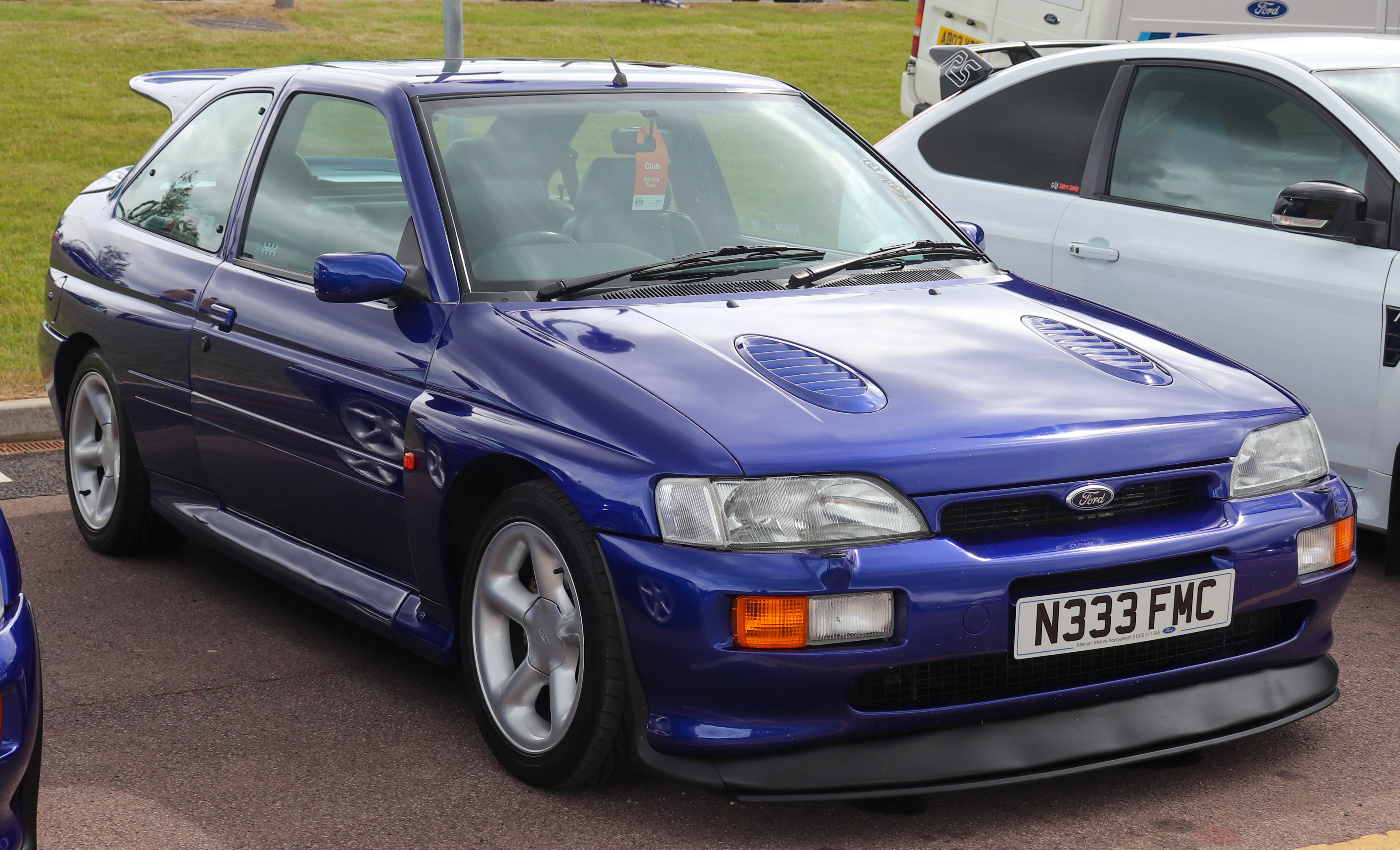
European manufacturers continued to produce hot hatches through the 1990s, including the Ford Fiesta RS Turbo, Ford Escort RS Cosworth, Peugeot 106 Rallye / GTi, Peugeot 306 GTi-6 / Rallye, Renault Clio Williams, SEAT Ibiza GTi / GT 16v / Cupra, Volkswagen Golf GTI / VR6 and Ford Focus ST170.
Japanese manufacturers also began to produce hot hatches, including the Honda Civic Type R, Mazda 323 GT-R, Nissan Pulsar GTI-R, Suzuki Swift GTi and Toyota Corolla GTi.
2000s
_quattro_3-door_hatchback_(2015-05-29)_01.jpg)
Hot hatches continued to get faster through the 2000s, with an increasing number of models using turbocharged engines. During the 2000s manufacturers started to emphasise the sub-brand of their hot hatch derivatives such as Renault's Renault Sport, Opel's OPC, Vauxhall's VXR and Fiat's Abarth.
European-built hot hatches from the 2000s include the Abarth Grande Punto, Alfa Romeo 147 GTA, Audi S3, Ford Fiesta ST, Ford Focus ST/RS, MG ZR, Mini Cooper S/JCW, Opel/Vauxhall Astra SRi Turbo/OPC/VXR, Peugeot 206 RC/207 GTi, Renault Clio RS/Mégane RS, SEAT León Cupra/FR+SEAT Ibiza Cupra/FR and Volkswagen Golf GTI/Golf R. Asian-built hot hatches included the Honda Civic Type R,Mazdaspeed 3, and Proton Satria GTi.
2010s
_4MATIC_hatchback_(2018-10-01)_01.jpg)
Although all-wheel drive system has been made available for hot hatches since the 1980s, further increases to power outputs saw more adoption of the drivetrain on several hot hatches in the 2010s, such as the 2010 Volkswagen Golf R, 2011 Audi RS 3, 2013 Mercedes-Benz A 45 AMG, and the 2015 Ford Focus RS. With these models expanding the definition of hot hatches from front-wheel drive to also include all-wheel drive, the hatchback versions of the Subaru Impreza WRX/STI that have been produced at various times could be considered to be hot hatches. However, the WRX/STI is generally considered a compact saloon (to rival the Mitsubishi Lancer Evolution), rather than a hot hatch.
The majority of hot hatches continued with the traditional front-wheel drive layout, with many models producing in excess of 270 bhp and the Ford Focus RS 500 producing 257 kW. The BMW M135i/M140i is a rare example of a rear-wheel drive hot hatch from the 2010s.
Another technical development for hot hatches since 2010 is the increasing use of dual-clutch transmissions.
The W177 Mercedes-AMG A 45 S, which was introduced in 2019, is the first mass-produced hot hatch that exceeded the 400 bhp border, with its M139 engine producing 416 bhp.
Asia
Japanese-built hot hatches include the 1982 Honda City Turbo, 1984 Isuzu Piazza XS Turbo, 1986 Suzuki Cultus GTi, 1988 Nissan March Super Turbo, 1988 Toyota Corolla GTi (AE92), 1989 Daihatsu Charade GTti, 1990 Toyota Starlet GT Turbo, 1992 Mazda 323 GT-R, 1992 Mitsubishi Mirage Cyborg R, 1994 Nissan Pulsar GTI-R, 1995 Nissan Pulsar VZ-R N1, 1996 Toyota Starlet Glanza, 1997 Honda Civic Type R, 1999 Toyota Yaris TS, 2004 Toyota Corolla TS, 2005 Suzuki Swift Sport, 2006 Mitsubishi Colt Ralliart Version-R, 2007 Mazdaspeed3, 2008 Subaru Impreza WRX STI hatchback, 2020 Toyota GR Yaris.
South Korean manufacturers began to produce hot hatches in 2013 with the Kia Pro_Cee'd GT. Hyundai's first hot hatch, the i30 N, was released in 2017 and was awarded Best Hot Hatch at the 2018 UK Car of the Year Awards. The Veloster N was released in 2019 and was awarded the 2020 Performance Car of the Year by Road and Track Magazine.
Malaysian manufacturer Proton produced the Proton Satria R3 and the Satria Neo R3 which is the second-generation model.
North America
In the 1980s, hot hatches built by Ford in the United States include the 1983 Escort GT (and its twin the Mercury Lynx XR3), Chrysler hot hatches include the 1984 Dodge Omni GLH ("Goes Like Hell") and the 1986 Shelby GLHS ("Goes Like Hell S'more"). General Motors produced the 1986 Chevrolet Cavalier Z24, 1986 Pontiac Sunbird GT and 1987 Buick Skyhawk Sport Hatch with rear hatches, however these are hatchback coupes, rather than traditional utilitarian hatchbacks.
More recent North American hot hatches include the 2002 Ford Focus SVT, 2008 Dodge Caliber SRT-4, and 2016 Ford Focus RS.
Ford stopped production of the Fiesta and Focus models in 2018, which also ended the production of the ST and RS models and left American automakers with no hot hatch offerings.
Records
Acceleration
The fastest accelerating petrol hot hatch is the Audi RS 3 at 3.8 seconds to 62 mph while the fastest electric hot hatch is the Hyundai Ioniq 5 N at 3.4 seconds.
Top speed
The record top speed on a hot hatch is held by the Honda Civic Type R at 171 mph.
Most aerodynamic
The most aerodynamic hot hatchback is the Mercedes A-Class AMG at 0.25 Cd.
References
References
- (1984). "The Motor". Temple Press.
- ''The Times'', Friday August 16, 1985; pg. 21; Issue 62218
- ''Autocar'' 5000th Road Test edition March 2011
- (4 January 2008). "Daily Mirror 4 January 2008".
- "First Drives: Peugeot 207".
- "Ford Fiesta ST v MINI Cooper v Suzuki Swift Sport".
- (1 June 2007). "Warm under the collar".
- Wilson, Bob. "1971 ad Gremlin Grembin".
- (February 23, 1970). "Autos: Shifting Down for the '70s".
- "History of the hot hatch: in pictures".
- (4 February 2014). "History of Hot Hatches in ten cars".
- "History of the hot hatch: in pictures".
- (29 June 2018). "The Best Hot Hatches".
- "History of the hot hatch: in pictures".
- (2010-11-22). "Evo November 2010". Evo.co.uk.
- "Here's the History of the First Hot Hatch: the Volkswagen Golf GTI".
- (27 June 2009). "Rabbit Rocket: The Volkswagen GTI and the Birth of the Hot Hatch > Ate Up With Motor".
- (August 2013). "Lotus Sunbeam driven".
- "1981-1989 FORD Fiesta XR2". Octane Classic.
- (2016-01-16). "Peugeot 205 GTi Crowned "The Greatest Ever Hot Hatch"". Car Scoop.
- "1984-1987 FIAT Strada Abarth 130TC".
- (30 July 2018). "The 20 greatest hot hatches of the 1980s".
- "Ford Fiesta RS Turbo (1990 - 1992)". Friday Ad.
- (27 January 2012). "New Renault range announced". Channel 5.
- Mallinson, James. (29 November 2005). "FHM and Vauxhall take fast route to success". Media Week.
- (December 2010). "Fiat 500C Abarth 1.4 16v Turbo". AA.
- (November 2002). "Power Crazed". Evo.
- "Hot Source". ACP Action.
- (October 2010). "The Knowledge". Evo Magazine.
- (25 April 2017). "VW Golf GTI – we drive all seven generations of the legendary hot hatch".
- (September 2006). "Ford Focus ST-2 v SEAT Leon 2.0T FSI FR". Auto Express.
- "MG ZR (2001 - 2005)".
- (January 2010). "Ford Focus RS v Renaultsport Megane 250 Cup v SEAT Leon Cupra R v VW Golf GTI". Evo.
- (October 2011). "Best Hot Hatch". Auto Express.
- (27 June 2013). "2013 Mazda Mazdaspeed 3 review notes".
- "Volkswagen Golf R: Hottest Golf yet!".
- "2012 Volkswagen Golf R: The Jalopnik Review".
- "Audi RS3 review - 376bhp, four-wheel drive BMW M2 rival".
- (29 May 2015). "2015 Audi RS3 Sportback review".
- (19 September 2017). "14 New Cars That Make Crazy Horsepower Per Liter".
- (13 December 2018). "Ford Focus RS Reviews".
- "Ford Focus RS review 2018".
- (26 December 2007). "Subaru WRX STI vs. Mitsubishi Evolution X - Comparison Test - Motor Trend".
- "Top 10 most powerful hot hatchbacks".
- (2010-12-09). "Top Gear hot hatch power league 9 December 2010". Topgear.com.
- "The world's fastest hot hatch? Mercedes reveals 310kW A45 pocket rocket".
- (24 June 2013). "First Drive: Kia Pro Ceed 1.6T GDi GT 3dr".
- "Car of the Year 2018 - Best Hot hatch".
- "2020 Performance Car of the Year".
- "Retro Review: '83 Ford Escort GT". MotorWeek.
- (3 July 2013). "History Lessons #19 – 1983 Ford Escort Turbo GT".
- "Ford Escort History".
- (2010-02-26). "Edmunds.com". Edmunds.com.
- "7 Unmissable Shelbys Going Up for Auction at Pebble Beach".
- "GM Made A V6 Hot Hatch Ten Years Before Volkswagen".
- "Class of '86 – Pontiac Sunbird GT".
- (17 October 2016). "Buick's Turbocharged Skyhawk: America's Forgotten Hot-Hatch".
- Pund, Daniel. (March 2002). "Ford SVT Focus vs. Honda Civic Si, VW GTI". Car and Driver.
- (2 September 2007). "2008 Dodge Caliber SRT-4".
- Markus, Frank. (November 2007). "First Drive: 2008 Dodge Caliber SRT-4". Motor Trend.
- "Ford Focus RS review – is Ford's hyperactive hatchback a cut price Audi RS3?".
- Perkins, Chris. (2018-04-25). "Ford Will Stop Selling Fiesta, Focus, Fusion In North America".
- "10 Fastest Hatchbacks Available in Australia".
- "Top 100 fastest front wheel drive hatch-backs 2025".
- (2025-01-02). "The world's most aerodynamic new cars".
This article was imported from Wikipedia and is available under the Creative Commons Attribution-ShareAlike 4.0 License. Content has been adapted to SurfDoc format. Original contributors can be found on the article history page.
Ask Mako anything about Hot hatch — get instant answers, deeper analysis, and related topics.
Research with MakoFree with your Surf account
Create a free account to save articles, ask Mako questions, and organize your research.
Sign up freeThis content may have been generated or modified by AI. CloudSurf Software LLC is not responsible for the accuracy, completeness, or reliability of AI-generated content. Always verify important information from primary sources.
Report