From Surf Wiki (app.surf) — the open knowledge base
Horchata
Sweet drink of Spanish origin

Sweet drink of Spanish origin
the beverage
Horchata (; ), or orxata (), is a name given to various beverages that are generally plant-based but sometimes contain milk. In Spain, it is made with soaked, ground, and sweetened tiger nuts. In Mexico, it is made with rice, cinnamon and other ingredients and it is well known as a type of Mexican agua fresca.
Etymology
The name probably derives from a Latin word for barley, the term hordeata, which in turn comes from hordeum (barley), related to a Mediterranean tradition of grain-based beverages. The Italian and Maltese orzata and the French and English orgeat have the same origin, although the beverages have diverged and are generally no longer made from barley.
History and composition

A barley drink originated in ancient Egypt, where the Romans got to know it as hordeata, from the Latin word for barley, hordeum. The main ingredient changed in time to tiger nuts, which were brought to the Iberian peninsula in the 8th century, during Muslim rule, and became a staple ingredient in the area of Valencia. It is estimated that during the 11th century it began to spread throughout Hispania (now Spain and Portugal). There are 13th-century records of an horchata-like beverage made near Valencia, where it remains a common drink.
From Spain, the concept of horchata was brought to the Americas. Drinks called agua de horchata or simply horchata came to be made with white rice and cinnamon instead of tiger nuts. Sometimes these drinks had vanilla added, or were served adorned with fruit. Similarly, flavored plant-based beverages are sold in various parts of the world as varieties of horchata or kunnu.
Varieties
{{lang|es|Horchata de chufa}}
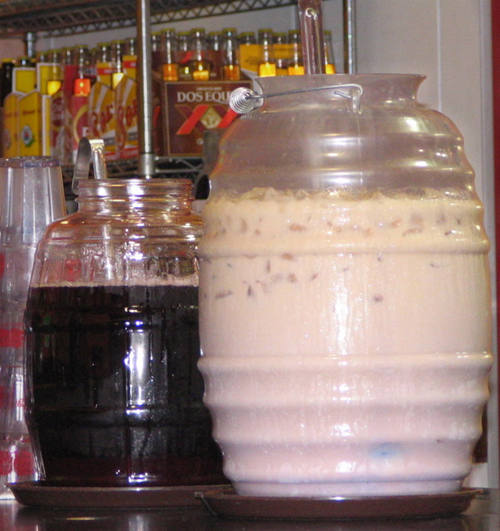
The drink now known as horchata de chufa (also sometimes called horchata de chufas or, in West African countries such as Nigeria and Mali, kunnu aya). It is made from soaked, ground and sweetened tiger nuts.
The Valencian or Chufa horchata is made with dried and sweetened tiger nuts (Cyperus esculentus). This form of horchata is now properly called orxata de xufa.
It remains popular in Spain, where a regulating council exists to ensure the quality and traceability of the product in relation to the designation of origin.
The majority of the Spanish tiger nut crop is utilised in the production of horchata de chufa. Alboraya is the most important production centre. In total, sixteen Valencian municipalities grow tiger nuts protected by the quality seal, the only one that guarantees its Valencian origin, which in aggregate covered around 485 hectares of tiger nut fields, with an approximate annual production of 8,000 tonnes, which is normally all sold by the time it is harvested.
In rare instances, various forms of aflatoxin could be present in horchata de chufa.
{{lang|es|Horchata de arroz}}

Horchata de arroz (es) is made of rice, sometimes with vanilla, and typically with cinnamon.
It is the most common variety of horchata in Mexico. In the United States, it is popular in taquerías and Mexican ice cream shops.
In Alvarado, horchata de arroz is scented with flowers of the Aztec marigold (cempasúchil or Tagetes erecta).
''Horchata lojana''
In Ecuador, horchata is a vivid red-coloured infusion or tea, consisting of some 18–20 different plants and herbs, and is most famous in the province of Loja (hence its common name of horchata lojana). Some of the herbs frequently used are escancel or bloodleaf (a type of amaranth), achiote or annatto, hibiscus, lemon verbena, lemongrass, spearmint, peppermint, chamomile, lemon balm, and rose geranium, among others. It is not at all similar to the sweet, grain-based horchatas of other Latin American countries, but simply shares the same term.
The urban and rural populaces who consume this drink, notably in the Loja province, report improved overall well-being and cognitive benefits. They also believe that this herbal infusion promotes a healthy digestive tract, improves focus and memory, and acts as an hepatic anti-inflammatory and a diuretic. There is valuable scientific evidence for the purported health benefits of each of these various ingredients—on their own and combined—including counteracting genotoxicity in the body, as well as antimicrobial and antioxidant properties.
{{lang|es|Horchata de melón}}
Horchata de melón is made of ground melon seeds.
Horchata de morro or {{lang|es|Semilla de jicaro}}
In the Central American countries of El Salvador, Nicaragua, Honduras, and Costa Rica, horchata refers to the drink known as horchata de morro or semilla de jicaro. Its base is made by grinding jicaro seeds, locally referred to as morro seeds, with rice.
In Nicaragua, it is also made with semilla de jicaro and rice as a base; these ingredients are toasted or dry-roasted, then ground into a fine powder. The powder is then mixed with water or milk, topped with ground cinnamon and, finally, sugar. Cocoa beans are sometimes added to the horchata, also toasted and ground with the base.
Horchata as a flavor

Horchata, as a flavor, makes appearances in ice cream, cookies, and other sweets, and other products such as RumChata, an alcoholic tribute to the beverage. Some smoothie shops, cafés, and McDonald's in the U.S. have been experimenting with horchata-flavored frappés.
References
References
- "Daily life and social customs". Encyclopaedia Britannica.
- (23 July 2015). "The Milky Life: The Practical Guide on Lactose Intolerance". Editorial AMAT.
- (9 March 2017). ""Horchata" drink in Southern Ecuador: medicinal plants and people's wellbeing". Journal of Ethnobiology and Ethnomedicine.
- Lobscouse & Spotted Dog: Which It's a Gastronomic Companion to the Aubrey/Maturin Novels : Grossman, Anne Chotzinoff; Thomas, Lisa Grossman {{ISBN. 0-393-04559-5
- (2021-11-11). "Tracing Mexico's Complicated Relationship With Rice". The New York Times.
- Kabir, Syed Rafid. (2023-11-10). "Who Invented Horchata? Story of the Delicious Drink".
- Goldstein, Darra. (4 July 2018). "The Oxford Companion to Sugar and Sweets". Oxford University Press.
- Clifford A. Wright, ''Mediterranean Vegetables'', 2012, {{isbn. 1558325913, ''s.v.'' 'chufa'
- (29 May 2012). "Dietary Fiber and Health". CRC Press.
- Grigson, Jane. (1 January 1983). "Jane Grigson's book of European cookery". Atheneum.
- (29 May 2012). "Dietary Fiber and Health". CRC Press.
- Cheney, Dina. (3 May 2016). "The New Milks: 100-Plus Dairy-Free Recipes for Making and Cooking with Soy, Nut, Seed, Grain, and Coconut Milks". Simon and Schuster.
- Gittleman, Ann Louise. (19 May 2017). "The New Fat Flush Foods". McGraw Hill Professional.
- (31 March 2018). "Authentic Spanish Recipe - Horchata de chufa".
- (5 August 2021). "Make horchata and fartons".
- (2002-12-31). "Consejo Regulador de la D.O. Chufa de Valencia. Horchata de Chufa de Valencia - Portada". Chufadevalencia.org.
- "About us".
- Leitch, James Muil. (4 July 1967). "Food Science and Technology: Manufacture and distribution of foods". Gordon and Breach.
- (12 June 2022). "Horchata de Chufa (Tiger Nut): The famous summer drink from Valencia".
- Weidenbörner, Martin. (24 January 2014). "Mycotoxins in Foodstuffs". Springer Science & Business Media.
- (25 August 2011). "Horchata de Arroz Tostado (Toasted Rice Drink)". [[Saveur]].
- "Horchata de arroz, una alternativa fácil y refrescante a la de chufa".
- "Horchata (Mexico) | Local Non-alcoholic Beverage from Mexico".
- [[Emeril Lagasse]], [http://www.foodnetwork.com/recipes/horchata Horchata Recipe : Food Network] Taste of Mexico, 2007.
- [http://www.marthastewart.com/1067306/horchata Horchata Recipe & Video] - Martha Stewart.
- [http://www.mexconnect.com/articles/2407-refreshing-rice-drink-horchata-de-arroz Refreshing Rice Drink: Horchata de Arroz] by Karen Hursh Graber 2003 (MexConnect).
- Gonzalez, Anita. (4 July 2018). "Jarocho's Soul: Cultural Identity and Afro-Mexican Dance". University Press of America.
- (March 2024). "Study of the volatile compounds present in the traditional ecuadorian beverage horchata: Chemical composition and biological activity". International Journal of Gastronomy and Food Science.
- (December 2017). "'Horchata' drink in Southern Ecuador: medicinal plants and people's wellbeing". Journal of Ethnobiology and Ethnomedicine.
- (2024). "Antimicrobials for Sustainable Food Storage".
- (December 2017). "Cytotoxic, antioxidative, genotoxic and antigenotoxic effects of Horchata, beverage of South Ecuador". BMC Complementary and Alternative Medicine.
- (25 August 2011). "Horchata de Melón (Cantaloupe Seed Drink)". [[Saveur]].
- Janovich, Adriana. (April 29, 2015). "Heavenly Horchata". The Spokesman-Review.
- Spiegel, Alison. (July 10, 2014). "Why Horchata Is Your New Best Friend This Summer".
- (August 10, 2017). "Starbucks' Latest Frappuccino Takes Inspiration From Horchata Drinks".
- Wei, Clarissa. (November 9, 2015). "A Taste of Nicaragua: Three Traditional Drinks".
- (July 11, 2008). "Horchata de Arroz Recipe (Latin sweet rice beverage)".
- Strom, Ray. (December 28, 2012). "RumChata fights to protect trademark". Chicago Daily Law Bulletin.
- (May 12, 2014). "McDonald's Testing Horchata Frappes in Southern California". [[Foodbeast]].
This article was imported from Wikipedia and is available under the Creative Commons Attribution-ShareAlike 4.0 License. Content has been adapted to SurfDoc format. Original contributors can be found on the article history page.
Ask Mako anything about Horchata — get instant answers, deeper analysis, and related topics.
Research with MakoFree with your Surf account
Create a free account to save articles, ask Mako questions, and organize your research.
Sign up freeThis content may have been generated or modified by AI. CloudSurf Software LLC is not responsible for the accuracy, completeness, or reliability of AI-generated content. Always verify important information from primary sources.
Report