From Surf Wiki (app.surf) — the open knowledge base
Hopf algebra
Construction in algebra
Construction in algebra
In mathematics, a Hopf algebra, named after Heinz Hopf, is a structure that is simultaneously a (unital associative) algebra and a (counital coassociative) coalgebra, with these structures' compatibility making it a bialgebra, and that moreover is equipped with an antihomomorphism satisfying a certain property. The representation theory of a Hopf algebra is particularly nice, since the existence of compatible comultiplication, counit, and antipode allows for the construction of tensor products of representations, trivial representations, and dual representations.
Hopf algebras occur naturally in algebraic topology, where they originated and are related to the H-space concept, in group scheme theory, in group theory (via the concept of a group ring), and in numerous other places, making them probably the most familiar type of bialgebra. Hopf algebras are also studied in their own right, with much work on specific classes of examples on the one hand and classification problems on the other. They have diverse applications ranging from condensed matter physics and quantum field theory to string theory and LHC phenomenology.
Formal definition
Let (H,\nabla,\eta,\Delta,\varepsilon) be an (associative and coassociative) bialgebra over a field K. One can consider the convolution algebra \operatorname{Hom}_K(H,H) of K-linear maps with product given by :(f\star g)(h)=\nabla\circ(f\otimes g)\circ\Delta(c). The identity of the convolution algebra is \eta\circ\varepsilon.
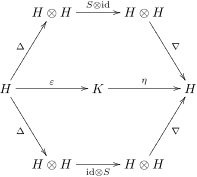
The bialgebra H is said to be a Hopf algebra if the identity of H, \operatorname{id}_H\in\operatorname{Hom}_K(H,H) has a convolutive inverse S\in\operatorname{Hom}_K(H,H) (called the antipode). The statement that S is the inverse of \operatorname{id}_H is equivalent to the commutativity of the following diagram :
In the sumless Sweedler notation, this property can also be expressed as :S(c_{(1)})c_{(2)}=c_{(1)}S(c_{(2)})=\varepsilon(c)1\qquad\mbox{ for all }c\in H.
As for algebras, one can replace the underlying field K with a commutative ring R in the above definition.
The definition of Hopf algebra is self-dual (as reflected in the symmetry of the above diagram), so if one can define a dual of H (which is always possible if H is finite-dimensional), then it is automatically a Hopf algebra.
Structure constants
Fixing a basis {e_k} for the underlying vector space, one may define the algebra in terms of structure constants for multiplication: :e_i\nabla e_j = \sum_k \mu^k_{;ij} e_k for co-multiplication: :\Delta e_i = \sum_{j,k} \nu^{;jk}i e_j\otimes e_k and the antipode: :S e_i = \sum_j \tau_i^{;j} e_j Associativity then requires that :\mu^k{;ij}\mu^m_{;kn}=\mu^k_{;jn}\mu^m_{;ik} while co-associativity requires that :\nu_k^{;ij}\nu_i^{;mn}=\nu_k^{;mi}\nu_i^{;nj} The connecting axiom requires that :\nu_k^{;ij}\tau_j^{;m}\mu^n_{;im}=\nu_k^{;jm}\tau_j^{,;i}\mu^n_{;im}
Properties of the antipode
The antipode S is sometimes required to have a K-linear inverse, which is automatic in the finite-dimensional case, or if H is commutative or cocommutative (or more generally quasitriangular).
In general, S is an antihomomorphism, so S2 is a homomorphism, which is therefore an automorphism if S was invertible (as may be required).
If S2 = idH, then the Hopf algebra is said to be involutive (and the underlying algebra with involution is a *-algebra). If H is finite-dimensional semisimple over a field of characteristic zero, commutative, or cocommutative, then it is involutive.
If a bialgebra B admits an antipode S, then S is unique ("a bialgebra admits at most 1 Hopf algebra structure"). Thus, the antipode does not pose any extra structure which we can choose: Being a Hopf algebra is a property of a bialgebra.
The antipode is an analog to the inversion map on a group that sends g to g−1.
Hopf subalgebras
A subalgebra A of a Hopf algebra H is a Hopf subalgebra if it is a subcoalgebra of H and the antipode S maps A into A. In other words, a Hopf subalgebra A is a Hopf algebra in its own right when the multiplication, comultiplication, counit and antipode of H are restricted to A (and additionally the identity 1 of H is required to be in A). The Nichols–Zoeller freeness theorem of Warren Nichols and Bettina Zoeller (1989) established that the natural A-module H is free of finite rank if H is finite-dimensional: a generalization of Lagrange's theorem for subgroups.{{citation
A Hopf subalgebra A is said to be right normal in a Hopf algebra H if it satisfies the condition of stability, adr(h)(A) ⊆ A for all h in H, where the right adjoint mapping adr is defined by adr(h)(a) = S(h(1))ah(2) for all a in A, h in H. Similarly, a Hopf subalgebra A is left normal in H if it is stable under the left adjoint mapping defined by adl(h)(a) = h(1)aS(h(2)). The two conditions of normality are equivalent if the antipode S is bijective, in which case A is said to be a normal Hopf subalgebra.
A normal Hopf subalgebra A in H satisfies the condition (of equality of subsets of H): HA+ = A+H where A+ denotes the kernel of the counit on A. This normality condition implies that HA+ is a Hopf ideal of H (i.e. an algebra ideal in the kernel of the counit, a coalgebra coideal and stable under the antipode). As a consequence one has a quotient Hopf algebra H/HA+ and epimorphism H → H/A+H, a theory analogous to that of normal subgroups and quotient groups in group theory.
Hopf orders
A Hopf order O over an integral domain R with field of fractions K is an order in a Hopf algebra H over K which is closed under the algebra and coalgebra operations: in particular, the comultiplication Δ maps O to O⊗O.
Group-like elements
A group-like element is a nonzero element x such that Δ(x) = x⊗x. The group-like elements form a group with inverse given by the antipode. A primitive element x satisfies Δ(x) = x⊗1 + 1⊗x.
Examples
| Depending on | Comultiplication | Counit | Antipode | Commutative | Cocommutative | Remarks | ||||
|---|---|---|---|---|---|---|---|---|---|---|
| group algebra KG | group G | Δ(g) = g ⊗ g for all g in G | ε(g) = 1 for all g in G | S(g) = g−1 for all g in G | if and only if G is abelian | yes | ||||
| functions f from a finite group to K, KG (with pointwise addition and multiplication) | finite group G | Δ(f)(x,y) = f(xy) | ε(f) = f(1G) | S(f)(x) = f(x−1) | yes | if and only if G is abelian | ||||
| Representative functions on a compact group | compact group G | Δ(f)(x,y) = f(xy) | ε(f) = f(1G) | S(f)(x) = f(x−1) | yes | if and only if G is abelian | ||||
| Regular functions on an algebraic group | Δ(f)(x,y) = f(xy) | ε(f) = f(1G) | S(f)(x) = f(x−1) | yes | if and only if G is abelian | |||||
| Tensor algebra T(V) | vector space V | Δ(x) = x ⊗ 1 + 1 ⊗ x, x in V, Δ(1) = 1 ⊗ 1 | ε(x) = 0 | S(x) = −x for all x in 'T1(V) (and extended to higher tensor powers) | If and only if dim(V)=0,1 | yes | ||||
| Universal enveloping algebra U(g) | Lie algebra g | Δ(x) = x ⊗ 1 + 1 ⊗ x for every x in g (this rule is compatible with commutators and can therefore be uniquely extended to all of U) | ε(x) = 0 for all x in g (again, extended to U) | S(x) = −x | if and only if g is abelian | yes | ||||
| Sweedler's Hopf algebra H=K[c, x]/c2 = 1, x2 = 0 and xc = −cx. | K is a field with characteristic different from 2 | Δ(c) = c ⊗ c, Δ(x) = c ⊗ x + x ⊗ 1, Δ(1) = 1 ⊗ 1 | ε(c) = 1 and ε(x) = 0 | S(c) = c−1 = c and S(x) = −cx | no | no | ||||
| ring of symmetric functionsSee | in terms of complete homogeneous symmetric functions *h*k (k ≥ 1): | ε(hk) = 0 | S(hk) = (−1)k ek | yes | yes |
Note that functions on a finite group can be identified with the group ring, though these are more naturally thought of as dual – the group ring consists of finite sums of elements, and thus pairs with functions on the group by evaluating the function on the summed elements.
Cohomology of Lie groups
The cohomology algebra (over a field K) of a Lie group G is a Hopf algebra: the multiplication is provided by the cup product, and the comultiplication :H^(G,K) \rightarrow H^(G\times G,K) \cong H^(G,K)\otimes H^(G,K) by the group multiplication G\times G\to G. This observation was actually a source of the notion of Hopf algebra. Using this structure, Hopf proved a structure theorem for the cohomology algebra of Lie groups.
Theorem (Hopf) Let A be a finite-dimensional, graded commutative, graded cocommutative Hopf algebra over a field of characteristic 0. Then A (as an algebra) is a free exterior algebra with generators of odd degree.
Quantum groups and non-commutative geometry
Main article: quantum group
Most examples above are either commutative (i.e. the multiplication is commutative) or co-commutative (i.e. Δ = T ∘ Δ where the twist map T: H ⊗ H → H ⊗ H is defined by T(x ⊗ y) = y ⊗ x). Other interesting Hopf algebras are certain "deformations" or "quantizations" of those from example 3 which are neither commutative nor co-commutative. These Hopf algebras are often called quantum groups, a term that is so far only loosely defined. They are important in noncommutative geometry, the idea being the following: a standard algebraic group is well described by its standard Hopf algebra of regular functions; we can then think of the deformed version of this Hopf algebra as describing a certain "non-standard" or "quantized" algebraic group (which is not an algebraic group at all). While there does not seem to be a direct way to define or manipulate these non-standard objects, one can still work with their Hopf algebras, and indeed one identifies them with their Hopf algebras. Hence the name "quantum group".
Representation theory
Main article: Representation theory of Hopf algebras
Let A be a Hopf algebra, and let M and N be A-modules. Then, M ⊗ N is also an A-module, with :a(m\otimes n):=\Delta(a)(m \otimes n)=(a_1\otimes a_2)(m\otimes n)=(a_1 m \otimes a_2 n) for m ∈ M, n ∈ N and Δ(a) = (a1, a2). Furthermore, we can define the trivial representation as the base field K with :a(m):=\epsilon(a)m for m ∈ K. Finally, the dual representation of A can be defined: if M is an A-module and M* is its dual space, then :(af)(m):=f(S(a)m) where f ∈ M* and m ∈ M.
The relationship between Δ, ε, and S ensure that certain natural homomorphisms of vector spaces are indeed homomorphisms of A-modules. For instance, the natural isomorphisms of vector spaces M → M ⊗ K and M → K ⊗ M are also isomorphisms of A-modules. Also, the map of vector spaces M* ⊗ M → K with f ⊗ m → f(m) is also a homomorphism of A-modules. However, the map M ⊗ M* → K is not necessarily a homomorphism of A-modules.
Analogy with groups
Groups can be axiomatized by the same diagrams (equivalently, operations) as a Hopf algebra, where G is taken to be a set instead of a module. In this case:
- the field K is replaced by the 1-point set
- there is a natural counit (map to 1 point)
- there is a natural comultiplication (the diagonal map)
- the unit is the identity element of the group
- the multiplication is the multiplication in the group
- the antipode is the inverse In this philosophy, a group can be thought of as a Hopf algebra over the "field with one element".
Hopf algebras in braided monoidal categories
The definition of Hopf algebra is naturally extended to arbitrary braided monoidal categories. A Hopf algebra in such a category (C,\otimes,I,\alpha,\lambda,\rho,\gamma) is a sextuple (H,\nabla,\eta,\Delta,\varepsilon,S) where H is an object in C, and
: \nabla:H\otimes H\to H (multiplication),
: \eta:I\to H (unit),
: \Delta:H\to H\otimes H (comultiplication),
: \varepsilon:H\to I (counit),
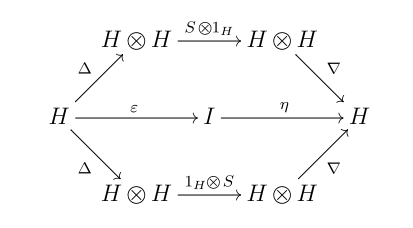
: S:H\to H (antipode)
— are morphisms in C such that
:1) the triple (H,\nabla,\eta) is a monoid in the monoidal category (C,\otimes,I,\alpha,\lambda,\rho,\gamma), i.e. the following diagrams are commutative:

:2) the triple (H,\Delta,\varepsilon) is a comonoid in the monoidal category (C,\otimes,I,\alpha,\lambda,\rho,\gamma), i.e. the following diagrams are commutative:

:3) the structures of monoid and comonoid on H are compatible: the multiplication \nabla and the unit \eta are morphisms of comonoids, and (this is equivalent in this situation) at the same time the comultiplication \Delta and the counit \varepsilon are morphisms of monoids; this means that the following diagrams must be commutative:


: where \lambda_I:I\otimes I\to I is the left unit morphism in C, and \theta the natural transformation of functors (A\otimes B)\otimes (C\otimes D)\stackrel{\theta}{\rightarrowtail} (A\otimes C)\otimes (B\otimes D) which is unique in the class of natural transformations of functors composed from the structural transformations (associativity, left and right units, transposition, and their inverses) in the category C.
The quintuple (H,\nabla,\eta,\Delta,\varepsilon) with the properties 1),2),3) is called a bialgebra in the category (C,\otimes,I,\alpha,\lambda,\rho,\gamma);
:4) the diagram of antipode is commutative:
The typical examples are the following.
- Groups. In the monoidal category (\text{Set},\times,1) of sets (with the cartesian product \times as the tensor product, and an arbitrary singletone, say, 1={\varnothing}, as the unit object) a triple (H,\nabla,\eta) is a monoid in the categorical sense if and only if it is a monoid in the usual algebraic sense, i.e. if the operations \nabla(x,y)=x\cdot y and \eta(1) behave like usual multiplication and unit in H (but possibly without the invertibility of elements x\in H). At the same time, a triple (H,\Delta,\varepsilon) is a comonoid in the categorical sense iff \Delta is the diagonal operation \Delta(x)=(x,x) (and the operation \varepsilon is defined uniquely as well: \varepsilon(x)=\varnothing). And any such a structure of comonoid (H,\Delta,\varepsilon) is compatible with any structure of monoid (H,\nabla,\eta) in the sense that the diagrams in the section 3 of the definition always commute. As a corollary, each monoid (H,\nabla,\eta) in (\text{Set},\times,1) can naturally be considered as a bialgebra (H,\nabla,\eta,\Delta,\varepsilon) in (\text{Set},\times,1), and vice versa. The existence of the antipode S:H\to H for such a bialgebra (H,\nabla,\eta,\Delta,\varepsilon) means exactly that every element x\in H has an inverse element x^{-1}\in H with respect to the multiplication \nabla(x,y)=x\cdot y. Thus, in the category of sets (\text{Set},\times,1) Hopf algebras are exactly groups in the usual algebraic sense.
- Classical Hopf algebras. In the special case when (C,\otimes,s,I) is the category of vector spaces over a given field K, the Hopf algebras in (C,\otimes,s,I) are exactly the classical Hopf algebras described above.
- Functional algebras on groups. The standard functional algebras {\mathcal C}(G), {\mathcal E}(G), {\mathcal O}(G), {\mathcal P}(G) (of continuous, smooth, holomorphic, regular functions) on groups are Hopf algebras in the category (Ste,\odot) of stereotype spaces,
- Group algebras. The stereotype group algebras {\mathcal C}^\star(G), {\mathcal E}^\star(G), {\mathcal O}^\star(G), {\mathcal P}^\star(G) (of measures, distributions, analytic functionals and currents) on groups are Hopf algebras in the category (Ste,\circledast) of stereotype spaces. These Hopf algebras are used in the duality theories for non-commutative groups.
References
- (1992). "Yangian symmetry of integrable quantum chains with long-range interactions and a new description of states in conformal field theory". Physical Review Letters.
- (2006). "Hopf algebra structure of the AdS/CFT S-matrix". Physical Review D.
- (2017-12-01). "Diagrammatic Hopf algebra of cut Feynman integrals: the one-loop case". Journal of High Energy Physics.
- {{harvnb. Underwood. 2011
- {{harvnb. Underwood. 2011
- Radford, David E.. (1976). "The Order of the Antipode of a Finite Dimensional Hopf Algebra is Finite". American Journal of Mathematics.
- Dăscălescu, Năstăsescu & Raianu. (2001). ["Hopf Algebra: An Introduction"]({{Google books).
- Dăscălescu, Năstăsescu & Raianu. (2001). ["Hopf Algebra: An Introduction"]({{Google books).
- [http://www.mathematik.uni-muenchen.de/~pareigis/Vorlesungen/98SS/Quantum_Groups/LN2_1.PDF Quantum groups lecture notes]
- {{harvnb. Montgomery. 1993
- {{harvnb. Underwood. 2011
- (2010). "Algebras, Rings, and Modules: Lie Algebras and Hopf Algebras". [[American Mathematical Society]].
- (2002). "The Concise Handbook of Algebra". [[Springer-Verlag]].
- Abe, Eiichi. (2004). "Hopf Algebras". [[Cambridge University Press]].
- Hochschild, G. (1965). "Structure of Lie groups". Holden-Day.
- (2003). "Representations of algebraic groups". [[American Mathematical Society]].
- (1941). "Über die Topologie der Gruppen–Mannigfaltigkeiten und ihre Verallgemeinerungen". Ann. of Math..
- {{harvnb. Underwood. 2011
- {{harvnb. Underwood. 2011
- {{harvnb. Montgomery. 1993
- (1994). "Multiplier Hopf algebras". Transactions of the American Mathematical Society.
- (1999). "Weak Hopf Algebras". J. Algebra.
- (2002). "New directions in Hopf algebras". M.S.R.I. Publications.
- [http://sbseminar.wordpress.com/2007/10/07/group-hopf-algebra/ Group = Hopf algebra « Secret Blogging Seminar], [https://www.youtube.com/watch?v=p3kkm5dYH-w Group objects and Hopf algebras], video of Simon Willerton.
This article was imported from Wikipedia and is available under the Creative Commons Attribution-ShareAlike 4.0 License. Content has been adapted to SurfDoc format. Original contributors can be found on the article history page.
Ask Mako anything about Hopf algebra — get instant answers, deeper analysis, and related topics.
Research with MakoFree with your Surf account
Create a free account to save articles, ask Mako questions, and organize your research.
Sign up freeThis content may have been generated or modified by AI. CloudSurf Software LLC is not responsible for the accuracy, completeness, or reliability of AI-generated content. Always verify important information from primary sources.
Report