From Surf Wiki (app.surf) — the open knowledge base
Hoop crown
Arched crown

Arched crown

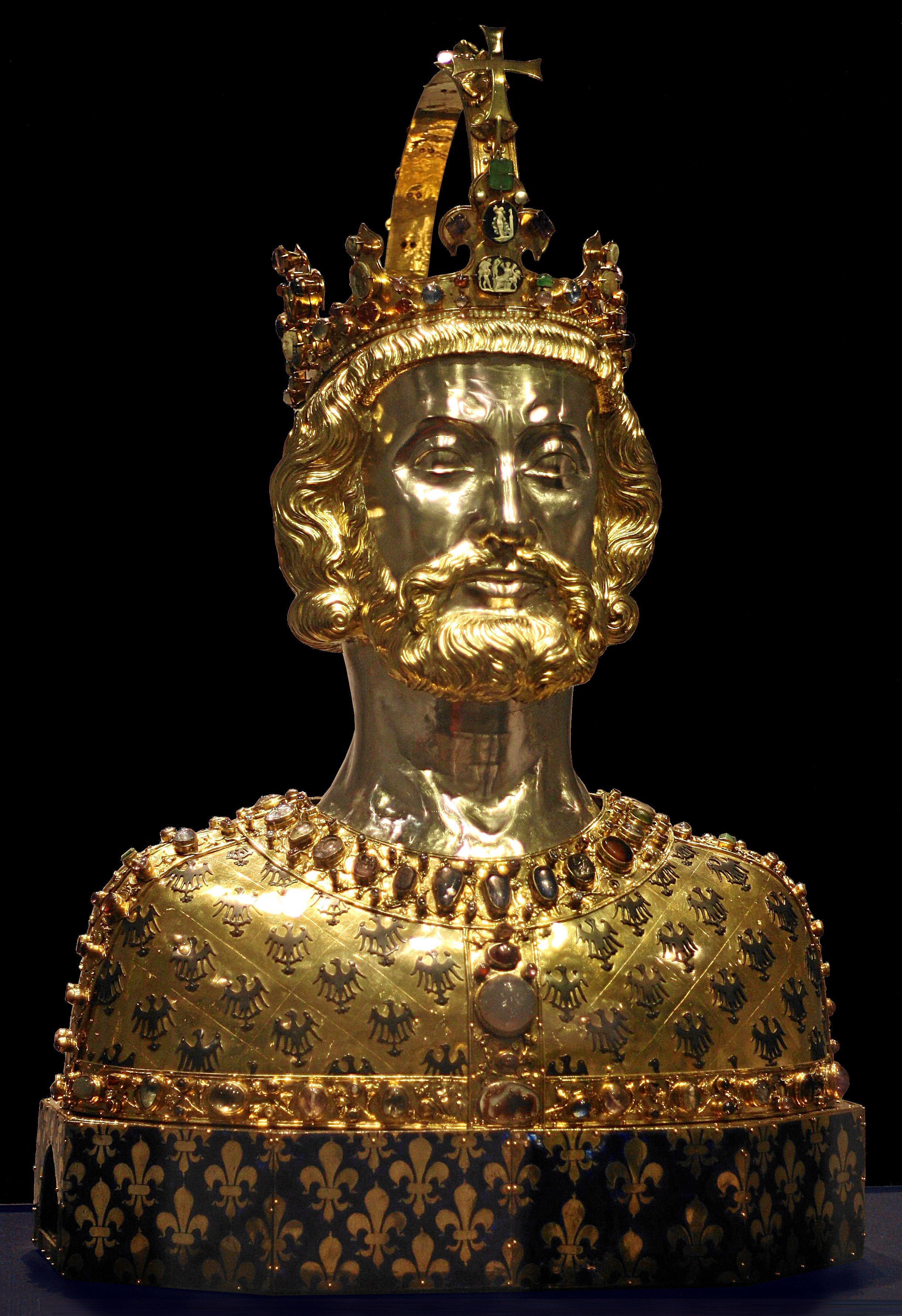
A hoop crown ( or Spangenkrone, ), arched crown, or closed crown, is a crown consisting of a "band around the temples and one or two bands over the head". First used by the Carolingian dynasty, hoop crowns became increasingly popular among royal dynasties in the Late Middle Ages, and the dominant type of crown in the Modern Era.
Origins
Hoop crowns were introduced to Germanic Europe by the Carolingian dynasty, The Carolingian hoop crown was most probably Sometimes, the Carolingian hoop crowns were combined with a cap, worn beneath.
Though hoop crowns were characteristic for Carolingian kings, there were several other types of crowns worn by the members of this dynasty. For example, Charlemagne also wore a crown shaped like a collar with an attachment on the front side. The features most Carolingian crowns had in common were "cap or bands over the head, edge-bands, and pendilia". Some of the Carolingian crowns were imitations of contemporary Byzantine Imperial crowns, which had the shape of a closed cap (kamelaukion). In turn, Byzantine Emperor Justinian I "the Great" (483–565) had hoops attached to his crown to carry a cross above it, creating the prototype of later hoop crowns.
Spread
Hoop crowns became popular in late medieval Europe. In addition, William had sceptre and virga created, resembling the imperial insignia.
However, not all late medieval crowns had hoops. For example, the 15th-century kings of France wore crowns of the lilly type, a collar decorated with four lilies. The hoop crown became the prevalent type of crown in the Early Modern Age.
Sources
References
Bibliography
References
- Schulz (2010)
- Hartmann [http://www.beyars.com/kunstlexikon/lexikon_8445.html online] {{Webarchive. link. (2017-12-01 , entries "Spangenkrone, Bügelkrone")
- Lohrmann (1973), p. 764
- Kornbluth (1990), p. 61
- Schramm (1956), p. 888
- Schramm (1959), p. 562
- Schramm (1959), p. 561
- who usurped the throne of the [[Frankish Empire]] from the [[Merovingian dynasty]] in 751. However their use dates back to the end of the [[Roman Empire]] and the [[Byzantine Empire]].Grierson, P. (1993). Catalogue of the Byzantine Coins in the Dumbarton Oaks Collection and in the Whittemore Collection, 2: Phocas to Theodosius III, 602-717. Universidad de Harvard. Estados Unidos.
- derived from the contemporary [[Germanic tribes. Germanic]] [[Spangenhelm. hoop helmet]] ({{langx. de. Pepin I (797–838)]] or [[Pepin II of Aquitaine. Louis II "the German"]] (806–876), [[Charles the Bald
- The [[Holy Roman Empire. Norman]] king [[William the Conqueror]] wore a hoop crown, and in the 12th century, the [[Kingdom of Hungary
This article was imported from Wikipedia and is available under the Creative Commons Attribution-ShareAlike 4.0 License. Content has been adapted to SurfDoc format. Original contributors can be found on the article history page.
Ask Mako anything about Hoop crown — get instant answers, deeper analysis, and related topics.
Research with MakoFree with your Surf account
Create a free account to save articles, ask Mako questions, and organize your research.
Sign up freeThis content may have been generated or modified by AI. CloudSurf Software LLC is not responsible for the accuracy, completeness, or reliability of AI-generated content. Always verify important information from primary sources.
Report