From Surf Wiki (app.surf) — the open knowledge base
Hoof
Tip of a toe of an ungulate mammal, strengthened by a thick and horny keratin covering

Tip of a toe of an ungulate mammal, strengthened by a thick and horny keratin covering
The hoof (: hooves or hoofs) is the tip of a toe of an ungulate mammal, which is covered and strengthened with a thick and horny keratin covering.
Hooves are present in some even-toed and odd-toed placental mammals, as well as in some nonmammalians.
- Artiodactyls ( : "even", and δάκτυλος : "toe") are even-toed ungulates, species whose feet have an even number of digits; the ruminants with two digits are the most numerous, e.g. giraffe, deer, bison, cattle, goats, gazelles, pigs, and sheep.
- The feet of perissodactyl ( : : uneven", and δάκτυλος : "toe") mammals have an odd number of toes, e.g. the horse, the rhinoceros, and the tapir.
- Although hooves are limb structures primarily found in placental mammals, hadrosaurs such as Edmontosaurus possessed hoofed hindlimbs. The marsupial Chaeropus also had hooves.
Description
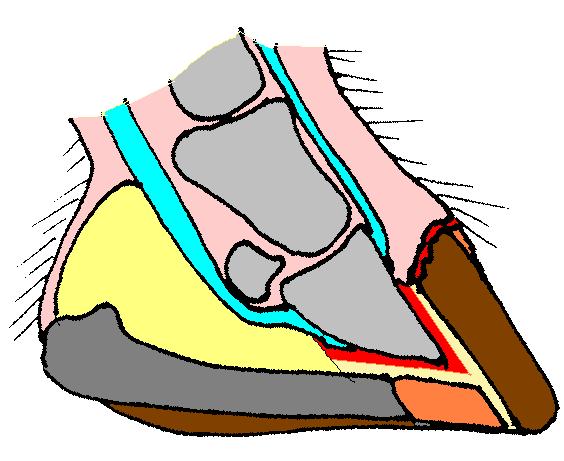
The hoof surrounds the distal end of the second phalanx, the distal phalanx, and the navicular bone. The hoof consists of the hoof wall, the bars of the hoof, the sole and frog and soft tissue shock absorption structures. The weight of the animal is normally borne by both the sole and the edge of the hoof wall. Hooves perform many functions, including supporting the weight of the animal, dissipating the energy impact as the hooves strike the ground or surface, protecting the tissues and bone within the hoof capsule, and providing traction for the animal. Numerous factors can affect hoof structure and health, including genetics, hoof conformation, environmental influences, nutrition, and athletic performance of the animal. The ideal hoof has a parallel hoof-pastern axis, a thick hoof wall, adequate sole depth, a solid heel base and growth rings of equal size under the coronary band.
There are four layers within the exterior wall of the hoof. From the outside, a hoof is made up of the stratum externum, the stratum medium, the stratum internum and the dermis parietis. The stratum externum and the stratum medium are difficult to distinguish, the stratum externum is thin and the stratum medium is what makes up the bulk of the hoof wall. Inside the hoof wall is a laminar junction, a soft tissue structure that allows the hoof to withstand the demands of force transmission it undergoes. This tissue structure binds the inner surface of the hoof wall, the dermis parietis and the outer surface of the third phalanx.
Most even-toed ungulates (such as sheep, goats, deer, cattle, bison and pigs) have two main claws on each foot, together called a cloven hoof. Most of these cloven-hooved animals also have two smaller hooves called dewclaws a little further up the leg – these are not normally used for walking, but in some species with larger dewclaws (such as deer and pigs) they may touch the ground when running or jumping, or if the ground is soft. In the mountain goat, the dewclaw serves to provide extra traction when descending rocky slopes as well as additional drag on loose or slippery surfaces made of ice, dirt, or snow. Other cloven-hooved animals (such as giraffes and pronghorns) have no dewclaws.
In some cloven-hooved animals, such as camels, the "hoof" is not properly a hoof – it is not a hard or rubbery sole with a hard wall formed by a thick nail – instead it is a soft toe with little more than a nail merely having an appearance of a hoof.
Some odd-toed ungulates (equids) have one hoof on each foot; others have (or had) three distinct hooved or heavily nailed toes, or one hoof and two dewclaws. The tapir is a special case, having three toes on each hind foot and four toes on each front foot.
Management

Hooves grow continuously. In nature, wild animals are capable of wearing down the hoof as it continuously grows, but captive domesticated species often must undergo specific hoof care for a healthy, functional hoof. Proper care improves biomechanical efficiency and prevents lameness. If not worn down enough by use, such as in the dairy industry, hooves may need to be trimmed. However, too much wear can result in damage of the hooves, and for this reason, horseshoes and oxshoes are used by animals that routinely walk on hard surfaces and carry heavy weight.
Horses
Within the equine world, the expression, "no foot, no horse" emphasizes the importance of hoof health. Hoof care is important in the equine industry. Problems that can arise with poor horse hoof care include hoof cracks, thrush, abscesses and laminitis.
Cattle

A cow hoof is cloven, or divided, into two approximately equal parts, usually called claws. Approximately 95% of lameness in dairy cattle occurs in the feet.
Hoof trimmers trim and care for bovine hooves, usually dairy cows. Hooves can be trimmed with a sharp knife while the cow is restrained and positioned with ropes. Professional hoof trimmers tend to use angle grinders and some type of hoof trimming crush to make the process quicker and less physically demanding on the hoof trimmer. A hoof trimmer using modern machinery may trim the hooves of more than 10,000 cows per year. The trimmer shapes the hooves to provide the optimal weight-bearing surface. A freshly trimmed hoof may be treated with copper sulfate pentahydrate to prevent foot rot.
Gallery
Masai Giraffe right-rear foot.jpg|Rear foot of a giraffe (no dewclaws) Horse rear hooves.jpg|Rear hooves of a horse Tapir hooves.jpg|Malayan tapir hooves: front with four toes, back with three toes Pig cracked hooves.JPG|Cloven hooves of a pig Schafbeine 01.jpg|Sheep hooves Amneville Bison 27082010 4.jpg|Pointed hooves of a bison Cameltoe - Flickr - loufi.jpg|Broad hooves of a camel Deer Are The Hoofed Ruminant Mammals Forming The Family Cervidae.jpg|Cloven hooves of an anoa Blogcaribou8.jpg|Reindeer hooves Winter horse hooves (5909760691).jpg|Horses' hooves in snow Rind - Hufe - Zoopark Erfurt - 20120409.JPG|Cattle hooves PSM V40 D380 Musk ox hooves.jpg|Muskoxen broad hooves Carcassonne - Dama dama 11.jpg|Hooves of a fallow deer showing dewclaws Giuseppe Arcimboldo - Study of a Goat's Deformed Hoof - WGA00854.jpg|Deformed hoof of a domestic goat Burg Meersburg April 2010 1010942.jpg|Moose hoof La Palmyre 106.jpg|White rhinoceroses' hoof The philosophical transactions (from the year 1732 Fleuron T103701-19.png|Rhinoceroses' hooves Sus Scrofa Vorderlauf.jpg|Hooves of a pig showing dewclaws Klaue eines Hausschweins.JPG|Pigs' hooves in soft ground
In culture
Hooves have historical significance in ceremonies and games. They have been used in burial ceremonies.
Notes
References
References
- "the definition of hoof".
- (2009-07-15). "Even-toed but uneven in length: the digits of artiodactyls". Zoology.
- Holbrook, Luke T.. (1999-09-01). "The Phylogeny and Classification of Tapiromorph Perissodactyls (Mammalia)". Cladistics.
- (2025-12-18). "Duck-billed dinosaur fleshy midline and hooves reveal terrestrial clay-template "mummification"". Science.
- (22 December 2012). "Why are There Fewer Marsupials than Placentals? On the Relevance of Geography and Physiology to Evolutionary Patterns of Mammalian Diversity and Disparity". Journal of Mammalian Evolution.
- (2008). "Basic Farriery for the Performance Horse". Veterinary Clinics of North America: Equine Practice.
- (2015-11-01). "RADIOGRAPHIC AND ANATOMIC CHARACTERISTICS OF DORSAL HOOF WALL LAYERS IN NONlAMINITIC HORSES". Veterinary Radiology & Ultrasound.
- (2000). "Shape, Orientation and Spacing of the Primary Epidermal Laminae in the Hooves of Neonatal and Adult Horses ''(Equus caballus)''". Cells Tissues Organs.
- (1 February 2002). "A Beast the Color of Winter: The Mountain Goat Observed". U of Nebraska Press.
- (2016-04-21). "Why Do Only Some Horses Wear Shoes?".
- Aoki, Yasuhiro. (2006). "Changes in walking parameters of milking cows after hoof trimming|(Aoki, Y. et al., 2006).". Animal Science Journal.
- "Common hoof problems : Horse : University of Minnesota Extension".
- Shearer, Jan K.. (2005). "Manual of foot care in cattle". Hoard's Dairyman Books.
- Weaver, A. D.. (1985-01-01). "Lameness in cattle—Investigational and diagnostic check lists". British Veterinary Journal.
- (September 2018). "A survey of United States dairy hoof care professionals on costs associated with treatment of foot disorders". Journal of Dairy Science.
- "HOOF TRIMMING CHUTE ANKA PRO 2.0 (380V)".
- M. E. Robertson-Mackay. (1980). "A head and hooves burial beneath a round barrow, with other Neolithic and Bronze Age sites on Hemp Knoll, near Avebury, Wiltshire". Proceedings of the Prehistoric Society.
This article was imported from Wikipedia and is available under the Creative Commons Attribution-ShareAlike 4.0 License. Content has been adapted to SurfDoc format. Original contributors can be found on the article history page.
Ask Mako anything about Hoof — get instant answers, deeper analysis, and related topics.
Research with MakoFree with your Surf account
Create a free account to save articles, ask Mako questions, and organize your research.
Sign up freeThis content may have been generated or modified by AI. CloudSurf Software LLC is not responsible for the accuracy, completeness, or reliability of AI-generated content. Always verify important information from primary sources.
Report