From Surf Wiki (app.surf) — the open knowledge base
Honi soit qui mal y pense
Anglo-Norman maxim
.svg)
Anglo-Norman maxim


Honi soit qui mal y pense (, ; ) is a maxim in the Anglo-Norman language, a dialect of Old Norman French spoken by the medieval ruling class in England, meaning "shamed be (the person) who thinks evil of it". Older translations state this as "evil be to him who thinks of evil".
It is the motto of the British chivalric Order of the Garter, the highest of all British knighthoods.
Origin
King Edward III founded the Order of the Garter around the time of his claim to the French throne. The traditional year of foundation is usually given as 1348 (when it was formally proclaimed).
According to Polydore Vergil's Anglica Historia, written in 1512–1513, 166 years after the event, the origin was a trivial mishap at a court function. King Edward III was dancing with Joan of Kent, his first cousin and daughter-in-law, at a ball held in Calais to celebrate the fall of the city after the Battle of Crécy. Her garter slipped down to her ankle, causing those around her to laugh at her humiliation. Edward placed the garter around his own leg, saying: "Honi soit qui mal y pense. Tel qui s'en rit aujourd'hui, s'honorera de la porter." ("Shame on anyone who thinks evil of it. Whoever is laughing at this [thing] today will later be proud to wear it."). Scholars typically consider this version to be apocryphal, as there are no contemporary sources for it, and as garters were not worn by women at that time.
According to David Nash Ford:
Sir Gawain and the Green Knight
The motto in Anglo-Norman, a dialect of Old Norman French spoken by the medieval ruling class in England, appears in the late 14th century Middle English poem Sir Gawain and the Green Knight as hony soyt qui mal pence, at the end of the text in the manuscript, albeit in a later hand. The poem is connected to the Order of the Garter.{{cite book | editor-last = Waldron | editor-first = Ronald Alan
In the poem, a girdle, very similar in its erotic undertones to the garter, plays a prominent role. A rough equivalent of the Order's motto has been identified in Gawain's exclamation corsed worth cowarddyse and couetyse boþe ("cursed be both cowardice and coveting", v. 2374). While the author of the poem remains disputed, there seems to be a connection between two of the top candidates and the Order of the Garter, John of Gaunt, and Enguerrand de Coucy, seventh Sire de Coucy. De Coucy was married to King Edward III's daughter, Isabella, and was admitted to the Order of the Garter on their wedding day.
Heraldic use
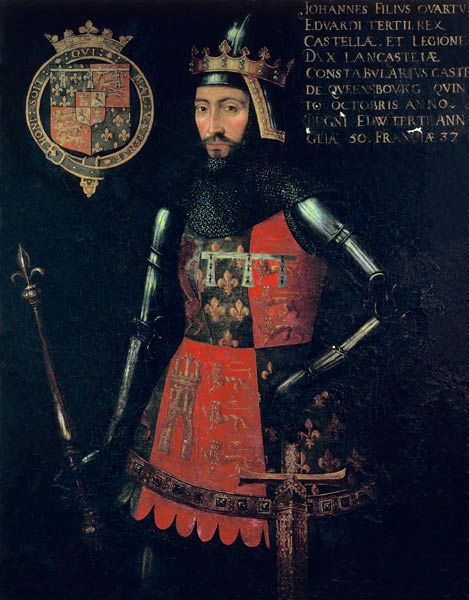
In English heraldry, the motto Honi soit qui mal y pense is used either as a stand-alone motto upon a motto scroll, or upon a circular representation of the Garter. Knights and Ladies of the Garter are entitled to encircle the escutcheon of their arms with the garter and motto (e.g. The 1st Duke of Marlborough).
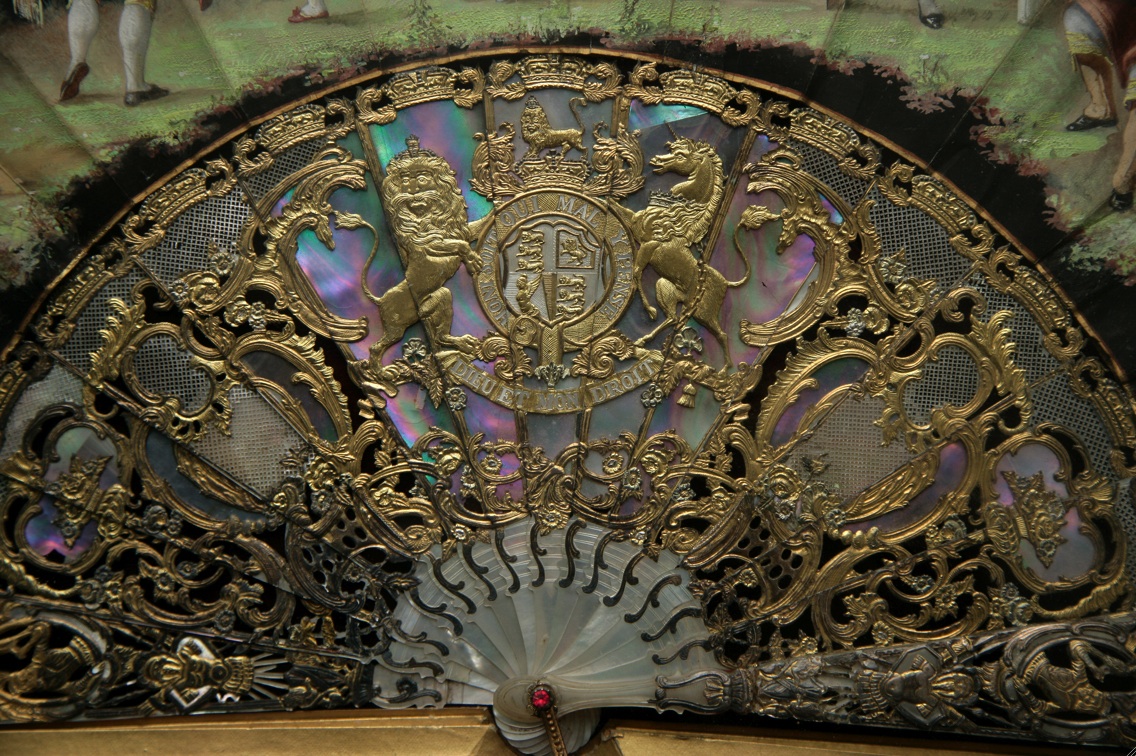
The latter usage can also be seen in the royal coat of arms of the United Kingdom, with the motto of the royal arms, Dieu et mon droit, being displayed on a scroll beneath the shield. As part of the royal arms, the motto is displayed in many public buildings in Britain and colonial era public buildings in various parts of the Commonwealth (such as all Courts of England and Wales). The royal arms (and motto) appear on many British government official documents (e.g. the front of current British passports); on packaging and stationery of companies operating under Royal Warrant (e.g. the banner of The Times, which uses the royal coat of arms of Great Britain circa 1714 to 1800); and are used by other entities so distinguished by the British monarch (e.g. as the official emblem of the Royal Yacht Britannia).
Several military organisations in the Commonwealth incorporate the motto inscribed upon a garter of the order within their badges (or cyphers) and some use Honi soit qui mal y pense as their motto. Corps and regiments using the motto in this fashion are ('*' indicates usage as a motto in addition to inclusion in the badge):
- Also used on items, e.g., the baton, of the Society of High Constables of Edinburgh (founded 1611), along with the phrase ' nisi dominus frustra'.
- British Army: the Royal Horse Artillery; Household Cavalry Regiment; Life Guards (motto appears in the Garter Star representation worn on Life Guard officer's helmets rather than in the unit badge); Blues and Royals; Royal Engineers; Grenadier Guards*; Coldstream Guards; Princess of Wales's Royal Regiment; Royal Regiment of Fusiliers; and the Royal Logistic Corps (which in April 1993 became an amalgamation of the trades of five corps, which included the Royal Corps of Transport the Royal Army Ordnance Corps, The Royal Pioneer Corps, the Army Catering Corps and the Postal and Courier Services of the Royal Engineers, all of these forming Corps used the motto inscribed garter in their badge).
- Australian Army: the Royal Australian Engineers* (motto is one of two used); Royal Australian Army Service Corps (merged in 1973 into the newly raised RACT (and who did not use the motto), and the Royal Australian Army Ordnance Corps);
- Canadian Army: The Governor General's Horse Guards, The Royal Regiment of Canada, The Royal Montreal Regiment* and The Royal Canadian Horse Artillery.
- New Zealand Army: the 6th Hauraki Infantry Regiment.
Other uses

- It appears on in the lower half of the coverpage for the Coverdale Bible where it surrounds the coat of arms of Henry VIII.
- It appears in The King's School, Grantham and Winchester College coats of arms.
- It appears on several British military cap badges including that of the Royal Engineers. The phrase is incorporated into the elaborate figurehead of , Horatio Nelson's flagship at the historic Battle of Trafalgar. Bounty mutineer James Morrison had the motto with a garter tattooed around his left leg, according to William Bligh's Notebook.
- It is a motto for many schools and educational institutions; the title of the University of Sydney student newspaper, Honi Soit, is derived from the motto.
- It appears in a number of literary works, including Robert Anton Wilson's Masks of the Illuminati, Robert A. Heinlein's Friday, Bernard Malamud's The Natural, Shakespeare's The Merry Wives of Windsor (Act V, Scene V), Thomas De Quincey's Confessions of an English Opium-Eater (Introduction to "The Pains of Opium"), Leo Tolstoy's Anna Karenina (Part 1, Chapter 17), Harold Brodkey’s short story “The Nurse’s Music,” and at the end of the late 14th-century Middle English Arthurian romance, Sir Gawain and the Green Knight.
- It appears in the stage directions of Giuseppe Verdi's Falstaff, libretto by Arrigo Boito, in Act 3, scene 1, where it is written above the door at the Garter Inn.
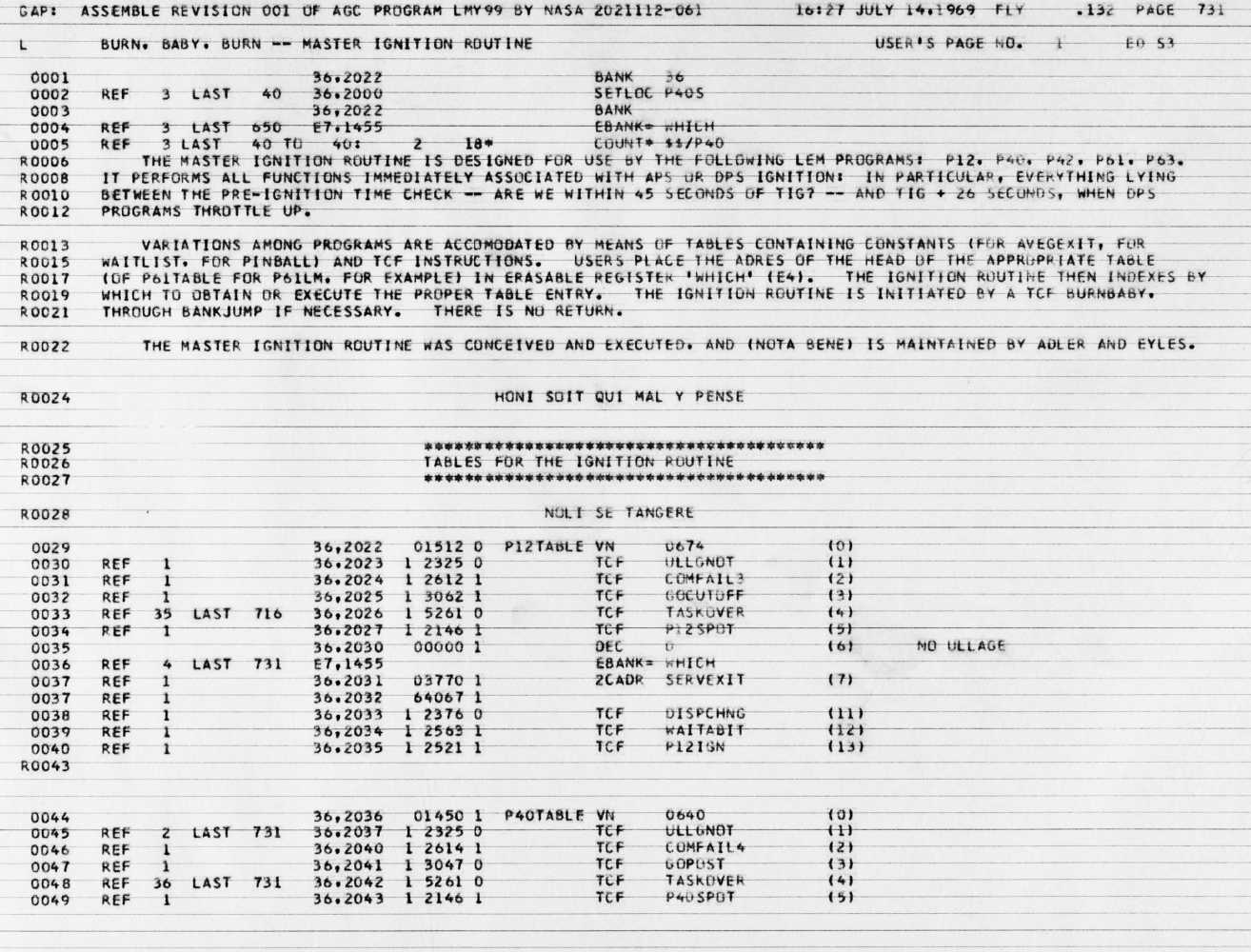
- It appears in the comments of the Apollo Guidance Computer assembly source code for the master ignition routine of the Lunar Module.
- It is sung in full as the chorus of John Cale's song "Honi Soit (La Première Leçon de Français)" featured on the 1981 album Honi Soit.
- It appears in the staff used by the Usher of the Black Rod of the Parliament of Canada. It also figures on the cap badge of the Royal Montreal Regiment.
- It is incorporated in the coat of arms of the Basilica of Saint Paul Outside the Walls in Rome.
- It is used as the motto of The Blue Book, a guide to prostitutes in Storyville, New Orleans published 1895–1915.
- It appears on the entry gates to pop star Michael Jackson's Neverland estate, and of the Victoria Memorial in Kolkata, India.
- It is a motto of the Fort Henry Guard, of Kingston, Ontario, and appears on the Shako worn by the guard.
References
References
- "Definition of HONI SOIT QUI MAL Y PENSE".
- (1995). "Great Britain". Dorling Kindersley.
- (December 2014). "honi soit qui mal y pense, ''n''". [[Oxford University Press]].
- "College of St George – Windsor Castle – The Order of the Garter". College of St George – Windsor Castle.
- (2015). "Joan of Kent: The First Princess of Wales". [[Amberley Publishing]].
- (2001). "Berkshire History: The Order of the Garter".
- Cotton Nero A.x [http://contentdm.ucalgary.ca/cdm/singleitem/collection/gawain/id/356/rec/176 128v]
- (1997). "Gawain's Girdle as Traditional Symbol". American Folklore Society.
- Savage, Henry L.. (1938). "Sir Gawain and the Order of the Garter". [[The Johns Hopkins University Press]].
- Fox-Davies, Arthur Charles. (1996). "Complete Guide to Heraldry". Wordsworth Editions.
- (24 November 2010). "Official Lineages Volume 3, Part 2: The Royal Regiment of Canada". Directorate of History and Heritage, Canadian Forces.
- Robson, Thomas. (1830). "The British Herald, or Cabinet of Armorial Bearings of the Nobility & Gentry of Great Britain & Ireland, Volume I". Turner & Marwood.
- (5 January 2007). "Scissors for Lefty review in The Times". Scissors for Lefty.
- "Coats of Arms". The Royal Household (2008-09).
- (25 December 2010). "Artillery Heritage". Royal New Zealand Artillery Association.
- Wilkinson-Latham, Robert. (2006). "Discovering British Military Badges and Buttons". Shire Books.
- (2012). "Welcome". Peter J Ashman.
- (2012). "Corps of Royal Engineers Badges and Emblems". British Army.
- (2012). "The Grenadier Guards". The Grenadier Guards.
- (2012). "Princess of Wales' Royal Regiment". British Army.
- (2012). "Royal Regiment of Fusiliers – Regimental History". British Army.
- (2012). "Royal Logistic Corps". British Army.
- "Royal Army Service Corps & Royal Corps of Transport Association". RASC & RCT Association.
- "Who we are – The Royal Australian Engineers". The Australian Army.
- "Royal Australian Army Service Corps". Digger History.
- "Who we are – The Royal Australian Army Ordnance Corps". The Australian Army.
- Personnel, Government of Canada, National Defence, Chief Military. "Armour, Artillery and Field Engineer Regiments - ARMOUR REGIMENTS - THE GOVERNOR GENERAL'S HORSE GUARDS".
- (24 November 2010). "Official Lineages Volume 3, Part 2: The Royal Regiment of Canada". Directorate of History and Heritage, Canadian Forces.
- (9 September 2010). "Official Lineages Volume 3, Part 2: The Royal Montreal Regiment". Directorate of History and Heritage, Canadian Forces.
- Army, Government of Canada, National Defence, Canadian. (24 June 2013). "1st Regiment, Royal Canadian Horse Artillery -1 Canadian Mechanized Brigade Group Unit- Canadian Army". forces.gc.ca.
- (10 June 2009). "Sixth Hauraki Battalion Group". New Zealand Army.
- "200 invalid-request".
- https://www.winchestercollege.org/welcome/heritage {{Bare URL inline. (July 2025)
- (2010-03-17). "Fatefulvoyage.com".
- "Source code for the Apollo 13 lunar module's guidance computer". Ibiblio.org.
- "Scan of source code page731 for the Apollo 11 (Luminary099) lunar module guidance computer". Ibiblio.org.
- "chrislgarry/Apollo-11".
- rightnowORneverever. (26 January 2011). "John Cale "Honi Soit (Le Première Leçon de Français)"". [[YouTube]].
- "Abbazia di San Paolo fuori le mura".
- "Blue Book Gallery | Storyville: New Orleans".
- "Neverland partie 3: l'Entrée du ranch - on Michael Jackson's footsteps".
- "Fort Henry Guard Club of Canada - Home".

This article was imported from Wikipedia and is available under the Creative Commons Attribution-ShareAlike 4.0 License. Content has been adapted to SurfDoc format. Original contributors can be found on the article history page.
Ask Mako anything about Honi soit qui mal y pense — get instant answers, deeper analysis, and related topics.
Research with MakoFree with your Surf account
Create a free account to save articles, ask Mako questions, and organize your research.
Sign up freeThis content may have been generated or modified by AI. CloudSurf Software LLC is not responsible for the accuracy, completeness, or reliability of AI-generated content. Always verify important information from primary sources.
Report