From Surf Wiki (app.surf) — the open knowledge base
Hong Kong City Hall
Municipal building in Central, Hong Kong

Municipal building in Central, Hong Kong
| Field | Value |
|---|---|
| name | Hong Kong City Hall |
| native_name | 香港大會堂 |
| native_name_lang | zh-hant |
| image | Hong Kong City Hall 2017.jpg |
| image_caption | Hong Kong City Hall in 2017 |
| building_type | City hall |
| architectural_style | International Style |
| location | Central, City of Victoria |
| address | 5 Edinburgh Place |
| location_country | Hong Kong (special administrative region of China) |
| groundbreaking_date | |
| completion_date | |
| owner | Hong Kong Government |
| landlord | Leisure and Cultural Services Department |
| material | Steel & concrete |
| grounds_area | 10000 m2 |
| architect | Gordon Brown |
| Ronald Phillips | |
| Alan Fitch | |
| embedded | {{Designation list |
| embed | yes |
| designation1 | HK Declared Monument |
| designation1_date | |
| designation1_number | 132 |
Ronald Phillips Alan Fitch
Hong Kong City Hall (HKCH, ) is a building located at Edinburgh Place, Central, Hong Kong Island, Hong Kong.
In the 19th century, the British founded the City of Victoria in the present-day Central after the establishment of the Crown Colony of Hong Kong. The Crown Colony (including the City of Victoria) was governed by a Governor and Urban Council, there was no mayor or city council, therefore, the City Hall does not hold the offices of a city government, unlike most city halls around the world. Instead, it is a complex providing municipal services, including performing venues and libraries.
The City Hall is managed by the Government's Leisure and Cultural Services Department. The Urban Council (UrbCo) managed the City Hall (through the Urban Services Department) and held its meetings there prior to its dissolution in December 1999. Prior to its dissolution the UrbCo served as the municipal council for Hong Kong Island and Kowloon (including New Kowloon). The UrbCo had its meeting chamber in the Low Block of the City Hall.
First generation
Main article: Old City Hall (Hong Kong)
Hong Kong's first City Hall was designed by the French architect Achille-Antoine Hermitte and was opened by Prince Alfred, Duke of Edinburgh in a ceremony on 28 June 1869, it occupied the current sites of the HSBC Hong Kong headquarters building (partly) and the Bank of China Building until its demolition in 1933.
The current site of the HSBC Hong Kong headquarters building was occupied in part by the old City Hall, and in part by the first and second generations of the HSBC building.
Second generation


The second and current City Hall complex was built in the late 1950s following a public campaign led by the Sino-British Club for the re-establishment of a civic centre in Hong Kong. It was built on a 10,000 m2 plot of land on the newly reclaimed seafront, about 200 m from the first generation building.
The foundation stone laying ceremony took place on 25 February 1960 with Sir Robert Brown Black, then Governor of Hong Kong, who also presided over the official opening ceremony on 2 March 1962. The City Hall was placed under the responsibility of the Urban Council.
Since 2009, it had been listed as a Grade I historic building. On 20 May 2022, the Hong Kong City Hall was declared a monument under the Antiquities and Monuments Ordinance. At the age of 60, it is the youngest as well as the first post-WW2 building in Hong Kong being declared as a monument.
Design

The building complex erected at the present site based on the original design by Professor Gordon Brown, the first Head of Department of Architecture of Hong Kong University, together with his team including Patricia O'Reilly Mayne, was completed by British architects Ronald Phillips and Alan Fitch at the cost of HK$20 million. With its clean lines and stark geometric forms, the new Hall is an example of the International style fashionable at the time. The structure was constructed using steel and concrete, and much of the equipment was of steel, glass and anodised aluminium.
The two separate blocks and gardens were laid out as a cohesive whole, along a central axis. The entrance to the lower block (exhibition hall) of the City Hall formed an axis with Queen's Pier to lend a sense of occasion to visiting dignitaries. On the façade of the Lower Block once had the old coat of arms of Hong Kong, which was removed before the handover in 1997. One major consideration was juxtaposing the city bustle whilst maximising public access to the surrounding area. Thus, the out-sized public areas of the Memorial Gardens and the piazza in front were conceived as a natural extension to promote the "freedom of movement and a sense of unlimited space".
Function
The most important civic function performed by City Hall was as a ceremonial location for the swearing in of successive Governors following their inauguration: The 24th to 28th Governors all swore their oaths of office there.
City Hall's Concert hall and theatre have been an important home to the performing arts in Hong Kong since its inauguration. A number of culture events, including the Hong Kong Festival, Hong Kong Arts Festival in 1973, Asian Arts Festival in 1976, the Hong Kong International Film Festival in 1977, and the International Arts Carnival in 1982 were hosted there. The conference room of the former Urban Council was also at the lower building of the City Hall.
The High block once housed Hong Kong's principal public library, until a new Central library was opened in 2001; the Hong Kong art gallery (which became the Hong Kong Art Museum in 1969) began life there on the tenth and eleventh floors. The Hong Kong Museum of History relocated in 1975, and the Hong Kong Museum of Art also moved out of City Hall in 1991.
The City Hall Memorial Garden, located at the north-western quadrant between the High Block and Low Block, is a walled garden wherein a 12-sided dodecagon Memorial Shrine commemorates soldiers and citizens who died in defence of Hong Kong during the Second World War. It is a popular spot and obligatory backdrop for photographs of couples who celebrate their marriage in the City Hall Registry. Within the Memorial Shrine are embedded memorial Roll of Honour and Plaques to combat units who fought in Hong Kong during World War II (1941–1945). Inscribed on the walls of the Memorial Shrine are eight Chinese characters evoking the everlasting spirit of the Brave and the Dead. The entrance gates to the City Hall Memorial Garden bear the regimental emblems of the Hong Kong Volunteer Defence Corps and Royal Hong Kong Regiment.
The complex also incorporates a three-storey car park, with 171 car park spaces, which was also designed by architects Ron Phillips and Alan Fitch.
Facilities

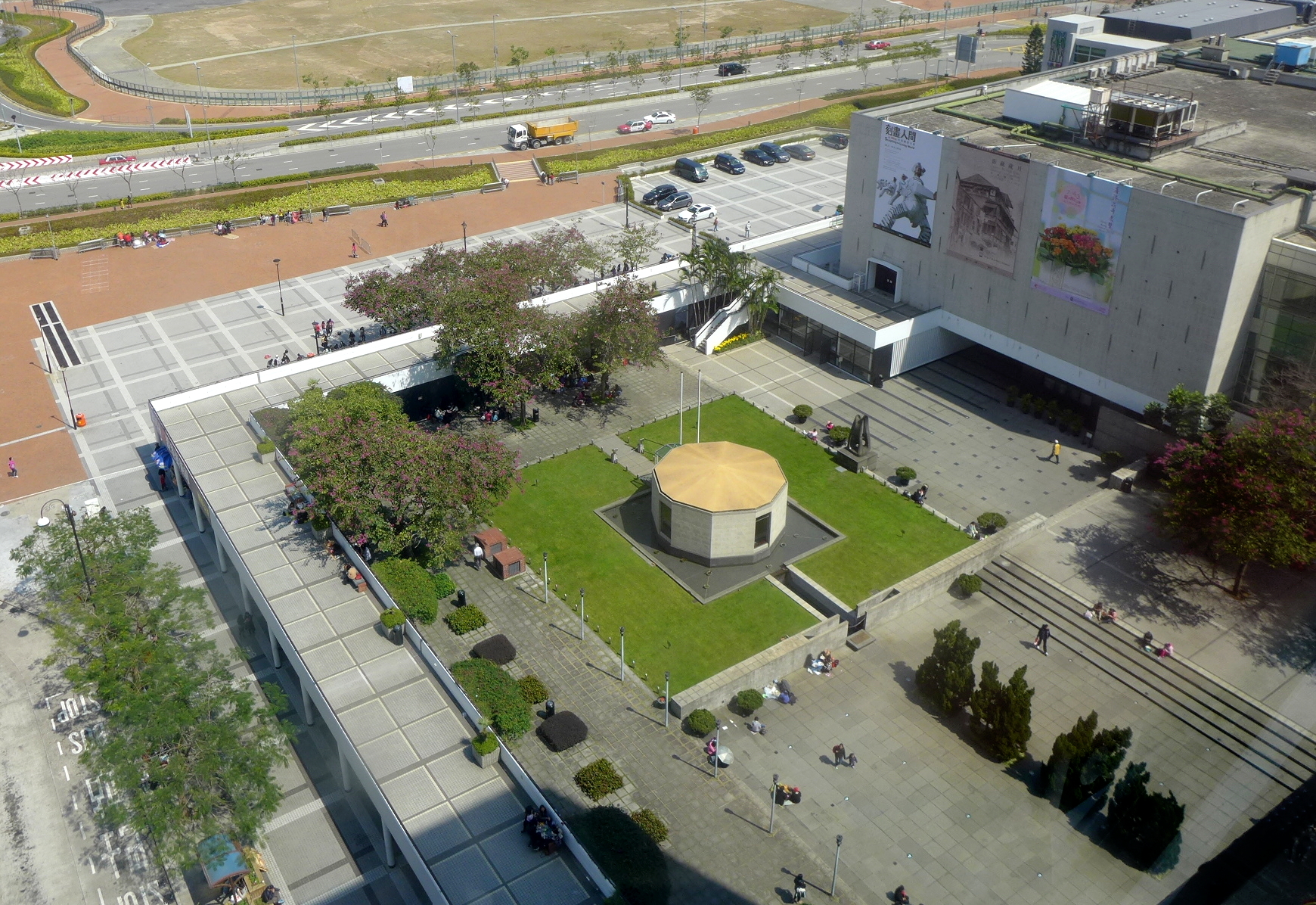

The second and current City Hall complex has two buildings, a garden and a three-storey car park.
City Hall Memorial Garden enclosing the World War II (1941–1945) Memorial Shrine
The High Block, a 12-storey building, is in the south-western end and houses a number of government facilities:
- City Hall Public Library, an eight-storey facility, which in the past served as the central library of Hong Kong (9th – 11th floors)
- Recital Hall with 111 seats (8th floor)
- Exhibition Gallery, 260 m2 (7th floor)
- Committee Rooms: two 40-seat committee rooms, each 35 m2 (7th floor)
- Marriage Registry (1st floor)
- Maxim's MX fast food restaurant, run by Maxim's Caterers (ground floor)
The 3-storey Low Block is at the eastern end, with the following facilities:
- Exhibition Hall, 590 m2 (first floor)
- HK Collectables Arts Shop (first floor)
- Concert Hall with 1,430 seats and 60 standees (mezzanine)
- Restaurants and a cafe, run by Maxim's Caterers: Chinese (City Hall Maxim's Palace), Continental (Deli and Wine), and European (City Hall Maxim's Café) cuisines
- Theatre with 463 seats
- URBTIX Box Office (foyer)
- Enquiry counter (foyer)
High Block floor directory
| 11th floor | 10th floor | 9th floor | 8th floor | 7th floor | 6th floor | 5th floor | 4th floor | 3rd floor | 2nd floor | 1st floor | Ground floor |
|---|---|---|---|---|---|---|---|---|---|---|---|
| Reference Library / Business and Industry Library | |||||||||||
| Multimedia Resource Centre | |||||||||||
| Reference Library (Entrance) | |||||||||||
| Creativity and Innovation Resource Centre | |||||||||||
| Newspapers and Periodicals Reading Room | |||||||||||
| Recital Hall | |||||||||||
| Extension Activities Room | |||||||||||
| Exhibition Gallery | |||||||||||
| Committee Room South/North | |||||||||||
| Computer and Information Centre | |||||||||||
| Office of Computerization Unit, Hong Kong Public Libraries | |||||||||||
| Basic Law Library | |||||||||||
| Adult Lending Library | |||||||||||
| Adult Lending Library | |||||||||||
| Adult Lending Library (Entrance) | |||||||||||
| Circulation Counter | |||||||||||
| Junior Library | |||||||||||
| Marriage Registry | |||||||||||
| Library Cloakroom |
References
References
- Davies, Stephen. (2014). "Achille-Antoine Hermitte (1840–70?)". Royal Asiatic Society Hong Kong Branch.
- [http://www.epd.gov.hk/eia/register/report/eiareport/eia_0552001/report/vol2/eia_0552001appendix_w.pdf EIA: A survey report of Historical Buildings and Structures within the Project Area of the Central Reclamation Phase III], Chan Sui San Peter for the HK Government, February 2001
- (2024). "The 'death' and 'rebirth' of museums in colonial Hong Kong: three decades of community endeavours to restore reputation and culture, 1933–1962". Taylor & Francis.
- [https://www.artlinkart.com/en/space/overview/623cvAp Hong Kong City Hall] at ArtLinkArt
- Hong Kong Memory: [https://www.hkmemory.hk/collections/MemoriesWeShare/live_broadcasts/opening_of_city_hall/index.html Grand opening of Hong Kong City Hall]
- "List of the 1,444 Historic Buildings in Building Assessment (as of 8 June 2017)".
- (20 May 2022). "Three historic buildings declared as monuments (with photos)".
- "1990s City Hall Coat of Arms | Gwulo: Old Hong Kong".
- Heron, Liz. (13 May 2007). "Save Queen's Pier, says architect of City Hall complex". [[South China Morning Post]].
- [http://www.amo.gov.hk/form/AAB_Paper129_queen_annexb_e.pdf Annexe B3] {{webarchive. link. (27 September 2007 , EIA: A survey report of Historical Buildings and Structures within the Project Area of the Central Reclamation Phase III, Chan Sui San Peter for the HK Government, February 2001)
- [[Antiquities Advisory Board]]: [http://www.aab.gov.hk/form/brief_information_grade1.pdf Brief Information on proposed Grade I Items. Item #52] {{Webarchive. link. (13 October 2012)
- Tsui, Enid. (31 May 2016). "Push to expand Hong Kong City Hall amid harbourfront development". [[South China Morning Post]].
This article was imported from Wikipedia and is available under the Creative Commons Attribution-ShareAlike 4.0 License. Content has been adapted to SurfDoc format. Original contributors can be found on the article history page.
Ask Mako anything about Hong Kong City Hall — get instant answers, deeper analysis, and related topics.
Research with MakoFree with your Surf account
Create a free account to save articles, ask Mako questions, and organize your research.
Sign up freeThis content may have been generated or modified by AI. CloudSurf Software LLC is not responsible for the accuracy, completeness, or reliability of AI-generated content. Always verify important information from primary sources.
Report