From Surf Wiki (app.surf) — the open knowledge base
Honda Gold Wing
Series of touring motorcycles by Honda

Series of touring motorcycles by Honda
| Field | Value |
|---|---|
| name | Honda Gold Wing |
| image | Honda Gold Wing GL 1800 (SC79 - 2018).jpg |
| caption | 2018 Honda Gold Wing GL1800 |
| manufacturer | Honda Motor Co., Ltd |
| production | 1974–present |
| assembly | Japan |
| class | Touring |
The Honda Gold Wing is a series of touring motorcycles manufactured by Honda. Gold Wings feature shaft drive and a flat engine. Characterized by press in September 1974 as "The world's biggest motorcycle manufacturer's first attack on the over-750cc capacity market...", it was introduced at the Cologne Motorcycle Show in October 1974.
The Gold Wing series
Total sales are more than 640,000, most of them in the U.S. market. Gold Wings were assembled in Marysville, Ohio, from 1980 until 2010, when motorcycle production there was halted.
The includes a Honda Gold Wing GL1000 manufactured in 1974 as one of their 240 Landmarks of Japanese Automotive Technology.
Over the course of its production history, the Gold Wing had many design changes, beginning in 1975 with a 999 cc flat-four engine; by 2001, this had grown to a 1832 cc flat-six. The 2012 model had anti-lock braking, cruise control, electrically assisted reverse gear, an optional airbag, a fairing with heating and an adjustable windscreen, panniers and a trunk, a pillion backrest, satnav, and a six-speaker radio/audio system with MP3/iPod connectivity.
Gold Wing development
In 1972, following the success of the CB750 superbike, the company assembled an R&D design team to explore concepts for a new flagship motorcycle. The project leader was Shoichiro Irimajiri, who in the 1960s had designed Honda's multi-cylinder Grand Prix engines and their Formula One V12 engine.
The 1974 Gold Wing with its flat-four shaft-drive powertrain used technologies both from earlier motorcycle and automotive designs.
Although preceded by the 1971 water-cooled Suzuki GT750 two-stroke triple, the Gold Wing was the first Japanese production motorcycle with a water-cooled four-stroke engine. The first four-cylinder boxer engine was produced in 1900.
Target market
During its development, the CB750 was known within Honda as their "King of Motorcycles." As it would sit atop the CB750 as the top of the line Honda motorcycle, the project that would become the Gold Wing was informally called the "King of Kings." realising that the primary market for the Gold Wing was the long-distance motorcyclist.
In America in the early 1970s, long-distance motorcyclists had only a few manufacturers to choose from: Harley-Davidson, Moto Guzzi and BMW. The H-D Electra Glide was a touring motorcycle with a loyal cult following. It faced strong competition from Moto Guzzi's 850cc Eldorado. BMW motorcycles were smoother and more reliable, if expensive. The Gold Wing was aimed at a newly emerging market segment, namely, a new kind of American long-distance rider who was not likely to buy a Harley-Davidson or BMW but who would open their wallets for a reliable machine offering comfort, endurance, low maintenance, and a smooth, torquey, quiet engine.
The Gold Wing's secondary target market was Europe, where riders prioritised handling and performance over luxury. (The European market's special demands subsequently led to the Honda Pan European). Though other motorcycle manufacturers build touring bikes, no other touring bike has achieved the popularity of the Gold Wing.
M1 prototype & Project 371
In 1972, the project team broke from Honda practice
The brainstorming team's M1 project was never intended as a production prototype. Nonetheless, the M1 should be seen as the primordial Gold Wing because so many of its distinctive features appeared on the GL1000. The flat-six gave the M1 a low center of gravity, enhancing stability, but the extreme length of the engine/gearbox unit resulted in a cramped riding position. Instead, the project team chose to build a bike with a compact one liter flat-four engine. took over from Irimajiri as project leader.
First generation
R: Swing arm, 86.3 mm travel R: Single disc, opposed 2-piston caliper R: 4.50 H-17A (tube type)
GL1000
The Project 371 team finally settled on a layout that became the characteristic Gold Wing: a liquid-cooled flat-four SOHC engine, with a gear-driven generator that contra-rotated to counteract the engine's torque reaction. Cylinder blocks and crankcase were integral, with the transmission situated beneath the crankcase to keep the unit construction engine as short as possible. Final drive was by shaft.
Before going on sale in the US and in Europe in 1975, the Gold Wing was revealed to dealers in September 1974 at American Honda's annual dealer meeting in Las Vegas, and then shown to the public the following month at the IFMA (International Bicycle and Motorcycle Exhibition; today Intermot) in Cologne.
Small fairings had been mounted on two of the show models at the US dealer show in Las Vegas. Consequently, the Gold Wing was issued naked, lacking saddlebags, a luggage rack, and a windshield. This created an opportunity for aftermarket accessory manufacturers, who soon offered a range of fairings and luggage accessories, particularly the Craig Vetter Windjammer series.
The original 999 cc GL1000 (designated K0) had an electric starter backed up by a kick start lever stored inside a dummy fuel tank, which also housed the radiator expansion tank, electrical components, as well as the air filter supplying four Keihin 32 mm CV carburetors. The real fuel tank was under the seat, in order to keep the center of mass as low as possible. The bike had a dry weight of 584 lb. 13,000 Gold Wings were sold in the United States in 1975.
There were no significant changes in the standard Gold Wing for 1976 (the K1 model). The LTD was a genuine limited edition with production restricted to about 2,000 units.
In the third model year (K2) Honda began refining the Gold Wing, although the changes for 1977 were small, such as exhaust pipe heat shields, revised seat and handlebar, as well as a new fuel gauge. Weight increased to 595 lb. The motorcycle division of Honda UK produced 52 Executive GL1000 K1 bikes by adding premium accessories to 1977 Gold Wings.
The engine was modified in 1978 for the GL1000 K3 model, in order to make more torque available at lower engine speeds; the carburetors were reduced in size by 1 mm, the exhaust system was redesigned, valve timing and ignition timing were altered. The kick-start mechanism was removed from the engine, and a reserve lighting module for the headlight and taillight (automatically switching to the second filament when one burns out) was removed from the electrics. Dry weight grew to 601 lb.
1979 marked the end of GL1000 development with the K4 model (the UK version was designated KZ). Dry weight increased slightly to 604 lb. During the final run of the GL1000 in 1979, Hondaline saddlebags and trunk were available, but Honda still did not offer a fairing.
Honda sold more than 97,000 units of the GL1000 in the United States between 1975 and 1979.
Second generation
1983 R: Air-assist shocks 80 mm travel R: Single disc, 1-piston caliper '80–'81 F: Dual discs, 2-piston calipers '82–'83 R: Single disc, 2-piston caliper '82–'83 F: 120/90-18 65H, R: 140/90-16 71H '82–'83 29.17 degrees/132 mm '82–'83
GL1100(SC02)
After five years of the GL1000, the second-generation Gold Wing was released in 1979 as a 1980 model, and the GL1100 would be continued through the 1983 model year. The GL1100 was manufactured in Japan until May 1980 when Honda started assembling 1981 models at the Marysville Motorcycle Plant in Ohio,
The Gold Wing faced competition from Japan in the form of the Suzuki GS1000 with an inline-four engine, and especially in the Kawasaki Z1300 that had a massive DOHC 1300cc straight-six engine with water cooling. Honda responded by increasing the displacement of the Gold Wing, and then followed-up by announcing the first Japanese full-dress tourer. The new engine was more than just a GL1000 with a 3 mm larger bore, the alterations clearly emphasized torque over horsepower. The cylinder heads were modified to improve combustion at low and middle engine speeds, transmission gear ratios were changed and the final drive ratio shortened to make more torque available at highway speeds. The bore size for all four carburetors was again reduced by 1 mm, to 30 mm.
The wheelbase was lengthened over that of the GL1000, and air suspension was added. The GL1100 had an adjustable seat, and for the first time used tubeless tires, mounted on black reverse ComStar wheels. The naked Gold Wing, which would become known as the Standard model, weighed 589 lb dry. In spite of the fact that there were only minor changes to differentiate the GL1100 '81 edition from the previous year.
Ridden by Emilio Scotto, the GL1100 is the bike that toured the world. Holding the record for the longest distance of any motorcycle total distance of 457,000 miles (735,000 km).
All the 1982 Gold Wings had transmission ratios revised (again) to lower engine rpm at cruising speeds, new brakes with twin-piston calipers and wider tires on smaller wheels. Dry weight for the GL1100 '82 was 595 lb.
Transmission gear ratios were revised yet again for the 1983 Gold Wings to lessen engine speed on the highway. Dry weight for the standard GL1100 inched up to 599 lb.
GL1100 Interstate
Honda went beyond the mechanical makeover of the naked Gold Wing in March 1980 by releasing the first Japanese turn-key tourer, the Interstate model (GL1100I) with a factory-installed full fairing, saddlebags and a removable trunk, plus a long list of optional extras including a stereo system. This bike was called the De Luxe model (GL1100DX) in some markets. The fairing was designed to protect both the rider and a passenger from the wind. Likewise, the saddlebags and trunk were intended to carry the baggage of two people. This made the Interstate significantly heavier than the standard model, with a dry weight of 672 lb. The almost identical Interstate model was made for 1981.
The GL1100I '82 model offered more options, such as a new stereo, a 40-channel CB transceiver, and an on-board compressor to adjust the suspension air pressure. Dry weight was 679 lb.
The GL1100I '83 received the engine and running gear updates of the standard model; dry weight increased to 686 lb.
GL1100 Aspencade
Starting in 1982, Honda offered three different Gold Wing models. With the introduction of the Aspencade (GL1100A) Honda took the full-dress tourer to a new level of luxury, with a larger seat, two-tone paint and more storage compartments, together with many options from the Interstate that were being included as standard. All three brake disks on the GL1100A were internally ventilated. The additional items jacked up the dry weight to 702 lb.
The GL1100A '83 received the same engine and running gear updates of the other models. The Aspencade also got new front and rear brakes, with internally ventilated front discs (only), as well as a digital LCD instrument panel and some additional amenities for rider and passenger. Weight went up just a bit to 707 lb.
Third generation
R:Air-assist shocks 4.1 in travel R: Single disc, 2-piston caliper
GL1200(SC14)
In 1983 Honda was facing a challenge in the marketplace from a new full-dress tourer, the Yamaha Venture XVZ 1200 with its DOHC four valve per cylinder V4 engine (as Yamaha's XS Eleven Venturer had challenged the GL1100 two years earlier). Honda hit back at the Milan motorcycle show late that year by announcing a new 1984 Gold Wing that pushed its four-cylinder engine design to its limits. The bored and stroked boxer produced more power and torque; a new final drive ratio gave the GL1200 taller gearing in order to reduce noise and vibration. The four Keihin 32 mm CV carburetors were larger than those on the GL1100 engine, on the other hand, they were the same size as the '75–'76 GL1000 carbs. Incorporating hydraulic actuation for the clutch, in addition to hydraulic tappets for the valves, made the new engine virtually maintenance-free. In order to make the Gold Wing more nimble, front and rear wheel diameters contracted (and tire widths expanded) one more time. The GL1200 was built on a new, stronger frame and despite all the improvements, the claimed dry weight of the naked bike remained unchanged at 599 lb for the 1984 model year.
1984 was the one and only year for the GL1200 Standard (which was not exported to Europe) for the reason that sales had decreased in favor of the Interstate and Aspencade models. This led to the decline of aftermarket manufacturers such as the Vetter Fairing Company.
The GL1200's competitors were becoming more numerous. Last of the big Japanese manufacturers to do so, Suzuki finally entered the marketplace in 1985 with their full-dress tourer, the GV1400 Cavalcade with a DOHC, four valves per cylinder, V4 engine. In 1986 Yamaha enlarged the Venture's V4 engine to 1300cc, and Kawasaki introduced the ZG 1200 Voyager XII with a four-valve, DOHC, Inline-four engine.
With three versions of the Gold Wing boxer motor spanning a dozen years, by 1987 further development of the flat-four engine was regarded as being constrained by the law of diminishing returns. Piston displacement had been increased twice to generate more torque, but this also made each power stroke more intense. During the same time period, gear ratios had been raised to decrease engine RPM (boosting fuel economy and reducing vibration as well as noise levels) which in turn made pulses through the drivetrain seem rougher to the rider because firing intervals were farther apart. The obvious way to deliver power more smoothly (as Irimajiri-san had demonstrated with the M1 engine) was to step up from four cylinders to six.
GL1200 Interstate
Having introduced the full-dress Interstate with the GL1100, Honda used the GL1200I '84 to refine the Gold Wing's fairing so that it would come across as a basic part of the bike and not as an afterthought. The new model Interstate (still called De Luxe in Europe) had an automotive-style instrument panel up front and increased luggage capacity in back: 38 L in each saddlebag plus another 63 L in the trunk. Dry weight for the 1984 Interstate was 697 lb.
Despite giving the Gold Wing taller gearing the year before, in 1985 Honda shortened the overall gearing to improve performance. There were many small changes to the GL1200I '85 but atypically its price was the same as it was the previous year, and at 699 lb its weight was basically stable.
The GL1200I '86 got more small updates, but the significant change was that all Gold Wing engines were being produced in Honda's Anna, Ohio plant from July 1985. Claimed dry weight for the 1986 Interstate was unchanged. The GL1200I '87 got a new seat design with three-stage foam; the weight was unchanged for 1987, the last year of the four-cylinder Gold Wing Interstate.
GL1200 Aspencade
The GL1200A '84 had all the features of the GL1200I, plus a new Panasonic audio system that combined AM/FM radio, cassette player and an intercom between the rider and passenger. Unlike the analog instruments of the Interstate, the Aspencade had a dashboard with an LCD digital display. The GL1200A also had foot boards for the passenger instead of footpegs. Claimed dry weight for the 1984 Aspencade was 723 lb. The price was unchanged for 1985, and the Aspencade received the same updates as the Interstate model for that year. Dry weight for the Aspencade was 728 lb in both '85 and ’86.
In 1986 Dolby noise reduction was added to the audio system, which was replaced with an improved Panasonic system in 1987. In its final year, the GL1200A got the same seat upgrade as the GL1200I '87 model and some amenities that had been optional were made standard, increasing the dry weight of the Aspencade to 743 lb.
Fuel-injected models
In 1985 Honda marked the tenth anniversary of the Gold Wing by launching a gold-painted Limited Edition model (GL1200L) luxuriously equipped with cruise control, auto-leveling rear suspension, an electronic trip computer and a four-speaker audio system. Also known as the LTD, 5372 units were built and sold only in North America. Claimed dry weight for the GL1200L was 782 lb.
To a limited extent, the Limited Edition turned out to be a sham when the SE-i (Special Edition—injected) debuted in 1986, as essentially a repainted GL1200L. The SE-i had the same Dolby audio system as the GL1200A '86 and was only available in the US. This was the only year for the SE-i because the high cost of the fuel injection system forced Honda to return to carburetors for 1987.
Fourth generation
R: Air-assisted shocks, 4.1 in travel R: Single disc, 2-piston caliper
GL1500(SC22)

A new design team began work on the fourth-generation Gold Wing in 1984. Honda describes prototype testing as involving sixty developmental stages, and building fifteen different test bikes, including one made from a GL1200 frame coupled with the original M1 engine so that a six-cylinder could be compared to a four-cylinder head-on. This early '70s prototype had an influence far beyond what the M1's initial designers could have expected.
New Gold Wing engine design goals were smoothness, quietness and enormous power. Ultimately, a redesigned Gold Wing made its debut at the 1987 Cologne Motorcycle Show, 13 years after the original GL1000 was first shown to the public at the same venue, and the GL1500 brought the most changes seen to the Gold Wing series since its inception. The biggest difference was that the flat-four engine was replaced with a flat-six engine. Although the GL1500 still used carburetors, there were just two large 36 mm CV Keihins supplying all six cylinders, the first time any Gold Wing had less than one carb per cylinder.
Honda also enclosed the entire motorcycle in plastic, giving it a seamless appearance. The seat height was lowest yet on a Gold Wing, the passenger back rest and trunk were integrated, and a central mechanism locked the trunk lid and saddlebags. Rear suspension air pressure was adjusted by an on-board compressor. One major innovation was the addition of a "reverse gear", which was actually a creative use of the electric starter motor linked to the transmission. Because of the size and weight, Honda felt that some people would have problems backing it up.
The new Gold Wing had grown in nearly every dimension. A larger windshield, longer wheelbase, two more cylinders, more horsepower, more bodywork, more electronics, more accessories and more mass: 794 lb dry. Options include a passenger audio control and rear speakers, CB radio, auxiliary lights and exterior trim. In another first for the GL1500, 1988 was the year Honda exported Gold Wings from the US to Japan for the first time.
For 1989 Honda modified the brake discs, and raised the price. Brake discs were modified again in 1990, as were the carbs and camshafts, without a price increase. The claimed GL1500 dry weight for '90 was 798 lb. In addition, a Gold Wing 15th Anniversary Special Edition model (GL1500SE) made its debut in 1990.
The following year, to celebrate the 10th anniversary of American-made Gold Wings, every bike produced for 1991 came with a numbered plaque and anniversary edition insignia. There were three '91 models: Aspencade indicated the regular GL1500 model; the luxurious Special Edition from the year before carried on as the SE model; and the Interstate name denoted a stripped-down model.
GL1500 Aspencade
When the Honda of America Manufacturing (HAM) plant in Marysville, Ohio produced its 500,000th vehicle in 1991, it was a Gold Wing Aspencade. The claimed dry weight for the GL1500A '91 was 800 lb. Honda began offering extra cost paint options, and Honda Canada inaugurated Canadian Edition Gold Wings in '92.
Beginning in 1993, all GL1500 rocker arms pivoted on needle bearings, and the cruise control was updated to directly read crankshaft speed for enhanced precision. 1994 was the seventh year of GL1500 production (longer than any of its forerunners) and nothing significant changed except the asking price.
1995 was the 20th anniversary of the Gold Wing. American Honda published a special hard-cover book All 1995 models got commemorative emblems, cosmetic changes, a thinner and narrower seat and suspension improvements which reduced ground clearance, contributing to an even lower seat height (offsetting the weight gain). The GL1500A was at its heaviest in '95; the claimed dry weight would stay at 802 lb until the end of this model.
The 1996 Aspencade received an upmarket audio system that had been exclusive to the GL1500SE. Yet another milestone was reached in mid-1996 when a Gold Wing Aspencade was the millionth Honda motorcycle made in America to roll off the assembly line at the Marysville Motorcycle Plant. The GL1500 family got bigger when Honda created the first GL1500C Valkyrie in May 1996 (for the 1997 model year). The Valkyrie was the first naked GL since 1984.
1997 GL1500s received engine, transmission and final drive improvements first introduced on the GL1500C. A 1998 Gold Wing styling makeover extended to the engine with redesigned valve covers, but no price increase. Honda commemorated 50 years in America by adding 50th Anniversary emblems to all 1999 Gold Wings; the GL1500A '99 price increased. The 2000 Gold Wings had chrome-plated valve covers, Canadian and American models also had gold-plated 25th Anniversary emblems marking 25 years since the first GL1000 debuted for the 1975 model year.
The 2000 model was the last GL1500 Aspencade model.
GL1500 SE
The original 15th Anniversary Special Edition model had a vented windshield, additional lights, upgraded sound system, two-tone paint with special insignia, adjustable passenger floorboards and adjustable foot pegs as well as foot heaters for the rider. In 1990 It had a weight of 807 lb dry. The GL1500SE '91 was essentially unchanged, though weight and price were up a bit at 809 lb.
Hitherto optional rear speakers and CB radio became standard on the GL1500SE '93; boosting both its weight—813 lb.
The GL1500SE '97 had powertrain updates. Honda marked its 50th anniversary in 1999 without a GL1500SE price increase, and the American-made GL1500SE '99 that was exported to Japan got a two-tone paint job. More significantly, the export model got an exhaust air-injection system along with carburetor modifications in order to pass Japan's new emission regulations.
The 25th Anniversary GL1500SE in 2000 had a claimed dry weight from 1995 to 2000 was 816 lb.
GL1500 Interstate
The GL1500I '91 model had its weight and price cut by eliminating the reverse gear, cruise-control, the passenger footboards, and by replacing the audio system with a small Kenwood radio. The seat was lowered by 0.8 in. Claimed dry weight for the 1991 Interstate was 760 lb. In 1992 the Kenwood radio was, in turn, replaced by a new Panasonic 25-watt-per-channel sound system with intercom. Weight for the GL1500I '92 rose slightly to 767 lb.
As with the other 20th Anniversary models, the cost of a GL1500I '95 jumped. The last GL1500I was the 1996 model. Claimed dry weight for '95 and '96 was 769 lb.
Fifth generation
R: Single-sided swing arm with electronically controlled preload, 105 mm travel R: Single disc, 3-piston caliper 898 lb 40 mpgus (high) 36 mpgus (avg)
GL1800(SC47)
The first new model for 13 years, the 2001 GL1800 had a larger 1832 cc engine with fuel injection, and a power increase from 74 kW to 87 kW. The GL1800's extruded aluminium frame, comprising 31 elements (barely half the GL1500's number) resulted in an overall weight decrease. Options included ABS braking.
The 2006 model had further options: an airbag, in-dash GPS called Internavi, with audio information provided through the speakers and headset cables, plus a rider "comfort package" comprising saddle heating, heated grips, and adjustable engine-air vents ahead of the driver's foot pegs.
Update(SC68)
The 2010 model year was the last to be produced in the United States, and no 2011 model year Gold Wings were produced while manufacturing was transferred to Japan in 2012. Some retailers and aftermarket traders group all GL1800 models into two categories: US made GL1800s (2001–2010) are "1st Generation", and Japanese-built GL1800's (2012–2017) are "2nd Generation".
2nd Gen GL1800 had minor updates: The trunk, fairing pockets and saddlebags gave a storage capacity of 150 L. The instrument display has a brighter screen, an updated satellite navigation / radio, and a revised six-speaker audio system with MP3 and iPod connectivity.
Sixth generation
7 speed [Dual clutch transmission], plus electric reverse R: Pro-link R: Single disc, 3-piston caliper R: 200/55R-16 74H 2575 mm(Tour) 905 mm(DCT) 1430 mm(Tour) 364 kg DCT 380 kg Tour MT 383 kg Tour DCT w/ airbag 5.6 L DCT
2018 GL1800(SC79)
For its sixth generation, in 2018, Honda produced a completely redesigned Gold Wing. The new model has a new four-valve engine and is available in two versions: the standard Gold Wing (replacing F6B bagger) and the "top trunk" Gold Wing Tour. Sportier in appearance, technologically more advanced, and more compact, the 2018 Gold Wing is 90 lb lighter than before. Its new robotically welded frame has a double wishbone front suspension, resembling the Duolever from BMW. New features include throttle by wire, four ride modes, traction control, LED lighting, hill start assist, Apple CarPlay, and (on the Tour model) electronically adjustable suspension. Options include automatic dual clutch transmission with a forward and reverse "walking mode".
In mid-June 2020, Honda introduced Android Auto. For 2021, Honda increased the size of the top trunk from 50 litres to 61 litres. The passenger's back seat rest features a more relaxed angle with thicker foam and taller profile. Speakers were changed to 45 watt with automatic volume adjustment and standard XM radio. Rear turn signals were changed to all red.
.jpg)
F6C "Valkyrie"
Main article: Honda Valkyrie


In 1997 Honda brought back an incarnation of the "Standard" or "classic" Gold Wing, renamed the Valkyrie in the US, and called F6C in the rest of the world. It had a higher performance engine, based on the GL1500, in a cruiser-style frame. The Valkyrie Tourer version had a windshield and saddlebags. A more touring-oriented version was introduced in 1999 as the Valkyrie Interstate with a full fairing, saddlebags and trunk. It was released as a naked bike, but also had a Tourer and an Interstate model. These two incarnations lasted relatively short and were re-absorbed by the Goldwing line.
These Valkyrie models were dropped due to slow sales, leaving the standard Valkyrie, which was discontinued after the 2003 model year and since then intermittently new Valkyrie models introduced into the market as "limited" editions. One such case was the in 2004 released Limited Edition model, the Valkyrie Rune, complete with 1832 cc engine and unique styling.
The Valkyrie engine is based on the Gold Wing engine, but has solid lifters instead of hydraulic lifters, six carburetors instead of the Goldwing's two (carbs ≤ 2000, FI ≥ 2001), more aggressive camshafts, a free flowing exhaust, and altered ignition timing to increase performance.
Valkyrie revival
At the 2013 Tokyo Motor Show, Honda revealed a new naked version of the GL1800, the 2014 Valkyrie, using the same 1832cc six-cylinder engine as the Gold Wing but weighing 70 kg less. The new Valkyrie has increased rake and trail, front and rear suspension revised for the reduced weight, 50/50 weight distribution and large tires after the fashion of sport-bikes. Going beyond the naked bike genre, the Valkyrie's horsepower-to-weight ratio puts it clearly into the muscle bike class.
F6B "Bagger"
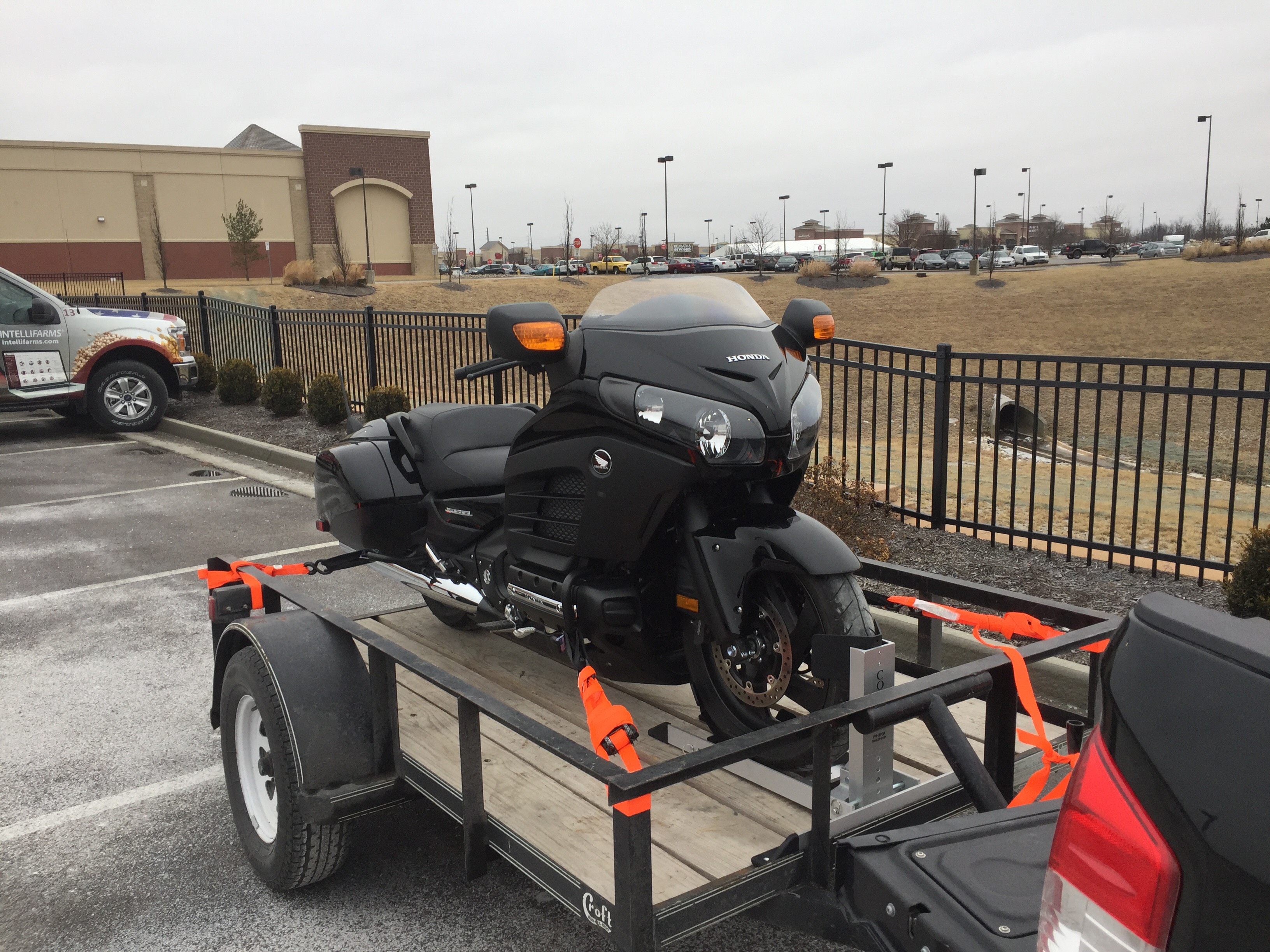
In 2013, Honda brought out a new variation on the traditional Gold Wing, itself being available in two models, The F6B and F6B Deluxe. The F6B is basically a greatly stripped-down version of the 'standard' Gold Wing with most of the chrome trim being 'blacked out', giving the F6B a look that should appeal to many cruiser buyers. It is affectionately known as the Bagger. The rear trunk has been eliminated and the windshield is much smaller. The seat is changed for both the passenger and the rider with the most obvious difference being that the passenger no longer has the oversize backrest – a result of the removal of the trunk. The F6B Deluxe does, however, come with a small passenger backrest, heated grips, self cancelling turn signals & center stand as standard equipment. The basic design is, otherwise, the same as the full blown Gold Wing except that there is no reverse gear and early models did not have cruise control. For 2018 this model is now just called the standard Gold Wing.
In popular culture
The 4th generation Honda GL1500 Goldwing served as basis for Gunmax's Gun Bike in Japanese mecha anime series The Brave Police J-Decker.
Notes
References
References
- Honda to launch 1000cc flat-4? ''[[Motor Cycle News]]'', 20 March 1974, p.1 (front cover). Retrieved 13 March 2022
- (10 March 2011). "Honda Gold Wing: A legend in its own time". Washington Times.
- (4 September 2012). "Honda Announces More New Models for 2013". American Honda Motor Co.
- (30 July 2009). "autoblog news article".
- Tuttle, Mark. (12 May 2010). "New Honda Gold Wing News".
- Burns, John. (21 September 2012). "The Best of Ten Best: Careening through the cream of the last 36 crops.". Bonnier Corp.
- Williams, Don. (9 April 2011). "2012 Honda Gold Wing {{!}} First Ride". Ultimate MotorCycling.
- "Gold Wing features at Honda Canada".
- Salvadori, Clement. (May–June 2007). "The Honda GL1000 Gold Wing". Ogden Publications.
- "M1: Long Live the King". American Honda Motor Co.
- (2 September 2003). "Soaring in the 2nd =American Honda Motor Co".
- The traditional [[BMW Motorrad]] layout, a wet-sump [[unit construction]] boxer-twin using [[Drive shaft. shaft final drive]], goes back to the [[BMW R32. R32]] model that began production in 1923.
- English, Bob. (20 April 2010). "The engine that Benz built still survives". The Globe and Mail (Canada).
- Biker, Maxx. (26 November 2008). "2009 Honda Gold Wing". Top Speed.
- "Suzuki GT750". Society of Automotive Engineers of Japan.
- Two-stroke water-cooled engines from [[The Scott Motorcycle Company]] go back to the 1920s.
- "Designers Talk: GL1800". Honda Motor Co.
- (1 February 2007). "Invention of the boxer engine: The Benz "contra engine" of 1897". Daimler AG.
- Frank, Aaron. (8 August 2012). "The Making of the Honda CB750 {{!}} 'The King of Motorcycles'". Bonnier Corp.
- Gales, Morgan. (16 March 2018). "Getting Technical With The 2018 Honda Gold Wing".
- Colker, David. (25 February 1999). "Luxury Bikes Can Bring Back That Old Feeling for Motor Touring". Los Angeles Times.
- J. Joshua Placa. (28 July 2011). "A Luxury-Touring Rethink". VerticalScope.
- Truett, Richard. (7 March 1996). "Valkyrie, The Un-harley". Orlando Sentinel.
- Ric Anderson. (November–December 2005). "1972 Moto Guzzi Eldorado". Ogden Publications.
- Duchene, Paul. (4 July 2005). "Honda's Gold Wing Goes the Distance". New York Times.
- (May 14, 1995). "Honda Gold Wing At 20: Smooth Sailing For Bikers".
- Visordown quote: "The Honda ST1100 Pan European was one of those bikes that quietly got on with doing the job it was designed to do. And that was to provide something just short of a full-dress touring bike in a slightly more manageable (and cheaper) form, at the behest of the European, not US, market. [http://www.visordown.com/reviews/motorcycles/tourers/honda-st1100-pan-european-1994-2003]
- Szymezak, Pascal. "Début de la légende". Fédération des GoldWing Club de France.
- Duchene, Paul. (13 July 1999). "How Honda Put The Glitter On Gold Wing". Chicago Tribune.
- (3 April 2017). "A BRIEF HISTORY OF THE HONDA GOLD WING".
- Floria, Phillip. "A quick look at the beginning of the Honda Gold Wing". Phillip Floria.
- "Prototyp (M1) 1972–1974". GoldWing Freunde Region Stuttgart.
- Washington, Randall. "Musings on Honda's 50th Anniversary in America". Ed Youngblood.
- (December 1977). "Honda GL1000 K2 Goldwing Test". Motorcyclist Illustrated.
- "GL1000". Goldwing Owners Club of Great Britain.
- Szymezak, Pascal. "Goldwing 1000". Fédération des GoldWing Club de France.
- {{in lang. de ''Internationale Fahrrad- und Motorrad-Ausstellung''
- (3 September 2003). "Gold Wing Spotter's Guide". American Honda Motor Co.
- "Goldwing historique". Honda Werther.
- (8 January 2013). "The Human Touch". American Honda Motor Co.
- (1980). "Honda GL1100 Interstate Owner's Manual 1981". Honda Motor Co.
- (1981). "Honda GL1100 Aspencade Owner's Manual 1982". Honda Motor Co.
- (2009). "Guinness World Records 2009". Random House.
- "Advanced Brake Systems: Q&A". Honda Motor Co.
- (4 June 2007). "2008 Honda Powersports Technology". American Honda Motor Co..
- (October 2000). "WE DIDN'T INVENT TOURING . . .". American Honda Motor Co.
- "GL1500 Service Manual and Electrical Troubleshooting Manual". Honda Motor Co.
- (9 June 2005). "Honda Chronology (1999–1990)". American Honda Motor Co.
- Dever, Paul. (9 August 2009). "Millionth Motorcycle Made at Marysville, Honda is Happy". The Auto Channel.
- (August 1999). "GL1500SE Gold Wing". Honda.
- Andrews, Bill. (17 June 1999). "The Interstate Valkyrie Has The Soul Of A Hot Rod While Retaining Some Of The Comfort Of The Gold Wing". Orlando Sentinel.
- "GoldWing 1st Generation (Front) Bike Map". Küryakyn Holdings, LLC.
- "GoldWing 2nd Generation (Front) Bike Map". Küryakyn Holdings, LLC.
- Note: These categories are somewhat is misleading, since the GL1800 itself is actually the 5th generation Gold Wing.
- (June 2011). "2010 Honda Gold Wing GL1800 Road Test". Rider Magazine.
- (21 February 2011). "Honda Gold Wing Timeline". American Honda Motor Co.
- (21 February 2011). "2012 Honda Gold Wing First Look". Motorcycle USA.
- "2020 HONDA GL1800 GOLD WING".
- Gales, Morgan. (March–April 2018). "2018 HONDA GOLD WING".
- (28 October 2017). "How Different Can Three Gold Wings Be? More Than You Can Ever Imagine!".
- The DuoLever was derived from a 1980s design by [[Norman Hossack]]
- (25 October 2017). "Honda Announces 2018 Gold Wing".
- Gales, Morga. (24 October 2017). "The 2018 Gold Wing Is Lighter, More Compact, and Sportier Than Ever". [[Cycle World]].
- Coldwells, Arthur. (24 October 2017). "2018 Honda Gold Wing First Look". Ultimate Motorcycling.
- (13 May 2020). "Honda Announces Android Auto Integration for Gold Wing Series".
- (5 January 2021). "Honda Improves Touring Comfort, Convenience with 2021 Gold Wing".
- (20 November 2013). "Revealed: Gold Wing F6C". Immediate Media Co.
- Ets-Hokin, Gabe. (20 November 2013). "2014 Honda Valkyrie Announced!". Motorcycle Daily.
- (20 November 2013). "Honda Launches 2014 Honda Valkyrie". Bikeland Media.
- Cook, Marc. (19 November 2013). "2014 Honda Valkyrie First Look". Source Interlink Media.
- Wilson, Andrea. (20 November 2013). "2014 Honda Valkyrie First Look". Cycle News.
- (4 June 2015). "Honda Gold Wing F6B Review - YouMotorcycle".
- (1 June 2023). "Gunmax - The Brave Police J-Decker".
- "Honda Gold Wing GL1000". Society of Automotive Engineers of Japan.
- "The History of Honda Gold Wing Development". Honda Motor Co.
- "HONDA GL1100 '80–'82 GL1100I '80–'82 GL1100A '82 PARTS MANUAL". Honda.
- "Honda GL1100 Gold Wing". www.hondagoldwings.com.
- Reijmerink, Teus. "Specifications GL 1100". Goldwingworld.
- "Honda Gold Wings 1975–77". hondabikespecs.com.
- "Honda Gold Wings 1983". hondabikespecs.com.
- "Honda Gold Wings 1984". hondabikespecs.com.
- "Honda GL1500 Gold Wing (1988–2000)". Bauer Media.
- Reijmerink, Teus. "Specifications GL 1500". Goldwingworld.
- (6 September 1996). "Full-Dress Heavyweight Tourers". VerticalScope.
- (2 September 2003). "Gold Wing - Specifications". American Honda Motor Co.
- "Honda GL 1800 Gold Wing 2001 Specifications". AllMotoInfo.
- "Honda Goldwing Specifications". Gold Wing Chrome.
- Abrahams, Dave. (26 September 2011). "Honda Goldwing is a very grand tourer". Independent Newspapers.
- (24 February 2009). "Honda GL1800 Gold Wing". Source Interlink Media.
- Saunders, Steve. "Goldwing History". Steve Saunders Goldwing Page.
- Sawyers, Arlena. (8 June 2009). "Gold Wing, Honda's top motorcycle, finds its destiny in Ohio". Crain Communications.
- "Search Safety Issues: Recalls, Investigations & Complaints". U.S. Department of Transportation.
- Andrea B.. "Storia della Goldwing". www.andreagoldwing.com.
- (April 2009). "2009 Honda GL1800 Gold Wing Road Test". Rider Magazine.
- "GL1100". Goldwing Owners Club of Great Britain.
- "GL1200". Goldwing Owners Club of Great Britain.
- "GL1500". Goldwing Owners Club of Great Britain.
- Szymezak, Pascal. "GoldWing 1100". Fédération des GoldWing Club de France.
- Szymezak, Pascal. "Usines GoldWing aux USA". Fédération des GoldWing Club de France.
- Szymezak, Pascal. "GoldWing 1200". Fédération des GoldWing Club de France.
- Szymezak, Pascal. "GoldWing 1500". Fédération des GoldWing Club de France.
- (25 August 1998). "Honda Announces that Modified US-Manufactured Gold Wing SE Touring Bike Complies with New Japanese Motorcycle Emission Regulations". Honda Motor Co.
- "Honda F6C Valkyrie (1996–2005)". Bauer Media.
- Finney, Kristin. (22 December 2013). "Christmas arrives on a fleet of motorcycles with annual Toy Ride". Valdosta Daily Times.
- Verpeide, Dag. (10 October 2008). "About The Valkrie". valkyrienorway.com.
- Bill, Andrews. (20 July 2000). "Top-notch Gold Wing: A Caddy On 2 Wheels". Orlando Sentinel.
This article was imported from Wikipedia and is available under the Creative Commons Attribution-ShareAlike 4.0 License. Content has been adapted to SurfDoc format. Original contributors can be found on the article history page.
Ask Mako anything about Honda Gold Wing — get instant answers, deeper analysis, and related topics.
Research with MakoFree with your Surf account
Create a free account to save articles, ask Mako questions, and organize your research.
Sign up freeThis content may have been generated or modified by AI. CloudSurf Software LLC is not responsible for the accuracy, completeness, or reliability of AI-generated content. Always verify important information from primary sources.
Report