From Surf Wiki (app.surf) — the open knowledge base
Homophony
Texture in music
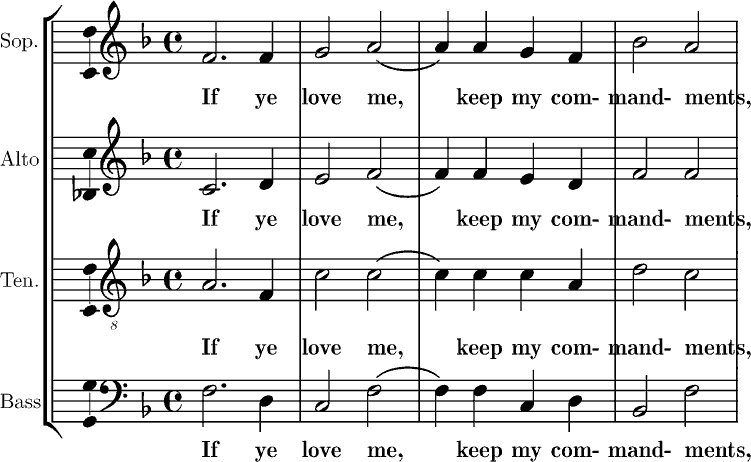
Texture in music
In music, homophony (;, Greek: ὁμόφωνος, homóphōnos, from ὁμός, homós, "same" and φωνή, phōnē, "sound, tone") is a texture in which a primary part is supported by one or more additional strands that provide the harmony. One melody predominates while the other parts play either single notes or an elaborate accompaniment. This differentiation of roles contrasts with equal-voice polyphony (in which similar lines move with rhythmic and melodic independence to form an even texture) and monophony (in which all parts move in unison or octaves). Historically, homophony and its differentiated roles for parts emerged in tandem with tonality, which gave distinct harmonic functions to the soprano, bass, and inner voices.
A homophonic texture may be homorhythmic, which means that all parts have the same rhythm. Chorale texture is another variant of homophony. The most common type of homophony is melody-dominated homophony, in which one voice, often the highest, plays a distinct melody, and the accompanying voices work together to articulate an underlying harmony.
Initially, in Ancient Greece, homophony indicated music in which a single melody is performed by two or more voices in unison or octaves, i.e. monophony with multiple voices. Homophony as a term first appeared in English with Charles Burney in 1776, emphasizing the concord of harmonized melody. : — gives 1768 as the date of earliest use of the term, ‘Homophony’, but gives no reference.
History
European music
Homophony first appeared as one of the predominant textures in Western classical music during the Baroque period in the early 17th century, when composers began to commonly compose with vertical harmony in mind, the homophonic basso continuo becoming a definitive feature of the style. In Western music, homophony may have originated in dance music, in which a simple and direct rhythmic style was needed for the prescribed bodily movements of individual dances. Homophony and polyphony coexisted in the 1600s and 1700s. Polyphony was the common melody during the Renaissance period. During the Baroque period, monophony became the new modern style. The choral arrangement of four voices (soprano, alto, tenor, and bass) has since become common in Western classical music. Homophony began by appearing in sacred music, replacing polyphony and monophony as the dominant form, but spread to secular music, for which it is one of the standard forms today.
Composers known for their homophonic work during the Baroque period include Claudio Monteverdi, Antonio Vivaldi, George Frideric Handel, and Johann Sebastian Bach.
In 20th-century classical music some of the "triad-oriented accompanimental figures such as the Alberti bass [a homophonic form of accompaniment] have largely disappeared from usage and, rather than the traditional interdependence of melodic and chordal pitches sharing the same tonal basis, a clear distinction may exist between the pitch materials of the melody and harmony, commonly avoiding duplication. However, some traditional devices, such as repeated chords, are still used.
Jazz and other forms of modern popular music generally feature homophonic influences, following chord progressions over which musicians play a melody or improvise.
African and Asian music
Homophony has appeared in several non-Western cultures, perhaps particularly in regions where communal vocal music has been cultivated. When explorer Vasco da Gama landed in West Africa in 1497, he referred to the music he heard there as being in "sweet harmony". While the concept of harmony in that time was not necessarily the same as the concept of homophony as understood by modern scholars, For instance, the Fang people of Gabon use homophony in their music.
In eastern Indonesia (i.e. in the music of the Toraja in South Sulawesi, in Flores, in East Kalimantan and in North Sulawesi), two-part harmonies are common, usually in intervals of thirds, fourths or fifths. Additionally, Chinese music is generally thought to be homophonic, since instruments typically provide accompaniment in parallel fourths and fifths and often double the voice in vocal music, heterophony also being common in China.
Melody-dominated homophony
In melody-dominated homophony, accompanying voices provide chordal support for the lead voice, which assumes the melody. Some popular music today might be considered melody-dominated homophony, voice typically taking on the lead role, while instruments like piano, guitar and bass guitar normally accompany the voice. In many cases, instruments also take on the lead role, and often the role switches between parts, voice taking the lead during a verse and instruments subsequently taking solos, during which the other instruments provide chordal support.
Monody is similar to melody-dominated homophony in that one voice becomes the melody, while another voice assumes the underlying harmony. Monody, however, is characterized by a single voice with instrumental accompaniment, whereas melody-dominated homophony refers to a broader category of homophonic music, which includes works for multiple voices, not just works for solo voice, as was the tradition with early 17th century Italian monody.
: { \new PianoStaff \new Staff { \relative c' { \key e \major \tempo "Lento" \partial 4 b4_\markup{ \italic "sostenuto"}(| gis'4. a8 b dis e cis b2 fis4. gis8^\markup{ \bold "Frédéric Chopin: Nocturne, Op. 62 No. 2"} e2\ b8 b4 a!)} } \new Staff { \relative c, { \key e \major \clef "bass" \partial 4 r4 | e\sustainOn \sustainOff(\sustainOn \sustainOff) b,,\sustainOn ( )\sustainOff \sustainOn \sustainOff \sustainOn \sustainOff \sustainOn \sustainOff \sustainOn \sustainOff \sustainOn \sustainOff } } } Melody dominated homophony in Chopin's Nocturne in E Op. 62 No. 2. The left hand (bass clef) provides chordal support for the melody played by the right hand (treble clef).
References
fr:Homophonie#Musique
References
- Tubb, Monte. (Fall 1987). "Textural Constructions in Music". [[Journal of Music Theory Pedagogy]].
- McKay, George Frederick. (2005). "Creative Orchestration". George Frederick McKay Music Publishing / Allyn & Bacon.
- Griffiths, Paul. (2004). "The Penguin Companion to Classical Music". Penguin Group.
- Randel, Don Michael. (1999). "Homorhythmic". Belknap Press of Harvard University Press.
- Hyer, Brian. "Homophony".
- de Lone, Richard. (1975). "Aspects of 20th Century Music". Prentice-Hall.
- "Part Six". [[San Diego State University]].
- Atta, Annan Mensah. (1967). "The polyphony of Gyil-gu, Kudzo, and Awutu Sakumo". [[Journal of the International Folk Music Council]].
- Kubik, Gerhard. "Africa".
- Sallée, Pierre. "Gabon".
- Yampolsky, Philip. "Indonesia".
- Mok, Robert T.. (1966). "Heterophony in Chinese folk music". [[Journal of the International Folk Music Council]].
- "Monody".
This article was imported from Wikipedia and is available under the Creative Commons Attribution-ShareAlike 4.0 License. Content has been adapted to SurfDoc format. Original contributors can be found on the article history page.
Ask Mako anything about Homophony — get instant answers, deeper analysis, and related topics.
Research with MakoFree with your Surf account
Create a free account to save articles, ask Mako questions, and organize your research.
Sign up freeThis content may have been generated or modified by AI. CloudSurf Software LLC is not responsible for the accuracy, completeness, or reliability of AI-generated content. Always verify important information from primary sources.
Report