From Surf Wiki (app.surf) — the open knowledge base
Homalocephale
Extinct genus of dinosaurs
Extinct genus of dinosaurs
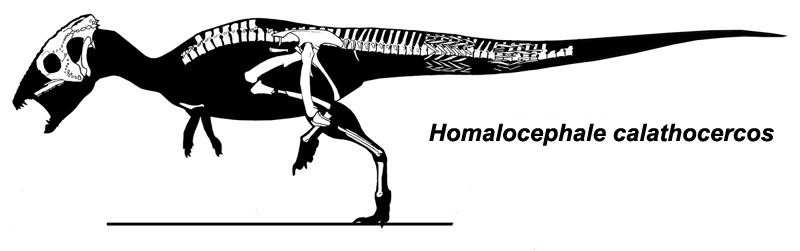
Homalocephale (from Greek ὁμαλός, homalos, "even", and κεφαλή, kephalē, "head") is a genus of pachycephalosaurid dinosaur that lived during the Late Cretaceous period of what is now the Nemegt Formation, Mongolia, about 70 million years ago. The genus was described in 1974 by Halszka Osmólska and Teresa Maryańska, and consists of a single species, H. calathocercos. Though Homalocephale has been regarded as a synonym (and juvenile form) of Prenocephale, juvenile specimens of the latter indicate that they were distinct. Homalocephale was 1.8 m long and possibly an omnivore.
Discovery
The type species, H. calathocercos, was described from an incomplete skull and postcranial material (holotype MPC-D 100/1201) from the Nemegt locality of the Nemegt Formation. The specimen has large openings on the top of the skull, a distinct frontoparietal suture, low and long infratemporal fenestrae, and a large, round eye socket. The forehead is notably rough, with multiple nodules on the lateral and posterior sides of the squamosal bone. Paleontologists concluded that the specimen was an adult, despite the fact that the sutures are discernible and that it had a flat skull (a juvenile trait in many pachycephalosaurid species).
In 2010, a study by Nick Longrich and colleagues suggested that flat-headed pachycephalosaurs were just juvenile forms of dome-headed adults, a view also supported by the earlier analysis of Horner and Goodwin in 2009. Longrich and colleagues suggested that Homalocephale is actually the juvenile or sub-adult stage of Prenocephale mainly based on the lack of a dome and being discovered in the same locality (Nemegt) as the latter.
David C. Evans and team in 2018 reported juvenile specimens of Prenocephale from the Nemegt Formation, noting a relatively linear growth in this pachycephalosaur characterized by a rounded dome. This differs from the flat skull of Homalocephale and given that even juvenile Prenocephale possessed a rather rounded dome, both taxa should be regarded as separate.
Description

Homalocephale was about 1.8 m long.Holtz, Thomas R. Jr. (2008) Dinosaurs: The Most Complete, Up-to-Date Encyclopedia for Dinosaur Lovers of All Ages Supplementary Information Unlike other definitely adult pachycephalosaurs (though similar to probable juvenile specimens referred to Dracorex and Goyocephale), Homalocephale sported a flat, wedge-shaped skull roof. Nonetheless, the surface of the skull was fairly thickened.
Classification

Below is a cladogram from .
Paleobiology

Homalocephale is also noted for having an unusually broad pelvis and some have suggested that the width served to protect vital organs from harm during flank-butting. Others think that they were for giving birth to live young, instead of laying eggs. Homalocephale also had rather long legs, indicating a fast-moving gait.
References
Sources
- Fantastic Facts About Dinosaurs ()
References
- (1974). "Pachycephalosauria, a new suborder of ornithischian dinosaurs". Palaeontologica Polonica.
- Longrich, N.R., Sankey, J. and Tanke, D. (2010). "''Texacephale langstoni'', a new genus of pachycephalosaurid (Dinosauria: Ornithischia) from the upper Campanian Aguja Formation, southern Texas, USA." ''Cretaceous Research'', . {{doi. 10.1016/j.cretres.2009.12.002
- (2018). "Morphology and histology of new cranial specimens of Pachycephalosauridae (Dinosauria: Ornithischia) from the Nemegt Formation, Mongolia". Palaeogeography, Palaeoclimatology, Palaeoecology.
- (2013). "The oldest North American pachycephalosaurid and the hidden diversity of small-bodied ornithischian dinosaurs". Nature Communications.
- Carpenter, Kenneth. (1997). "Agonistic behavior in pachycephalosaurs (Ornithischia:Dinosauria): a new look at head-butting behavior". Contributions to Geology.
- Maryańska, Teresa. (2004). "The Dinosauria". University of California Press.
This article was imported from Wikipedia and is available under the Creative Commons Attribution-ShareAlike 4.0 License. Content has been adapted to SurfDoc format. Original contributors can be found on the article history page.
Ask Mako anything about Homalocephale — get instant answers, deeper analysis, and related topics.
Research with MakoFree with your Surf account
Create a free account to save articles, ask Mako questions, and organize your research.
Sign up freeThis content may have been generated or modified by AI. CloudSurf Software LLC is not responsible for the accuracy, completeness, or reliability of AI-generated content. Always verify important information from primary sources.
Report