From Surf Wiki (app.surf) — the open knowledge base
Hokuriku Shinkansen
High-speed railway line in Japan
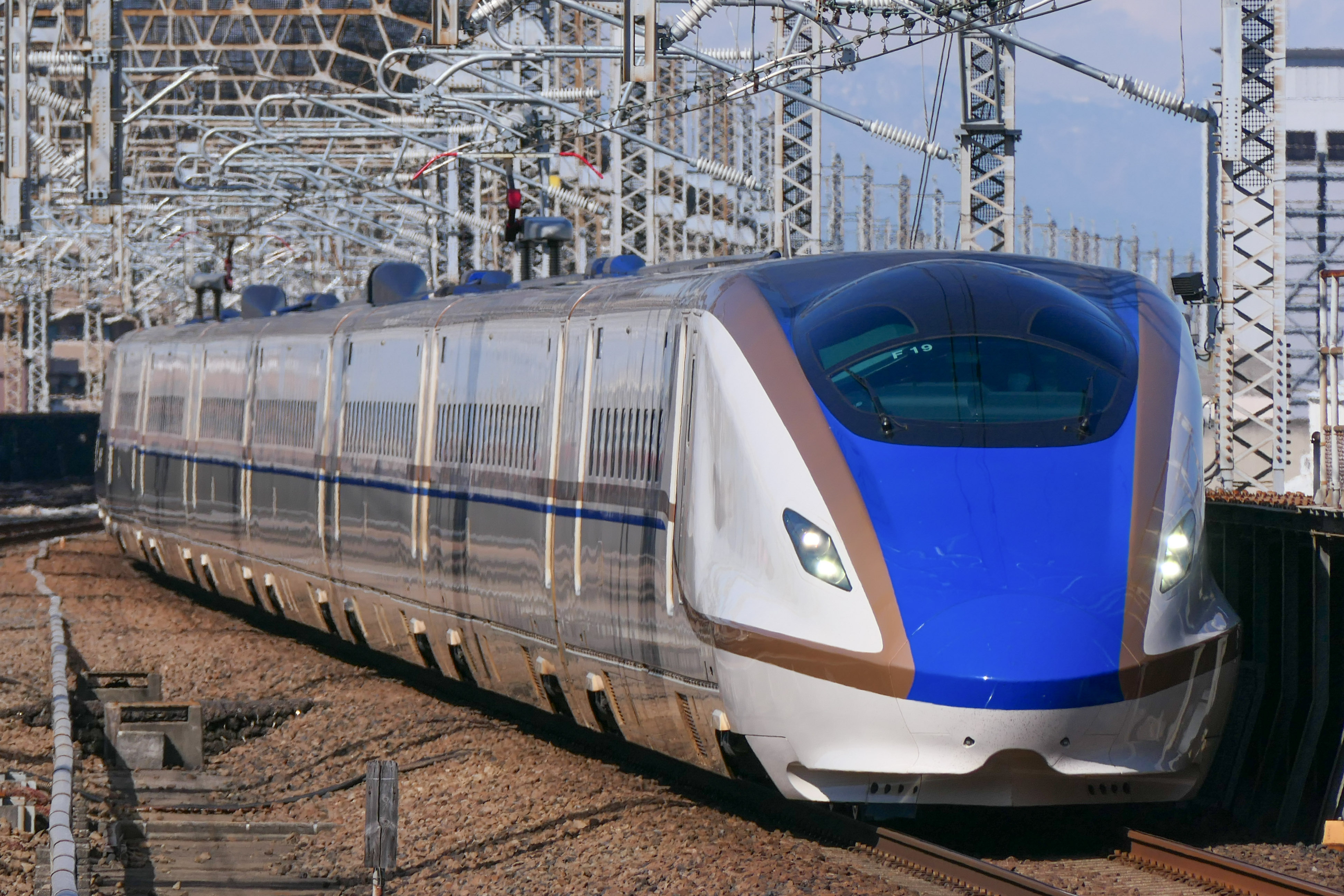
High-speed railway line in Japan
| Field | Value | ||
|---|---|---|---|
| name | Hokuriku Shinkansen | ||
| native_name | 北陸新幹線 | ||
| native_name_lang | ja | ||
| color | |||
| color2 | |||
| logo | Shinkansen-E.svg | ||
| logo2 | shinkansen jrw.svg | ||
| logo_width | 50 | ||
| logo_width2 | 50 | ||
| image | SeriesE7-F19.jpg | ||
| caption | JR East E7 series train on the Hokuriku Shinkansen | ||
| type | High-speed rail (Shinkansen) | ||
| system | Shinkansen | ||
| status | Operational | ||
| locale | Tokyo, Saitama, Gunma, Nagano, Niigata, Toyama, Ishikawa, and Fukui prefectures | ||
| start | |||
| end | (through service to ) | ||
| stations | 24 | ||
| routes | {{flatlist | ||
| open | |||
| lastextension | (Kanazawa to ) | ||
| owner | [[File:Img identity logo.png | 20px]] JRTT | |
| operator | (Takasaki – ) | ||
| (Jōetsumyōkō – Tsuruga) | |||
| depot | Nagano, Hakusan | ||
| stock | {{flatlist | ||
| linelength | 470.6 km | ||
| tracks | 2 | ||
| gauge | |||
| electrification | and | ||
| speed | 260 km/h, 275 km/h (Omiya – Takasaki) | ||
| minradius | 4,000 m | ||
| trainprotection | DS-ATC | ||
| signalling | Cab signalling | ||
| maxincline | 3.0% | ||
| map | [[File:Hokuriku Shinkansen(English).jpg | 300px | Hokuriku Shinkansen]] |
| map_state | show |
- Kagayaki
- Hakutaka
- Tsurugi
- Asama |}} (Jōetsumyōkō – Tsuruga)
- E7
- W7 |}}
The Hokuriku Shinkansen () is a high-speed Shinkansen railway line connecting Tokyo with Tsuruga in the Hokuriku region of Japan. It is jointly operated by East Japan Railway Company (JR East) and West Japan Railway Company (JR West).
The first section, between and in Nagano Prefecture, opened on 1 October 1997 in time for the 1998 Winter Olympics, and was originally called the Nagano Shinkansen. The extension to in Toyama Prefecture and Kanazawa in Ishikawa Prefecture opened on 14 March 2015. Construction of a further section onward to and in Fukui Prefecture, covering 125 km and six stations, commenced in 2012 and opened on 16 March 2024. The route of the final section to Shin-Osaka was initially decided on 20 December 2016 as the Osaka–Kyoto route, with construction expected to begin in the late 2020s and take about 25 years, after impact assessment procedures for areas along the line are completed. However as of 16 December 2025, these plans are withheld at the request of Kyoto Prefecture and .
Train names and service patterns
Since March 2015, services on the line are split into four types, with train names as listed below. Trains operate over the Joetsu and Tohoku Shinkansen tracks between Tokyo and Takasaki.
- Kagayaki: Tokyo–Tsuruga, limited-stop service, since 14 March 2015
- Hakutaka: Tokyo–Tsuruga, mostly all-stations service, since 14 March 2015
- Tsurugi: Toyama–Tsuruga, mostly all-stations shuttle service, since 14 March 2015
- Asama: Tokyo–Nagano, mostly all-stations service, corresponding to existing Nagano Shinkansen service introduced in 1997
The original Nagano Shinkansen Asama services, introduced in 1997, replaced the conventional Shin'etsu Main Line limited express services, also named Asama, which previously took 2 hours 50 minutes from Tokyo (Ueno Station) to Nagano. Following the opening of the Shinkansen, part of the conventional line was abandoned between Yokokawa and Karuizawa. This section included the steeply-graded Usui Pass which required the use of bank engines on all trains. Travel time between Tokyo and Tsuruga is 3 hours 8 minutes, 50 minutes shorter than using a conventional train between Kanazawa and Tsuruga.
Stations
Service column legend:
| ● | ▲ | ||
|---|---|---|---|
| All trains stop | |||
| Some trains stop | |||
| All trains pass |
| Line | Station | Distance in km (mi) from | Service | Transfers | Location | ||
|---|---|---|---|---|---|---|---|
| Tōhoku | 108.60 km | 0 km | ● | ● | |||
| 105.0 km | 3.6 km | ▲ | ● | ● | |||
| Jōetsu | 77.3 km | 31.3 km | ● | ● | |||
| 40.7 km | 67.9 km | ● | |||||
| 19.6 km | 89.0 km | ● | |||||
| Hokuriku | 0 km | 108.6 km | ● | ||||
| 18.5 km | 127.1 km | ▲ | |||||
| 41.8 km | 150.4 km | ▲ | ● | ||||
| 59.4 km | 168.0 km | ▲ | ● | ||||
| 84.2 km | 192.8 km | ▲ | ● | ||||
| 117.4 km | 226.0 km | ● | ● | ● | |||
| 147.3 km | 255.9 km | ▲ | |||||
| 176.9 km | 285.5 km | ● | {{Plainlist | ||||
| 213.9 km | 322.5 km | ● | {{Plainlist | ||||
| 253.1 km | 361.7 km | ● | {{Plainlist | ||||
| 286.9 km | 395.5 km | ● | ● | ● | |||
| 305.8 km | 414.4 km | ● | ● | ||||
| 345.5 km | 454.1 km | ● | ● | ● | |||
| 372.6 km | 481.2 km | ▲ | ● | ▲ | |||
| 387.1 km | 495.7 km | ▲ | ● | ▲ | |||
| 403.5 km | 512.0 km | ▲ | ● | ▲ | |||
| 421.5 km | 530.0 km | ● | ● | ● | |||
| 440.5 km | 549.0 km | ▲ | ● | ▲ | |||
| 470.6 km | 579.2 km | ● | ● | ● | |||
| Environmental impact assessment is underway. | |||||||
| Hokuriku | **This is a tentative name | ||||||
| ** | |||||||
| ** | |||||||
| ** |
- The boundary between JR East and JR West lies immediately to the north of Jōetsumyōkō Station.
- Stations in italics are not currently operational.
Notes
As of 2024, the maximum line speed is 110 km/h between Tokyo and Ueno, 130 km/h between Ueno and Omiya, 275 km/h between Omiya and Takasaki, and 260 km/h between Takasaki and Tsuruga.
Rolling stock
- E7 series 12-car "F" sets" (since 15 March 2014)
- W7 series 12-car "W" sets" (since 14 March 2015)
With the start of Nagano Shinkansen services, trains were operated by a new fleet of JR East E2 series 8-car sets. A fleet of 17 new E7 series 12-car trainsets were phased in from March 2014, and these were augmented by a fleet of 10 JR West W7 series 12-car sets introduced from March 2015. The fleet of W7 series was purchased at a cost of ¥32.8 billion.
In 2019, ten trains, eight from JR East with a book value of ¥11.8 billion and two from JR West, were damaged when a train yard in Nagano was flooded as the Chikuma River overflowed during typhoon Hagibis.
Non-revenue-earning types
- East i (E926)
Former rolling stock
- E2 series 8-car "N" sets on Tokyo - Nagano Asama services only
- E2 series 8-car "J" sets
- E4 series 8-car "P50/P80" sets as Max Asama
- 200 series 12-car set F80 during February 1998 only
The original E2 series 8-car "J" sets, primarily used on Tohoku Shinkansen services were also used on some Asama services until they were subsequently lengthened to 10 cars. One specially-modified 200 series set, numbered F80, was used on additional Asama services in February 1998 during the 1998 Winter Olympics held in Nagano. The train was modified to operate on both 25 kV AC 50 Hz and 60 Hz overhead power supplies, incorporated weight-saving measures to comply with the 16 tonne axle load restriction, and included additional control equipment to cope with the 30‰ gradient of the Nagano Shinkansen. Its maximum speed was limited to 210 km/h. The last services operated using eight-car E2 series trainsets ran on 31 March 2017, from which date all Asama services were formed of E7 and W7 series trainsets.
File:N11 Asama 514 Tokyo 20020601.jpg|Nagano Shinkansen E2 series "N" set (Set N11) approaching Tokyo, June 2002 File:E2 J6 Asama Karuizawa 19980218.jpg|Nagano Shinkansen E2 series "J" set (Set J6) approaching , February 1998 File:Shinkansen E4series (4467135007).jpg|An E4 series set (Set P14) File:200 F80 Asama Ueda 19980218.jpg|Modified set F80 on a Nagano Shinkansen Asama service, February 1998
History
Nagano Shinkansen
The initial section between Takasaki and Nagano opened on 1 October 1997, in time for the 1998 Winter Olympics in Nagano.
Between May 2012 and March 2014, station platforms on the Nagano Shinkansen had their platform roofs extended to handle the E7 series 12-car trains which entered service in March 2014 ahead of the March 2015 opening of the extension beyond Nagano. The Hokuriku Shinkansen extension from Nagano to opened in March 2015. The 113 km extension from Kanazawa to Tsuruga was approved for construction in June 2012.
From the start of the revised timetable on 15 March 2014, E7 series trainsets were introduced on Asama services. Initially used on seven return services daily, this number was increased to eleven return services daily from 19 April 2014.
Naming
The line's legal name has always been Hokuriku Shinkansen. However, just before the opening of the Nagano section, JR East decided that using this name in passenger service was to be avoided. From 22 March 1997 until the extension of the Hokuriku Shinkansen to Kanazawa, the primary route for Hokuriku customers (from the Tokyo area) was to use the Joetsu Shinkansen to Echigo-Yuzawa Station, then transfer to a Hakutaka service via the Hokuetsu Express, rendering using the Takasaki–Nagano section of the Hokuriku Shinkansen meaningless for them. Therefore, JR East sought other names.
Alternatively, local governments in Hokuriku, fearing construction west of Nagano may be halted, petitioned that the name "Hokuriku" should remain in use for operational purposes.
JR East announced the following solution on 25 July 1997:
- Voice announcements using "Nagano Shinkansen"
- Tokyo area stations using depictions with "Nagano-bound Shinkansen".
- Stations between Annaka-Haruna Station and Nagano Station depicting "Shinkansen" only.
Soon, "Nagano-bound Shinkansen" fell out of use, and timetables by various publishers use "Nagano Shinkansen" only. Construction to Kanazawa was officially decided, thereby reducing the opposition to the name.
Extension beyond Nagano

Construction of the extension from Nagano to Kanazawa was completed on 24 May 2014. When services commenced in March 2015, the travel time from Tokyo to Toyama was reduced to about two hours, with Kanazawa an additional 30 minutes away. Final permission to start construction to Fukui was granted in December 2011, with modification works to Fukui Station already in progress for several years in anticipation of the extension. The extension to Tsuruga was approved for construction on 30 June 2012, and opened on 16 March 2024. Beyond Jōetsumyōkō Station, the line is operated by West Japan Railway Company (JR West) instead of East Japan Railway Company (JR East).
Naming issue rises again
Many people speculated about and discussed what the line's operational name should be after Nagano–Kanazawa section is completed.
Nagano economic associations argued a sudden change in name will confuse customers, propose "Nagano–Hokuriku Shinkansen" to be used. In contrast government officials and economic associations in Hokuriku region defended the legal name, including statements such as "a just result should come after 3 prefectures striving for 40 years".
The section west of Jōetsumyōkō belongs to JR West, which did not state an opinion and used "Hokuriku Shinkansen" only.
On 2 October 2013, JR East announced formal line name will be Hokuriku Shinkansen (consistent with National Shinkansen Railway Development Act) and depicted as Hokuriku Shinkansen (via Nagano) to reflect its expansion into the region, resolving the naming issue.
Test-running
Test-running on the JR East section of the line between Nagano and Kurobe-Unazukionsen commenced on 1 December 2013, initially at low speeds using the "East i" test train. From 6 December of that year, test-running commenced using 10-car E2 series trainsets, with running speeds gradually increased to the full line speed of 260 km/h. Test-running continued until the end of March 2014. Test-running on the entire line between Nagano and Kanazawa (Hakusan Depot) started on 1 August 2014, using the "East i" test train. Test-running using W7 series trains commenced on 5 August 2014, initially at low speed, on the JR West section between and .
Tsuruga extension
In the months preceding the opening, JR West conducted various low speed runs on the new Kanazawa-Tsuruga section using "East i" test trains on 23 September 2023. Runs using regular W7 series trainsets started on 26 September. Regular passenger service began on 16 March 2024, with ceremonies at both and from the respective presidents of JR West and JR East. The extension cost to build.
In accordance with the opening of the extension, the limited express service Thunderbird ended its service between Tsuruga and Kanazawa on 15 March 2024.
Electrification
The Hokuriku Shinkansen is electrified at 25 kV AC, but uniquely amongst Shinkansen routes, it crosses Japan’s 50 Hz/60 Hz frequency boundary three times, requiring dual-frequency rolling stock. The section between Tokyo and Karuizawa operates at 50 Hz, the section between Karuizawa and Itoigawa at 60 Hz, and the line then reverts to 50 Hz around Itoigawa before switching back to 60 Hz between Kurobe-Unazukionsen and Tsuruga. To accommodate this arrangement, the E7 and W7 series trainsets are equipped with onboard converters and automatic frequency-switching equipment.
Future plans
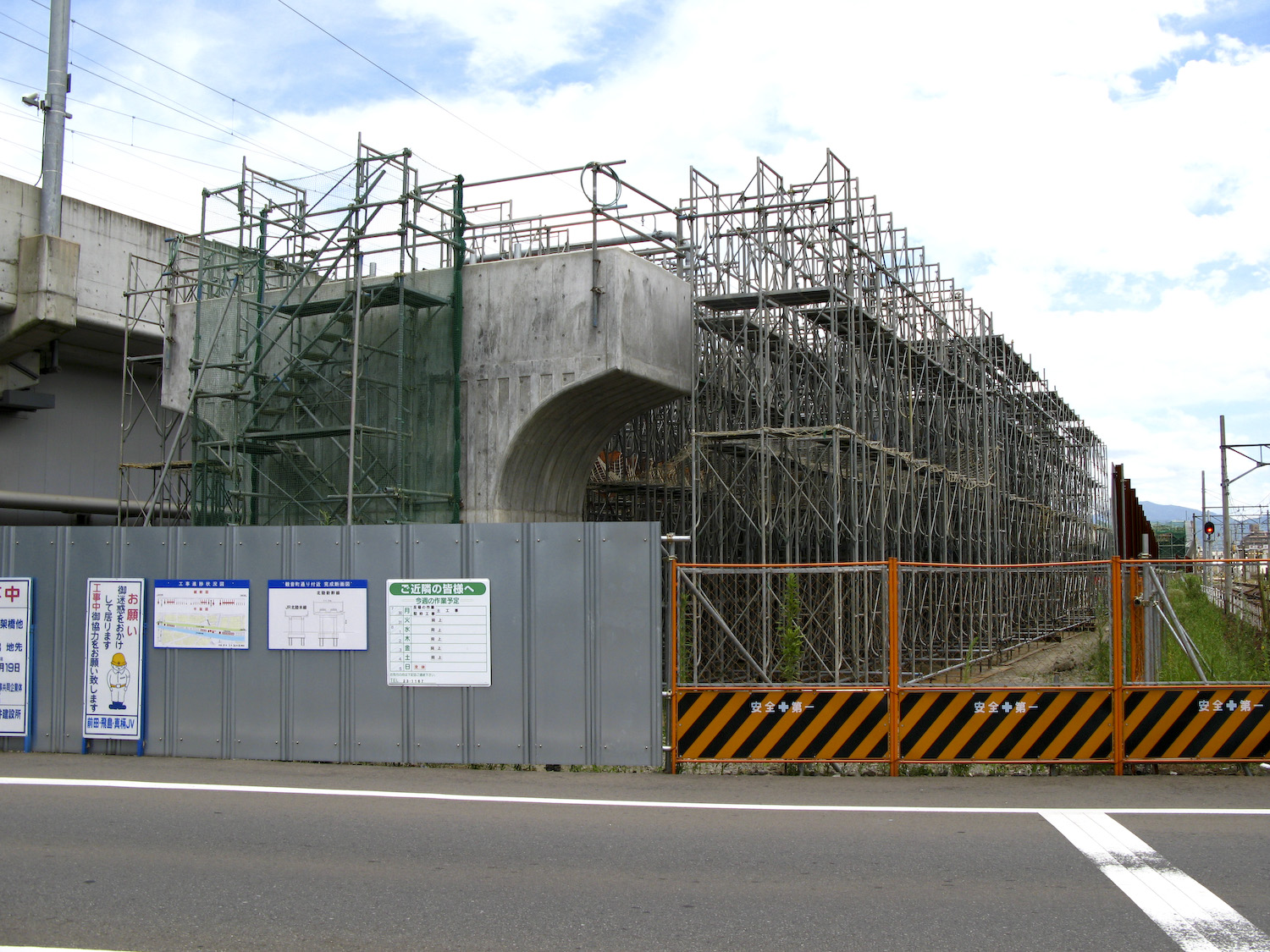


The route of the final section from to was finalized on 20 December 2016 as the Obama–Kyoto route. JRTT proposed three possible stations in Kyoto at a meeting that took place on 8 August 2024. Two options include a new station underground near Kyoto Station. The third option is a newly constructed station near Katsuragawa Station, also underground. The route extension is estimated to cost up to and require up to 28 years to complete construction.
Including the Obama–Kyoto route, the following four options were under consideration before the December 2016 announcement, with a fifth unofficial option suggested by a local politician.
- Maibara Route: This involved building a full standard shinkansen track to Maibara Station. The proposal was one third of the length of the Obama Route, and provided good access to both Kyoto and Nagoya. However, a severe drawback was that it would have resulted in longer travel time to Osaka than the other options and trains would have had to use the existing, already heavily congested Tokaido Shinkansen tracks between Maibara and Shin-Osaka.
- Kosei Route: This involved no new track construction; instead, this proposal would have upgraded the Kosei Line to , either by regauging or dual-gauging the line to support Mini-Shinkansen, or alternatively utilizing Gauge Change Train (GCT) operations. This was the cheapest option, but meant train speeds would likely be limited to a maximum of 160 km/h and hence travel times would have been longer than the other options.
- Obama Route: First proposed in 1973, this route involved building a full standard shinkansen track via and . It was the shortest route to Osaka, but also the most expensive (approximately 1 trillion yen), and would have bypassed .
- Obama–Kyoto Route: This, the now selected route, was first made public in August 2015, and involves following the proposed Obama Route west as far as Obama and then building shinkansen track southward to link with the Tokaido Shinkansen at . Including Kyoto on the route is seen as important to increase tourism.
- Maizuru Route: Kyoto politician, Shoji Nishida's proposal from Tsuruga, via Obama, to Maizuru then south-east to Kyoto City, southern Osaka City, and Kansai International Airport. This option did not have a price estimated, but would have likely been the most expensive due to the scale of the proposal. Its case was to provide development to the Maizuru region as per the Japanese national government's policy, with the Maizuru Maritime Self-Defence Force Base and several nuclear power stations put forward as reasonable traffic generators. The option to extend the line south of Kyoto to a new Osaka station (, located in the south east of Osaka City) was seen as a means to avoid the congestion of the Tokaido line. It may have served as an alternative route or terminus to Shin-Osaka station for Tokaido line trains, reducing Tokaido line congestion.
A government committee deliberating the proposals decided in April 2016 to narrow the proposed route to three alignments between and and two alignments between Kyoto and (a northern route through Minoh and a southern route through the Kansai Science City). On 6 March 2017 the government committee announced the chosen route from Kyoto to Shin-Osaka is to be via Kyotanabe, with a station at Matsuiyamate on the Katamachi Line. There are also requests from Kyoto City and Kyoto Prefecture, local governments along the route, to further extend the line to .
Interim plans
In an attempt to extend the benefits of the Hokuriku Shinkansen to stations west of Tsuruga before the section to Shin-Osaka is completed, JR West was working in partnership with Talgo on the development of a Gauge Change Train (GCT), which was proposed to be capable of operating under both the 25 kV AC electrification used on the Shinkansen and the 1.5 kV DC system employed on conventional lines. The six-car train was due to start trials on the Hokuriku Shinkansen and the Hokuriku and Kosei lines in 2017. As part of the project JR West had begun trials with a purpose-built 180 m long gauge-changer at Tsuruga. However, as a result of the abandonment of the proposed use of a GCT on the West Kyushu Shinkansen to Nagasaki by JR Kyushu, in August 2018 JR West announced that the proposed GCT between Tsuruga and Osaka had been abandoned.
2025 revision
On 16 December 2025, the LDP–Japan Innovation Party coalition under Sanae Takaichi announced that it would reconsider the Obama–Kyoto route that was selected in 2016. The revision came at the behest of Kyoto Prefecture and citing negative economic and environmental impacts. Including the withheld Obama–Kyoto alignment and the two other routes decided upon in 2016, four additional choices were proposed as alternatives. As a result, the Ministry of Land, Infrastructure, Transport and Tourism has suspended its plans to commence construction in fiscal year 2026.
Conventional lines running parallel to the Hokuriku Shinkansen
With the opening of the initial Nagano Shinkansen section in October 1997, the section of the conventional (narrow gauge) Shinetsu Main Line running along approximately the same route between and was transferred from the control of JR East to a newly established third-sector railway operating company, Shinano Railway, becoming the Shinano Railway Line.
With the opening of the Hokuriku Shinkansen extension north of Nagano on 14 March 2015, the conventional lines running along approximately the same route were transferred from the control of their respective JR owning companies to newly established third-sector railway operating companies funded primarily by the prefectural and municipal governments through which the lines pass. A total of 252.2 km of route between Nagano and Kanazawa was transferred to four separate operating companies, including 75.0 km of the Shinetsu Main Line between Nagano and , and 177.2 km of the Hokuriku Main Line between Naoetsu and Kanazawa. Details of the five third-sector operating companies and their respective lines are as shown below.
In 2019, it was decided that the section of the Hokuriku Main Line between Tsuruga and Fukui would be transferred to third-sector railway operating companies. Three years later in 2022, it was determined that the section would be split among two operators. The IR Ishikawa Railway would extend their operations from Kanazawa to Daishoji, while a new company, Hapi-Line Fukui, established during the preparation phase, would take over the section between Daishoji and Tsuruga. Hapi-Line Fukui took over the 84.3 km section of the Hokuriku Main Line on 16 March 2024.
| Former line name | Former operating company | Date transferred | Section | Length (km) | New line name | Operating company | Prefecture |
|---|---|---|---|---|---|---|---|
| Shinetsu Main Line | JR East | 1 October 1997 | – | 65.1 | Shinano Railway Line | Shinano Railway | Nagano |
| 14 March 2015 | – | 37.3 | Shinano Railway Kita-Shinano Line | ||||
| – | 37.7 | Myōkō Haneuma Line | Echigo Tokimeki Railway | Niigata | |||
| Hokuriku Main Line | JR West | – | 59.3 | Nihonkai Hisui Line | |||
| – | 100.1 | Ainokaze Toyama Railway Line | Ainokaze Toyama Railway | Toyama | |||
| – | 17.8 | IR Ishikawa Railway Line | IR Ishikawa Railway | Ishikawa | |||
| 16 March 2024 | – | 46.4 | |||||
| – | 84.3 | Hapi-Line Fukui Line | Hapi-Line Fukui | Fukui |
References
References
- . (18 March 2024). ["Kanazawa to Tsuruga extension of the Hokuriku Shinkansen opens"](https://www.railwaygazette.com/high-speed/tsuruga-joined-to-shinkansen-network/66140.article). *Railway Gazette International*.
- (30 August 2023). "北陸新幹線 金沢—敦賀間の開業日が2024年3月16日に決定 〜運行計画の概要を発表〜".
- (23 December 2016). "Hokuriku extension route agreed". Railway Gazette.
- link. Railway Bureau, MLIT. (August 2024)
- {{cite press release. link. (27 August 2014). JR East & JR West
- link. (16 March 2024). Newswitch
- [https://web.archive.org/web/20210515110007/https://www.fukuishimbun.co.jp/articles/-/1316537 About a new station name]
- "Document on Primary Environment Impact Consideration (May 2019)". [[Japan Railway Construction, Transport and Technology Agency]].
- "The Tohoku Shinkansen: Full Speed Ahead - Japan Railway Journal {{!}} NHK WORLD-JAPAN".
- (2022-12-25). "JR東日本、上越新幹線が最高275km/hに - 北陸新幹線も所要時間短縮".
- (April 2012). "300km/hのトップランナー". Kōyūsha Co., Ltd..
- {{cite magazine. Kōtsū Shimbun. (May 2014)
- link. (21 March 2017). Yomiuri Online. The Yomiuri Shimbun
- (13 October 2019). "Ten Hokuriku Shinkansen Line trains worth ¥32.8 billion sustain damage after yard is flooded in Typhoon Hagibis". The Japan Times Online.
- (2019). "All 10 typhoon-flooded shinkansen bullet trains to be scrapped". Kyodo News+.
- {{cite magazine. Koyusha Co., Ltd.. (April 1998)
- link. (1 April 2017). Japan Railfan Magazine Online. Koyusha Co., Ltd.
- link. Tadayuki. Ito. (3 May 2012). The Asahi Shimbun Digital. The Asahi Shimbun Company
- [[Kyodo News]], "[http://www.japantimes.co.jp/text/nn20120630b2.html Bullet-train extensions approved]", ''[[The Japan Times]]'', 30 June 2012, p. 2
- 「北陸新幹線・東京-長野 10月開業を発表 列車愛称『あさま』」『信濃毎日新聞』 [Hokuriku Shinkansen Tokyo-Nagano will open October]. Shinano Daily News, Apr 16 1997 (in Japanese).
- 「呼称は長野か北陸か新幹線揺れる―JR東日本『まだ長野まで』北陸自治体『名前は残して』」『日本経済新聞』1997年5月5日
- 「北陸新幹線ダイヤを発表 長野まで最速79分 しなの鉄道2割増」『信濃毎日新聞』1997年7月26日
- [http://www.rurubu.com/book/recomm/jikokuhyou/ayumi3.aspx JTB時刻表 時刻表80年のあゆみ-第3回-] - JTB Publishing るるぶ.com
- (25 May 2014). "Hokuriku Shinkansen line between Nagano, Kanazawa completed". Asahi Shimbun.
- [http://www.asahi.com/travel/rail/news/OSK201112260130.html] {{webarchive. link. (5 January 2012)
- "Shinkansen to get 3 new sections : National : DAILY YOMIURI ONLINE (The Daily Yomiuri)".
- (16 September 2022). "The Shinkansen: Japan's Bullet Train".
- [[Kyodo News]], "[http://www.japantimes.co.jp/text/nn20111217a2.html DPJ may OK three new bullet-train sections]", ''The Japan Times'', 17 December 2011, p. 1.
- (2009-03-17). "北陸新幹線:名称は「長野北陸新幹線」に 県商工会議所連合会らJRに要望/長野". [[毎日新聞社]].
- (2013-02-20). "新幹線あくまで「北陸」 知事 「3県で40年努力した」". [[Chunichi Shimbun Company]].
- (2013-02-21). "新幹線 堂々と「北陸に」 谷本知事「乗客が誤解する」". [[Chunichi Shimbun]] Hokuriku branch.
- (2013-03-02). "問答無用「北陸」で当然". 中日新聞北陸本社.
- (2012-09-04). "北陸新幹線用の新型車両について". [[JR West]].
- (22 December 2023). "New bullet train route makes it easier than ever to visit Japan's stunning Hokuriku region". [[CNN]].
- (5 October 2013). "". link. Webun. The Kitanippon Shimbun
- link. (4 August 2014). Tetsudo Hobidas. Neko Publishing
- link. (5 August 2014). Tetsudo Hobidas. Neko Publishing
- (26 September 2023). "Test run starts on extended line of Hokuriku Shinkansen". Yoshito Asakura.
- (16 March 2024). "New bullet train extension comes into service". NHK.
- (15 March 2024). "New bullet train extension comes into service".
- link. (15 March 2024). NHK
- Sato, Yoshihiko. (February 11, 2014). "Japan: first Hokuriku trains take to the tracks".
- "Hokuriku Shinkansen (Tsuruga/Shin-Osaka) Detailed station locations and route map (draft)". [[Japan Railway Construction, Transport and Technology Agency]].
- Johnston, Eric. (8 August 2024). "Hokuriku Shinkansen extension to come with ballooning costs". Japan Times Online.
- (29 August 2015). "". link. Asahi Shimbun Digital. The Asahi Shimbun Company
- Johnston, Eric. (24 January 2016). "Politics heating up over Hokuriku Shinkansen Line's undecided last leg". Japan Times Online.
- link. Kyoto News
- link
- link. . (2016). City of Kyoto
- link. . (8 April 2024). City of Kyoto
- (7 August 2015). "Talks begin on Hokuriku Shinkansen extension".
- (August 25, 2018). "北陸新幹線にフリーゲージ断念へ政府、与党とJR西日本".
- (16 December 2025). "Japan to Reconsider Route of Planned Hokuriku Shinkansen Section". Yomiuri Shimbun.
- (2025-12-16). "執政黨將重新檢討北陸新幹線路線=納入「小浜・京都」等8項方案".
- {{cite magazine. Osano. Kagetoshi. Kōtsū Shimbun. (March 2015)
- (14 August 2019). "新幹線並行在来線の準備会社発足".
- (19 January 2022). "福井県並行在来線準備株式会社鉄道線の鉄道事業再構築実施計画の認定について".
- (4 July 2022). "新社名「株式会社ハピラインふくい」に変更しました".
- (31 August 2023). "並行在来線「ハピラインふくい」も3月16日開業".
This article was imported from Wikipedia and is available under the Creative Commons Attribution-ShareAlike 4.0 License. Content has been adapted to SurfDoc format. Original contributors can be found on the article history page.
Ask Mako anything about Hokuriku Shinkansen — get instant answers, deeper analysis, and related topics.
Research with MakoFree with your Surf account
Create a free account to save articles, ask Mako questions, and organize your research.
Sign up freeThis content may have been generated or modified by AI. CloudSurf Software LLC is not responsible for the accuracy, completeness, or reliability of AI-generated content. Always verify important information from primary sources.
Report