From Surf Wiki (app.surf) — the open knowledge base
HMS Prince of Wales (1860)
Ship of the line of the Royal Navy
Ship of the line of the Royal Navy
| Field | Value | ||
|---|---|---|---|
| section1 | {{Infobox ship/image | ||
| image | HMS Britannia by Henry J Morgan.jpg | ||
| image_size | 350px | ||
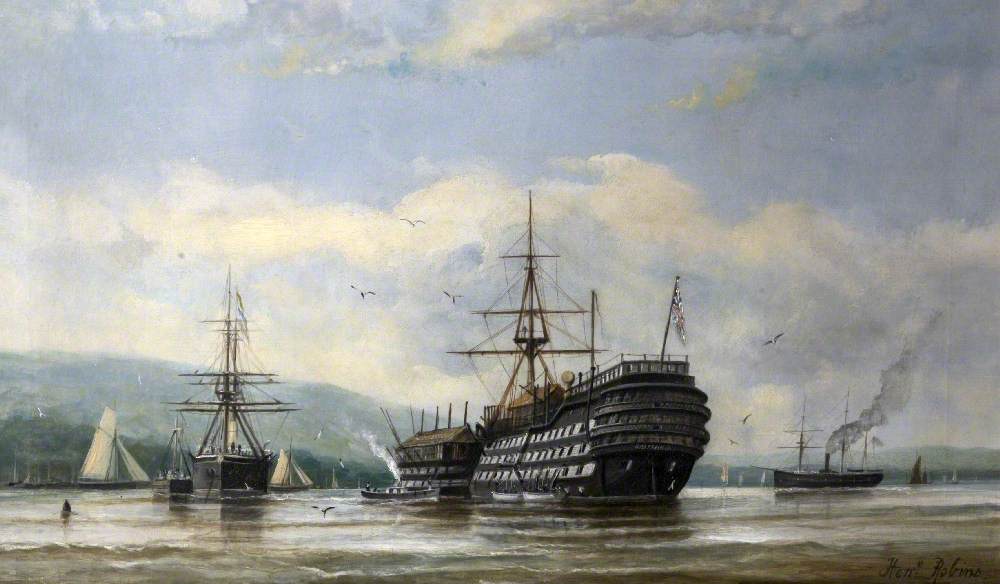
| image_caption | HMS Britannia, painting by Henry J. Morgan | ||
| section2 | {{Infobox ship/career | ||
| country | United Kingdom | ||
| flag | [[File:Naval Ensign of the United Kingdom.svg | 60px | Royal Navy Ensign]] |
| name | HMS Prince of Wales | ||
| ordered | *29 June 1848 | ||
| *Re-ordered to complete as screw 9 April 1856 <ref name | Winfield90/ | ||
| builder | Portsmouth Dockyard | ||
| laid_down | *10 June 1848 | ||
| *Commenced conversion to steam 27 October 1856<ref name | Lambert127/ | ||
| launched | 25 January 1860 | ||
| renamed | HMS Britannia, 3 March 1869 | ||
| fate | *Sold 13 September 1914 | ||
| *Arrived at Blyth for breaking up July 1916<ref name | Winfield183/ | ||
| *Hulked from September 1909.<ref name | Winfield183/ | ||
| notes | Engines removed 1867. | ||
| section3 | {{Infobox ship/characteristics | ||
| class | Modified Queen*-class 120- gun three-decker (as designed) | ||
| *Screw three-decker (as built)<ref name | Lambert127/ | ||
| displacement | 6201 LT (as built) | ||
| tonnage | *3,186 tons (as designed) | ||
| *3,966 tons (as redesigned for steam)<ref name | Winfield183/ | ||
| *3,994 tons (as built)<ref name | Winfield183/ | ||
| length | *210 ft (64 m) overall (as designed) | ||
| *171 ft 1 in (52.1 m) keel-line (as designed)<ref name | Winfield90/ | ||
| *252 ft 0 in (76.8 m) overall (as built)<ref name | Winfield90/ | ||
| *213 ft 0 in (64.9 m) keel-line (as built)<ref name | Lambert127/ | ||
| beam | *60 ft 0 in (18.3 m) (as designed) | ||
| *60 ft 2 in (18.3 m) (as built)<ref name | Winfield183Lyon, David and Winfield, Rif The Sail and Steam Navy List, All the Ships of the Royal Navy 1815-1889, page 183. | ||
| draught | 25 ft 5 in (if fully stored) | ||
| hold_depth | 25 ft 2 in (7.7 m) | ||
| propulsion | *Sails as designed | ||
| *single lifting screw, 800 nhp Penn engines 3,352 ihp (trials 31 Oct 1860)<ref name | Lambert127/ | ||
| *Main mast 67 ft x 42 in, Fore mast 61 ft x 40 in, Mizen 51 ft 6 in x 26 in (if fitted).<ref name | Lambert127/ | ||
| speed | 12.6 kn Stokes Bay trials 31 Oct 1860 | ||
| complement | *970 (as sailing ship) | ||
| *1,100<ref name | Lambert127/ | ||
| armament | *Gun deck 32 × 8-inch 65 cwt | ||
| *(Armament scheme at time of launch.)<ref name | Lambert127/ | ||
| notes | Cost of building £134,192 |
-
Re-ordered to complete as screw 9 April 1856
-
Commenced conversion to steam 27 October 1856
-
Arrived at Blyth for breaking up July 1916
-
Hulked from September 1909.
-
Screw three-decker (as built)
-
3,966 tons (as redesigned for steam)
-
3,994 tons (as built)
-
171 ft 1 in (52.1 m) keel-line (as designed)
-
252 ft 0 in (76.8 m) overall (as built)
-
213 ft 0 in (64.9 m) keel-line (as built)
-
60 ft 2 in (18.3 m) (as built)
-
Sails and screw as built
-
single lifting screw, 800 nhp Penn engines 3,352 ihp (trials 31 Oct 1860)
-
Main mast 67 ft x 42 in, Fore mast 61 ft x 40 in, Mizen 51 ft 6 in x 26 in (if fitted).
-
1,100
-
Middle deck 30 × 8 in 65 cwt
-
Main deck 32 × 32-pdr 58 cwt
-
Upper deck 26 × 32-pdr 42 cwt 1 × 68-pdr 95 cwt
-
(Armament scheme at time of launch.)
'*HMS *Prince of Wales''''' was one of six 121-gun screw-propelled first-rate three-decker line-of-battle ships of the Royal Navy. She was launched on 25 January 1860.
In 1869 she was renamed '*HMS *Britannia''''' and under that name served at Dartmouth as a cadet training ship until 1905.
History
The Prince of Wales was originally a 3,186 ton 120 gun design by John Edye and Isaac Watts for a modified Queen-class sailing line-of-battle ship. She was laid down at Portsmouth on 10 June 1848, although she was not formally ordered until 29 June, and the design was approved on 28 July 1848.
In 1849, the Royal Navy started ordering screw line-of-battle ships starting with the Agamemnon. It is possible that construction of Prince of Wales was suspended, as screw line-of-battle ships laid down after her, were completed before her. Prince of Wales was reordered to complete as a 121 gun screw line-of-battle ship on 9 April 1856,
Her engine was 800-nominal horsepower, two-cylinder (82 inch diameter, 4 ft stroke) horizontal trunk steam engine built by John Penn and Sons.
She was launched on 25 January 1860, and did her trials at sea in Stokes Bay on 31 October 1860 unrigged. She made an average of 12.6 kn.
Prince of Wales was completed toward the end of the unarmoured phase of a naval arms race between Britain and France. In 1860 the Royal Navy had more wooden steam line-of-battle ships than it needed to man in peacetime. The Royal Navy's first armoured line-of-battle ship, Warrior was commissioned in 1861. Unarmoured screw line-of-battle ships were still of value in the early to mid-1860s, and several new screw line-of-battle ships were commissioned in the 1860s.
In 1867, the Prince of Waless engines were removed so they could be installed in the ironclad Repulse.
_and_his_elder_brother_Albert_Victor_(Eddy),_dated_by_George_1878,_cadets_on_board_the_training_ship_HMS_Britannia.jpg)
In 1869 she was renamed Britannia and began service as a cadet training ship at Dartmouth, replacing the previous Britannia in that role. Among those starting their naval careers on her were, in 1877, the future Admiral and First Sea Lord Rosslyn Wemyss, Prince Albert Victor, and his younger brother, the future King George V.
A shore-based college at Dartmouth was opened in September 1905 and this was named Royal Naval College, Dartmouth. The Britannia training establishment was closed at the same time.
A new King Edward VII-class battleship called Britannia was launched in December 1904. The former Prince of Wales was officially hulked in September 1909, sold to Garnham on 23 September 1914, then resold to Hughes Bolckow arriving at Blyth in July 1916 for breaking up. In 1917 her "wreck" was etched by Frank Brangwyn, a print of which can be seen in Bruges' Groeningemuseum today.
The figurehead of the ship, depicting the Prince of Wales, survives and can be seen at the Scottish Maritime Museum in Irvine.
Notes
References
- Lyon, David and Winfield, Rif The Sail and Steam Navy List, All the Ships of the Royal Navy 1815-1889, Chatham, 2004,
References
- Lambert, Andrew ''Battleships in Transition, the Creation of the Steam Battlefleet 1815-1860'' pages 122, 127-128
- Lyon, David and Winfield, Rif ''The Sail and Steam Navy List, All the Ships of the Royal Navy 1815-1889'', page 90.
- Lyon, David and Winfield, Rif ''The Sail and Steam Navy List, All the Ships of the Royal Navy 1815-1889'', page 183.
- Lambert, Andrew ''Battleships in Transition, the Creation of the Steam Battlefleet 1815-1860''
- ''Duke of Wellington'']] and [[HMS Royal Sovereign (1857). ''Royal Sovereign'']] were lengthened with an extra 23 ft amidships and 8 ft in the run, and originally it was intended that [[HMS Marlborough (1855)
- For instance the new screw three-decker [[HMS Victoria (1859). ''Victoria'']] was first commissioned in 1864, and the new screw two-deckers [[Duncan class ship of the line (1859). ''Gibraltar'' and ''Duncan'']] were first commissioned in 1863 and 1864 respectively. See Lambert ''Battleships in Transition''.
- As ''Britannia'', she was a [[hulk (ship type). hulk]], and had only her foremast.See photograph of ''Britannia'' at the turn of the century on page 127 of Lambert ''Battleships in Transition, the Creation of the Steam Battlefleet 1815-1860''.
- Lord Tweedmouth, ''First Lord's Statement explanatory of Navy Estimates, 1906-7'', 26 February 1906, reproduced in ''The Naval Annual 1906'', page 370.
- ''Conway's All the World's Fighting Ships, 1806-1905'', p. 38.
- "Figurehead of HMS "Prince Of Wales"".
This article was imported from Wikipedia and is available under the Creative Commons Attribution-ShareAlike 4.0 License. Content has been adapted to SurfDoc format. Original contributors can be found on the article history page.
Ask Mako anything about HMS Prince of Wales (1860) — get instant answers, deeper analysis, and related topics.
Research with MakoFree with your Surf account
Create a free account to save articles, ask Mako questions, and organize your research.
Sign up freeThis content may have been generated or modified by AI. CloudSurf Software LLC is not responsible for the accuracy, completeness, or reliability of AI-generated content. Always verify important information from primary sources.
Report