From Surf Wiki (app.surf) — the open knowledge base
HMNZS Te Mana
Anzac-class frigate of Royal New Zealand Navy
Anzac-class frigate of Royal New Zealand Navy
| Field | Value |
|---|---|
| section1 | {{Infobox ship/image |
| image | HMNZS Te Mana (cropped).jpg |
| image_caption | HMNZS Te Mana, June 2022 |
| section2 | {{Infobox ship/career |
| country | New Zealand |
| flag | |
| name | HMNZS Te Mana |
| namesake | The concept of Mana |
| builder | Tenix Defence |
| laid_down | 18 May 1996 |
| launched | 10 May 1997 |
| commissioned | 10 December 1999 |
| identification | |
| motto | Kokiri Kia U (Māori: "Striving towards perfection") |
| status | Active as of 2024 |
| sponsor | Dame Te Atairangikaahu |
| section3 | {{Infobox ship/characteristics |
| class | |
| displacement | 3,600 tonnes full load |
| length | 118 m |
| beam | 15 m |
| draught | 4 m |
| propulsion | *1 × General Electric LM2500+ gas turbine providing 30000 hp |
| speed | 27 kn |
| range | 6000 nmi at 18 kn |
| complement | 178 officers and ratings (25 officers, 153 ratings) |
| sensors | *Sonars: Broadband Sonar Advanced Processing System (BSAPS) for the Spherion B hull-mounted sonar and the TUUM-6 multi-channel Digital Underwater Communication System (DUWCS). Provision for towed array |
| *Navigation: Two Furuno 3320 series X band radars.<ref name | "navalnews.com"/ |
| EW | *ESM: Eibit/Elisra ESM. |
| armament | *Guns and missiles: |
| aircraft | One Kaman SH-2G Super Seasprite helicopter |
- 2 × MTU 12V1163 TB83 diesel engines providing 8,840 hp (6.5 MW)
- two shafts with controllable pitch propellers in CODOG configuration
- Air search radar: Thales Group Smart-S Mk2 3d multi-beam naval search radar.
- Surface search radar: Thales Group Smart-S Mk2 3d multi-beam naval search radar. Sharpe Eye 2D.
- Navigation: Two Furuno 3320 series X band radars.
- Infred: Vampir IRST Infred.
- Laser: Elbit Systems Laser Warning/Detection.
- Countermeasures: Decoys: G & D Aircraft SRBOC Mk 36 Mod 1 decoy launchers for SRBOC. Rheinmetall MASS. DLF Floating Decoys. Sea Sentor.
- 1 × 5 in/54 (127 mm) Mk 45 Mod 2 gun.
- 1 × Phalanx CIWS
- 8 × M2 .50 Cal Browning machine guns (2 are Mini Typhoon)
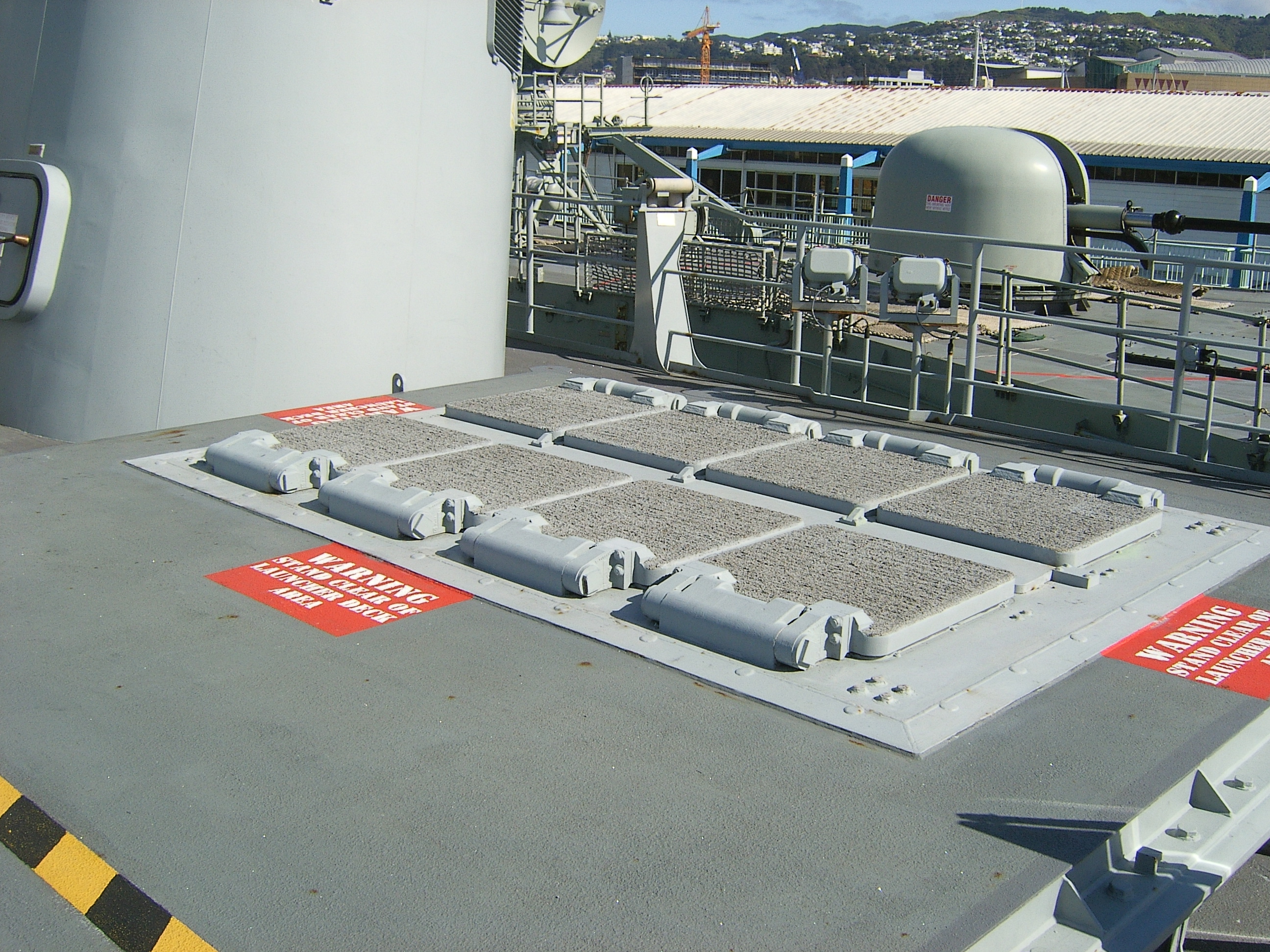
- 20 GWS.35 VLS cells for Sea Ceptor surface-to-air missiles
- AGM-119 Mk 2 Mod 7 Penguin missile launched from SH-2G(I) Super Seasprite
- Torpedoes:
- 2 × triple 324 mm Mk 32 Mod 5 tubes or launched from SH-2G(I) Super Seasprite
- Fire control:
- Navantia fire control
- Combat data systems:
- CMS 330 Link 16
- Weapons control:
- CMS 330 Navantia fire control
- Fitted for but not with
- Anti Ship Missile ie; Harpoon, NSM
HMNZS Te Mana (F111) is one of ten frigates and one of two serving in the Royal New Zealand Navy (RNZN). The name Te Mana is Māori, approximately translating as 'status' or 'authority' (for further information on this term, see Mana). The ship was laid down under the joint Anzac project by Tenix Defence at Williamstown, Victoria in 1996, launched in 1997, and commissioned into the RNZN in 1999.
In 2003 and 2004 and 2013–2014, Te Mana was deployed on operations in the Arabian Sea. In 2005, she became the first New Zealand warship to visit a Russian port, Vladivostok.
On 5 August 2015, the ship emerged from the dry dock at Devonport Naval Base wearing the US Navy 'Haze Grey' coating, following a major systems upgrade which involved a long refit.
Te Mana represented New Zealand in the 2018 Rim of the Pacific exercise in Hawaii and was crowned the winner of RIMPAC's Naval Surface Fire Support Rodeo competition, with the ship landing her shells closer to the target than any other ship.
Design and construction
Main article: Anzac-class frigate
During the mid-1980s, the RNZN began considering the replacement of their four frigates. Around the same time, a deterioration in New Zealand-United States relations forced the New Zealand government to improve ties with local nations. As the Royal Australian Navy (RAN) was seeking to replace their s with ships nearly identical to what the RNZN wanted, the two nations decided to collaborate on the acquisition in early 1987. Tenders had been requested in 1986, and 12 ship designs (including an airship) were submitted. By August 1987, these were narrowed down in October to Blohm + Voss's MEKO 200 design, the M class (later ) offered by Royal Schelde, and a scaled-down Type 23 frigate proposed by Yarrow Shipbuilders. In 1989, the Australian government announced that Melbourne-based shipbuilder AMECON (which became Tenix Defence) would build the modified MEKO 200 design. However, the decision to buy the frigates had been highly controversial in New Zealand, primarily because of the cost of purchasing frigate-type ships, plus the idea that the high-capability warships would be too few and too overspecialised for the fisheries and economic exclusion zone (EEZ) patrols expected to be the RNZN's core operations. Despite ongoing debate, the New Zealand government agreed to purchase two frigates in addition to the RAN's eight, and had an option for two more. This option expired in 1997 without the New Zealanders acting upon it; there were proposals to buy a new or second-hand Anzac outside the terms of the original contract, but a lack of political support stopped this developing, and the number built for the RNZN remained at two. The drop in capability and the issue of tying up the Anzacs on EEZ patrols when they could be deployed more suitably elsewhere were factors leading to the RNZN's Project Protector acquisition program.
The Anzacs are based on Blohm + Voss' MEKO 200 PN (or ) frigates, modified to meet Australian and New Zealand specifications and maximise the use of locally built equipment. The ships are 109 m long at the waterline, and 118 m long overall, with a beam of 14.8 m, and a full load draught of 4.35 m. Maximum speed is 27 kn, and maximum range is over 6000 nmi at 18 kn; about 50% greater than other MEKO 200 designs. The standard ship's company of an Anzac consists of 22 officers and 141 sailors.
As designed, the main armament for the frigate is a 5-inch 54 calibre Mark 45 gun, supplemented by an eight-cell Mark 41 vertical launch system for RIM-7 Sea Sparrow, two 12.7 mm machine guns, and two Mark 32 triple torpedo tube sets firing Mark 46 torpedoes. The New Zealand Anzacs initially operated with a Westland Wasp helicopter, which were later replaced by Kaman SH-2 Seasprites, then Kaman SH-2G Super Seasprite helicopters.
Te Mana was laid down at Williamstown, Victoria on 18 May 1996. The ship was assembled from six hull modules and six superstructure modules; the superstructure modules were fabricated in Whangarei, New Zealand, and hull modules were built at both Williamstown and Newcastle, New South Wales, with final integration at Williamstown. In early 2002, microscopic cracks in Te Manas bilge keel and hull plating were discovered. This problem, which was common to the first four ships of the Anzac class, was later rectified.
Operational history
_alongside_USS_Abraham_Lincoln_(CVN_72),_30_July,_2008.jpg)
Te Mana was sent to the Solomon Islands in 2000, in preparation to evacuate around 225 New Zealanders from the ethnic conflict on the islands.
A sailor died at sea aboard the frigate on 29 March 2001; the death was investigated by the New Zealand Police but treated as not suspicious.
In February 2002, a Seasprite helicopter flown by a Royal Australian Navy test pilot crashed into Te Manas deck. The ship was operating during 3 m high seas in Cook Strait, a court of enquiry later found that no single event was to blame for the accident. The repairs to the Seasprite cost an estimated $7.4 million.
Te Mana went to the aid of in July 2002, when Nottingham ran aground on the submerged Wolf Rock, and provided manpower, supplies and salvage equipment to the stricken vessel.
_board_a_dhow,_May_6,_2004.jpg)
From 28 January 2003 until 4 August 2003, Te Mana was deployed to the Gulf of Oman and the Arabian Sea, conducting Maritime Interdiction Operations as part of Operation Enduring Freedom.
Te Mana deployed to the Arabian Sea and the Gulf of Oman for a second time in 2004, again to undertake Maritime Interdiction Operations, as part of Combined Task Force 150. In May the helicopter was damaged, at a cost of up to $4 million; a court of enquiry later found the pilot and co-pilot had failed to lash the aircraft down to the deck correctly. In the Gulf of Oman on 14 July 2004, a crew member aboard a merchant bulk chemical carrier fell into a tank while cleaning it. Te Mana responded to the emergency call and sprinted to the scene, the ship's medic was flown over to the bulk carrier, but the patient was unable to be revived. She returned to Devonport on 10 September 2004, having queried 380 ships and boarded 38.
_in_Devonport,_2008-03-28.jpg)
Te Mana and were the first RNZN vessels to visit Russia, arriving in the Pacific port of Vladivostok on 10 June 2005 on a diplomatic mission.
A fire broke out about Te Mana in February 2006, while it was participating in an exercise off the coast of Australia. The ship's Seasprite helicopter was diverted to sister ship and the fire was put out by the crew.
The breeding ground of the Kermadec Storm Petrel was discovered with the assistance of Te Mana in August 2006, when the ship transported an ornithologist to a rocky outcrop in the Kermadec Islands group, enabling him to find a nest. The ship was on the annual mission to resupply Raoul Island for the Department of Conservation.
Early in 2007 the vessel's diesel engines developed a problem as she crossed the Tasman Sea to Sydney. The engines became unusable and the ship had to use the gas turbine for propulsion. Sister ship * Te Kaha* suffered a similar problem one month later.
Te Mana deployed from Devonport to the Central and Southern Persian Gulf on 7 April 2008, as part of Coalition Task Force 152. Sailing via Singapore, she arrived on 11 May 2008, beginning a three-month patrol of the region's waterways, including guarding against threats to the oil industry infrastructure, as well to prevent smuggling and piracy.
In October 2013, Te Mana participated in the International Fleet Review 2013 in Sydney.
On June 14, 2017, Commander Lisa Hunn became the first female commanding officer of a RNZN warship, when she took command of Te Mana.
Refit
In 2018, a comprehensive mid-life refit of both Te Mana and her sister ship was initiated. The refit provided for the replacement of the Sea Sparrow air defence missiles with Sea Ceptor as well as other comprehensive system upgrades carrying a total cost of some $600 million. The refit of Te Mana was being undertaken by the Seaspan shipyard in Canada as of 2020.
On 16 April 2021, six RNZN personnel and six family members assigned to Te Mana tested positive for COVID-19. At the time, the naval personnel and their family were stationed at an accommodation block 12 kilometers away from the Royal Canadian Navy's base at Esquimalt near Victoria, British Columbia. Te Mana was undergoing a major upgrade in Canada. In May 2022, the ship sailed for New Zealand having completed her upgrade.
Citations
References
Books
Journal articles
Web sites
References
- (9 September 2020). "Royal New Zealand Navy's Te Kaha Frigate Starts Post-Upgrade Sea Trials".
- [https://web.archive.org/web/20160604081823/http://www.cpf.navy.mil/rimpac/participants/ "Participating ships"], U.S. Navy RIMPAC website. Retrieved 11 July 2018
- [https://www.nzdf.mil.nz/navy/what-we-do/combat-ready/#the-largest-maritime-exercise "The largest maritime exercise"], NZDF Navy website. Retrieved 27 March 2022
- Greener, ''Timing is everything'', pp. 23–5
- Greener, ''Timing is everything'', pp. 26–7
- Jones, in Stevens, ''The Royal Australian Navy'', pp. 244–5
- Fairall-Lee, Miller, & Murphy, in Forbes, ''Sea Power'', p. 336
- Greener, ''Timing is everything'', pp. 27–9
- Jones, in Stevens, ''The Royal Australian Navy'', p. 244
- Greener, ''Timing is everything'', p. 30
- Jones, in Stevens, ''The Royal Australian Navy'', p. 245
- Greener, ''Timing is everything'', p. 31
- Grazebrook, ''Anzac frigates sail diverging courses''
- Greener, ''Timing is everything'', pp. 31–2
- Wertheim (ed.), ''The Naval Institute Guide to Combat Fleets of the World'', p. 504
- Greener, ''Timing is everything'', pp. 43–4
- Greener, ''Timing is everything'', pp. 81–6
- McKinnon, ''New Zealand's navy follows a new heading''
-
- t. LT
- The ships are fitted with a [[Combined Diesel or Gas]] (CODOG) propulsion machinery layout, consisting of two [[controllable-pitch propellers]] driven by a single [[General Electric LM2500]]-30 gas turbine and two MTU diesel engines: initially the TB83 model, but these were replaced in 2010 with more powerful TB93s.Scott, ''New Zealand invests in ANZAC upgrade path''
- Scott, ''Enhanced small-calibre systems offer shipborne stopping power''
- Wertheim, ''The Naval Institute Guide to Combat Fleets of the World'', p. 21
- (17 April 2002). "Navy to fix frigate damage now, argue cost later". [[The New Zealand Herald]].
- (8 June 2000). "Australia plans Solomons rescue". BBC News.
- (30 March 2001). "NZ Navy sailor dies at sea". The New Zealand Herald.
- (18 June 2002). "Chopper repairs set to cost $2m". The New Zealand Herald.
- (2 May 2003). "No one event to blame for navy helicopter crash landing". The New Zealand Herald.
- (16 July 2002). "Navy warship crew fly to Australia". BBC News.
- (4 August 2003). "Te Mana returns after stint in Gulf". The New Zealand Herald.
- Ansley, Greg. (23 February 2005). "Pilots censured on helicopter bungle". The New Zealand Herald.
- (15 July 2004). "Te Mana Races to the Aid of a Merchant Ship". Scoop.
- (11 September 2004). "Cool to be home for HMNZS Te Mana crew". The New Zealand Herald.
- (14 June 2005). "New Zealand Navy pays first visit to Vladivostok, Russia". Vladivostok Novosti.
- (16 February 2005). "Navy ships head to Russia". The New Zealand Herald.
- (27 March 2006). "Sailors fought fire at sea on Anzac warship". The New Zealand Herald.
- (28 August 2006). "Elusive petrel breeding ground found". TVNZ.
- (27 April 2007). "Navy's frigates break down at sea". The New Zealand Herald.
- (7 April 2008). "HMNZS Te Mana sails for Persian Gulf". NewsTalkZB.
- (11 May 2008). "Te Mana arrives in Arabian Gulf". NewsTalkZB.
- ''Welcome to the Arabian Gulf'' – ''Navy Today'', Defence Public Relations Unit, Issue 133, 8 June, pages 4–6
- (2013). "Participating Warships". Royal Australian Navy.
- (21 September 2018). "Lisa Hunn: Master and Commander". UNO Magazine.
- (9 September 2020). "Royal New Zealand Navy's Te Kaha Frigate Starts Post-Upgrade Sea Trials". [[Naval News]].
- (16 April 2021). "Navy personnel and family members test positive for Covid-19 in Canada". [[Stuff (website).
- Felton, Ben. (6 June 2022). "New Zealand Frigate Sails Home Following Upgrade".
This article was imported from Wikipedia and is available under the Creative Commons Attribution-ShareAlike 4.0 License. Content has been adapted to SurfDoc format. Original contributors can be found on the article history page.
Ask Mako anything about HMNZS Te Mana — get instant answers, deeper analysis, and related topics.
Research with MakoFree with your Surf account
Create a free account to save articles, ask Mako questions, and organize your research.
Sign up freeThis content may have been generated or modified by AI. CloudSurf Software LLC is not responsible for the accuracy, completeness, or reliability of AI-generated content. Always verify important information from primary sources.
Report