From Surf Wiki (app.surf) — the open knowledge base
Historicity of Jesus
Whether Jesus was a historical figure
Whether Jesus was a historical figure
The historicity of Jesus is the debate "on the fringes of scholarship" and in popular culture regarding whether Jesus historically existed or was a purely mythological figure. Mainstream New Testament scholarship ignores the non-existence hypothesis and its arguments, as the question of historicity was generally settled in scholarship in the early 20th century, and the general consensus among modern scholars is that a Jewish man named Jesus of Nazareth existed in the Herodian Kingdom of Judea (specifically in Galilee) and the subsequent Herodian tetrarchy in the 1st century AD, upon whose life and teachings Christianity was later constructed. However, scholars distinguish between the 'Christ of faith' as presented in the New Testament and the subsequent Christian theology, and a minimal 'Jesus of history', of whom almost nothing can be known.
There is no scholarly consensus concerning the historicity of most elements of Jesus's life as described in the Bible, and only two key events of the biblical story of Jesus's life have been widely accepted as historical, based on the criterion of embarrassment, namely his baptism by John the Baptist and his crucifixion by the order of Pontius Pilate, though even the baptism-narrative has been questioned. Furthermore, the historicity of supernatural elements like his purported miracles and resurrection are deemed to be solely a matter of 'faith' or of 'theology', or lack thereof.
The Christ myth theory, developed in 19th century scholarship and gaining popular attraction since the turn of the 20th century, is the view that Jesus is purely a mythological figure and that Christianity began with belief in such a figure. Proponents use a three-fold argument developed in the 19th century: that the New Testament has no historical value with respect to Jesus's existence, that there are no non-Christian references to Jesus from the first century, and that Christianity had pagan or mythical roots. The idea that Jesus was a purely mythical figure has a fringe status in scholarly circles and has had no support in critical studies for more than a century, with most such theories going without recognition or serious engagement.
Academic efforts from multiple fields in biblical studies to determine facts of Jesus's life have been refined through an ongoing "quest for the historical Jesus", and several methods are used in evaluating the authenticity of elements of the Gospel-story. The criterion of multiple attestation is used to argue that attestation by multiple independent sources confirms his existence. There are at least fourteen independent sources for the historicity of Jesus from multiple authors within a century of the crucifixion of Jesus such as the letters of Paul (a contemporary of Jesus who personally knew eyewitnesses since the mid 30s AD), the gospels (as biographies on historical people similar to Xenophon’s Memoirs of Socrates); non-Christian sources such as Josephus (Jewish historian and commander in Galilee) and Tacitus (Roman historian and Senator). Multiple independent sources affirm that Jesus actually had family.
Modern scholarship
Existence of historical Jesus
Main article: Quest for the historical Jesus, Historical Jesus
Scholars regard the question of historicity as generally settled in the early 20th century, and scholars agree that a Jewish man named Jesus of Nazareth existed in the Herodian Kingdom of Judea in the 1st century AD. Since the 18th century, three separate scholarly quests for the historical Jesus have taken place, each with distinct characteristics and based on different research criteria, which were often developed during that phase. Modern scholarly research on the historical Jesus focuses on what is historically probable or plausible about Jesus.

Jesus' death and resurrection seem to have been part of one of the oldest credos as given by Paul, but there is no scholarly consensus concerning most elements of Jesus's life as described in the Christian and non-Christian sources. Reconstructions of the "historical Jesus" are broadly debated for their reliability, and only two events of this historical Jesus have been subject to "almost universal assent," namely that Jesus was baptized by John the Baptist and was crucified by order of the Roman Prefect Pontius Pilate (who officiated 26–36 AD),{{refn|group=note|Two facts:
- states of "baptism and crucifixion", these "two facts in the life of Jesus command almost universal assent".
- "That he was crucified is as sure as anything historical can ever be, since both Josephus and Tacitus ... agree with the Christian accounts on at least that basic fact."}} though even the baptism-narrative has been questioned. Lightfoot Professor of Divinity James Dunn stated that these two facts "rank so high on the 'almost impossible to doubt or deny' scale of historical 'facts' they are obvious starting points for an attempt to clarify the what and why of Jesus' mission."
Based on the criterion of embarrassment, scholars argue that the early Christian Church would not have invented the painful death of their leader. Scholars vary in their classification of the criterion of embarrassment, either treating it as a subset of the criterion of dissimilarity (Holmén, Polkow) or treating it as its own criterion (Allison, Casey). The criterion of embarrassment is also used to argue in favor of the historicity of the baptism of Jesus, given that John baptised for the remission of sins, although Jesus was viewed as without sin and this positioned John above Jesus. Yet, the usefulness of the criterion of embarrassment has also been questioned, as these dissimilarities do not in themselves prove that these oldest traditions are not also inventions. Nonetheless, other scholars use other methods besides the criteria such as memory studies for the baptism and other elements of the life of Jesus.
In his popular book Did Jesus Exist? (2012), American New Testament scholar Bart Ehrman explained:
A distinction is made between 'the Jesus of history and the Christ of faith', and the historicity of the supernatural elements of the latter narrative, including his purported miracles or resurrection, are outside the reach of the historical methods.
Christ myth theory
Main article: Christ myth theory
The Christ myth theory, which developed within scholarly research in the 19th century, is, in Geoffrey W. Bromiley's words, the view that "the story of Jesus is a piece of mythology" possessing no "substantial claims to historical fact". Bart Ehrman summarises Earl Doherty's view as being "that no historical Jesus worthy of the name existed, that Christianity began with a belief in a spiritual, mythical figure, that the Gospels are essentially allegory and fiction, and that no single identifiable person lay at the root of the Galilean preaching tradition".
Many mythicism proponents use a three-fold argument developed in the 19th century: that the New Testament has no historical value with respect to Jesus's existence, that there are no non-Christian references to Jesus from the first century, and that Christianity had pagan or mythical roots.
Mythicism has not gained traction among experts. The Christ myth theory has been on the fringes of scholarship for over two centuries, with virtually no support from scholars. Virtually all scholars dismiss theories of Jesus's non-existence or regard them as refuted.
Mythicism is criticized on numerous grounds such as commonly being advocated by non-experts or poor scholarship, being ideologically driven, its reliance on arguments from silence, lacking positive evidence, the dismissal or distortion of sources, questionable or outdated methodologies, either no explanation or wild explanations of origins of Christian belief and early churches, and outdated comparisons with mythology.
David Gullotta states that modern interest in mythicism has been "amplified by internet conspiracy culture, pseudoscience, and media sensationalism". Justin Meggitt, Professor of the Study of Religion at Cambridge University, partially attributed the recent cultural prominence of mythicism to the popularisation of a new wave of scholarship promoting the idea. Maurice Casey and Ehrman note that many mythicism proponents are either atheists or agnostics.
Sources for the historicity of Jesus
Main article: Sources for the historicity of Jesus
Methodological considerations
Multiple attestation
The criterion of multiple attestation looks at the number of early sources that mention Jesus and evaluates the reliability of those sources. To establish the existence of a person without any assumptions, one source from one author (either a supporter or opponent) is needed; for Jesus, there are at least twelve independent sources from five authors in the first century from supporters and two independent sources from two authors from non-supporters, most of which represents sources that have become canonical for Christianity. Other independent sources did not survive.
There are Christian sources on the person of Jesus (the letters of Paul and the Gospels), and there are also Jewish and Roman sources (e.g. Josephus, Suetonius, Tacitus, Pliny the Younger) that mention Jesus. From Paul, Josephus, and Tacitus alone, the existence of Jesus along with the general time and place of his activity can be confirmed.
There are also apocryphal texts that are examples of the wide variety of writings from early Christianity. These are additional independent sources on Jesus's existence, and they corroborate details found in other surviving sources as a "bedrock of historical tradition". Contemporary non-Christian sources in the first and second century never deny the existence of Jesus, and there is also no indication that Pagan or Jewish writers in antiquity who opposed Christianity questioned the existence of Jesus. Taking into consideration that sources on other first-century individuals from Galilee were also written by either supporters or enemies as well, the sources on Jesus cannot be dismissed.
Early dates of the Christian oral traditions and Paul
Biblical scholarship assumes that the gospel-stories are based on oral traditions and memories of Jesus. These traditions precede the surviving gospels by decades, going back to the time of Jesus and the time of Paul's persecution of the early Christian Jews, prior to his conversion.
According to British biblical scholar and Anglican priest Christopher M. Tuckett, most available sources are collections of early oral traditions about Jesus. He states that the historical value of traditions are not necessarily correlated with the later dates of composition of writings since even later sources can contain early tradition material. Theologians Gerd Theissen and Annette Merz state that these traditions can be dated back well before the composition of the synoptic gospels, that such traditions show local familiarity of the region, and that such traditions were explicitly called "memory", indicating biographical elements that included historical references such as notable people from his era. According to Maurice Casey, some sources, such as parts of the Gospel of Mark, are translations of early Aramaic sources that indicate proximity with eyewitness testimony.
Paul's letters (generally dated to circa 48–62 AD) are the earliest surviving sources on Jesus. Paul adds autobiographical details such as knowing and interacting with eyewitnesses of Jesus, including his most intimate disciples (Peter and John) and family members (his brother James) starting around 36 AD, within a few years of the crucifixion (30 or 33 AD). Paul was a contemporary of Jesus and a fairly full outline of the life of Jesus can be found throughout his letters.
Reliability of sources
Main article: Historical reliability of the Gospels
Since the third quest for the historical Jesus, the four gospels and noncanonical texts have been viewed as more useful sources to reconstruct the life of Jesus compared to the previous quests.
German historian of religion Hans-Joachim Schoeps argued that the Gospels are unsatisfactory as they were not written as detailed historical biographies, that the non-Christian sources provide no new information, and that the sources hopelessly intertwine history and legend, but present the views and beliefs of the early disciples and the Christian community. However, evangelical New Testament scholars like Craig Blomberg argue that the source material on Jesus correlates significantly with historical data.
Christian origins scholar Craig A. Evans argued that there are also archeological finds that corroborate aspects of the time of Jesus mentioned in the surviving sources, such as context from Nazareth, the Caiaphas ossuary, numerous synagogue buildings, and Jehohanan, a crucified victim who had a Jewish burial after execution. Written sources and archeologist Ken Dark's excavations on Nazareth correlate with Jesus' existence, Joseph and Jesus' occupation as craftworkers, presence of literacy, existence of synagogues, Gospel accounts relating to Nazareth, and other Roman period sources on Nazareth.
Other historical persons in first-century AD sources
Historiographical approaches associated with the study of the poor in the past, such as microhistory, can help assess what type of sources can be reasonably expected in the historical record for individuals like Jesus. For instance, Justin Meggitt argues that since most people in antiquity left no sign of their existence, especially the poor, it is unreasonable to expect non-Christian sources to corroborate the specific existence of someone with Jesus's socio-economic status. Ehrman argues that the historical record for the first century was so lacking that no contemporary eyewitness reports for prominent individuals such as Pontius Pilate or Josephus survive. Theissen and Merz observe that even if ancient sources were to be silent on any individual, they would not impact their historicity since there are numerous instances of people whose existence is never doubted and yet were not mentioned by contemporary authors. For instance, Paul is not mentioned by Josephus or non-Christian sources; John the Baptist is not mentioned by Paul, Philo, or rabbinic writings; Rabbi Hillel is not mentioned by Josephus - despite him being a Pharisee; Bar Kochba, a leader of the Jewish revolt against the Romans, is not mentioned by Dio Cassius in his account of the revolt.
With at least 14 sources by believers and nonbelievers within a century of the crucifixion, there is more evidence available for Jesus than for other notable people from 1st-century Galilee. Classicist-numismatist Michael Grant argued that when the New Testament is analyzed with the same criteria used by historians on ancient writings that contain historical material, Jesus's existence cannot be denied any more than secular figures whose existence is never questioned.
New Testament sources
Pauline epistles
The seven Pauline epistles considered by scholarly consensus to be genuine were written in a span of a decade starting in the late 40s (i.e., approximately 20 to 30 years after the generally accepted time period of Jesus's death) and are the earliest surviving texts that include any information about Jesus. However, Paul was already interacting with eyewitnesses of Jesus by 35 AD, within a few years of the crucifixion, since he wrote about meeting and knowing James, the brother of Jesus and Jesus's intimate disciples Peter and John. From Paul's writings alone, a fairly full outline of the life and teachings of Jesus can be found: his descent from Abraham and David, his upbringing in the Jewish Law, gathering together disciples (including Cephas (Peter) and John), having a brother named James, other siblings who had wives, living an exemplary life, the Last Supper and the betrayal, numerous details surrounding his death and resurrection (e.g. crucifixion, Jewish involvement in putting him to death, burial, resurrection; seen by Peter, James, the twelve and others) along with numerous quotations referring to notable teachings and events found in the Gospels. Although Paul the Apostle provides relatively little biographical information about Jesus compared to the Gospels, he was a contemporary of Jesus and provides numerous substantial biographical elements and he makes it clear that he considers Jesus to have been a real person who was "born of a woman" and a Jew. The particular term used by Paul to refer to Jesus being 'born of a woman' also relates to human births in other ancient literature such as Plato’s Republic and Josephus’ Antiquities. The brother wording used by Paul "οἱ ἀδελφοὶ τοῦ Κυρίου" (1 Cor 9:5) and "Ἰάκωβον τὸν ἀδελφὸν τοῦ Κυρίου" (Gal 1:19) is the same biological sibling relations grammatical wording found in Greco-Roman texts on siblings of kings and rulers. Additionally, there are independent sources (Mark, John, Paul, Josephus) affirming that Jesus had brothers and other family members (e.g. James, Joseph, Symeon, and Jude).
Craig A. Evans and Ehrman argue that Paul's letters are among the earliest sources that provide a direct link to people who lived with and knew Jesus since Paul was personally acquainted with Peter and John, two of Jesus's original disciples, and James, the brother of Jesus. Paul's first meeting with Peter and James was around 36 AD. Paul is the earliest surviving source to document Jesus' death by crucifixion and his conversion occurred two years after this event. Paul mentioned details in his letters such as that Jesus was a Jew, born of the line of David, and had biological brothers. According to Simon Gathercole, Paul's description of Jesus's life on Earth, his personality, and family tend to establish that Paul regarded Jesus as a natural person, rather than an allegorical figure.
Synoptic Gospels
Main article: Synoptic Gospels
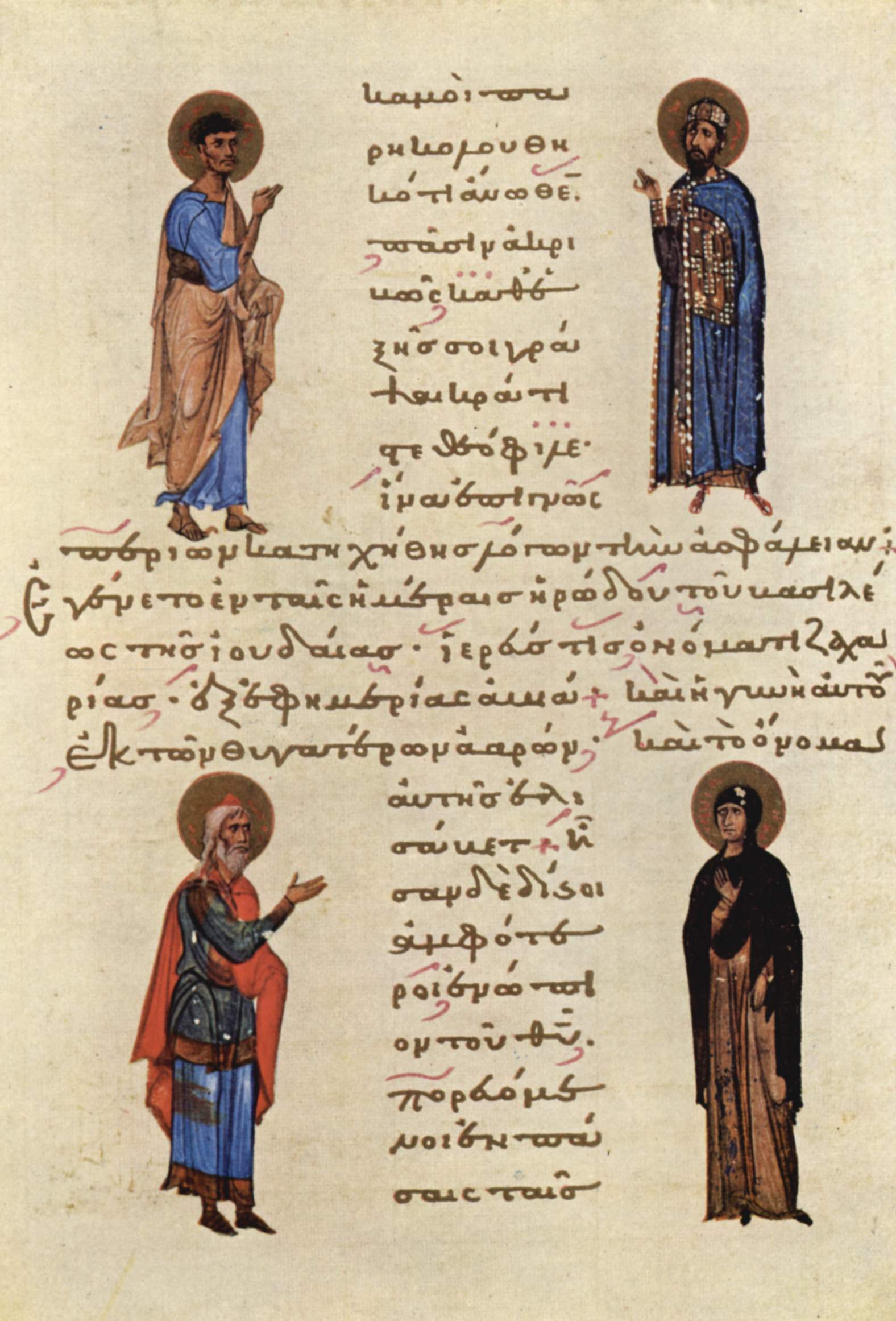
The synoptic gospels are the primary sources of historical information about Jesus and of the religious movement he founded. Among contemporary scholars, there is consensus that the gospels are a type of ancient biography. similar to Greco-Roman biographies such as Xenophon’s Memoirs of Socrates which narrate the lives of historical people. The Gospels of Matthew, Mark, and Luke recount the life, ministry, crucifixion and resurrection of a Jew named Jesus who spoke Aramaic. There are different hypotheses regarding the origin of the texts because the gospels of the New Testament were written in Greek for Greek-speaking communities, and were later translated into Syriac, Latin, and Coptic. Scholars argue that the surviving gospels show usage of earlier independent written and oral sources that extended back to the time of Jesus's death, but did not survive. Aramaic sources have been detected in Mark's Gospel, which could indicate use of early or even eyewitness testimony when it was being written. Historians often study the historical reliability of the Acts of the Apostles when studying the reliability of the gospels, as the Book of Acts was seemingly written by the same author as the Gospel of Luke.
Non-Christian sources
Josephus and Tacitus
Main article: Josephus on Jesus, Tacitus on Jesus
Non-Christian sources used to study and establish the historicity of Jesus include the first century Jewish historian Josephus and Roman historian Tacitus. These sources are compared to Christian sources, such as the Pauline letters and synoptic gospels, and are usually independent of each other. Similarities and differences between these sources are used in the authentication process. From these two independent sources alone, certain facts about Jesus can be adduced: that he existed, his personal name was Jesus, he was called a messiah, he had a brother named James, he won over Jews and gentiles, Jewish leaders had unfavorable opinions of him, Pontius Pilate decided his execution, he was executed by crucifixion, and he was executed during Pilate's governorship. Josephus and Tacitus agree on four sequential points: a movement was started by Jesus, he was executed by Pontius Pilate, his movement continued after his death, and that a group of "Christians" still existed; analogous to common knowledge of founders and their followers like Plato and Platonists.
Josephus was personally involved in Galilee, where Jesus ministered and people who knew him resided, when he was the commander of Jewish forces during the revolt against Roman occupation and trained 65,000-100,000 fighters in the region. His knowledge of Galilee and its inhabitants was notable since he recounted his activities in Galilee in the mid-60s AD in his autobiographical work called The Life of Flavius Josephus as an appendix to Antiquities of the Jews, where the references to Jesus are located. He even stationed in Sepphoris for a time, which was 3 miles away from Jesus's hometown of Nazareth and kept contact with people in the trials of Jesus and his brother James such as the Sanhedrin and Ananus II. Jesus is referenced by Josephus twice, once in Book 18 and once in Book 20* of Antiquities of the Jews*, written around 93 to 94 AD. On the first reference, known as the Testimonium Flavianum in Book 18, since the late 20th century, the general consensus has held that the Testimonium is partially authentic in that an authentic nucleus referencing the life of Jesus was original to Josephus. Up to the Enlightenment, the Testimonium was never used in relation to the existence of Jesus since no ancient source or ancient reference to the Testimonium supports negation. On the second reference, Josephus scholar Louis H. Feldman states that "few have doubted the genuineness" of the reference found in Antiquities 20, 9, 1 to "the brother of Jesus, who was called Christ, whose name was James".
Tacitus, in his Annals (written ), book 15, chapter 44, describes Nero's scapegoating of the Christians following the Great Fire of Rome. He writes that the founder of the sect was named Christus (the Christian title for Jesus); that he was executed under Pontius Pilate; and that the movement, initially checked, broke out again in Judea and even in Rome itself. The scholarly consensus is that Tacitus' reference to the execution of Jesus by Pilate is both authentic and of historical value as an independent Roman source.Mercer dictionary of the Bible by Watson E. Mills, Roger Aubrey Bullard (2001) page 343
Mishnah
The Mishnah ( 200) may refer to Jesus as it reflects the early Jewish traditions of portraying Jesus as a sorcerer or magician. Other references to Jesus and his execution exist in the Talmud, but they aim to discredit his actions, not deny his existence.
Mara bar Serapion
Main article: Mara bar Serapion on Jesus
Mara bar Serapion was a Stoic philosopher from the Roman province of Syria. In a letter he wrote to his son Serapion he refers to the unjust treatment of "three wise men": the murder of Socrates, the burning of Pythagoras, and the execution of "the wise king" of the Jews. Most scholars date it to shortly after 73 AD during the first century.
Notes
-
: "The term the historical Jesus denotes the life and teachings of Jesus that are reconstructed by specialists in Jesus Research. The Jesus of history is the real person of history who will always remain elusive and cannot be presented again on a reconstructed stage of history. The term the Christ of faith signifies the present and living Lord known by Christians in various church liturgies and in daily life."
-
: In agreement with the view of Albert Schweitzer: "The Jesus proclaimed by preachers and theologians today had no existence. That particular Jesus is (or those particular Jesuses are) a myth. But there was a historical Jesus, who was very much a man of his time."}}
-
James D. G. Dunn (1974) Paul's understanding of the death of Jesus in Reconciliation and Hope. New Testament Essays on Atonement and Eschatology Presented to L.L. Morris on his 60th Birthday. Robert Banks, ed., Carlisle: The Paternoster Press, pp. 125–141, citing G. A. Wells (The Jesus of the Early Christians (1971)): "Perhaps we should also mention that at the other end of the spectrum Paul's apparent lack of knowledge of the historical Jesus has been made the major plank in an attempt to revive the nevertheless thoroughly dead thesis that the Jesus of the Gospels was a mythical figure." An almost identical quotation is included in Dunn, James DG (1998) The Christ and the Spirit: Collected Essays of James D.G. Dunn, Volume 1, Wm. B. Eerdmans Pub. Co., p. 191, and Sykes, S. (1991) Sacrifice and redemption: Durham essays in theology. Cambridge [England]: Cambridge University Press. pp. 35–36.
-
Classicist-numismatist Michael Grant stated in 1977: "To sum up, modern critical methods fail to support the Christ-myth theory. It has 'again and again been answered and annihilated by first-rank scholars'. In recent years, 'no serious scholar has ventured to postulate the non-historicity of Jesus', or at any rate very few, and they have not succeeded in disposing of the much stronger, indeed very abundant, evidence to the contrary."
-
: Walter Weaver, scholar of philosophy and religion: "The denial of Jesus' historicity has never convinced any large number of people, in or out of technical circles, nor did it in the first part of the century."
-
Robert E. Van Voorst, New testament scholar: :* , referring to G. A. Wells: "The nonhistoricity thesis has always been controversial, and it has consistently failed to convince scholars of many disciplines and religious creeds. Moreover, it has also consistently failed to convince many who for reasons of religious skepticism might have been expected to entertain it, from Voltaire to Bertrand Russell. Biblical scholars and classical historians now regard it as effectively refuted." :* : "debate on the existence of Jesus has been in the fringes of scholarship [...] for more than two centuries." :* : "Among New Testament scholars and historians, the theory of Jesus' nonexistence remains effectively dead as a scholarly question."
-
: "[F]arfetched theories that Jesus' existence was a Christian invention are highly implausible."
-
: "There are those who argue that Jesus is a figment of the Church's imagination, that there never was a Jesus at all. I have to say that I do not know any respectable critical scholar who says that any more."
-
G. A. Wells, mythicist admitted "by around 1920 nearly all scholars had come to regard the case against Jesus's historicity as totally discredited"
-
Robert M. Price, former apologist and prominent mythicist, agrees that his perspective runs against the views of the majority of scholars to the point that they "dismiss Christ Myth theory as a discredited piece of lunatic fringe thought alongside Holocaust Denial and skepticism about the Apollo moon landings."
-
Paul Johnson, a popular historian: "His life has been written more often than that of any other human being, with infinite variations of detail, employing vast resources of scholarship, and often controversially, not to say acrimoniously. Scholarship, like everything else, is subject to fashion, and it was the fashion, in the late nineteenth and early twentieth centuries, for some to deny that Jesus existed. No serious scholar holds that view now, and it is hard to see how it ever took hold, for the evidence of Jesus's existence is abundant."
-
Bart Ehrman, agnostic New Testament scholar: "It is fair to say that mythicists as a group, and as individuals, are not taken seriously by the vast majority of scholars in the fields of New Testament, early Christianity, ancient history, and theology. This is widely recognized, to their chagrin, by mythicists themselves....Not much has changed in the sixty-five years since Robertson's brief volume appeared."
-
Michael Martin, skeptic philosopher of religion: "Some skeptics have maintained that the best account of biblical and historical evidence is the theory that Jesus never existed; that is, that Jesus' existence is a myth (Wells 1999). Such a view is controversial and not widely held even by anti-Christian thinkers."
-
Maurice Casey, an irreligious Emeritus Professor of New Testament Languages and Literature at the University of Nottingham, concludes in his book Jesus: Evidence and Argument or Mythicist Myths? that "the whole idea that Jesus of Nazareth did not exist as a historical figure is verifiably false. Moreover, it has not been produced by anyone or anything with any reasonable relationship to critical scholarship. It belongs to the fantasy lives of people who used to be fundamentalist Christians. They did not believe in critical scholarship then, and they do not do so now. I cannot find any evidence that any of them have adequate professional qualifications."
-
Patrick Gray, religious studies scholar, "Christian and non-Christian scholars alike now almost universally reject the "Christ myth" hypothesis. That Jesus did in fact walk the face of the earth in the first century is no longer seriously doubted even by those who believe that very little about his life or death can be known with any certainty. [Note 4:] Although it remains a fringe phenomenon, familiarity with the Christ myth theory has become much more widespread among the general public with the advent of the Internet."
-
, historian of religion: "Given the fringe status of these theories, the vast majority have remained unnoticed and unaddressed within scholarly circles." "In short, the majority of mythicist literature is composed of wild theories, which are poorly researched, historically inaccurate, and written with a sensationalist bent for popular audiences."
-
Larry Hurtado (December 2, 2017), Why the "Mythical Jesus" Claim Has No Traction with Scholars: "The "mythical Jesus" view doesn't have any traction among the overwhelming number of scholars working in these fields, whether they be declared Christians, Jewish, atheists, or undeclared as to their personal stance. Advocates of the "mythical Jesus" may dismiss this statement, but it ought to count for something if, after some 250 years of critical investigation of the historical figure of Jesus and of Christian Origins, and the due consideration of "mythical Jesus" claims over the last century or more, this spectrum of scholars have judged them unpersuasive (to put it mildly)."
-
"The theory of a pre-Christian Jesus, while exceptionally intriguing, still has not found any decent footing in recent years. Though there have been some attempts at innovating the concept, invariably the arguments for this have relied heavily on conjectural interpretations of biblical and extrabiblical literature in an attempt to validate the hypothesis…All of these issues, and more, demonstrate that the pre-Christian Jesus hypothesis is still an unreliable thesis, and likely should be discounted as it was a century ago. The renovated theories fail to convincingly explain the evidence at hand."
-
Marko Marina, ancient historian: states that Richard Carrier's mythicist views have not won any supporters from critical scholars or the academic community and that mythicist theory remains as fringe}}
-
: "We wield our criteria to get what we want."
-
: "The traditional criteria, relied upon for so long, are now bankrupt."
-
: "Criteria of authenticity, which were considered then to be the state of the art (but whose collective utility was already being called into question by Meyer, among others), are now widely recognized as bankrupt historiographical instruments in need of serious revision or if not outright repudation."}}
-
: "Since in the quest for the historical Jesus almost anything is possible, the function of the criteria is to pass from the merely possible to the really probable, to inspect various probabilities, and to decide which candidate is most probable. Ordinarily the criteria can not hope to do more."
-
Miles Pattenden, historian, On historians and the historicity of Jesus — a response to John Dickson, ABC Religion: "...few scholars would deny that there must be some kernel of historicity in Jesus’s figure. It is just that they might well also say that it is a stretch to claim this historical person as unequivocally equivalent to the biblical Jesus.
Ultimately, the question here is ontological: what makes “Jesus” Jesus? Is it enough that a man called Jesus (or Joshua), who became a charismatic teacher, was born around the turn of the millennium in Palestine? What additional characteristics do we need to ascribe to the historical figure to make him on balance identifiable with the scriptural one? A baptism in the river Jordan? A sermon on the Mount? Death at the hands of Pontius Pilate? What else?
Partly because there is no way to satisfy these queries, professional historians of Christianity — including most of us working within the secular academy — tend to treat the question of whether Jesus existed or not as neither knowable nor particularly interesting. Rather, we focus without prejudice on other lines of investigation, such as how and when the range of characteristics and ideas attributed to him arose.
In this sense Jesus is not an outlier among similar historical figures. Other groups of historians engage in inquiries similar to those that New Testament scholars pursue, but concerning other key figures in the development of ancient religion and philosophy in Antiquity: Moses, Socrates, Zoroaster, and so on.}}
- : Today nearly all historians, whether Christians or not, accept that Jesus existed and that the gospels contain plenty of valuable evidence which has to be weighed and assessed critically. There is general agreement that, with the possible exception of Paul, we know far more about Jesus of Nazareth than about any first or second century Jewish or pagan religious teacher.
- : "There's a lot of evidence for his existence."
- : "Historians also have at their disposal certain facts about Jesus which can be shown to be independent of the theological creativity of the early Christian movement and which provide a framework which helps interpret less certain material. We offer some of the most important facts. We know with virtually complete certainty that Jesus began his work after he was baptized by John the Baptist..We know that Jesus was executed by the Romans as 'King of the Jews'...Yet it is also a fact that Jesus' followers were not executed with him, nor were they troubled by the Romans for some decades."
- : "He certainly existed, as virtually every competent scholar of antiquity, Christian or non-Christian, agrees, based on certain and clear evidence."
- : "Serious historians of the early Christian movement—all of them—have spent many years preparing to be experts in their field. Just to read the ancient sources requires expertise in a range of ancient languages: Greek, Hebrew, Latin, and often Aramaic, Syriac, and Coptic, not to mention the modern languages of scholarship (for example, German and French). And that is just for starters. Expertise requires years of patiently examining ancient texts and a thorough grounding in the history and culture of Greek and Roman antiquity, the religions of the ancient Mediterranean world, both pagan and Jewish, knowledge of the history of the Christian church and the development of its social life and theology, and, well, lots of other things. It is striking that virtually everyone who has spent all the years needed to attain these qualifications is convinced that Jesus of Nazareth was a real historical figure."
- : In agreement with the view of Albert Schweitzer: "The Jesus proclaimed by preachers and theologians today had no existence. That particular Jesus is (or those particular Jesuses are) a myth. But there was a historical Jesus, who was very much a man of his time"
- : Levine: "There is a consensus of sorts on a basic outline of Jesus' life. Most scholars agree that Jesus was baptized by John, debated with fellow Jews on how best to live according to God's will, engaged in healings and exorcisms, taught in parables, gathered male and female followers in Galilee, went to Jerusalem, and was crucified by Roman soldiers during the governorship of Pontius Pilate."
- : "We can begin by asking the simple question—do we know that Jesus existed as a historical figure, rather than an invented person like James Bond or Superman? Like almost all professional archaeologists and historians who have worked on the first-century Holy Land—whatever their beliefs—I think that the answer is certainly ‘yes’." This broad consensus is acknowledged by mythicists:
- :"Today, most secular scholars accept Jesus as a historical, although unimpressive, figure."
- : "The historicity of Jesus Christ is currently the default consensus."}}
- : "Contrary to previous times, virtually everyone in the field today acknowledges that Jesus was considered by his contemporaries to be an exorcist and a worker of miracles. However, when it comes to historical assessment of the miracles tradition itself, the consensus quickly shatters. Some, following in the footsteps of Bultmann, embrace an explicit methodological naturalism such that the very idea of a miracle is ruled out a priori. Others defend the logical possibility of miracle at the theoretical level, but, in practice, retain a functional methodological naturalism, maintaining that we could never be in possession of the type and/or amount of evidence that would justify a historical judgment in favor of the occurrence of a miracle. Still others, suspicious that an uncompromising methodological naturalism most likely reflects an unwarranted metaphysical naturalism, find such a priori skepticism unwarranted and either remain open to, or even explicitly defend, the historicity of miracles within the Jesus tradition."
- : "I should emphasize that historians do not have to deny the possibility of miracles or deny that miracles have actually happened in the past. Many historians, for example, committed Christians and observant Jews and practicing Muslims, believe that they have in fact happened. When they think or say this, however, they do so not in the capacity of the historian, but in the capacity of the believer. In the present discussion, I am not taking the position of the believer, nor am I saying that one should or should not take such a position. I am taking the position of the historian, who on the basis of a limited number of problematic sources has to determine to the best of his or her ability what the historical Jesus actually did. As a result, when reconstructing Jesus' activities, I will not be able to affirm or deny the miracles that he is reported to have done [...] This is not a problem for only one kind of historian—for atheists or agnostics or Buddhists or Roman Catholics or Baptists or Jews or Muslims; it is a problem for all historians of every stripe."
- : "Nevertheless, what is perhaps most surprising is the extent to which contemporary scholarly literature on the 'historical Jesus' has studiously ignored and downplayed the question of the resurrection [...] But even the more mainstream participants in the late twentieth-century 'historical Jesus' bonanza have tended to avoid the subject of the resurrection—usually on the pretext that this is solely a matter of 'faith' or of 'theology', about which no self-respecting historian could possibly have anything to say. Precisely that scholarly silence, however, renders a good many recent 'historical Jesus' studies methodologically hamstrung, and unable to deliver what they promise [...] In this respect, benign neglect ranks alongside dogmatic denial and naive credulity in guaranteeing the avoidance of historical truth."}}
References
Sources
;Printed sources
- Boyarin, Daniel (2004). Border Lines. The Partition of Judaeo-Christianity. University of Pennsylvania Press.
- Doherty, Earl (1999). The Jesus Puzzle. Did Christianity Begin with a Mythical Christ? : Challenging the Existence of an Historical Jesus.
- Drews, Arthur & Burns, C. Deslisle (1998). The Christ Myth (Westminster College–Oxford Classics in the Study of Religion).
- France, R.T. (2001). The Evidence for Jesus. Hodder & Stoughton.
- George, Augustin & Grelot, Pierre (Eds.) (1992). Introducción Crítica al Nuevo Testamento. Herder.
- Gowler, David B. (2007). What Are They Saying About the Historical Jesus?. Paulist Press.
- Meier, John P., A Marginal Jew: Rethinking the Historical Jesus, Anchor Bible Reference Library, Doubleday : (1991), v. 1, The Roots of the Problem and the Person, : (1994), v. 2, Mentor, Message, and Miracles, : (2001), v. 3, Companions and Competitors, : (2009), v. 4, Law and Love,
- Mendenhall, George E. (2001). Ancient Israel's Faith and History: An Introduction to the Bible in Context.
- Messori, Vittorio (1977). Jesus hypotheses. St Paul Publications.
- New Oxford Annotated Bible with the Apocrypha, New Revised Standard Version. (1991) New York, Oxford University Press.
- Wells, George A. (1988). The Historical Evidence for Jesus. Prometheus Books.
- Wells, George A. (1998). The Jesus Myth.
- Wells, George A. (2004). Can We Trust the New Testament?: Thoughts on the Reliability of Early Christian Testimony.
- Wilson, Ian (2000). Jesus: The Evidence (1st ed.). Regnery Publishing.
;Web-sources
References
- (2018). "The Historical and Human Existence of Jesus in Paul's Letters". Journal for the Study of the Historical Jesus.
- (2021). "The Cambridge Companion to the New Testament". Cambridge University Press.
- T.C. Schmidt. (2025). "Josephus and Jesus: New Evidence for the One Called Christ". [[Oxford University Press]].
- (2022). "The Oxford Dictionary of the Christian Church". Oxford University Press.
- [[Robert M. Price]] (a Christian atheist) who denies the existence of Jesus agrees that this perspective runs against the views of the majority of scholars: Robert M. Price "Jesus at the Vanishing Point" in ''The Historical Jesus: Five Views'' edited by James K. Beilby & Paul Rhodes Eddy, 2009 InterVarsity, {{ISBN. 0830838686 p. 61
- Ben Witherington, ''The Jesus Quest: The Third Search for the Jew of Nazareth'' (1997) {{ISBN. 0830815449 pp. 9–13
- ''Jesus as a Figure in History: How Modern Historians View the Man from Galilee'' by Mark Allan Powell (1999) {{ISBN. 0664257038 pp. 19–23
- ''John, Jesus, and History'' Volume 1 by Paul N. Anderson, Felix Just and Tom Thatcher (2007) {{ISBN. 1589832930 p. 131
- John P. Meier "How do we decide what comes from Jesus" in ''The Historical Jesus in Recent Research'' by James D. G. Dunn and Scot McKnight 2006 {{ISBN. 1-57506-100-7 pp. 126–128
- ''Who Is Jesus?'' by John Dominic Crossan, Richard G. Watts 1999 {{ISBN. 0664258425 pp. 31–32
- ''Jesus as a figure in history: how modern historians view the man from Galilee'' by Mark Allan Powell 1998 {{ISBN. 0-664-25703-8 p. 47
- (23 December 2024). "Consensus, Disagreement, and the Criteria of Authenticity". Journal for the Study of the Historical Jesus.
- (2022). "The Jesus Handbook". Eerdmans.
- [https://www.divinity.cam.ac.uk/directory/justin-meggitt Professor Justin Meggitt]
- ''Encyclopedia of theology: a concise Sacramentum mundi'' by Karl Rahner 2004 {{ISBN. 0860120066 pp. 730–731
- Van Voorst, Robert E (2000). ''Jesus Outside the New Testament: An Introduction to the Ancient Evidence''. Eerdmans Publishing. {{ISBN. 0802843689 p. 15
- (2008). "The Routledge Encyclopedia of the Historical Jesus". Routledge.
- Craig Evans, "Life-of-Jesus Research and the Eclipse of Mythology," Theological Studies 54 (1993) p. 13-14
- Schoeps, Hans-Joachim. (1968). "The Religions of Mankind". [[Anchor Books]].
- (2013). "Jesus and his World: The Archaeological Evidence". Westminster John Knox Press.
- (26 March 2012). "The Archaeological Evidence for Jesus".
- {{harvnb. Ehrman. 2012
- [[s:Bible (American Standard)/Galatians#1:19. Galatians 1:19]]
- (2007). "The Historical Jesus For Dummies". For Dummies.
- [[s:Bible (American Standard)/Galatians#2:9. Galatians 2:9]]
- ''Jesus Remembered: Christianity in the Making'' by James D. G. Dunn (2003) {{ISBN. 0802839312 p. 143
- ''Jesus Christ in History and Scripture'' by Edgar V. McKnight (1999) {{ISBN. 0865546770 p. 38
- ''Jesus according to Paul'' by Victor Paul Furnish (1994) {{ISBN. 0521458242 pp. 19–20
- Gathercole, Simon. "The Historical and Human Existence of Jesus in Paul’s Letters." Journal for the Study of the Historical Jesus 16.2–3 (2018): 191, n. 32.
- "Jesus Christ".
- Vermes, Geza. The authentic gospel of Jesus. London, Penguin Books. 2004.
- Stanton, G. H. (2004). ''Jesus and Gospel''. Cambridge: Cambridge University Press. p. 192.
- Burridge, R. A. (2006). Gospels. In J. W. Rogerson & Judith M. Lieu (Eds) ''The Oxford Handbook of Biblical Studies''. Oxford: Oxford University Press. p. 437
- Wills, L. M. (1997). ''The Quest of the Historical Gospel: Mark, John and the Origins of the Gospel Genre''. London: Routledge. p. 10.
- Mark Allan Powell (editor), ''The New Testament Today'', p. 50 (Westminster John Knox Press, 1999). {{ISBN. 0-664-25824-7
- Stanley E. Porter (editor), ''Handbook to Exegesis of the New Testament'', p. 68 (Leiden, 1997). {{ISBN. 90-04-09921-2
- (2013). "Dictionary of Jesus and the Gospels". IVP Academic.
- (1998). "Studying the Historical Jesus: Evaluations of the State of Current Research". BRILL.
- ''Jesus and the Gospels: An Introduction and Survey'' by Craig L. Blomberg (2009) {{ISBN. 0-8054-4482-3 pp. 431–436
- (January 2015). "Did Jesus Exist? Searching for Evidence Beyond the Bible".
- Crossan, John (2009). "Response to Robert M. Price". In Beilby, James K.; Eddy, Paul R. (eds.). The Historical Jesus: Five Views. InterVarsity Press. pp. 86. {{ISBN. 978-0-8308-3868-4
- (1999). "The New Complete Works of Josephus". Kregel Publications.
- (2016). "A Companion to Josephus". John Wiley & Sons, Inc.
- (2015). "A Companion to Josephus". Wiley Blackwell.
- Schreckenberg, Heinz. (1992). "Jewish Traditions in Early Christian Literature". Van Gorcum.
- Kostenberger, Andreas J.. (2009). "The Cradle, the Cross, and the Crown: An Introduction to the New Testament". B&H Publishing.
- (2015). "A Companion to Josephus". Wiley Blackwell.
- ''The new complete works of Josephus'' by Flavius Josephus, William Whiston, Paul L. Maier {{ISBN. 0-8254-2924-2 pp. 662–663
- ''Josephus XX'' by [[Louis H. Feldman]] (1965), {{ISBN. 0674995023 p. 496
- Flavius Josephus; Maier, Paul L. (December 1995). ''Josephus, the Essential Works: A Condensation of Jewish Antiquities and The Jewish war'' {{ISBN. 978-0-8254-3260-6 pp. 284–285
- [[P. E. Easterling]], [[E. J. Kenney]] (general editors), ''The Cambridge History of Latin Literature'', p. 892 (Cambridge University Press, 1982, reprinted 1996) {{ISBN. 0-521-21043-7
- (2023). "Early Classical Authors on Jesus". T&T Clark.
- ''Pontius Pilate in History and Interpretation'' by Helen K. Bond (2004) {{ISBN. 0-521-61620-4 page xi
- 082648011X pp. 693–694
- ''Jesus in the Talmud'' by Peter Schäfer (24 Aug 2009) {{ISBN. 0691143188 pp. 9, 141
- ''Jesus and the Gospels: An Introduction and Survey'' by Craig L. Blomberg (1 Aug 2009) {{ISBN. 0805444823 p. 280
- ''Jesus and the Politics of his Day'' by E. Bammel and C. F. D. Moule (1985) {{ISBN. 0521313449 p. 393
- Kostenberger, Andreas J.; Kellum, L. Scott; Quarles, Charles L. (2009). ''The Cradle, the Cross, and the Crown: An Introduction to the New Testament'' {{ISBN. 0-8054-4365-7. pp. 107–109
- ''Evidence of Greek Philosophical Concepts in the Writings of Ephrem the Syrian'' by Ute Possekel 1999 {{ISBN. 90-429-0759-2 pages 29-30
- Van Voorst, Robert E (2000). ''Jesus Outside the New Testament: An Introduction to the Ancient Evidence''. Eerdmans Publishing. {{ISBN. 0-8028-4368-9 pages 53-56
This article was imported from Wikipedia and is available under the Creative Commons Attribution-ShareAlike 4.0 License. Content has been adapted to SurfDoc format. Original contributors can be found on the article history page.
Ask Mako anything about Historicity of Jesus — get instant answers, deeper analysis, and related topics.
Research with MakoFree with your Surf account
Create a free account to save articles, ask Mako questions, and organize your research.
Sign up freeThis content may have been generated or modified by AI. CloudSurf Software LLC is not responsible for the accuracy, completeness, or reliability of AI-generated content. Always verify important information from primary sources.
Report