From Surf Wiki (app.surf) — the open knowledge base
Hindush
Province of the Achaemenid Empire

Province of the Achaemenid Empire
| Field | Value | |
|---|---|---|
| conventional_long_name | Hindush | |
| native_name | ||
| common_name | Hindush | |
| subdivision | Satrapy | |
| nation | the Achaemenid Empire | |
| image_map | Eastern Satrapies of the Achaemenid Empire.jpg | |
| image_map_caption | Hiⁿdūš was part of the easternmost territories of the Achaemenid Empire | |
| image_flag | [[File:Standard of Cyrus the Great.svg | 115px]] |
| flag | Shahbaz (bird) | |
| flag_type | Standard of Cyrus the Great | |
| year_start | ||
| year_end | ||
| p1 | Sindhu-Sauvīra | |
| s1 | Wars of Alexander the GreatMacedonian Empire | |
| leader1 | Darius I (first) | |
| year_leader1 | 513–499 BCE | |
| leader2 | Darius III (last) | |
| year_leader2 | 336–330 BCE | |
| government_type | Monarchy | |
| title_leader | Monarchs | |
| event_start | Persian conquest of the Indus Valley | |
| event_end | Indian campaign of Alexander the Great |
Hindush ( peo) was an administrative division of the Achaemenid Empire the lower Indus Valley. Established through the Persian conquest of the Indus Valley in the 6th century BCE, it is believed to have continued as a province for approximately two centuries, ending when it fell to the Macedonian Empire during the Indian campaign of Alexander the Great. According to the Greek historian Herodotus, it was the "easternmost province" governed by the Achaemenid dynasty.
Etymology
It is widely accepted that the name peo derives from sa, the Sanskrit name of the Indus river as well as the region at the lower Indus basin. The Proto-Iranian sound change *s h occurred between 850–600 BCE, according to Asko Parpola. The -sh suffix is common among the names of many Achaemenid provinces, such as peo (the land of Harauvati or Haraxvaiti, i.e., Arachosia) or peo (Bactria). Accordingly, peo would mean the land of sa.
The Greeks of Asia Minor, who were also part of the Achaemenid empire, called the province 'India'. More precisely, they called the people of the province as 'Indians' ('Ινδοι, grc) The loss of the aspirate was probably due to the dialects of Greek spoken in Asia Minor. Herodotus also generalised the term "Indian" from the people of Hindush to all the people living to the east of Persia, even though he had no knowledge of the geography of the land.
Geography
The territory of Hindush may have corresponded to the area covering the lower and central Indus basin (present day Sindh and the southern Punjab region of Pakistan). Hindush bordered Gandāra (spelt as Gaⁿdāra by the Achaememids) to the north. These areas remained under Persian control until the invasion by Alexander. Alternatively, some authors consider that Hindush may have been located in the Punjab region.
Integration

Second Persian invasion of Greece
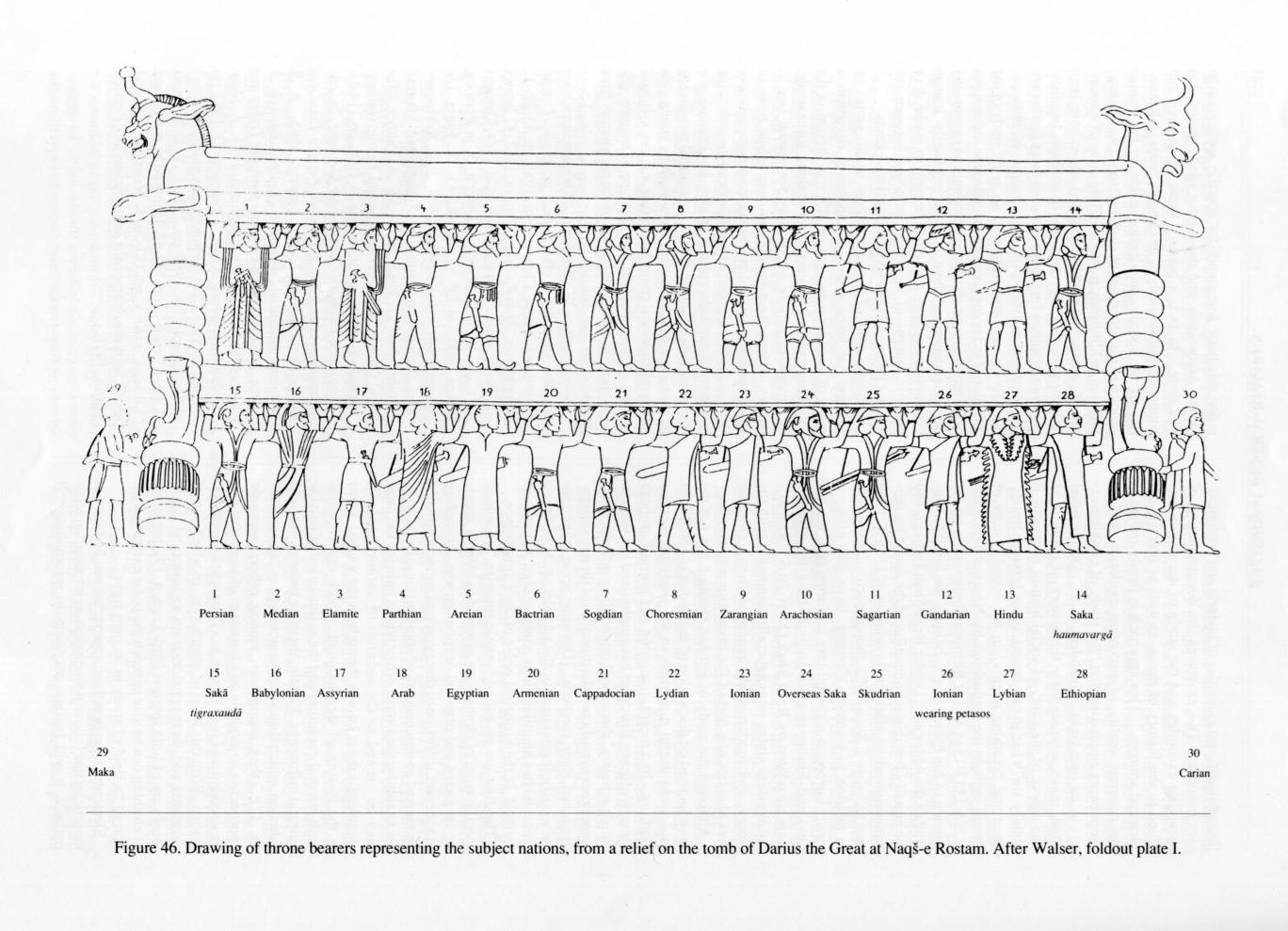
According to Herodotus, the 'Indians' participated to the Second Persian invasion of Greece circa 480 BCE. At the final Battle of Platea (479 BCE), they formed one of the main corps of Achaemenid troops (one of "the greatest of the nations"). Indians were still supplying troops and elephants for the Achaemenid army at the Battle of Gaugamela (331 BCE). They are also depicted on the Achaemenid tombs of Naqsh-e Rostam and Persepolis.
Demographic representation

Representatives of Hindush are depicted as delegates bringing gifts to the king on the Apadana staircases, and as throne/ dais bearers on the Tripylon and Hall of One Hundred Columns reliefs at Persepolis The representatives of Hindush (as well as Gandara and Thatagus) in each in- stance are characterized by their loincloths, sandals, and exposed upper body, which distinguish them from the representatives of other eastern provinces such as Bactria and Arachosia.
Notes
References
References
- (1982). "Encyclopaedia Iranica". Routledge & Kegan Paul.
- Some sounds are omitted in the writing of Old Persian, and are shown with a raised letter.[https://archive.org/stream/OldPersian#page/n177/mode/2up/ Old Persian p.164][https://archive.org/stream/OldPersian#page/n23/mode/2up/ Old Persian p.13]. In particular Old Persian nasals such as "n" were omitted in writing before consonants [https://archive.org/stream/OldPersian#page/n27/mode/2up/ Old Persian p.17][https://archive.org/stream/OldPersian#page/n35/mode/2up/ Old Persian p.25]
- "DNa - Livius".
- Parpola, Asko. (2015). "The Roots of Hinduism". Oxford University Press.
- [https://www.perseus.tufts.edu/hopper/morph?l=%29indoi%2F&la=greek&can=%29indoi%2F0&prior=oi( 'Ινδοι], Greek Word Study Tool, Tufts University
- Horrocks, Geoffrey. (2009). "Greek: A History of the Language and its Speakers". John Wiley & Sons.
- Panayotou, A.. (2007). "A History of Ancient Greek: From the Beginnings to Late Antiquity". Cambridge University Press.
- Arora, Udai Prakash. (2005). "India — Studies in the History of an Idea". Munshiram Manoharlal Publishers.
- (1974). "The Civilizations of Monsoon Asia". Angus and Robertson.
- (2000). "Problems of Ancient India". Aditya Prakashan.
- M. A. Dandamaev. "A Political History of the Achaemenid Empire" p 147. BRILL, 1989 {{ISBN. 978-9004091726
- 0875868592
- (2002). "Cambridge Ancient History". Cambridge University Press.
- "Naqs-e Rostam – Encyclopaedia Iranica".
- "Naqs-e Rostam – Encyclopaedia Iranica List of nationalities of the Achaemenid military with corresponding drawings".
- Herodotus [https://penelope.uchicago.edu/Thayer/E/Roman/Texts/Herodotus/7B*.html VII 64-66]
- (2000). "A military history of ancient India". Vision Books.
- "LacusCurtius • Herodotus — Book IX: Chapters 1‑89".
- (1986). "India and Greece before Alexander". Annals of the Bhandarkar Oriental Research Institute.
- (October 2005). "The Achaemenid Empire in South Asia and Recent Excavations in Northwest Pakistan". University of Chicago.
This article was imported from Wikipedia and is available under the Creative Commons Attribution-ShareAlike 4.0 License. Content has been adapted to SurfDoc format. Original contributors can be found on the article history page.
Ask Mako anything about Hindush — get instant answers, deeper analysis, and related topics.
Research with MakoFree with your Surf account
Create a free account to save articles, ask Mako questions, and organize your research.
Sign up freeThis content may have been generated or modified by AI. CloudSurf Software LLC is not responsible for the accuracy, completeness, or reliability of AI-generated content. Always verify important information from primary sources.
Report