From Surf Wiki (app.surf) — the open knowledge base
Hinduism in Bangladesh
none
none
| Field | Value | ||
|---|---|---|---|
| group | Bangladeshi Hindus | ||
| Bāṅlādēśī Hindu | |||
| বাংলাদেশী হিন্দু | |||
| flag | [[File:Bengali Swastika Symbol half.svg | 50px]] | |
| population | 13,130,109 (2022 Census) | ||
| *(7.95% of the country's population) * | languages=Sanskrit (Liturgical) | ||
| Bangla and other tribal languages | religions | Hinduism (majority) | |
| Tribal religions identified as Hindus (minority) | |||
| region1 | Dhaka Division | pop1= 2,766,874 (6.26%) | |
| region3 | Chittagong Division | pop3= 2,196,947 (6.61%) | |
| region6 | Rajshahi Division | pop6= 1,159,197 (5.70%) | |
| region4 | Khulna Division | pop4= 2,007,502 (11.54%) | |
| region5 | Sylhet Division | pop5= 1,491,315 (13.51%) | |
| region7 | Barisal Division | pop7= 750,177 (8.24%) | |
| region2 | Rangpur Division | pop2= 2,290,450 (12.98%) | |
| region8 | Mymensingh Division | ||
| pop8 | 481,742 (3.92%) | ||
| regions | Throughout Bangladesh | image=File:Shiva_temples_Dhakeshwari_Mandir_2_by_Ragib_Hasan.jpg | image_caption=Dhakeshwari National Temple in Dhaka |
Bāṅlādēśī Hindu বাংলাদেশী হিন্দু *(7.95% of the country's population) *|languages=Sanskrit (Liturgical)
Bangla and other tribal languages|religions=Hinduism (majority) Tribal religions identified as Hindus (minority) regions=Throughout Bangladesh|image=File:Shiva_temples_Dhakeshwari_Mandir_2_by_Ragib_Hasan.jpg|image_caption=Dhakeshwari National Temple in Dhaka}}
Hinduism is the second-largest religion in Bangladesh, accounting for about 7.95% of the country's population, approximately 13.1 million people, as per the 2022 census of Bangladesh. Around 21% of the Bangladeshi diaspora follow Hinduism.
Bangladesh has the world's third-largest Hindu population, after India and Nepal. Hinduism is the second-largest religion in 61 of 64 districts in Bangladesh, but there are no Hindu majority districts in Bangladesh.
Demographics
| Year | Percentage (%) | Hindu Population | Total population | Notes | 1901 | 1911 | 1921 | 1931 | 1941 | 1951 | 1961 | 1974 | 1981 | 1991 | 2001 | 2011 | 2022 | Source: Census of India 1901–1941, Census of East Pakistan 1951–1961, Bangladesh Government Census 1974-2022 |
|---|---|---|---|---|---|---|---|---|---|---|---|---|---|---|---|---|---|---|
| 9,546,240 | 28,927,626 | Eastern Bengal region | ||||||||||||||||
| 9,939,825 | 31,555,363 | Before partition | ||||||||||||||||
| 10,176,030 | 33,254,607 | |||||||||||||||||
| 10,466,988 | 35,604,189 | |||||||||||||||||
| 11,759,160 | 41,999,221 | |||||||||||||||||
| 9,239,603 | 42,062,462 | During Pakistani rule | ||||||||||||||||
| 9,379,669 | 50,804,914 | |||||||||||||||||
| 9,673,048 | 71,478,543 | After independence of Bangladesh | ||||||||||||||||
| 10,570,245 | 87,120,487 | |||||||||||||||||
| 11,178,866 | 106,315,583 | |||||||||||||||||
| 11,822,581 | 123,151,871 | |||||||||||||||||
| 12,299,940 | 144,043,697 | |||||||||||||||||
| 13,130,109 | 165,158,616 |

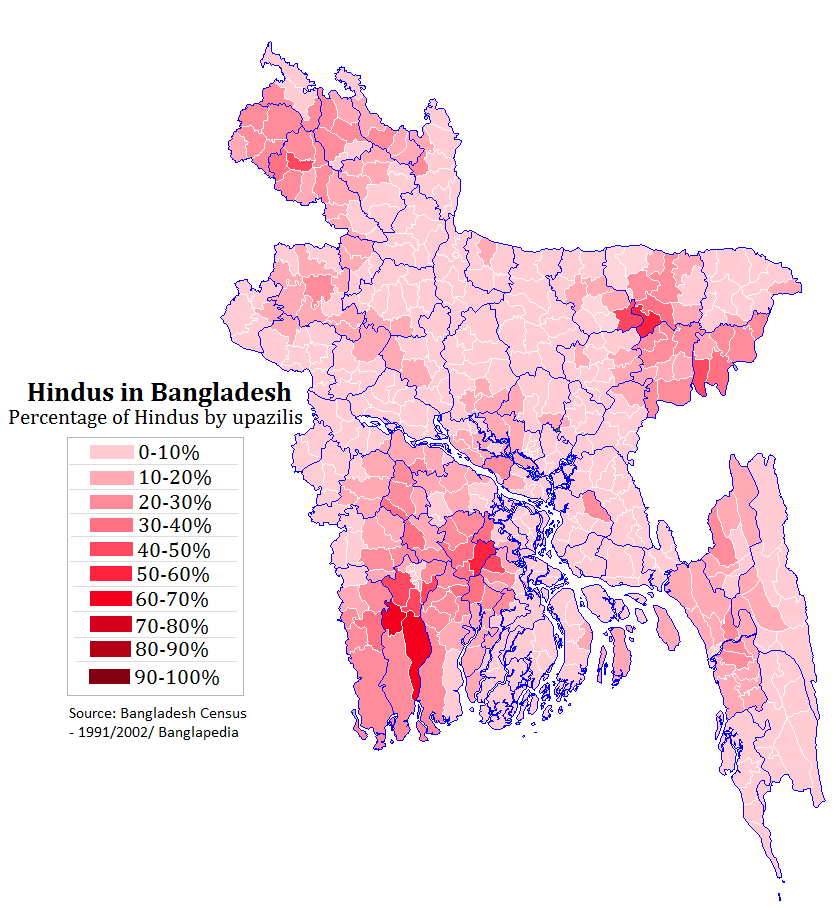
According to the 2001 Bangladesh census, there were around 11.82 million Hindus in Bangladesh, constituting 9.6% of the population, which at the time was 123.15 million. The Bangladesh 2011 census states that approximately 12.73 million people responded that they were Hindus, constituting 8.54% of the total 149.77 million. While the 2022 Census of Bangladesh put the number of Hindus in Bangladesh at 13.1 million out of a total population of 165.1 million, thus constituting 7.95% of the population. According to a report published by a local daily newspaper in Bangladesh, the Hindu population in the country has reduced by nearly one million between 2001 and 2011. The reduction mainly happened in nine districts: Bhola, Barisal, Jhalokati, Pirojpur, Bagerhat, Narail, Gopalganj, Rajbari, and Manikganj. The United States Commission on International Religious Freedom has said that Hindus constitute merely 7% of the population in Bangladesh, as per the latest 2016 figures. Hindus in Bangladesh in the late 2000s were almost evenly distributed in all regions, with large concentrations in Gopalganj, Dinajpur, Sylhet, Sunamganj, Mymensingh, Khulna, Jessore, Chittagong, and parts of Chittagong Hill Tracts. In the capital city of Dhaka, Hindus are the second-largest religious community after the Muslims, and the largest concentration of Hindus can be found in and around Shankhari Bazaar in the old city.
In 2013, Amnesty International reported that the rise of more explicitly Islamist political formations in Bangladesh during the 1990s had resulted in many Hindus being intimidated or attacked, and that fairly substantial numbers were leaving the country for India.
In 1901, Hindus constituted 33% of the population of what is now Bangladesh. In 1941, about 28% of the population were Hindus. Their proportion declined to 22% in 1951 after the Partition of India in 1947, as Hindus migrated from East Bengal to India. Wealthy Hindus who migrated lost their land and assets through the East Bengal Evacuees Act. Poor and middle-class Hindus who were left behind were targets of discriminatory new laws. At the outbreak of the 1965 India-Pakistan war, the Defense of Pakistan Ordinance, and later the Enemy (Custody and Registration) Order II, labeled Hindus as the "enemy" and expropriated their property. The 1974 census of Bangladesh showed that the population of Hindus had fallen to 13.5%. Even after independence, the Hindus were branded "Indian stooges" and untrustworthy citizens.
Since 1971, the Hindu percentage has continued to decline, forming 8.5% of the population as of 2011. The fall in the share of the total population has been attributed to outward migration, and the fertility rate for Hindus remaining consistently lower than Muslims (2.1 versus 2.3 as of 2014).
Hinduism by divisions
| Division | Hindu Population | Total population | Percentage (%) |
|---|---|---|---|
| Barisal | 750,177 | 9,100,104 | |
| Chittagong | 2,196,947 | 33,202,357 | |
| Dhaka | 2,766,874 | 44,215,759 | |
| Khulna | 2,007,502 | 17,415,924 | |
| Mymensingh | 481,742 | 12,225,449 | |
| Rajshahi | 1,159,197 | 20,353,116 | |
| Rangpur | 2,290,450 | 17,610,955 | |
| Sylhet | 1,491,315 | 11,034,952 |
According to the Bangladesh Bureau of Statistics report, Khulna division has the highest decline in Hindu population (1.33%) from 2011 to 2022. In 2011, 12.85% of the population of the division were Hindus. This rate has come down to 11.52% in 2022. Among the eight divisions, Khulna has the fourth highest Hindu population. According to the 2022 census, Sylhet division has the highest Hindu population of 13.5%, but the ratio was 14.05% in 2011. In Rangpur Division, the Hindu population has decreased from 13.21% in 2011 to 12.98% in 2022. Mymensingh Division has the lowest percentage of people belonging to the Hindu community at (3.92%) as of 2022.
Hinduism by districts
| District | Hindu population | Total population | Percentage (%) |
|---|---|---|---|
| Barguna | 69,492 | 1,010,531 | |
| Barisal | 275,263 | 2,570,446 | |
| Bhola | 55,535 | 1,932,518 | |
| Jhalokati | 61,352 | 661,160 | |
| Patuakhali | 107,553 | 1,727,254 | |
| Pirojpur | 180,982 | 1,198,195 | |
| Bandarban | 16,501 | 481,106 | |
| Brahmanbaria | 220,960 | 3,306,563 | |
| Chandpur | 146,524 | 2,635,748 | |
| Chattogram | 982,604 | 9,169,465 | |
| Cumilla | 269,214 | 6,212,216 | |
| Cox's Bazar | 108,166 | 2,823,268 | |
| Feni | 91,160 | 1,648,896 | |
| Khagrachhari | 119,706 | 714,119 | |
| Lakshmipur | 61,846 | 1,937,948 | |
| Noakhali | 147,154 | 3,625,442 | |
| Rangamati | 33,112 | 647,586 | |
| Dhaka | 672,269 | 14,734,701 | |
| Faridpur | 182,561 | 2,162,879 | |
| Gazipur | 263,490 | 5,263,450 | |
| Gopalganj | 348,974 | 1,295,057 | |
| Kishoreganj | 158,778 | 3,267,626 | |
| Madaripur | 144,904 | 1,293,027 | |
| Manikganj | 138,875 | 1,558,025 | |
| Munshiganj | 122,238 | 1,625,416 | |
| Narayanganj | 144,105 | 3,909,138 | |
| Narsingdi | 184,309 | 2,224,944 | |
| Rajbari | 110,569 | 1,189,818 | |
| Shariatpur | 42,724 | 1,294,562 | |
| Tangail | 257,351 | 4,037,608 | |
| Bagerhat | 264,229 | 1,613,076 | |
| Chuadanga | 27,804 | 1,234,054 | |
| Jessore | 313,592 | 3,076,144 | |
| Jhenaidah | 168,444 | 2,005,849 | |
| Khulna | 542,417 | 2,613,385 | |
| Kushtia | 58,771 | 2,149,692 | |
| Magura | 162,138 | 1,033,115 | |
| Meherpur | 8,497 | 705,356 | |
| Narail | 124,465 | 788,671 | |
| Satkhira | 337,145 | 2,196,582 | |
| Jamalpur | 39,827 | 2,499,738 | |
| Mymensingh | 202,440 | 5,899,005 | |
| Netrokona | 202,648 | 2,324,853 | |
| Sherpur | 36,827 | 1,501,853 | |
| Bogra | 216,657 | 3,734,297 | |
| Chapai Nawabganj | 72,178 | 1,835,528 | |
| Joypurhat | 87,595 | 956,431 | |
| Naogaon | 321,341 | 2,784,599 | |
| Natore | 107,124 | 1,859,922 | |
| Pabna | 74,265 | 2,909,624 | |
| Rajshahi | 133,514 | 2,915,009 | |
| Sirajganj | 146,523 | 3,357,706 | |
| Dinajpur | 648,326 | 3,315,236 | |
| Gaibandha | 177,593 | 2,562,233 | |
| Kurigram | 143,381 | 2,329,160 | |
| Lalmonirhat | 185,322 | 1,428,406 | |
| Nilphamari | 327,333 | 2,092,568 | |
| Panchagarh | 184,951 | 1,179,843 | |
| Rangpur | 283,964 | 3,169,614 | |
| Thakurgaon | 339,580 | 1,533,895 | |
| Habiganj | 374,104 | 2,358,886 | |
| Maulvibazar | 519,263 | 2,123,447 | |
| Sunamganj | 315,044 | 2,695,496 | |
| Sylhet | 282,904 | 3,857,123 |
Hinduism by upazilas
According to the 2022 census, there are 43 upazilas with a Hindu percentage above 20%. They are listed below according to percentage.
.png)
Dacope Upazila is the only Hindu majority Upazila in Bangladesh.
| Upazila | District | Percentage of Hinduism |
|---|---|---|
| Dacope Upazila | Khulna District | 54.44% |
| Kotalipara Upazila | Gopalganj District | 47.10% |
| Shalla Upazila | Sunamganj District | 44.19% |
| Kaharole Upazila | Dinajpur District | 43.59% |
| Agailjhara Upazila | Barishal District | 40.47% |
| Sreemangal Upazila | Moulvibazar District | 39.49% |
| Bochaganj Upazila | Dinajpur District | 38.07% |
| Dumuria Upazila | Khulna District | 34.72% |
| Khaliajuri Upazila | Netrokona District | 33.69% |
| Juri Upazila | Moulvibazar District | 33.40% |
| Rajoir Upazila | Madaripur District | 30.85% |
| Chitalmari Upazila | Bagerhat District | 30.23% |
| Kamalganj Upazila | Moulvibazar District | 30.22% |
| Paikgachha Upazila | Khulna District | 28.99% |
| Nazirpur Upazila | Pirojpur District | 28.43% |
| Pirganj Upazila | Thakurgaon District | 28.31% |
| Batiaghata Upazila | Khulna District | 27.56% |
| Birganj Upazila | Dinajpur District | 27.47% |
| Khansama Upazila | Dinajpur District | 27.12% |
| Tungipara Upazila | Gopalganj District | 26.26% |
| Derai Upazila | Sunamganj District | 25.44% |
| Birol Upazila | Dinajpur District | 25.20% |
| Khagrachhari Sadar Upazila | Khagrachhari District | 24.76% |
| Atwari Upazila | Panchagarh District | 24.72% |
| Thakurgaon Sadar Upazila | Thakurgaon District | 24.38% |
| Dasar Upazila | Madaripur District | 24.24% |
| Debiganj Upazila | Panchagarh District | 24.17% |
| Shalikha Upazila | Magura District | 23.99% |
| Ajmiriganj Upazila | Habiganj District | 23.98% |
| Ujirpur Upazila | Barishal District | 23.46% |
| Narail Sadar Upazila | Narail District | 23.37% |
| Gopalganj Sadar Upazila | Gopalganj District | 23.41% |
| Tala Upazila | Satkhira District | 23.36% |
| Ashashuni Upazila | Satkhira District | 23.36% |
| Muksudpur Upazila | Gopalganj District | 23.07% |
| Chirirbandar Upazila | Dinajpur District | 22.92% |
| Guimara Upazila | Khagrachhari District | 22.51% |
| Boda Upazila | Panchagarh District | 22.52% |
| Madhyanagar Upazila | Sunamganj District | 22.07% |
| Rajnagar Upazila | Moulvibazar District | 21.95% |
| Panchhari Upazila | Khagrachhari District | 21.46% |
| Fakirhat Upazila | Bagerhat District | 20.83% |
| Ranishankail Upazila | Thakurgaon District | 20.58% |
Hindu majority unions
There are 80 hindu majority union in Bangladesh out of 4,579.
| District | Upazila | Unions |
|---|---|---|
| Gopalganj District(15) | Kotalipara Upazila(6) | 1.Kalabari Union |
| 2.Kandi Union | ||
| 3.Radhaganj Union | ||
| 4.Ramshil Union | ||
| 5.Sadullapur Union | ||
| 6.Suagram Union | ||
| Muksudpur Upazila(3) | 1.Jalirpar Union | |
| 2.Kasalia Union | ||
| 3.Ujani Union | ||
| Gopalganj Sadar Upazila(3) | 1.Boultali Union | |
| 2.Sahapur Union | ||
| 3.Satpar Union | ||
| Kashiani Upazila(2) | 1.Hatiara Union | |
| 2.Singa Union | ||
| Tungipara Upazila(1) | 1.Gopalpur Union | |
| Khulna District(13) | Dacope Upazila(6) | 1.Bajua Union |
| 2.Banishanta Union | ||
| 3.Dacope Union | ||
| 4.Kailashganj Union | ||
| 5.Loudob Union | ||
| 6.Tildanga Union | ||
| Dumuria Upazila(3) | 1.Bhandarpara Union | |
| 2.Magurkhali Union | ||
| 3.Ragunathpur Union | ||
| Batiaghata Upazila(2) | 1.Batiaghata Union | |
| 2 Gangarampur Union | ||
| Paikgachha Upazila(2) | 1.Deluti Union | |
| 2.Lata Union | ||
| Dinajpur District(8) | Kaharole Upazila(4) | 1.Dabar Union |
| 2.Ramchandrapur Union | ||
| 3.Rasulpur Union | ||
| 4.Targaon Union | ||
| Biral Upazila(2) | 1.Mangalpur Union | |
| 2.Rajarampur Union | ||
| Birganj Upazila(1) | 1.Mohammadpur union | |
| Bochaganj Upazila(1) | 1.Ishania Union | |
| Moulvibazar District(7) | Juri Upazila(3) | 1.Fultala Union |
| 2.Pashchim Juri Union | ||
| 3.Purba Juri Union | ||
| Sreemangal Upazila(3) | 1.Kalighat Union | |
| 2.Rajghat Union | ||
| 3.Satgaon Union | ||
| Kamalganj Upazila(1) | 1.Madhabpur Union | |
| Madaripur District(5) | Rajoir Upazila(4) | 1.Amgram Union |
| 2.Kadambari Union | ||
| 3.Khalia Union | ||
| 4.Rajoir Union | ||
| Dasar Upazila(1) | 1.Nabagram Union | |
| Thakurgaon District(4) | Thakurgaon Sadar Upazila(2) | 1.Akcha Union |
| 2.Dholarhat Union | ||
| Baliadangi Upazila(1) | 1.Dhantala Union | |
| Pirganj Upazila(1) | 1.Daulatpur Union | |
| Barishal District(4) | Agailjhara Upazila(2) | 1.Bakal Union |
| 2.Rajihar Union | ||
| Wazirpur Upazila(2) | 1.Harta Union | |
| 2.Jalla Union | ||
| Bagerhat District(3) | Chitalmari Upazila(1) | 1.Char Baniari Union |
| Fakirhat Upazila(1) | 1.Mulghar Union | |
| Rampal Upazila(1) | 1.Hurka Union | |
| Khagrachhari District(3) | Khagrachhari Sadar Upazila(1) | 1.Bhaibonchhara Union |
| Matiranga Upazila(1) | 1.Matiranga Union | |
| Guimara Upazila(1) | 1.Guimara Union | |
| Chattogram District(3) | Patiya Upazila(2) | 1.Dhalghat Union |
| 2.Kelishahar Union | ||
| Boalkhali Upazila(1) | 1.Amuchia Union | |
| Jessore District(3) | Manirampur Upazila(2) | 1.Haridaskati Union |
| 2.Kultia union | ||
| Abhaynagar Upazila(1) | 1.Sundoli Union | |
| Kishoreganj District(2) | Austagram Upazila(1) | 1.Kalma Union |
| Itna Upazila(1) | 1.Dhanpur Union | |
| Pirojpur District(2) | Nazirpur Upazila(1) | 1.Dirgha Union |
| Nesarabad Upazila(1) | 1.Daihari Union | |
| Sunamganj District(2) | Sullah Upazila(2) | 1.Bahara Union |
| 2.Habibpur Union | ||
| Dhaka District(1) | Nawabganj Upazila(1) | 1.Jantrail Union |
| Habiganj District(1) | Ajmiriganj Upazila(1) | 1.Badalpur union |
| Magura District(1) | Magura Sadar Upazila(1) | 1.Atharokhada Union |
| Narail District(1) | Narail Sadar Upazila(1) | 1.Mulia Union |
| Netrokona District(1) | Khaliajuri Upazila(1) | 1.Nagar Union |
| Rajbari District(1) | Baliakandi Upazila(1) | 1.Jangal Union |
Hinduism in Bangladesh by decades
| Year | Percent | Increase |
|---|---|---|
| 1901 | - | |
| 1911 | -1.5% | |
| 1921 | -0.9% | |
| 1931 | -1.2% | |
| 1941 | -1.4% | |
| 1951 | -6% | |
| 1961 | -3.5 | |
| 1974 | -5 | |
| 1981 | -1.4 | |
| 1991 | -1.6 | |
| 2001 | -0.9% | |
| 2011 | -1.06% | |
| 2022 | -0.59% |
The Hindu population in what is now Bangladesh has consistently decreased as a percentage of the population, from 28% in 1941 to 13.5% at the time of Bangladesh's founding in 1974, and reducing further to 7.9% in 2022. The Bangladesh Census authority has found that during the last 50 years, about 7.5 million (75 lakhs) Hindus have left the country due to religious persecution and discrimination. As per 2016 official figures, it is estimated that the Hindu population has came down to a mere 7%.
Future population
|1901 | 9,546,240 |1911 | 9,939,825 |1921 | 10,176,030 |1931 | 10,466,988 |1941 | 11,759,160 |1951 | 9,239,603 |1961 | 9,379,669 |1974 | 9,673,048 |1981 | 10,570,245 |1991 | 11,178,866 |2001 | 11,822,581 |2011 | 12,730,651 |2022 | 13,130,109 From his 30-year-long research, Barkat found that the exodus mostly took place during military governments after independence. Barkat also states that there should have been 28.7 million Hindus in the year 2013 instead of 12.2 million, Or, to put it another way, Hindus should have accounted for 16-18% of Bangladesh's population, not 9.7% as they do currently. According to the United States Commission on International Religious Freedom, Hindus constitute merely 7% of the population in Bangladesh as per the latest 2016 figures.
According to the Pew Research Center, Bangladesh will have 14.47 million Hindus by 2050 who will comprise 7.3% of the country's population. Another theory suggests that Bangladesh will have at least 180-200 million people by 2050, out of which there will be around 8.51-9.25 million Hindus living in this nation, thus constituting only 4% after the beginning of the half-century. On average, annually 230,612 Hindus were leaving Bangladesh for India permanently. So between (2024–2050), it is estimated that 5,995,912 Hindus will leave the country if current immigration rates continue further.
| Year | Total Population | Hindu population | Percentage | Source: |
|---|---|---|---|---|
| 2020 | 168,180,000 | 13,790,000 | ||
| 2030 | 183,430,000 | 14,490,000 | ||
| 2040 | 193,550,000 | 14,710,000 | ||
| 2050 | 198,219,000 | 14,470,000 |
Missing population
With migration into West Bengal, the 1947 partition of Bengal significantly altered religious demographics in the eastern segment of the province, which later became Bangladesh. Violence also saw an uptick in the 1950s and 1960s in what had then become East Pakistan (present-day Bangladesh), leading to large numbers of upper caste Bengali Hindus migrating to West Bengal, Assam, and Tripura, with official Indian government records indicating 2,519,557 (Hindu) refugees crossed into India from East Bengal between 1941 and 1951.
Utilizing demography studies and other methods over a 55-year period from 1947 to 2001, Sachi Dastidar of the State University of New York calculates that well over 49 million Hindus are missing today from Bangladesh. According to a report published by a local daily newspaper of Bangladesh, the Hindu population in the country has reduced by 1 million between 2001 and 2011 period. Ergo in the absence of partition in 1947 and other events that followed, It is estimated the present-day Bangladeshi Hindu population would be approximately 63.13 million or 28%, well above the current population of 12.73 million or 8.5%, as reported in the Bangladesh 2011 census.https://www.ipf.org.in › EncycPDF Bangladesh Book final English – India Policy Foundation
After the 1960s, most of the migration was lower caste – a trend that has continued to till this day. As per a BJP estimate, Bangladeshi Hindu immigrants are a significant presence in 75 Assembly constituencies – making up approximately a fourth of the state's seats.
Starting from the 2014 Lok Sabha elections, the BJP has made the issue of Hindu Bangladeshi immigrants a core part of its strategy in West Bengal. An estimation shows that around 30 million Bangladeshi origin low-caste Hindu refugees live in different parts of West Bengal specially in southern districts namely North 24 Parganas, South 24 Parganas, Nadia and other smaller pockets of North and South Bengal, they are having an influence in over 70 assembly constituencies and are eagerly waiting to acquire Indian citizenship through CAA which was passed by Indian parliament in 2019 year for the purpose of granting them citizenship (if their religion is Hinduism, Sikhism, Jainism) as a promise criteria made by BJP in the election campaign of West Bengal earlier before the passage of that bill. An estimation shows that Assam has around 2 million Bangladeshi Hindus living in different parts of the state and are struggling to acquire Indian citizenship just like their counterparts in neighbouring West Bengal. The BJP hopes to wean away a large chunk of Bengali settlers who took refuge in Tripura from Bangladesh (former East Pakistan). The influx of the Bengali Hindus increased during the Bangladesh Liberation War and around at that time of (1971), India have received 10 million refugees from East Pakistan- mostly 80% being Hindus, and after Bangladesh become independent, nearly 1.5 million of Bengali Hindu refugees decided to stay back in India particularly in West Bengal and other North Eastern states majorly in Assam and Tripura.IIT Kanpur https://home.iitk.ac.in › ArticlePDF Hindu Genocide in East Pakistan Census data show the population of Tripura's 19 Scheduled Tribes dropped from 63.77% in 1881 to 31.78% in 2011. This is attributed to the migration of 6.10 lakh Bengalis – the figure almost equal to the State's total population in 1951 – from East Pakistan (now Bangladesh) between 1947 and 1971. At present, there are around 2.2 million Bengali Hindus in Tripura (mostly having Eastern Bangladeshi origin), making them the largest ethnic group in the State, constituting around 60 per cent of the state population.
Population controversies
The official number of Hindus living in Bangladesh is about 13.1 million or say 7.9% as per as 2022 census conducted by Bangladesh government authority. However, at certain times different leaders as well as Bangladesh Bureau of Statistics have given different estimates. Bangladesh Institute of Development Studies (BIDS) have found that 4.67 million people, which is about 2.75% of country's total population, were have not been counted by the Bangladesh Bureau of Statistics (BBS) for 2022 census. Moreover, around 2.75% of undercount was reported in the case of Muslims against 2.68% of followers of other religions. At the same time, Indigenous activists of Bangladesh have claimed that Ethnic minorities have been undercounted in Bangladesh's latest census.
| Source/claimed by | Population (%) | Year of claimed | Reference | ||||||||
|---|---|---|---|---|---|---|---|---|---|---|---|
| Claimed by State Government of Bangladesh | 20,160,000 | ||||||||||
| 1998 | |||||||||||
| Claimed by Rabindranath Trivedi, President of Human Rights Congress for Bangladesh Minorities (HRCBM) | 22,260,000 | ||||||||||
| 2010 | |||||||||||
| Claimed Bangladesh Bureau of Statistics | 15,500,000 | ||||||||||
| 2014 | date=2016-06-23 | title=Bangladesh's Hindus number 1.7 crore, up by 1 p.c. in a year: report | url=https://www.thehindu.com/news/international/Bangladesh%E2%80%99s-Hindus-number-1.7-crore-up-by-1-p.c.-in-a-year-report/article14397035.ece | access-date=2021-05-09 | work=The Hindu | language=en-IN | issn=0971-751X | agency=Press Trust of India | archive-date=15 April 2021 | archive-url=https://web.archive.org/web/20210415143148/https://www.thehindu.com/news/international/Bangladesh%E2%80%99s-Hindus-number-1.7-crore-up-by-1-p.c.-in-a-year-report/article14397035.ece | url-status=live}} |
| Claimed Bangladesh Bureau of Statistics | 17,000,000 | ||||||||||
| 2016 | |||||||||||
| Claimed by Ravindra Ghosh, Chairman of Bangladesh Hindu Janajagruti Samiti | 18,000,000 | ||||||||||
| 2019 | |||||||||||
| Claimed Bangladesh Government Official Website (Introduction) | 18,150,000 | ||||||||||
| (Unknown) | |||||||||||
| Claimed by KMSS leader Akhil Gogoi | 19,000,000 | ||||||||||
| 2019 | |||||||||||
| 2019 report on International religious freedom: Bangladesh (US State Dept) | 15,280,000 | ||||||||||
| 2019 | url=https://web.archive.org/web/19961230182605/https://www.state.gov/ | date=30 December 1996 }} › reports › ba... | |||||||||
| Claimed by Bangladesh grand Hindu alliance leader Govindo Pramanik | 25,000,000 | ||||||||||
| 2019 | |||||||||||
| Claimed by The Statesman Newspaper | 19,560,000 | ||||||||||
| 2021 | |||||||||||
| Claimed by Bangladesh Information Minister Muhammad Hasan Mahmud | 20,000,000 | ||||||||||
| 2022 |
Culture
In Bangladeshi Hinduism, ritual bathing, vows, and pilgrimages to sacred rivers, mountains, and shrines are common practices. An ordinary Hindu will worship at the shrines of Muslim pirs, without being concerned with the religion to which that place is supposed to be affiliated. Hindus revere many holy men and ascetics conspicuous for their bodily mortifications. Durga Puja, held in September–October, is the most important festival of Bangladeshi Hindus and it is widely celebrated amongst Bangladeshi Hindus. Thousands of pandals (mandaps) are set up in various cities, towns, and villages to mark the festival. Other festivals are Kali Puja, Janmashtami, Holi, Saraswati Puja, Shivratri and Rathayatra, the most popular being the century-old Dhamrai Rathayatra. The principle of ahimsa is expressed in almost universally observed rules against eating beef. By no means are all Bangladeshi Hindus vegetarians, but abstinence from all kinds of meat is regarded as a "higher" virtue. The Priestly Caste Brahmin (pronounced Brahmon in Bengali) Bangladeshi Hindus, unlike their counterparts elsewhere in South Asia, eat fish and chicken. This is similar to the Indian state of West Bengal, where Hindus also consume fish, eggs, chicken, and mutton. There are also some vegetarians as well. There are also non-Bengali Hindus in Bangladesh, majority of the Hajong, Rajbongshi people and Tripuris in Bangladesh are Hindus.
Hindu temples
Main article: List of Hindu temples in Bangladesh
File:Kantaji Temple Dinajpur Bangladesh (12).JPG|Kantajew Temple File:Shiva Temple, Puthia, Rajshahi NK (2).jpg|Shiva Temple, Puthia, Rajshahi. File:রমনা কালী মন্দির 5.jpg|Ramna Kali Temple, Dhaka File:Kal Bhairab in Brahmanbaria, Bangladesh-5.jpg|Kal Bhairab Temple at Brahmanbaria. File:Gobinda Temple, Puthia, Rajshahi (1).JPG|Gobinda Temple, Puthia, Rajshahi, Bangladesh. File:Durgapuja Dhaka JBI.jpg|Durga Puja in Dhaka. File:Roth Procession.jpg|Roth Yatra procession.
Hindu temples and shrines are more or less distributed all across the country. The Kantaji Temple is an elegant example of an 18th-century temple. The most important temple in terms of prominence is the Dhakeshwari National Temple, located in Dhaka. This temple along with other Hindu organizations arranges Durga Puja and Krishna Janmaashtami very prominently. The other main temples of Dhaka are the Ramakrishna Mission, Ramna Kali Temple, Joy Kali Temple, Laxmi Narayan Mandir, Swami Bagh Temple and Siddheswari Kalimandir.
Many Hindu temples have suffered from the implementation of the Vested Property Act through which land and moveable property has been confiscated by agents acting on behalf of successive governments.
Hindu marriage law
Hindu family law governs the personal life of Hindus in Bangladesh. There is no known limit for the number of wives a Hindu man can take in Bangladesh so polygamy for Hindu man is legal in Bangladesh.
"Under Bangladesh Hindu (civil) law, men may have multiple wives, but there are officially no options for divorce", the United States Department of State 2023 Report on International Religious Freedom: Bangladesh reported. Women are also prohibited from inheriting property under the civil laws for Hindus, the report said. A survey conducted during the year by Research Initiatives in Bangladesh and MJF showed that 26.7% of Hindu men and 29.2% of Hindu women would like to obtain a divorce but did not do so because of existing laws.
Persecution
Hindus and others have been regularly and systematically persecuted, the persecution has occurred during events which include the Bangladesh genocide, the Bangladesh Liberation War and numerous recurring massacres of civilians
Bangladesh Liberation War atrocities (1971)
Main article: Bangladesh Liberation War, 1971 Bangladesh atrocities, Operation Searchlight
The Bangladesh Liberation War resulted in one of the largest genocides of the 20th century. While estimates of the number of casualties were 200,000–3,000,000, it is reasonably certain that Hindus bore a disproportionate brunt of the Pakistan Army's onslaught against the Bengali population of what was East Pakistan. The Pakistani Army killed many Bengali Hindus during the Liberation War, and most of the Bengali Hindu-owned businesses were permanently destroyed. The historic Ramna Kali Temple in Dhaka and the century-old Rath at Dhamrai were demolished and burned down by the Pakistani Army.{{Refn|An article in Time magazine dated 2 August 1971, stated "The Hindus, who account for three-fourths of the refugees and a majority of the dead, have borne the brunt of the Moslem military's hatred."
An estimated 10 million East Pakistanis sought refuge in India, with 80% being Hindus. Approximately 8 million Hindus fled to various parts of India during the 1971 Bangladesh Liberation War to escape persecution by Pakistani armies and Islamic militias. Active perpetrators of genocide, ethnic cleansing and rapes of Hindus in Bangladesh include the Pakistani Military, Al Sham, East Pakistan Central Peace Committee, Razakars, Muslim League, After Independence, it was discovered that 1.5 million Hindus remained in India, while the remaining 6.5 million returned to Bangladesh. Additionally, an estimated 3.1 million Hindus who were already residing in Bangladesh chose to remain during the turmoil and survived the atrocities. It is estimated that between 300,000 and 3 million people were killed during the Bangladesh Liberation War, with 300,000 to 400,000 Bengali women being raped, with many of the victims being Hindus.
Senator Edward Kennedy wrote in a report that was part of United States Senate Committee on Foreign Relations testimony dated 1 November 1971, "Hardest hit have been members of the Hindu community who have been robbed of their lands and shops, systematically slaughtered, and in some places, painted with yellow patches marked "H". All of this has been officially sanctioned, ordered and implemented under martial law from Islamabad". In the same report, Senator Kennedy reported that 60% of the refugees in India were Hindus and according to numerous international relief agencies such as UNESCO and World Health Organization, the number of East Pakistani refugees at its peak in India was close to 10 million.
The Pulitzer Prize–winning journalist Sydney Schanberg covered the start of the war and wrote extensively on the suffering of the East Bengalis, including the Hindus both during and after the conflict. In a syndicated column "The Pakistani Slaughter That Nixon Ignored", he wrote about his return to liberated Bangladesh in 1972. "Other reminders were the yellow "H"s the Pakistanis had painted on the homes of Hindus, particular targets of the Pakistani army, (Newsday, 29 April 1994).}}
Post-liberation period (1971 onwards)
Persecution of Hindus continued in independent Bangladesh. According to the report of United States Commission on International Religious Freedom (USCIRF) in 2018, Hindus are among those who are persecuted in Bangladesh, with hundreds of cases of "killings, attempted killings, death threats, assaults, rapes, kidnappings, and attacks on homes, businesses, and places of worship" of religious minorities in 2017. Hindu temples in Bangladesh have also been vandalised.
According to Dr. Abul Barkat, no Hindus will be left in Bangladesh 30 years from now if the current rate of "exodus" continues as on an average 632 people from the minority community leave the Muslim-majority country each day. From 1964 to 2013, around 11.3 million Hindus left Bangladesh due to religious persecution and discrimination which means on an average 632 Hindus left the country each day and 230,612 annually, he said at the book launch ceremony at the Dhaka University (DU).
Sheikh Mujib era (1972–1975)
In the first constitution of the newly independent country, secularism and equality of all citizens irrespective of religious identity were enshrined. On his return to liberated Bangladesh, Sheikh Mujibur Rahman in his first speech to the nation, specifically recognized the disproportionate suffering of the Hindu population during the Bangladesh Liberation War. On a visit to Kolkata, India in February 1972, Mujib visited the refugee camps that were still hosting several million Bangladeshi Hindus and appealed to them to return to Bangladesh and to help to rebuild the country.
Despite the public commitment of Sheikh Mujibur Rahman and his government to re-establishing secularism and the rights of non-Muslim religious groups, two significant aspects of his rule remain controversial as relates to the conditions of Hindus in Bangladesh. The first was his refusal to return the premises of the Ramna Kali Mandir, historically the most important temple in Dhaka, to the religious body that owned the property. This centuries-old Hindu temple was demolished by the Pakistan army during the Bangladesh Liberation War, and around one hundred devotees were murdered. Under the provisions of the Enemy Property Act, it was determined that ownership of the property could not be established as there were no surviving members to claim inherited rights, and the land was handed over to the Dhaka Club.
Secondly, state-authorized confiscation of Hindu owned property under the provisions of the Enemy Property Act was rampant during Mujib's rule, and as per the research conducted by Abul Barkat of Dhaka University, the Awami League party of Sheikh Mujib was the largest beneficiary of Hindu property transfer in the past 35 years of Bangladeshi independence. This was enabled considerably because of the particular turmoil and displacement suffered by Bangladeshi Hindus, who bore the disproportionate burnt of the Pakistan army's genocide, as well documented by international publications such as Time magazine and the New York Times, and by the declassified Hamoodur Rahman Commission report. This caused much bitterness among Bangladeshi Hindus, particularly given the public stance of the regime's commitment to secularism and communal harmony.
Zia and Ershad regimes (1975–1990)
President Ziaur Rahman abandoned the constitutional provision for secularism and began to introduce Islamic symbolism in all spheres of national life (such as official seals and the constitutional preamble). Zia brought back the multi-party system thus allowing organizations such as Jamaat-e-Islami Bangladesh (an offshoot of the Islamist Jamaat-e-Islami in Pakistan) to regroup and contest elections. In 1988, President Hussein Mohammed Ershad declared Islam to be the State Religion of Bangladesh. Although the move was protested by students and left-leaning political parties and minority groups, to this date neither the regimes of the BNP or Awami League has challenged this change and it remains in place.
In 1990, the Ershad regime was widely blamed for negligence (and some human rights analysis allege active participation) in the anti-Hindu riots following the Babri Mosque incident in India, the largest communal disturbances since Bangladesh independence, as a means of diverting attention from the rapidly increasing opposition to his rule. Many Hindu temples, Hindu neighbourhoods and shops were attacked and damaged including, for the first time since 1971, the Dhakeshwari temple. The atrocities were brought to the West's attention by many Bangladeshis, including Taslima Nasrin and her book Lajja which translated into English means "shame".
Return to democracy (1991–2008)
_in_Bangladesh.jpg)
Immediately after the Bangladesh Nationalist Party and its Islamic fundamentalist allies came to power in the October 2001 elections, ruling coalition activists attacked Hindus on a large scale in retribution for their perceived support of the opposition Awami League. Hundreds were killed, many were raped, and thousands fled to India. The events were widely seen as a repercussion against the razing of the Babri Mosque in India.
Prominent political leaders frequently fall back on "Hindu bashing" in an attempt to appeal to extremist sentiment and to stir up communal passions. In one of the most notorious utterances of a mainstream Bangladeshi figure, the immediate past Prime Minister Khaleda Zia, while the leader of the opposition in 1996, declared that the country was at risk of hearing "uludhhwani" (a Hindu custom involving women's ululation) from mosques, replacing the azan (Muslim call to prayer) (e.g., see Agence-France Press report of 18 November 1996, "Bangladesh opposition leader accused of hurting religious sentiment").
After the election of 2001, when a right-wing coalition including two Islamist parties (Jamaat-e-Islami Bangladesh and Islami Oikya Jote) led by the pro-Islamic right wing Bangladesh Nationalist Party (BNP) came to power, many minority Hindus and liberal secularist Muslims were attacked by a section of the governing regime. Thousands of Bangladeshi Hindus were believed to have fled to neighbouring India to escape the violence unleashed by activists sympathetic to the new government. Many Bangladeshi Muslims played an active role in documenting atrocities against Hindus during this period.
The new government also clamped down on attempts by the media to document alleged atrocities against non-Muslim minorities following the election. Severe pressure was put on newspapers and other media outside of government control through threats of violence and other intimidation. Most prominently, the Muslim journalist and human rights activist Shahriyar Kabir was arrested on charges of treason on his return from India where he had been interviewing Hindu refugees from Bangladesh; this was by the Bangladesh High Court and he was subsequently freed.
The fundamentalists and right-wing parties such as the BNP and Jatiya Party often portray Hindus as being sympathetic to India, and transferring economic resources to India, contributing to a widespread perception that Bangladeshi Hindus are disloyal to the state. Also, the right-wing parties claim the Hindus to be backing the Awami League. As widely documented in international media, Bangladesh authorities have had to increase security to enable Bangladeshi Hindus to worship freely following widespread attacks on places of worship and devotees.
In October 2006, the United States Commission on International Religious Freedom published a report titled 'Policy Focus on Bangladesh,' which said that since its last election, 'Bangladesh has experienced growing violence by religious extremists, intensifying concerns expressed by the country's religious minorities'. The report further stated that Hindus are particularly vulnerable in a period of rising violence and extremism, whether motivated by religious, political or criminal factors, or some combination. The report noted that Hindus had multiple disadvantages against them in Bangladesh, such as perceptions of dual loyalty concerning India and religious beliefs that are not tolerated by the politically dominant Islamic Fundamentalists of the BNP. Violence against Hindus has taken place "in order to encourage them to flee in order to seize their property". The previous reports of the Hindu American Foundation were acknowledged and confirmed by this non-partisan report.
On 2 November 2006, USCIRF criticized Bangladesh for violence against minority Hindus. It also urged the Bush administration to get Dhaka to ensure the protection of religious freedom and minority rights before Bangladesh's next national elections in January 2007.
Sheikh Hasina era (2008–2024)
In 2013, the International Crimes Tribunal indicted several Jamaat members for war crimes against Hindus during the 1971 Bangladesh atrocities. In retaliation, violence against Hindu minorities in Bangladesh was instigated by the Bangladesh Jamaat-e-Islami.
BJHM (Bangladesh Jatiya Hindu Mahajote) claimed in its report that in 2017, at least 107 people of the Hindu community were killed and 31 fell victims to enforced disappearance 782 Hindus were either forced to leave the country or threatened to leave, and besides this, 23 were forced to get converted into other religions and at least 25 Hindu women and children were raped, while 235 temples and statues were vandalized during the year. The total number of atrocities happened with the Hindu community in 2017 is 6474.
During the 2019 Bangladesh elections, eight houses belonging to Hindu families on fire in Thakurgaon alone. In April 2019, two idols of Hindu goddesses, Lakshmi and Saraswati, have been vandalized by unidentified miscreants at a newly constructed temple in Kazipara of Brahmanbaria. In the same month, several idols of Hindu gods in two temples in Madaripur Sadar Upazila which were under construction were desecrated by miscreants.
In 2021, many temples and houses of Hindus were broken and vandalized after an attack on them on Narendra Modi visit to Bangladesh by Hefazat-e-Islam and other radical groups as anti-Modi protests. Similarly, there were attacks on Hindus in 2020, after some of them supported France after the Murder of Samuel Paty. In the October of the same year there had been a severe communal violence in Bangladesh against the Bengali Hindus, after the video of Quran desecration at the Durga Puja pandals was spread in which more than 120 Hindu temples were vandalized and 7 Hindus were killed. It was described by The New York Times as "worst communal violence in years".
Post-revolution Bangladesh (2024–present)
Main article: 2024 Bangladesh anti-Hindu violence, 2025 Bangladesh anti-Hindu violence
Following the July Revolution that overthrown Hasina regime in August 2024, Hindu temples, businesses and homes were attacked by mobs upset with how many Hindus in the country were seen as supporting the deposed Hasina's Awami League party, something that was alleged to have upset more conservative Islamist political groups. As of 8 August 2024, a school teacher was reported dead and 45 injured, with 45 out of the country's 64 districts having at least one attack on Hindu individuals or property. Protesters protected Hindu temples and communities from extremists.
Political representation
Because Hindus of Bangladesh are scattered across all areas (except in Narayanganj), they cannot unite politically. However, Hindus became sway voters in various elections. Hindus have usually voted in large mass for Bangladesh Awami League and communist parties, as these are the only parties which have a nominal commitment to secularism.
Even after the decline of the Hindu population in Bangladesh from 13.5% in 1974, just after the independence, Hindus were at around 11.2% of the population in 2001 according to government estimates following the census. However, Hindus accounted for only thirty two members of the 300 member parliament following the 2001 elections through direct election; this went up to thirty five following a by-election victory in 2004. Of the 50 seats reserved for women that are directly nominated by the Prime Minister, only four were allotted to a Hindu. The political representation is not at all satisfactory and several Hindu advocacy groups in Bangladesh have demanded a return to a communal electorate system as existed during the Pakistan period, to enable a more equitable and proportionate representation in parliament, or a reserved quota since the persecution of Hindus has continued since 1946.
Despite their dwindling population in terms of overall percentage, Hindus still yield considerable influence because of their geographical concentration in certain regions. They form a majority of the electorate in at least two parliamentary constituencies (Khulna-1 and Gopalganj-3) and account for more than 25% in at least another thirty. For this reason, they are often the deciding factor in parliamentary elections where victory margins can be extremely narrow. It is also frequently alleged that this is a prime reason for many Hindus being prevented from voting in elections, either through intimidating actual voters or through exclusion in voter list revisions.
References
Bibliography
References
- (27 July 2022). "Census 2022: Bangladesh population now 165 million". Dhaka Tribune.
- Schulte-Droesch, Lea. (2018). "Making place through ritual : land, environment and region among the Santal of Central India". De Gruyter.
- (March 2014). "Population & Housing Census-2011: Union Statistics". Bangladesh Bureau of Statistics.
- (20 August 2024). "Pew survey: What migration reveals about religion in India". BBC.
- "Latest News @". Newkerala.com.
- "Bangladesh". State.gov.
- "Bangladesh – Population Census 1991".
- Network, T. D. G.. (27 July 2022). "Bangladesh's Hindu Population Decreased by 0.59% in a decade".
- Nagarajan, Rema. (22 May 2010). "Door out of Dhaka". The Times of India.
- "Official Census Results 2011 page xiii". Bangladesh Government.
- "Bangladeshi Hindus seeking safety in India". Deutsche Welle.
- Alaldulal. (2014-04-12). "Is this the Bangladesh we wanted? Analyzing the Hindu Population Gap (2001-2011)".
- "As per as Bangladesh Bureau of Statistics, The country's Hindu population have declined from 8.5% in 2011 to 7% in 2016". The New Indian Express.
- (6 March 2013). "Bangladesh: Wave of violent attacks against Hindu minority". [[Amnesty International]].
- (2019). "Hindu Population Growth in Bangladesh: A Demographic Puzzle". Journal of Religion and Demography.
- Lintner, Bertil. (2015). "Great Game East: India, China, and the Struggle for Asia's Most Volatile Frontier". Yale University Press.
- (27 July 2022). "Population of minority religions decrease further in Bangladesh". The Business News.
- "Population & Housing Census 2022".
- "বাংলাদেশ পরিসংখ্যান ব্যুরো".
- Ashraf, Ajaz. "Interview: Hindus in Bangladesh have faced ethnic cleansing since 1947". Scroll.in.
- Mithun, Mahanam Bhattacharjee. (2019-05-14). "Reasons Behind the Forced Migration of Bangladeshi Hindu Religious Minorities to India". International Journal on Minority and Group Rights.
- (15 November 2021). "Hindus in Bangladesh decrease by 7.5 million over 50 years: Census".
- "At a mere 7 per cent, Bangladesh Hindus under threat, says US rights activist". The New Indian Express.
- (20 November 2016). "'No Hindus will be left after 30 years'". Dhaka Tribune.
- (2016-11-20). "No Hindus will be left after 30 years". Dhaka Tribune.
- (2019-10-08). "Bangladeshis Say Amit Shah Playing Jinnah's Game".
- "At a mere 7 per cent, Bangladesh Hindus under threat, says US rights activist". The New Indian Express.
- (2015-04-02). "Projected Changes in the Global Hindu Population".
- (2018-04-14). "What will Bangladesh look like in 2050?". The Daily Star.
- "Violence Against Minority Hindus in Bangladesh: An Analysis".
- (2016-11-22). "No Hindus will be left in Bangladesh after 30 years: professor". The Hindu.
- (2011). "Demographics of Muslims and Non-Muslims in Bangladesh". Demography India.
- "Religions in Bangladesh {{!}} PEW-GRF".
- "Homepage".
- "Ethnic cleansing of Hindus on rise in Bangladesh". The New Indian Express.
- "OHCHR {{!}} Home".
- https://www.ipf.org.in {{Webarchive. link. (28 March 2021 › EncycPDF Bangladesh Book final english – India Policy Foundation)
- (2016-06-07). "Bangladeshi Hindus seeking safety in India". Deutsche Welle.
- Alaldulal. (2014-04-12). "Is this the Bangladesh we wanted? Analyzing the Hindu Population Gap (2001-2011)".
- (10 August 2017). "Why Hindu immigrants from Bangladesh are a key component of the BJP's West Bengal expansion strategy". Scroll.in.
- Daniyal, Shoaib. "Why Hindu immigrants from Bangladesh are a key component of the BJP's West Bengal expansion strategy". Scroll.in.
- Lahiri, Ishadrita. (2021-02-22). "Explained: Why The Matua Vote Is Crucial For Bengal Elections". TheQuint.
- "Bengal polls: Matua MP says his community wants CAA to be implemented, waiting to hear from Shah". The New Indian Express.
- (2020-11-07). "TMC, BJP jostle for SC, ST, refugee vote banks in Bengal ahead of Assembly polls in 2021". Deccan Herald.
- "20 lakh Bangladeshi Hindus to become Indians if Citizenship Bill is passed: KMSS". The Free Press Journal.
- "When Indira Gandhi said: Refugees of all religions must go back – Watch video". Times Now.
- (30 July 2000). "A home ... far from home?". The Hindu.
- Ayoob, Mohammed. (2018-03-15). "Explaining 1971". The Hindu.
- Karmakar, Rahul. (2018-10-27). "Tripura, where demand for Assam-like NRC widens gap between indigenous people and non-tribal settlers". The Hindu.
- "BJP eyes 2.2 m Bengali Hindus in Tripura quest". The Pioneer.
- "Tripura election 2018: What prompted Bengali-majority Tripura to forgive BJP {{!}} India News". The Times of India.
- (6 February 2023). "46.7 lakh people undercounted in latest census: BIDS". The Business Standard.
- "Ethnic Minorities Missing From Census, Say Bangladesh Activists". Barrons.
- [https://1997-2001.state.gov/background_notes/bangladesh_1197_bgn.html Background Notes: Bangladesh, November 1997] {{Webarchive. link. (1 March 2023 U.S. Department of State. Retrieved 11 March 2023)
- (22 May 2010). "Door out of Dhaka". The Times of India.
- (2016-06-23). "Bangladesh's Hindus number 1.7 crore, up by 1 p.c. in a year: report". The Hindu.
- (25 December 2019). "Atrocities on Hindus in Bangladesh: Now, 1.8 crore Hindu Bengali citizens of Bangladesh are ready to go to India, said Ravindra Ghosh, Chairman of Bangladesh Hindu Janajagruti Samiti.".
- "Bangladesh – An Introduction".
- (2019-12-06). "Protests across Assam over Citizenship (Amendment) Bill". The Hindu.
- (6 April 2019). "As per as Bangladesh Bureau of Statistics, there are around 2.5 crore Hindus living in the country, constituting 15.7 per cent of the population as of 2019 year.".
- (27 November 2021). "Migration Muddle". [[The Statesman (India).
- "As per Bangladesh Information Minister, "There are about two crore Hindus living in Bangladesh and in 2022, about 33,000 Durga Puja pandals have been organized throughout the nation". The Telegraph.
- (2020-11-13). "Kali Puja on Saturday". Dhaka Tribune.
- "The Subaltern Deities of Bengal Are up Against Aggressive Hindutva Now". [[The Wire (India).
- Rahim, Enayetur. (1989). "Hinduism". [[Federal Research Division]], [[Library of Congress]].
- Mark W. Muesse. (2011). "The Hindu traditions". Fortress Press.
- Chari, S. M. Srinivasa. (1994). "Vaiṣṇavism: Its Philosophy, Theology, and Religious Discipline". Motilal Banarsidass Publishers.
- "International Journal of Hindu Studies {{!}} Volumes and issues".
- Aquil, Raziuddin. "History of a distinct culture".
- Refugees, United Nations High Commissioner for. "Refworld – World Directory of Minorities and Indigenous Peoples – Bangladesh : Adivasis".
- (2019-09-11). "Top 10 Hindu Temple in Bangladesh (Oldest And Biggest)".
- Feldman, Shelley. (2016-04-22). "The Hindu as Other: State, Law, and Land Relations in Contemporary Bangladesh". South Asia Multidisciplinary Academic Journal.
- "Bangladesh: Family code".
- (2017-08-16). "Hindus can practice polygamy in Bangladesh; forbidden to divorce, remarry". [[Business Standard]].
- (14 June 2015). "Forkan Razakar's verdict any day". Dhaka Tribune.
- (25 March 2016). "Why is the mass sexualized violence of Bangladesh's Liberation War being ignored?". Women In The World.
- "Discovery of numerous Mass Graves, Various types of torture on Women" and "People's Attitude". kean.edu.
- "Crimes Against Humanity in Bangladesh". scholar.smu.edu.
- (25 March 2010). "Bangladesh war: The article that changed history". BBC News.
- White, Matthew, ''[http://users.erols.com/mwhite28/warstat2.htm#Bangladesh Death Tolls for the Major Wars and Atrocities of the Twentieth Century] {{Webarchive. link. (9 June 2007 '')
- "First Razakar camp in Khulna turns into ghost house after Liberation War". The Daily Observer.
- Sharlach, Lisa. (2000). "Rape as Genocide: Bangladesh, the Former Yugoslavia, and Rwanda". New Political Science.
- Sajjad, Tazreena. (2012). "Plight and Fate of Women During and Following Genocide". Transaction Publishers.
- {{harvnb. Murshid. 2018
- {{harvnb. Lorea. 2016
- (2 August 1971). "Pakistan: The Ravaging of Golden Bengal".
- Mamoon, Muntassir. "Al-Badr". Bangladesh Asiatic Society.
- (1991). "War and Secession: Pakistan, India, and the Creation of Bangladesh". University of California Press.
- "Pakistan's first two militant Islamist groups, Al-Badar and Al-Shams – by Nadeem F. Paracha".
- Karlekar, Hiranmay. (2005). "Bangladesh: The Next Afghanistan?". SAGE.
- (16 December 2019). "Govt publishes list of Razakars". The Daily Star.
- Kann, Peter R.. (27 July 1971). "East Pakistan Is Seen Gaining Independence, But It Will Take Years". The Wall Street Journal.
- "Treatment of the 1971 East Bengali refugees: A forgotten experience". The Times of India.
- Dummett, Mark. (2011-12-15). "Bangladesh war: The article that changed history".
- Magazine, Smithsonian. (2016-12-16). "The Genocide the U.S. Can't Remember, But Bangladesh Can't Forget".
- Bergman, David. (2016-04-05). "The Politics of Bangladesh's Genocide Debate".
- Mookherjee, Nayanika. (2012). "Rape in Wartime". Palgrave Macmillan.
- (2014). "Modern Genocide: The Definitive Resource and Document Collection". [[ABC-CLIO]].
- (2019). "Bangladesh 2018 International Religious Freedom Report". US State Department.
- {{USCongRec. 2004. H3057. (17 May 2004)
- (21 November 2016). "In 30 years, there would be no Hindus in Bangladesh".
- {{Harvard citation no brackets. Nasrin. 2014. Benkin. 2014. Rummel. 1998
- Krishnaswami Aiyangar, Sakkottai. (1921). "South India and her Muhammadan invaders". H. Milford, Oxford University Press.
- "Bangladesh slammed for persecution of Hindus". Rediff.com.
- Gupta, Jyoti Bhusan Das. (2007). "Science, Technology, Imperialism, and War". Pearson Education India.
- "Discrimination against Bangladeshi Hindus: Report". [[rediff]].
- Mujtaba, Syed Ali. (2005). "Soundings on South Asia". Sterling Publishers Pvt. Ltd.
- {{Harvard citation no brackets. Bandyopadhyay. 2004
- (8 June 1988). "Bangladesh Parliament Votes To Make Islam State Religion". The New York Times.
- (31 October 1990). "Primary Report". Hrcbm.org.
- "South Asia: Afghanistan". [[United States House Committee on International Relations]].
- Ramananda Sengupta. (22 March 2006). "The truth about Bangladesh's Hindus". Rediff.com.
- (19 October 2001). "Analysis: Fears of Bangladeshi Hindus". BBC News.
- "Bangladesh". State.gov.
- (15 November 2001). "India state warns of Bangladesh refugees". BBC News.
- (8 November 2001). "Bangladesh Hindu atrocities 'documented'". BBC News.
- (12 January 2002). "Bangladesh scribe arrest 'illegal'". BBC News.
- (8 October 2002). "Security fears for Hindu festival". BBC News.
- "Bangladesh slammed for persecution of Hindus". Rediff.com.
- "Original USCIRF Report, United States Commission on International Religious Freedom". Uscirf.gov.
- "Bangladesh: Wave of violent attacks against Hindu minority". Amnesty International.
- (2018-01-06). "BJHM: 107 Hindus killed, 31 forcibly disappeared in 2017". Dhaka Tribune.
- (2018-12-28). "Hindu houses under 'arson' attack ahead of Bangladesh elections". The Statesman.
- (2019-04-08). "Hindu idols vandalized in Brahmanbaria". Dhaka Tribune.
- (2019-04-26). "Hindu idols desecrated in Madaripur". Dhaka Tribune.
- (20 March 2021). "Extremist Islamist group's supporters attack 70-80 Hindu houses in Bangladesh: Police".
- "Bangladesh violence spreads after PM Modi's visit, attacks on Hindu temples, train – Times of India". The Times of India.
- (2021-03-18). "Hardline Hefazat-e-Islam supporters attack Hindu village in Bangladesh: Report". Hindustan Times.
- (2020-11-02). "Hindu homes attacked in Bangladesh over rumours about alleged Facebook post slandering Islam". The Hindu.
- (2021-10-16). "Seven dead after violence erupts during Hindu festival in Bangladesh". The Guardian.
- (2021-10-20). "Police: Comilla resident Iqbal placed the Quran on a Puja idol". Dhaka Tribune.
- (2021-10-15). "Bangladesh Strengthens Security as Violence Targets Hindu Festival". The New York Times.
- "Bangladesh students' movement forms committees to protect Hindu temples, households amidst unrest". The Week.
- "Hindus in Bangladesh try to flee to India amid violence". Reuters.
- link
- "Home – Noakhali Noakhali". Noakhalinoakhali.webs.com.
- "Hindu areas in Ctg still out of listing". The Daily Star.
This article was imported from Wikipedia and is available under the Creative Commons Attribution-ShareAlike 4.0 License. Content has been adapted to SurfDoc format. Original contributors can be found on the article history page.
Ask Mako anything about Hinduism in Bangladesh — get instant answers, deeper analysis, and related topics.
Research with MakoFree with your Surf account
Create a free account to save articles, ask Mako questions, and organize your research.
Sign up freeThis content may have been generated or modified by AI. CloudSurf Software LLC is not responsible for the accuracy, completeness, or reliability of AI-generated content. Always verify important information from primary sources.
Report