From Surf Wiki (app.surf) — the open knowledge base
Hindu temple
Place of worship in Hinduism

Place of worship in Hinduism
| Field | Value | |||
|---|---|---|---|---|
| title | Ancient Hindu temples outside the Indian subcontinent | |||
| image | {{image array | perrow=2 | width=160 | height=120 |
| image1 | Templo de fuego, Baku, Azerbaiyán, 2016-09-27, DD 23.jpg | caption1 = Ateshgah temple, used for Hindu, Sikh, and Zoroastrian worship, Azerbaijan | ||
| image2 | Angkor Wat.jpg | caption2 = Angkor Wat, Cambodia | ||
| image3 | Prambanan Shiva Temple.jpg | caption3 = Prambanan temple, Indonesia | ||
| image4 | Po Nagar 1.jpg | caption4 = Po Nagar temple, Vietnam |
A Hindu temple, also known as a Mandir, Devasthanam, Pura, Kshetram or Kovil, is a sacred place where Hindus worship and show their devotion to deities through worship, sacrifice, and prayers. It is considered the house of the god to whom it is dedicated. Hindu temple architecture, which makes extensive use of squares and circles, has its roots in later Vedic traditions, which also influence the temples' construction and symbolism. Through astronomical numbers and particular alignments connected to the temple's location and the relationship between the deity and the worshipper, the temple's design also illustrates the idea of recursion and the equivalency of the macrocosm and the microcosm. A temple incorporates all elements of the Hindu cosmos—presenting the good, the evil and the human, as well as the elements of the Hindu sense of cyclic time and the essence of life—symbolically presenting dharma, artha, kama, moksha, and karma.
The spiritual principles symbolically represented in Hindu temples are detailed in the ancient later Vedic texts, while their structural rules are described in various ancient Sanskrit treatises on architecture (Bṛhat Saṃhitā, Vāstu Śāstras). The layout, motifs, plan, and the building process recite ancient rituals and geometric symbolism, and reflect beliefs and values innate within various schools of Hinduism.
Significance and meaning of a temple
A Hindu temple reflects a synthesis of arts, the ideals of dharma, beliefs, values and the way of life cherished under Hinduism. It is a link between man, deities, and the Universal Puruṣa in a sacred space. It represents the triple-knowledge (trayi-vidya) of the Vedic vision by mapping the relationships between the cosmos (brahmaṇḍa) and the cell (pinda) by a unique plan based on astronomical numbers. Subhash Kak sees the temple form and its iconography to be a natural expansion of Vedic ideology related to recursion, change and equivalence.

Susan Lewandowski states that the underlying principle in a Hindu temple is the belief that all things are one, that everything is connected. The pilgrim is welcomed through 64-grid or 81-grid mathematically structured spaces, a network of art, pillars with carvings and statues that display and celebrate the four important and necessary principles of human life—the pursuit of artha (prosperity, wealth), of kama (pleasure, sex), of dharma (virtues, ethical life) and of moksha (release, self-knowledge). At the centre of the temple, typically below and sometimes above or next to the deity, is mere hollow space with no decoration, symbolically representing Purusa, the Supreme Principle, the sacred Universal, one without form, which is omnipresent, connects everything, and is the essence of everyone. A Hindu temple is meant to encourage reflection, facilitate purification of one's mind, and trigger the process of inner realization within the devotee.
In Hindu tradition, there is no dividing line between the secular and the lonely sacred. the birth of a child, other significant life events or the death of a loved one. In political and economic life, Hindu temples have served as a venue for succession within dynasties and landmarks around which economic activity thrived.
Forms and designs of Hindu temples
Main article: Hindu temple architecture
Almost all Hindu temples take two forms: a house or a palace. A house-themed temple is a simple shelter that serves as a deity's home. The temple is a place where the devotee visits, just like he or she would visit a friend or relative. The use of moveable and immoveable images is mentioned by Pāṇini. In the Bhakti school of Hinduism, temples are venues for puja, which is a hospitality ritual, where the deity is honored, and where devotee calls upon, attends to and connects with the deity. In other schools of Hinduism, the person may simply perform japa, or meditation, or yoga, or introspection in his or her temple. Palace-themed temples often incorporate more elaborate and monumental architecture.
Site
The appropriate site for a temple, suggests ancient Sanskrit texts, is near water and gardens, where lotus and flowers bloom, where swans, ducks and other birds are heard, and where animals rest without fear of injury or harm. These harmonious places were recommended in these texts with the explanation that such are the places where gods play, and thus the best site for Hindu temples.
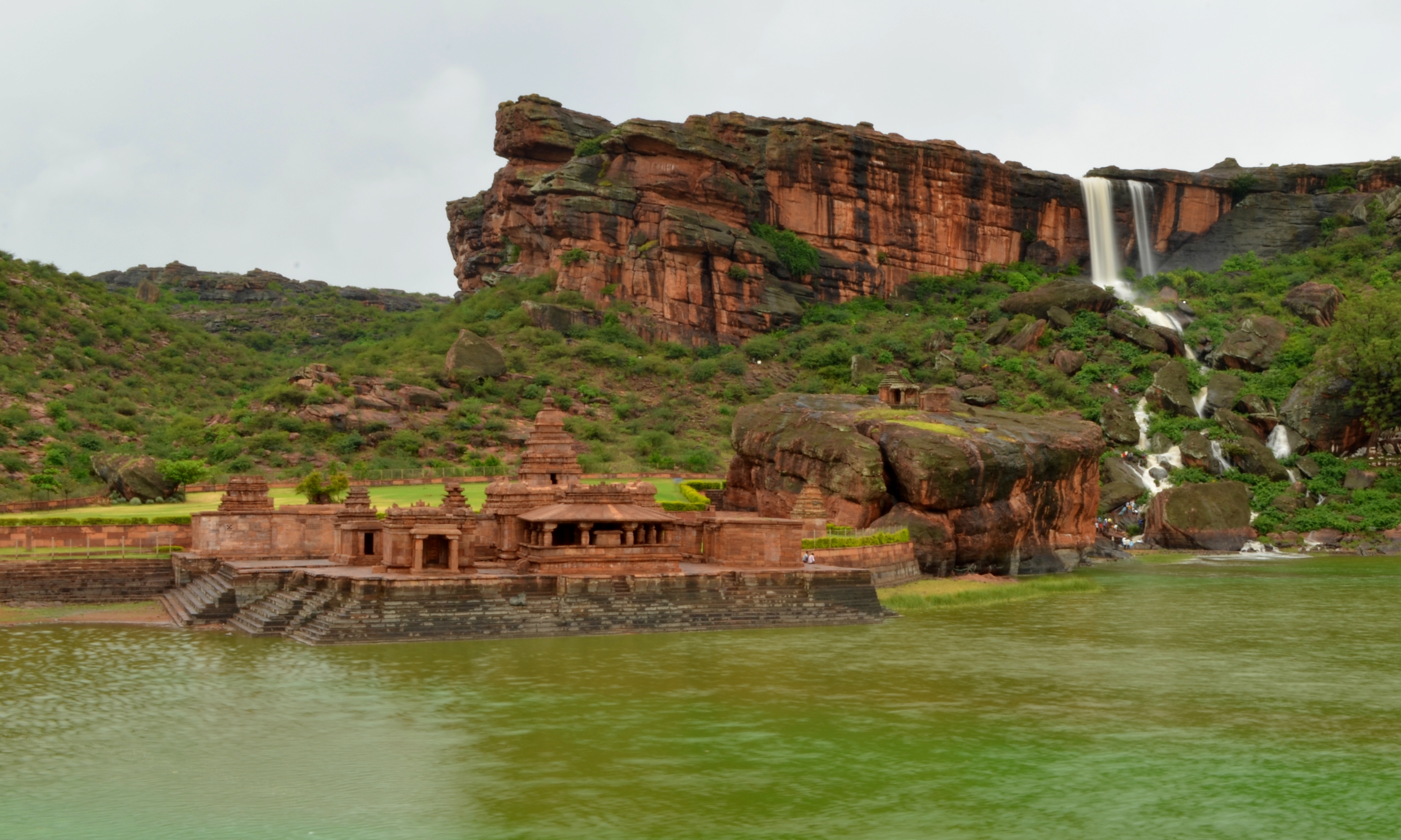
1= The gods always play where lakes are, where the sun's rays are warded off by umbrellas of lotus leaf clusters, and where clear waterpaths are made by swans whose breasts toss the white lotus hither and thither, where swans, ducks, curleys and paddy birds are heard, and animals rest nearby in the shade of Nicula trees on the river banks.
The gods always play where rivers have for their braclets the sound of curleys and the voice of swans for their speech, water as their garment, carps for their zone, the flowering trees on their banks as earrings, the confluence of rivers as their hips, raised sand banks as breasts and plumage of swans their mantle.
The gods always play where groves are near, rivers, mountains and springs, and in towns with pleasure gardens.
While major Hindu temples are recommended at sangams (confluence of rivers), river banks, lakes and seashore, Brhat Samhita and Puranas suggest temples may also be built where a natural source of water is not present. Here too, they recommend that a pond be built preferably in front or to the left of the temple with water gardens. If water is neither present naturally nor by design, water is symbolically present at the consecration of the temple or the deity. Temples may also be built, suggests Visnudharmottara in Part III of Chapter 93, inside caves and carved stones, on hill tops affording peaceful views, on mountain slopes overlooking beautiful valleys, inside forests and hermitages, next to gardens, or at the head of a town street.
Manuals
Ancient builders of Hindu temples created manuals of architecture, called Vastu-Sastra (literally "science" of dwelling; vas-tu is a composite Sanskrit word; vas means "reside", tu means "you"); these contain Vastu-Vidya (literally, knowledge of dwelling) and Sastra meaning system or knowledge in Sanskrit. There exist many Vastu-Sastras on the art of building temples, such as one by Thakkura Pheru, describing where and how temples should be built. Sanskrit manuals have been found in India since the 6th century CE. Vastu-Sastra manuals included chapters on home construction, town planning, While it is unclear, states Barnett, as to whether these temple and town planning texts were theoretical studies and if or when they were properly implemented in practice, the manuals suggest that town planning and Hindu temples were conceived as ideals of art and integral part of Hindu social and spiritual life.

The Silpa Prakasa of Odisha, authored by Ramacandra Bhattaraka Kaulacara in the 9th or 10th centuries CE, is another Sanskrit treatise on Temple Architecture. Silpa Prakasa describes the geometric principles in every aspect of the temple and symbolism such as 16 emotions of human beings carved as 16 types of female figures. These styles were perfected in Hindu temples prevalent in the eastern states of India. Other ancient texts found expand these architectural principles, suggesting that different parts of India developed, invented and added their own interpretations. For example, in the Saurastra tradition of temple building found in western states of India, the feminine form, expressions and emotions are depicted in 32 types of Nataka-stri compared to 16 types described in Silpa Prakasa. and Silpa Ratnakara compiled by Narmada Sankara provide a more extensive list of Hindu temple types.
Ancient Sanskrit manuals for temple construction discovered in Rajasthan, in northwestern region of India, include Sutradhara Mandana's Prasadamandana (literally, manual for planning and building a temple). Manasara, a text of South Indian origin, estimated to be in circulation by the 7th century CE, is a guidebook on South Indian temple design and construction. Isanasivagurudeva paddhati is another Sanskrit text from the 9th century describing the art of temple building in India in south and central India. In north India, Brihat-samhita by Varāhamihira is the widely cited ancient Sanskrit manual from 6th century describing the design and construction of Nagara style of Hindu temples.
Plan
A Hindu temple design follows a geometrical design called vastu-purusha-mandala. The name is a composite Sanskrit word with three of the most important components of the plan. Mandala means circle, Purusha is universal essence at the core of Hindu tradition, while Vastu means the dwelling structure. The Vastu-purusha-mandala is a yantra, a design laying out a Hindu temple in a symmetrical, self-repeating structure derived from central beliefs, myths, cardinality and mathematical principles.
The four cardinal directions help create the axis of a Hindu temple, around which is formed a perfect square in the space available. The circle of the mandala circumscribes the square. The square is considered divine for its perfection and as a symbolic product of knowledge and human thought, while the circle is considered earthly, human and observed in everyday life (moon, sun, horizon, water drop, rainbow). Each supports the other. Each pada is conceptually assigned to a symbolic element, sometimes in the form of a deity. The central square(s) of the 64- or 81-grid is dedicated to Brahman (not to be confused with Brahmin, the scholarly and priestly class in India), and are called Brahma padas.
The 49-grid design is called Sthandila and is of great importance in creative expressions of Hindu temples in South India, particularly in Prakaras. The symmetric Vastu-purusa-mandala grids are sometimes combined to form a temple superstructure with two or more attached squares. The temples face sunrise, and the entrance for the devotee is typically this east side. The mandala pada facing sunrise is dedicated to Surya, the sun-god. The Surya pada is flanked by the padas of Satya, the deity of Truth, on one side and Indra, the king of the demigods, on other. The east and north faces of most temples feature a mix of gods and demigods; while the west and south feature demons and demigods related to the underworld. This vastu-purusha-mandala plan and symbolism is systematically seen in ancient Hindu temples on the Indian subcontinent as well as those in southeast Asia, with regional creativity and variations.
Beneath the mandala's central square(s) is the space for the all-pervasive, all-connecting Universal Spirit, the highest reality, the purusha. This space is sometimes known as the garbha-griya (literally, "womb house")—a small, perfect square, windowless, enclosed space without ornamentation that represents universal essence. or vision).
Above the vastu-purusha-mandala is a superstructure with a dome called Shikhara in north India, and Vimana in south India, that stretches towards the sky. Sometimes, in makeshift temples, the dome may be replaced with symbolic bamboo with few leaves at the top. The vertical dimension's cupola or dome is designed as a pyramid, a cone or other mountain-like shape, once again using the principle of concentric circles and squares. Scholars suggest that this shape is inspired by the cosmic mountain of Meru or Himalayan Kailasa, the abode of the gods, according to Vedic mythology.
In larger temples, the central space typically is surrounded by an ambulatory for the devotee to walk around and ritually circumambulate the Purusa, the universal essence. Often this space is visually decorated with carvings, paintings or images meant to inspire the devotee. In some temples, these images may be stories from Hindu Epics; in others, they may be Vedic tales about right and wrong or virtues and vice; in yet others, they may be murtis of locally worshipped deities. The pillars, walls and ceilings typically also have highly ornate carvings or images of the four just and necessary pursuits of life—kama, artha, dharma and moksa. This walk around is called pradakshina.
Large temples also have pillared halls, called mandapa—one of which, on the east side, serves as the waiting room for pilgrims and devotees. The mandapa may be a separate structure in older temples, but in newer temples this space is integrated into the temple superstructure. Mega-temple sites have a main temple surrounded by smaller temples and shrines, but these are still arranged by principles of symmetry, grids and mathematical precision. An important principle found in the layout of Hindu temples is mirroring and repeating fractal-like design structure, each unique yet also repeating the central common principle, one which Susan Lewandowski refers to as "an organism of repeating cells".
The ancient texts on Hindu temple design, the Vāstu-puruṣa-mandala and Vastu Śāstras, do not limit themselves to the design of a Hindu temple. They describe the temple as a holistic part of its community, and lay out various principles and a diversity of alternate designs for home, village and city layout along with the temple, gardens, water bodies and nature.
;Exceptions to the square grid principle A predominant number of Hindu temples exhibit the perfect-square grid principle. However, there are some exceptions. For example, the Telika Mandir in Gwalior, built in the 8th century CE, is not a square but a rectangle in 2:3 proportion. Further, the temple explores a number of structures and shrines in 1:1, 1:2, 1:3, 2:5, 3:5 and 4:5 ratios. These ratios are exact, suggesting that the architect intended to use these harmonic ratios, and the rectangle pattern was not a mistake, nor an arbitrary approximation. Other examples of non-square harmonic ratios are found at the Naresar temple site of Madhya Pradesh and at the Nakti-Mata temple near Jaipur, Rajasthan. Michael Meister suggests that these exceptions mean that the ancient Sanskrit manuals for temple building were guidelines, and Hinduism permitted its artisans flexibility in expression and aesthetic independence.
Symbolism

A Hindu temple is a symbolic reconstruction of the universe and the universal principles that enable everything in it to function. The temples reflect Hindu philosophy and its diverse views on the cosmos and on truth.
Hinduism has no traditional ecclesiastical order, no centralized religious authorities, no governing body, no prophet nor any binding holy book save the Vedas; Hindus can choose to be polytheistic, pantheistic, monistic, or atheistic.See:
- Julius J. Lipner, Hindus: Their Religious Beliefs and Practices, 2nd Edition, Routledge, , page 8; Quote: "(...) one need not be religious in the minimal sense described to be accepted as a Hindu by Hindus, or describe oneself perfectly validly as Hindu. One may be polytheistic or monotheistic, monistic or pantheistic, even an agnostic, humanist or atheist, and still be considered a Hindu.";
- Lester Kurtz (Ed.), Encyclopedia of Violence, Peace and Conflict, , Academic Press, 2008;
- MK Gandhi, The Essence of Hinduism, Editor: VB Kher, Navajivan Publishing, see p. 3; According to Gandhi, "a man may not believe in God and still call himself a Hindu." Within this diffuse and open structure, spirituality in Hindu philosophy is an individual experience, and referred to as kṣaitrajña ()Monier-Williams Sanskrit-English Dictionary, क्षैत्रज्ञ Jim Funderburk and Peter Scharf (2012); Quote:
- क्षैत्रज्ञ [ kṣaitrajña ] n. ( fr. [ kṣetra-jñá ] g. [ yuvādi ], spirituality, nature of the soul Lit. W.; the knowledge of the soul Lit. W.). It defines spiritual practice as one's journey towards moksha, awareness of self, the discovery of higher truths, true nature of reality, and a consciousness that is liberated and content.See the following two in Ewert Cousins's series on World Spirituality:
- Bhavasar and Kiem, "Spirituality and Health", in Hindu Spirituality, Editor: Ewert Cousins (1989), , Crossroads Publishing New York, pp. 319-337;
- John Arapura, "Spirit and Spiritual Knowledge in the Upanishads", in Hindu Spirituality, Editor: Ewert Cousins (1989), , Crossroads Publishing New York, pp. 64-85. A Hindu temple reflects these core beliefs. The central core of almost all Hindu temples is not a large communal space; the temple is designed for the individual, a couple or a family—a small, private space to allow visitors to experience darsana.
Darsana is itself a symbolic word. In ancient Hindu scripts, darsana is the name of six methods or alternate viewpoints of understanding truth. These are Nyaya, Vaisesika, Sankhya, Yoga, Mimamsa and Vedanta—which flowered into individual schools of Hinduism, each of which is considered a valid, alternate path to understanding truth and achieving self-realization in the Hindu way of life.
From names to forms, from images to stories carved into the walls of a temple, symbolism is everywhere in a Hindu temple. Life principles such as the pursuit of joy, connection and emotional pleasure (kama) are fused into mystical, erotic and architectural forms in Hindu temples. These motifs and principles of human life are part of the sacred texts of the Hindus, such as its Upanishads; the temples express these same principles in a different form, through art and spaces. For example, Brihadaranyaka Upanisad (4.3.21) recites: 1= In the embrace of the beloved, one forgets the whole world, everything both within and without; in the same way, one who embraces the Self knows neither within nor without.
The architecture of Hindu temples is also symbolic. The whole structure fuses the daily life and its surroundings with the divine concepts, through a structure that is open yet raised on a terrace, transitioning from the secular towards the sacred, a boundary and gateway separates the secular and the sacred, and this gateway door is grand. In Hindu tradition, this is discarded in favor of an open and diffusive architecture, where the secular world was not separated from the sacred, but transitioned and flowed into the sacred. The Hindu temple has structural walls, which were patterned usually within the 64-grid, or other geometric layouts. Yet the layout was open on all sides, except for the core space with a single opening for darsana. The temple space is laid out in a series of courts (mandapas). The outermost regions may incorporate the negative and suffering side of life with the symbolism of evil, asuras and rakshashas; but in small temples this layer is dispensed with. When present, this outer region diffuse into the next inner layer that bridges as human space, followed by another inner Devika padas space and symbolic arts incorporating the positive and joyful side of life about the good and the gods. This divine space then concentrically diffuses inwards and lifts the guest to the core of the temple, where resides the main murti, as well as the space for the Purusa, and ideas held to be most sacred principles in Hindu tradition. The symbolism in the arts and temples of Hinduism, suggests Edmund Leach, is similar to those in Christianity and other major religions of the world.
Building teams
Indian texts call the craftsmen and builders of temples "Silpin" (), derived from "Silpa". One of the earliest mentions of the Sanskrit word "Silpa" is in Atharvaveda, from about 1000 BCE; according to scholars, the word was used to denote any work of art. Some scholars suggest that the word "Silpa" has no direct or one-word translation in English, nor does the word "Silpin". "Silpa", explains Stella Kramrisch, is a multicolored word and incorporates art, skill, craft, ingenuity, imagination, form, expression and inventiveness of any art or craft. Similarly, "Shilpin", notes Kramrisch, is a complex Sanskrit word, describing any person who embodies art, science, culture, skill, and rhythm and employs creative principles to produce any divine form of expression. Silpins who built Hindu temples, as well as the artworks and sculptures within them, were considered by the ancient Sanskrit texts to deploy arts whose number are unlimited, Kala (techniques) that were 64 in number, and Vidya (science) that were of 32 types.
The Hindu manuals of temple construction describe the education, characteristics of good artists and architects. The general education of a Hindu Shilpin in ancient India included Lekha or Lipi (alphabet, reading and writing), Rupa (drawing and geometry), Ganana (arithmetic). These were imparted from age 5 to 12. The advanced students would continue in higher stages of Shilpa Sastra studies till the age of 25. Apart from specialist technical competence, the manuals suggest that best Silpins for building a Hindu temple are those who know the essence of Vedas and Agamas, consider themselves as students, keep well verse with principles of traditional sciences and mathematics, painting and geography. Further they are kind, free from jealousy, righteous, have their sense under control, of happy disposition, and ardent in everything they do.
According to Silparatna, a Hindu temple project would start with a Yajamana (patron), and include a Sthapaka (guru, spiritual guide and architect-priest), a Sthapati (architect) who would design the building, a Sutragrahin (surveyor), and many Vardhakins (workers, masons, painters, plasterers, overseers) and Taksakas (sculptors). While the temple is under construction, all those working on the temple were revered and considered sacerdotal by the patron as well as others witnessing the construction.
Styles
Hindu temples are found in diverse locations each incorporating different methods of construction and styles:
- Mountain temples such as Masrur
- Cave temples such as Chandrabhaga, Chalukya and Ellora
- Stepwell temple compounds such as the Mata Bhavani, Ankol Mata and Huccimallugudi
- Forest
- River bank and sea shore temples such as Somnath |File:Masrur rockcut temple.jpg |Mountain temple |File:Undavalli Caves.jpg |Cave temple |File:Rani ki vav 07.jpg |Stepwell style |File:Hindu temple in Ubud.jpg |Forest temple |File:Somnath-current.jpg |Seashore temple
;Step well temples In arid western parts of India, such as Rajasthan and Gujarat, Hindu communities built large walk-in wells that served as the only source of water in dry months but also served as social meeting places and carried religious significance. These monuments went down into the earth towards subterranean water, up to seven storeys, and were part of a temple complex. These vav (literally, stepwells) had intricate art reliefs on the walls, with numerous murtis and images of Hindu deities, water spirits and erotic symbolism. The step wells were named after Hindu deities; for example, Mata Bhavani's Stepwell, Ankol Mata Vav, Sikotari Vav and others.
; Cave temples The Indian rock-cut architecture evolved in Maharashtran temple style in the 1st millennium CE. The temples are carved from a single piece of rock as a complete temple or carved in a cave to look like the interior of a temple. Ellora Temple is an example of the former, while The Elephanta Caves are representative of the latter style. The Elephanta Caves consist of two groups of caves—the first is a large group of five Hindu caves and the second is a smaller group of two Buddhist caves. The Hindu caves contain rock-cut stone sculptures, representing the Shaiva Hindu sect, dedicated to the god Shiva.
Arts inside Hindu temples

A typical, ancient Hindu temple has a profusion of arts—from paintings to sculpture, from symbolic icons to engravings, from thoughtful layout of space to fusion of mathematical principles with Hindu sense of time and cardinality.
Ancient Sanskrit texts classify murtis and images in a number of ways. For example, one method of classification is the dimensionality of completion:
- Chitra: images that are three-dimensional and completely formed
- Chitrardha: images that are engraved in half relief
- Chitrabhasa: images that are two-dimensional, such as paintings on walls and cloth
Another way of classification is by the expressive state of the image:
- Raudra or Dugra: are images that were meant to terrify, induce fear. These typically have wide, circular eyes, carry weapons, have skulls and bones as adornment. These murtis were worshiped by soldiers before going to war, or by people in times of distress or terrors. Raudra deity temples were not set up inside villages or towns, but invariably outside and in remote areas of a kingdom.
- Shanta and saumya: are images that were pacific, peaceful and expressive of love, compassion, kindness and other virtues in Hindu pantheon. These images would carry symbolic icons of peace, knowledge, music, wealth, flowers, sensuality among other things. In ancient India, these temples were predominant inside villages and towns.
A Hindu temple may or may not include a murti or images, but larger temples usually do. Personal Hindu temples at home or a hermitage may have a pada for yoga or meditation, but be devoid of anthropomorphic representations of god. Nature or others arts may surround him or her. To a Hindu yogin, states Gopinath Rao, one who has realised the Self and the Universal Principle within himself, there is no need for any temple or divine image for worship. However, for those who have yet to reach this height of realization, various symbolic manifestations through images, murtis and icons as well as mental modes of worship are offered as one of the spiritual paths in the Hindu way of life. Some ancient Hindu scriptures like the Jabaladarshana Upanishad appear to endorse this idea
1= शिवमात्मनि पश्यन्ति प्रतिमासु न योगिनः । अज्ञानं भावनार्थाय प्रतिमाः परिकल्पिताः ॥५९॥
- जाबालदर्शनोपनिषत् A yogin perceives god (Siva) within himself; images are for those who have not reached this knowledge.
However, devotees aspiring to a personal relationship with the Supreme Lord, whom they worship variously as Krishna or Shiva, for example, tend to reverse such hierarchical views of self-realization, holding that the personal form of the deity, as the source of the Brahma-jyoti, or the light into which impersonalists, according to their ideals, propose to merge themselves and their individual identities, will benevolently accept worship through an arca vigraha, an authorized form constructed not according to imagination but in pursuit of scriptural directives.
Historical development and destruction
Main article: Hindu temple architecture
A number of ancient Indian texts suggest the prevalence of murtis, temples and shrines in Indian subcontinent for thousands of years. For example, the temples of the Koshala kingdom are mentioned in the Valmiki Ramayana (various recent scholars' estimates for the earliest stage of the text range from the 7th to 4th centuries BCE, with later stages extending up to the 3rd century CE) The 5th century BCE text, Astadhyayi, mentions male deity arcas or murtis of Agni, Indra, Varuna, Rudra, Mrda, Pusa, Surya, and Soma being worshipped, as well as the worship of arcas of female goddesses such as Indrani, Varunani, Usa, Bhavani, Prthivi and Vrsakapayi. The 2nd century BCE "Mahabhasya" of Patanjali extensively describes temples of Dhanapati (deity of wealth and finance, Kubera), as well as temples of Rama and Kesava, wherein the worship included dance, music and extensive rituals. The Mahabhasya also describes the rituals for Krsna, Visnu and Siva. An image recovered from Mathura in north India has been dated to the 2nd century BCE.
Early Jain and Buddhist literature, along with Kautilya's Arthashastra, describe structures, embellishments and designs of these temples—all with motifs and deities currently prevalent in Hinduism. Bas-reliefs and murtis have been found from 2nd to 3rd century, but none of the temple structures have survived. Scholars theorize that those ancient temples of India, later referred to as Hindu temples, were modeled after domestic structure—a house or a palace. Beyond shrines, nature was revered, in forms such as trees, rivers, and stupas, before the time of Buddha and Vardhamana Mahavira. As Jainism and Buddhism branched off from the religious tradition later to be called Hinduism, the ideas, designs and plans of ancient Vedic and Upanishad era shrines were adopted and evolved, likely from the competitive development of temples and arts in Jainism and Buddhism. Ancient reliefs found so far, states Michael Meister, suggest five basic shrine designs and combinations thereof in 1st millennium BCE:
- A raised platform with or without a symbol
- A raised platform under an umbrella
- A raised platform under a tree
- A raised platform enclosed with a railing
- A raised platform inside a pillared pavilion
Many of these ancient shrines were roofless, some had toranas and roof.
From the 1st century BCE through 3rd century CE, the evidence and details about ancient temples increases. The ancient literature refers to these temples as Pasada (or Prasada), stana, mahasthana, devalaya, devagrha, devakula, devakulika, ayatana and harmya. The entrance of the temple is referred to as dvarakosthaka in these ancient texts notes Meister, the temple hall is described as sabha or ayagasabha, pillars were called kumbhaka, while vedika referred to the structures at the boundary of a temple.
File:Lad NKAD90.JPG|The 5th-century Ladkhan Shiva Temple, in the Aihole Hindu-Jain-Buddhist temple site, in Karnataka File:5th century Hindu temples Eran Madhya Pradesh, plan sketched in 1880.jpg|Plan of 5th-century temples in Eran, Madhya Pradesh File:View of the Remains of the Dashavatara Temple in Deogarh.jpg|The early 6th-century Dashavatara Temple in the Deogarh complex has a simple, one-cell plan. File:1880 sketch of early 6th century Deogarh Dashavatara Hindu temple plan.jpg|1880 sketch of the 9-square floorplan of the same temple (not to scale or complete). For better drawings: File:Plan of 6th century Badami Cave 3 Hindu temple, annotated.jpg|Layout of Cave 3 temple of the 6th-century Chalukyan-style Badami cave temples File:Elephanta Map.svg|Plan of the 6th-century main-cave temple at Elephanta File:6th century Cave 1 temple Elephanta island Mandala Mumbai harbor.svg|The Elephanta main cave is thought to follow this mandala design. File:Durga Temple Ceiling, Aihole, Karnataka.jpg|A 7th century Chalukyan-style temple ceiling, also in Aihole File:Rani ki vav1.jpg|Rani ki Vav is an 11th-century stepwell, built by the Chaulukya dynasty, located in Patan.
With the start of Gupta dynasty in the 4th century, Hindu temples flourished in innovation, design, scope, form, use of stone and new materials as well as symbolic synthesis of culture and dharmic principles with artistic expression. It is this period that is credited with the ideas of garbhagrha for Purusa, mandapa for sheltering the devotees and rituals in progress, as well as symbolic motifs relating to dharma, karma, kama, artha and moksha. Temple superstructures were built from stone, brick and wide range of materials. Entrance ways, walls and pillars were intricately carved, while parts of temple were decorated with gold, silver and jewels. Visnu, Siva and other deities were placed in Hindu temples, while Buddhists and Jains built their own temples, often side by side with Hindus.
The 4th through 6th century marked the flowering of Vidharbha style, whose accomplishments survive in central India as Ajanta Caves, Pavnar, Mandhal and Mahesvar. In the Malaprabha river basin, South India, this period is credited with some of the earliest stone temples of the region: the Badami Chalukya temples are dated to the 5th century by some scholars, and the 6th by some others.
Over 6th and 7th centuries, temple designs were further refined during Maurya dynasty, evidence of which survives today at Ellora and in the Elephanta cave temples.
It is the 5th through 7th century CE when outer design and appearances of Hindu temples in north India and south India began to widely diverge. Nevertheless, the forms, theme, symbolism and central ideas in the grid design remained same, before and after, pan-India as innovations were adopted to give distinctly different visual expressions.
The Western Chalukya architecture of the 11th- and 12th-century Tungabhadra region of modern central Karnataka includes many temples. Step-wells are consist of a shaft dug to the water table, with steps descending to the water; while they were built for secular purposes, some are also decorated as temples, or serve as a temple tank.
During the 5th to 11th century, Hindu temples flourished outside Indian subcontinent, such as in Cambodia, Vietnam, Malaysia and Indonesia. In Cambodia, Khmer architecture favoured the Temple mountain style famously used in Angkor Wat, with a prang spire over the sanctum cell. Indonesian candi developed regional forms. In what is modern south and central Vietnam, Champa architecture built brick temples.
Destruction, conversion, and rebuilding Many Hindu temples have been destroyed, some, after rebuilding, several times. Deliberate temple destruction usually had religious motives. Richard Eaton has listed 80 campaigns of Hindu temple site destruction stretching over centuries, particularly from the 12th through the 18th century. Others temples have served as non-Hindu places of worship, either after conversion or simultaneously with Hindu use.
In the 12th–16th century, during Muslim conquests in the Indian subcontinent and South Asia, Hindu temples, along with the temples of Buddhists and Jains, intermittently became targets of armies from Persian, Central Asian, and Indian sultanates. Imagined by these foreign zealots to be mere idols, sacred Forms of various deities were broken, spires and pillars were torn down, and temples were looted of their treasury. Some temples were converted into mosques, or parts used to build mosques.See:
- Elizabeth Merklinger, The Mosques of Raichur: A preliminary classification, Kunst des Orients, Vol. 12, H. 1/2 (1978/1979), pp. 79-94.
- Mark Jarzombek et al. (2010), A Global History of Architecture, Wiley, , Chapters and Sections: "1200 CE – Delhi through Qutb Minar"
- Ali Javid, World Heritage Monuments and Related Edifices in India, Volume 1, , pp. 263. Quote - "The stones to construct the mosque were obtained by demolishing twenty seven Hindu and Jain temples." There exist both Indian and Muslim traditions of religious toleration. Muslim rulers led campaigns of temple destruction and forbade repairs to damaged temples, following the Muslim traditions. The Delhi Sultanate destroyed a large number of temples; Sikandar the Iconoclast, Sultan of Kashmir, was also known for his intolerance.See:
- Peter Jackson (2003), The Delhi Sultanate: A Political and Military History, Cambridge University Press, , pp. 168
- A.L. Srivastava (1966), Delhi Sultanate, 5th Edition, Agra College
- Vincent Smith (1920), The Oxford History of India: From the Earliest Times to the End of 1911, Oxford University Press, pp. 268-269, 306-307, 437-438
The 16th- and 19th-century Goa Inquisition destroyed hundreds of Hindu temples. All Hindu temples in Portuguese colonies in India were destroyed, according to a 1569 letter in the Portuguese royal archives. Religious conflict and desecrations of places of worship continued during the British colonial era. Historian Sita Ram Goel's book "What happened to Hindu Temples" lists over 2000 sites where temples have been destroyed and mosques have been built over them. Some historians suggest that around 30,000 temples were destroyed by Islamic rulers between 1200 and 1800 CE. Destruction of Hindu temple sites was comparatively less in the southern parts of India, such as in Tamil Nadu. Cave-style Hindu temples that were carved inside a rock, hidden and rediscovered centuries later, such as the Kailasa Temple, have also preferentially survived. Many are now UNESCO world heritage sites.
In India, the Place of Worship (Special Provisions) Act was enacted in 1991 which prohibited the conversion of any religious site from the religion to which it was dedicated on 15 August 1947.
Somnath temple ruins (1869).jpg|The Somnath temple in Gujarat was repeatedly destroyed and rebuilt. Here it is shown in 1869, after having been ruined by order of Aurangzeb in 1665. These ruins were demolished and the temple rebuilt in the 1950s. Benares- The Golden Temple, India, ca. 1915 (IMP-CSCNWW33-OS14-66).jpg|The Kashi Vishwanath Temple was destroyed by the army of Qutb ud-Din Aibak in 1194 CE. Since then, it has been demolished twice (in the 1400s, and 1669 CE) and rebuilt four times (in the 1200s and twice in the 1500s). The current structure was built by Ahilyabai Holkar on an adjacent site after the demolition by Aurangzeb. Shown is the current temple, with a gold temple roof, donated by Ranjit Singh in 1835. File:Plan Of The Ancient Temple Of Vishveshvur by James Prinsep 1832.jpg|An 1832 reconstruction of the 1500s temple Akbar funded. James Prinsep based the reconstruction on the foundations of the Gyanvapi Mosque. Many Hindu temples were rebuilt as mosques between 12th and 18th century CE. Sun temple martand indogreek.jpg|Ruins of the Martand Sun Temple after being destroyed on the orders of the Sultan of Kashmir, Sikandar the Iconoclast, in the early 15th century, with demolition lasting a year. Temple de Mînâkshî01.jpg|In the 14th century, the armies of Delhi Sultanate, led by Malik Kafur, plundered the Meenakshi Temple and looted it of its valuables; it was rebuilt and expanded in the 16th century. Warangal_fort.jpg|Kakatiya Kala Thoranam (the Warangal Gate) built in the 12th century by the Kakatiya dynasty; the Warangal Fort temple complex was destroyed in the 1300s by the Delhi Sultanate. Elevation of Kirtistambh Rudramahalaya Sidhpur Gujarat India.jpg|Artistic rendition of the Kirtistambh, a surviving portion of the 10–11th century Rudra Mahalaya Temple. The temple was partly destroyed by the Sultan of Delhi, Alauddin Khalji, in 1296 CE, with part converted into a mosque and further parts destroyed by Ahmed Shah I in the 15th century. Exteriors Carvings of Shantaleshwara Shrine 02.jpg|Exterior wall reliefs at Hoysaleswara Temple. The temple was twice sacked and plundered by the Delhi Sultanate in the early 14th century, and abandoned in the mid 14th century. File:Mahadev Temple at Tambdi Surla.jpg|The 12th-century Mahadev Temple is the only Kadamba-period temple building to survive the Goa Inquisition.
Customs and etiquette

In Hinduism, temples are considered sacred spaces where the divine is believed to manifest, and devotees visit these places to experience the presence and blessings of the deity. The customs and etiquette for visiting temples varies across India. Devotees in major temples may bring in symbolic offerings for the puja. This includes fruits, flowers, sweets and other symbols of the bounty of the natural world. Temples in India are usually surrounded with small shops selling these offerings.
When inside the temple, devotees keep both hands folded (namaste mudra). The inner sanctuary, where the murtis reside, is known as the garbhagriha. It symbolizes the birthplace of the universe, the meeting place of the gods and humankind, and the threshold between the transcendental and the phenomenal worlds. It is in this inner shrine that devotees seek darśana (seeing and being seen by the auspicious sight of the divine) and offer prayers. Devotees may or may not be able to personally present their offerings at the feet of the deity. In most large Indian temples, only the pujaris (priest) are allowed to enter the main sanctum.
Temple management staff typically announce the hours of operation, including timings for special pujas. These timings and nature of special puja vary from temple to temple. Additionally, there may be specially allotted times for devotees to perform pradakshina (circumambulations) around the temple.
Visitors and worshipers to large Hindu temples may be required to deposit their shoes and other footwear before entering. Where this is expected, the temples provide an area and help staff to store footwear. Dress codes vary. It is customary in temples in Kerala, for men to remove shirts and to cover pants and shorts with a traditional cloth known as a Mundu. In Java and Bali (Indonesia), before one enters the most sacred parts of a Hindu temple, shirts are required as well as a sarong around one's waist. At many other locations, this formality is unnecessary.
Regional variations in Hindu temples
Nagara Architecture of North Indian temples
North Indian temples are referred to as Nagara style of temple architecture. They have sanctum sanctorum where the deity is present, open on one side from where the devotee obtains darśana. There may or may not be many more surrounding corridors, halls, etc. However, there will be space for devotees to go around the temple in clockwise fashion circumambulation. In North Indian temples, the tallest towers are built over the sanctum sanctorum in which the deity is installed.
The north India Nagara style of temple designs often deploy fractal-theme, where smaller parts of the temple are themselves images or geometric re-arrangement of the large temple, a concept that later inspired French and Russian architecture such as the matryoshka principle. One difference is the scope and cardinality, where Hindu temple structures deploy this principle in every dimension with garbhgriya as the primary locus, and each pada as well as zones serving as additional centers of loci. This makes a Nagara Hindu temple architecture symbolically a perennial expression of movement and time, of centrifugal growth fused with the idea of unity in everything.
Temples in West Bengal
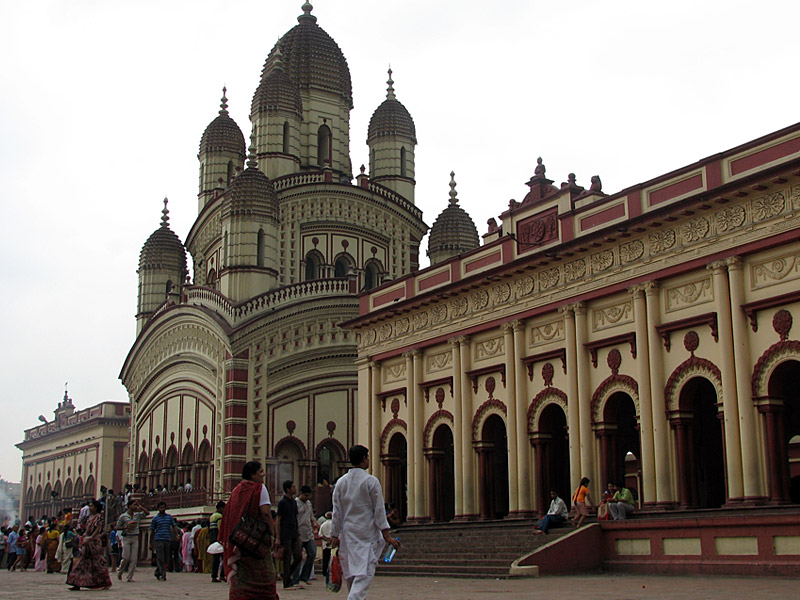
In West Bengal, the Bengali terra cotta temple architecture is found. Due to lack of suitable stone in the alluvial soil locally available, the temple makers had to resort to other materials instead of stone. This gave rise to using terracotta as a medium for temple construction. Terracotta exteriors with rich carvings are a unique feature of Bengali temples. The town of Bishnupur in West Bengal is renowned for this type of architecture. There is also a popular style of building known as Naba-ratna (nine-towered) or Pancha-ratna (five-towered). An example of Navaratna style is the Dakshineswar Kali Temple.
Temples in Odisha
Odisha temple architecture is known as Kalinga architecture, classifies the spire into three parts, the Bāḍa (lower limb), the Ganḍi (body) and the Cuḷa/Mastaka (head). Each part is decorated in a different manner. Kalinga architecture is a style which flourished in Kalinga, the name for kingdom that included ancient Odisha. It includes three styles: Rekha Deula, Pidha Deula and Khakhara Deula. The former two are associated with Vishnu, Surya and Shiva temples while the third is mainly associated with Chamunda and Durga temples. The Rekha Deula and Khakhara Deula houses the sanctum sanctorum while the Pidha Deula style includes space for outer dancing and offering halls. |File:Bird view of Jagannath Temple, Puri.jpg |Bird's Eye view of one of the four Char Dhams, The Jagannath Temple at Puri, Odisha built using the Kalinga Architecture |File:Jagannath Temple, Emami Paper Mill Complex, Balasore.jpg |Jagannath Temple in the Balasore District |File:The sun temple at konark.jpg |Konark Sun Temple near Puri |File:Raja Rani Temple - A different angle.jpg | Rajarani Temple in Bhubaneswar
Temples of Goa and Konkani

The temple architecture of Goa is quite unique. As Portuguese colonial hegemony increased, Goan Hindu temples became the rallying point to local resistance. Many these temples are not more than 500 years old, and are a unique blend of original Goan temple architecture, Dravidian, Nagar and Hemadpanthi temple styles with some British and Portuguese architectural influences. Goan temples were built using sedimentary rocks, wood, limestone and clay tiles, and copper sheets were used for the roofs. These temples were decorated with mural art called as Kavi kala or ocher art. The interiors have murals and wood carvings depicting scenes from the Hindu mythology.
South Indian and Sri Lankan temples
|File:Le temple de Srirangam (Tiruchirapalli, Inde) (13903661293).jpg |A row of gopurams (towers) in the Srirangam Ranganathaswmy temple, a typical South Indian Vaishnavate temple complex in Srirangam, Tamil Nadu |File:Spiritual 16.jpg |Koneswaram Temple, a Tamil Saivate temple in Tirukonamalai, Sri Lanka
South Indian temples have a large gopuram, a monumental tower, usually ornate, at the entrance of the temple. This forms a prominent feature of Koils, Hindu temples of the Dravidian style.{{cite book| first=Francis D.K.| last= Ching| year= 2007| title= A Global History of Architecture
Temples in Kerala

Temples in Kerala have a different architectural style (keeping the same essence of Vastu), especially due to climatic differences Kerala have with other parts of India with larger rainfall. The temple roof is mostly tiled and is sloped and the walls are often square, the innermost shrine being entirely enclosed in another four walls to which only the pujari (priest) enters. The walls are decorated with either mural paintings or rock sculptures which many times are emphasised on Dwarapalakas.
Temples in Tamil Nadu

The Srirangam Ranganathaswamy temple is the worlds largest functioning Hindu temple. The temple is present in Tamil Nadu, the temple was first built by the Chola ruler, Dharmavarma. The Kaveri river flood destroyed the temple and vimanam submerged in the island, and later, the early Cholas King Killivalavan rebuilt the temple complex as is present today. Beyond the ancient textual history, archaeological evidence such as inscriptions refer to this temple, and these stone inscriptions are from late 100 BCE to 100 CE. Hence, making it one of the Oldest surviving active temple complexes in South India. Later, the temple constructions reached its peak during the Pallavas era. They built various temples around Kancheepuram, and Narasimhavarman II built the Thirukadalmallai and Shore Temple in Mamallapuram, a UNESCO World Heritage Site. The Pandyas rule created temples such as the Koodal Azhagar temple and Meenakshi Amman Temple at Madurai and Srivilliputhur Andal Temple at Srivilliputhur. The Cholas were prolific temple builders right from the times of the first medieval king Vijayalaya Chola. The Chola temples include Sri Ranganathaswamy Temple at Srirangam, the Brihadeeshwarar temple at Tanjore, Brihadeeshwarar temple at Gangaikonda Cholapuram and the Airavatesvarar Temple of Darasuram which are among the UNESCO World Heritage Sites. The Nayaks of Madurai reconstructed some of the well-known temples in Tamil Nadu such as the Meenakshi Temple. One of the southernmost famous temples in South India, the Ramanathaswamy Temple was built in the 17th century on the island of Rameshwaram in Tamil Nadu.
Temples in Nepal
The Pashupatinath temple in Kathmandu, Nepal is an important temple in Hinduism. It is built in a pagoda style and is surrounded by hundreds of temples and buildings built by kings. The temples top is made from pure gold.

Khmer Temples

Angkor Wat was built as a Hindu temple by King Suryavarman II in the early 12th century in Yasodharapura (Khmer, present-day Angkor), the capital of the Khmer Empire, as his state temple and eventual mausoleum. Breaking from the Shaiva tradition of previous kings, Angkor Wat was instead dedicated to Vishnu. The Spire in Khmer Hindu temple is called Giri (mountain) and symbolizes the residence of gods just like Meru does in Bali Hindu mythology and Ku (Guha) does in Burmese Hindu mythology.
Angkor Wat is just one of numerous Hindu temples in Cambodia, most of them in ruins. Hundreds of Hindu temples are scattered from Siem Reap to Sambor Prei Kuk in central Cambodian region.
Temples in Indonesia
Main article: Candi of Indonesia, List of Hindu temples in Indonesia, Balinese temple

Ancient Hindu temples in Indonesia are called Candi (read: chandi). Prior to the rise of Islam, between the 5th to 15th century Dharmic faiths (Hinduism and Buddhism) were the majority in Indonesian archipelago, especially in Java and Sumatra. As the result numerous Hindu temples, locally known as candi, constructed and dominated the landscape of Java. According to local beliefs, Java valley had thousands of Hindu temples which co-existed with Buddhist temples, most of which were buried in massive eruption of Mount Merapi in 1006 CE.

Between 1,100 and 1,500 additional Hindu temples were built, but abandoned by Hindus and Buddhists as Islam spread in Java circa 15th to 16th century. In last 200 years, some of these have been rediscovered mostly by farmers while preparing their lands for crops. Most of these ancient temples were rediscovered and reconstructed between 19th to 20th century, and treated as the important archaeological findings and also as tourist attraction, but not as the house of worship. Hindu temples of ancient Java bear resemblances with temples of South Indian style. The largest of these is the 9th century Javanese Hindu temple, Prambanan in Yogyakarta, now a UNESCO world heritage site. It was designed as three concentric squares and has 224 temples. The inner square contains 16 temples dedicated to major Hindu deities, of which Shiva temple is the largest. The temple has extensive wall reliefs and carvings illustrating the stories from the Hindu epic Ramayana.[[File:Yogyakarta Indonesia Prambanan-temple-complex-02.jpg|thumb|250x250px|]]
In Bali, the Hindu temple is known as "Pura", which is designed as an open-air worship place in a walled compound. The compound walls have a series of intricately decorated gates without doors for the devotee to enter. The design, plan and layout of the holy pura follows a square layout.
The majority of Hindu temples in Java were dedicated to Shiva, who Javanese Hindus considered as the God who commands the energy to destroy, recombine and recreate the cycle of life. Small temples were often dedicated to Shiva and his family (wife Durga, son Ganesha). Larger temple complexes include temples for Vishnu and Brahma, but the most majestic, sophisticated and central temple was dedicated to Shiva. The 732 CE Canggal inscription found in Southern Central Java, written in Indonesian Sanskrit script, eulogizes Shiva, calling him God par-excellence.
Temples in Vietnam

There are a number of Hindu temple clusters built by the Champa Kingdoms along the coast of Vietnam, with some on UNESCO world heritage site list. Examples include Mỹ Sơn—a cluster of 70 temples with earliest dated to be from the 4th century CE and dedicated to Siva, while others are dedicated to Hindu deities Krishna, Vishnu and others. These temples, internally and with respect to each other, are also built on the Hindu perfect square grid concept. Other sites in Vietnam with Hindu temples include Phan Rang with the Cham temple Po Klong Garai.
Temples in Thailand
_2019_03.jpg)
Thailand has many notable Hindu temples including: the Sri Mariammam temple in Bangkok, the Devasathan, the Erawan Shrine, Prasat Muang Tam, Sdok Kok Thom and Phanom Rung. Most of the newer Hindu temples are of South Indian origin and were built by Tamil migrant communities. However, Thailand has many historic indigenous Hindu temples such as Phanom Rung. Although most indigenous Hindu temples are ruins, a few such as Devasathan in Bangkok are actively used.
Temples outside Asia
Many members of the diaspora from the Indian subcontinent have established Hindu temples outside India as a means of preserving and celebrating cultural and spiritual heritage abroad. Describing the hundreds of temples that can be found throughout the United States, scholar Gail M. Harley observes, "The temples serve as central locations where Hindus can come together to worship during holy festivals and socialize with other Hindus. Temples in America reflect the colorful kaleidoscopic aspects contained in Hinduism while unifying people who are disbursed throughout the American landscape." Numerous temples in North America and Europe have gained particular prominence and acclaim, many of which were built by the Bochasanwasi Akshar Purushottam Swaminarayan Sanstha. New Jersey and New York City have developed an exceptional variety of Hindu temples. The Ganesh temple of Hindu Temple Society of North America, in Flushing, Queens, New York City, is the oldest Hindu temple in the Western Hemisphere, and its canteen feeds 4,000 people a week, with as many as 10,000 during the Diwali (Deepavali) festival. Meanwhile, the Om Sri Sai Balaji Temple in Monroe Township, Middlesex County, New Jersey, hosts the largest indoor Hanuman statue in the Western Hemisphere, embellished by a laser lighting display portraying the Ramayana and Hanuman's heroic accomplishments in this epic Hindu story.
New York/New Jersey
File:Exterior Hindu Temple.JPG|The Ganesh temple of Hindu Temple Society of North America is the oldest Hindu temple in the Western Hemisphere, in Flushing, Queens, New York City. File:BAPS Robbinsville Mandir - Exterior.jpg|Swaminarayan Akshardham in Robbinsville, New Jersey, U.S., is the world's third-largest Hindu temple and the largest and most-visited Hindu temple outside Asia. File:Bridge water Temple, New Jersey.jpeg|Sri Venkateswara Temple in Bridgewater, New Jersey, in a semi-rural setting, serves as the flagship for the Hindu Temple and Cultural Society of USA
Outside New York/New Jersey
File:Sri Siva Vishnu Temple.jpg|Sri Siva Vishnu Temple in Maryland, U.S., welcomes both Vaishnavite and Shaivite worshippers. File:Hindu Temple Victoria Seychelles Islands of Africa.jpg|Hindu temple in Victoria, Seychelles File:Clairwood-Shree-Shiva-Temple.jpg|Clairwood Shri Shiva Temple in Durban, South Africa
Temple management
The Archaeological Survey of India has control of most ancient temples of archaeological importance in India. In India, day-to-day activities of a temple is managed by a temple board committee that administers its finances, management, and events. Since independence, the autonomy of individual Hindu religious denominations to manage their own affairs with respect to temples of their own denomination has been severely eroded and the state governments have taken control of major Hindu temples in some countries; however, in others, such as the United States, private temple management autonomy has been preserved.
Etymology and nomenclature
In Sanskrit, the liturgical language of Hinduism, the word mandira means "house" (). Ancient Sanskrit texts use many words for temple, such as matha, vayuna, kirti, kesapaksha, devavasatha, vihara, suravasa, surakula, devatayatana, amaragara, devakula, devagrha, devabhavana, devakulika, and niketana. Regionally, they are also known as prasada, vimana, kshetra, gudi, ambalam, punyakshetram, deval, deula, devasthanam, kovil, candi, pura, and wat.
The following are the other names by which a Hindu temple is referred to in India:
- Devasthana (ದೇವಸ್ಥಾನ) in Kannada
- Deul/Doul/Dewaaloy in Assamese and in Bengali
- Deval/Raul/Mandir (मंदिर) in Marathi
- Devro/Mindar in Rajasthani
- Devala, Devalaya, Math, Devaghar or Mandira in Bhojpuri. Thakurbari and sivala are specially use of Krishna temple and Shiva temple respectively.
- Deula (ଦେଉଳ) or Mandira(ମନ୍ଦିର) in Odia and Gudi in Kosali Odia
- Gudi (గుడి), Devalayam (దేవాలయం), Devasthanam (దేవస్థానము), Kovela (కోవెల), Kshetralayam (క్షేత్రాలయం), Punyakshetram (పుణ్యక్షేత్రం), or Punyakshetralayam (పుణ్యక్షేత్రాలయం), Mandiramu (మందిరము) in Telugu
- Kovil or kō-vill (கோவில்) and occasionally Aalayam (ஆலயம்) in Tamil; the Tamil word Kovil means "residence of God"
- Kshetram (ക്ഷേത്രം), Ambalam (അമ്പലം), Kovil (കോവിൽ), Devasthanam (ദേവസ്ഥാനം) or Devalayam (ദേവാലയം) in Malayalam
- Mandir (मंदिर) in Hindi, Nepali, Kashmiri, Marathi, Punjabi (ਮੰਦਰ), Gujarati (મંદિર), and Urdu (مندر)
- Mondir (মন্দির) in Bengali
In Southeast Asia temples known as:
- Candi in Indonesia, especially in Javanese, Malay and Indonesian, used both for Hindu or Buddhist temples.
- Pura in Hindu majority island of Bali, Indonesia.
- Wat in Cambodia and Thailand, also applied to both Hindu and Buddhist temples.
; Temple sites Some lands, including Varanasi, Puri, Kanchipuram, Dwarka, Amarnath, Kedarnath, Somnath, Mathura and Rameswara, are considered holy in Hinduism. They are called kṣétra (). A kṣétra has many temples, including one or more major ones. These temples and its location attracts pilgrimage called tirtha (or tirthayatra).
Notes
References
Bibliography
- Deva, Kṛṣṇa (1995). Temples of India. New Delhi: Aryan Books International.
- Goel, S. R., and Arun Shourie (1992). Hindu temples: what happened to them. New Delhi: Voice of India.
- Kramrisch, Stella Hindu Temple,
- Meister, Michael W. Encyclopaedia of Indian Temple Architecture,
- Michell, George The Hindu Temple: An Introduction to Its Meaning and Forms,
- Ram Rāz, Henry Harkness (1834), —on Hindu Temple Vimana, Pillars and Śilpa Śastras.
- Nagar, Shanti Lal (1990). The temples of Himachal Pradesh. New Delhi: Aditya Prakashan.
References
- Stella Kramrisch. (1946). "The Hindu Temple". Motilal Banarsidass.
- George Michell. (1977). "The Hindu Temple: An Introduction to Its Meaning and Forms". University of Chicago Press.
- Stella Kramrisch. (1946). "The Hindu Temple". Motilal Banarsidass.
- [[Subhash Kak]], "The axis and the perimeter of the temple." Kannada Vrinda Seminar Sangama 2005 held at Loyola Marymount University in Los Angeles on 19 November 2005.
- Subhash Kak, "Time, space and structure in ancient India." Conference on Sindhu-Sarasvati Valley Civilization: A Reappraisal, Loyola Marymount University, Los Angeles, 21 & 22 February 2009.
- [[Stella Kramrisch]], ''The Hindu Temple'', Vol 2, Motilal Banarsidass, {{ISBN. 978-81-208-0222-3, pp. 346-357 and 423-424
- [[Klaus Klostermaier]], "The Divine Presence in Space and Time – Murti, Tirtha, Kala"; in ''A Survey of Hinduism'', {{ISBN. 978-0-7914-7082-4, State University of New York Press, pp. 268-277.
- George Michell. (1977). "The Hindu Temple: An Introduction to Its Meaning and Forms". University of Chicago Press.
- M.R. Bhat (1996), ''Brhat Samhita of Varahamihira'', {{ISBN. 978-8120810600, Motilal Banarsidass
- 978-0226532301, pp. 58-65.
- Alice Boner (1990), ''Principles of Composition in Hindu Sculpture: Cave Temple Period'', {{ISBN. 978-8120807051, see Introduction and pp. 36-37.
- Francis Ching et al., ''A Global History of Architecture'', Wiley, {{ISBN. 978-0470402573, pp. 227-302.
- Brad Olsen (2004), ''Sacred Places Around the World: 108 Destinations'', {{ISBN. 978-1888729108, pp. 117-119.
- Paul Younger, ''New Homelands: Hindu Communities'', {{ISBN. 978-0195391640, Oxford University Press
- Frances Kai-Hwa Wang. (28 July 2014). "World's Largest Hindu Temple Being Built in New Jersey". NBC News.
- George Michell (1988), ''The Hindu Temple: An Introduction to Its Meaning and Forms'', University of Chicago Press, {{ISBN. 978-0226532301, Chapter 1
- Subhash Kak, "Time, space and structure in ancient India." Conference on Sindhu-Sarasvati Valley Civilization: A Reappraisal, Loyola Marymount University, Los Angeles, 21 & 22 February 2009. {{ArXiv. 0903.3252
- Kak, S. Early Indian architecture and art. Migration and Diffusion. vol.6, pp. 6-27 (2005)
- Susan Lewandowski, "The Hindu Temple in South India", in ''Buildings and Society: Essays on the Social Development of the Built Environment'', Anthony D. King (Ed.), {{ISBN. 978-0710202345, Routledge, Chapter 4
- Alain Daniélou (2001), ''The Hindu Temple: Deification of Eroticism,'' translated from French to English by Ken Hurry, {{ISBN. 0-89281-854-9, pp. 101-127.
- Samuel Parker (2010), "Ritual as a Mode of Production: Ethnoarchaeology and Creative Practice in Hindu Temple Arts", ''South Asian Studies'', 26(1), pp. 31-57; Michael Rabe, "Secret Yantras and Erotic Display for Hindu Temples", (Editor: David White), {{ISBN. 978-8120817784, ''Princeton University Readings in Religion'' (Motilal Banarsidass Publishers), Chapter 25, pp. 435-446.
- Alain Daniélou. (2001). "The Hindu Temple: Deification of Eroticism". Inner Traditions.
- Susan Lewandowski, The Hindu Temple in South India, in Buildings and Society: Essays on the Social Development of the Built Environment, Anthony D. King (Editor), {{ISBN. 978-0710202345, Routledge, pp. 71-73.
- "Hindu Temple – Vishva Hindu Parishad – Thailand".
- [[Stella Kramrisch]], The Hindu Temple, Vol 1, Motilal Banarsidass, {{ISBN. 978-81-208-0222-3, page 4
- [[Stella Kramrisch]], The Hindu Temple, Vol 1, Motilal Banarsidass, {{ISBN. 978-81-208-0222-3, page 5-6
- BB Dutt (1925), {{Google books. J3jEJFNxdy4C. Town planning in Ancient India, {{ISBN. 978-81-8205-487-5; See critical review by LD Barnett, ''Bulletin of the School of Oriental and African Studies'', Vol. 4, Issue 2, June 1926, pp. 391.
- Stella Kramrisch (1976), The Hindu Temple Volume 1 & 2, {{ISBN. 81-208-0223-3
- Jack Hebner (2010), Architecture of the Vastu Sastra – According to Sacred Science, in Science of the Sacred (Editor: David Osborn), {{ISBN. 978-0557277247, pp. 85-92; N Lahiri (1996), Archaeological landscapes and textual images: a study of the sacred geography of late medieval Ballabgarh, ''World Archaeology'', 28(2), pp. 244-264
- Susan Lewandowski (1984), Buildings and Society: Essays on the Social Development of the Built Environment, edited by Anthony D. King, Routledge, {{ISBN. 978-0710202345, Chapter 4
- 978-1423601326
- G. D. Vasudev (2001), Vastu, Motilal Banarsidas, {{ISBN. 81-208-1605-6, pp. 74-92.
- LD Barnett, Bulletin of the School of Oriental and African Studies, Vol 4, Issue 2, June 1926, pp. 391.
- Alice Boner and Sadāśiva Rath Śarmā (1966), {{Google books. itQUAAAAIAAJ. Silpa Prakasa Medieval Orissan Sanskrit Text on Temple Architecture, E.J. Brill (Netherlands)
- Silpa Prakasa provides a brief introduction to 12 types of Hindu temples. Other texts, such as ''Pancaratra Prasada Prasadhana'' compiled by Daniel SmithH. Daniel Smith (1963), Ed. Pāncarātra prasāda prasādhapam, A Pancaratra Text on Temple-Building, Syracuse: University of Rochester, {{OCLC. 68138877
- Mahanti and Mahanty (1995 Reprint), Śilpa Ratnākara, Orissa Akademi, {{OCLC. 42718271
- (1998). "Design of Settlements in the Vaastu Shastras". Journal of Cultural Geography.
- Ganapati Sastri (1920), Īśānaśivagurudeva paddhati, Trivandrum Sanskrit Series, {{OCLC. 71801033
- Meister, Michael. (1983). "Geometry and Measure in Indian Temple Plans: Rectangular Temples". Artibus Asiae.
- H, Kern (1865), [http://www.wilbourhall.org/pdfs/BrhatSamhitaSanskrit.pdf The Brhat Sanhita of Varaha-mihara], The Asiatic Society of Bengal, Calcutta
- Susan Lewandowski, ''The Hindu Temple in South India, in Buildings and Society: Essays on the Social Development of the Built Environment'', Anthony D. King (ed.), {{ISBN. 978-0710202345, Routledge, pp. 68-69.
- In addition to a square four-sided layout, the ''Brhat Samhita'' also describes Vastu and mandala design principles based on a perfect triangle (3), hexagon (6), octagon (8) and hexadecagon (16) sided layouts, according to Stella Kramrisch.
- (2007). "Fractal geometry as the synthesis of Hindu cosmology in Kandariya Mahadev temple, Khajuraho". Building and Environment.
- Stella Kramrisch (1976), ''The Hindu Temple'', Volume 1, {{ISBN. 81-208-0223-3
- Datta and Beynon (2011), [http://dro.deakin.edu.au/eserv/DU:30045633/beynon-earlyconnections-2011.pdf "Early Connections: Reflections on the canonical lineage of Southeast Asian temples"] {{Webarchive. link. (1 November 2018 , in ''EAAC 2011: South of East Asia: Re-addressing East Asian Architecture and Urbanism: Proceedings of the East Asian Architectural Culture International Conference'', Department of Architecture, National University of Singapore, Singapore, pp. 1-17)
- V.S. Pramar, [https://www.jstor.org/stable/3250257 Some Evidence on the Wooden Origins of the Vāstupuruṣamaṇḍala],''Artibus Asiae'', Vol. 46, No. 4 (1985), pp. 305-311.
- This concept has equivalence to the concept of [[Acintya]], or Sang Hyang Widhi Wasa, in Balinese Hindu temples; elsewhere it has been referred to as [[satcitananda]]
- garbha-griya]] which devotees seek for ''[[Darshana. darsana]]'' (literally, a sight of knowledge,Stella Kramrisch (1976), ''The Hindu Temple'', Vol. 1, {{ISBN. 81-208-0223-3, p. 8.
- Trivedi, K. (1989). "Hindu temples: models of a fractal universe." ''The Visual Computer,'' 5(4), 243-258
- S. Bafna, "On the Idea of the Mandala as a Governing Device in Indian Architectural Tradition," ''Journal of the Society of Architectural Historians'', Vol. 59, No. 1 (Mar., 2000), pp. 26-49
- Meister, Michael W.. (April–June 1979). "Maṇḍala and Practice in Nāgara Architecture in North India". Journal of the American Oriental Society.
- Stella Kramrisch, ''The Hindu Temple'', Vol. 1, Motilal Banarsidass, {{ISBN. 978-81-208-0222-3, pp. 10-11.
- George Michell (1988), ''The Hindu Temple: An Introduction to Its Meaning and Forms'', University of Chicago Press, {{ISBN. 978-0226532301, pp. 21-22.
- Edmund Leach, [https://www.jstor.org/stable/3629670 "The Gatekeepers of Heaven: Anthropological Aspects of Grandiose Architecture"], ''Journal of Anthropological Research'', Vol. 39, No. 3 (Autumn 1983), pp. 243-264.
- Gavin Flood, ''Brill's Encyclopedia of Hinduism'', Editor: Knut Jacobsen (2010), Volume II, Brill, {{ISBN. 978-90-04-17893-9, see Article on ''Wisdom and Knowledge'', pp. 881-884.
- [[Stella Kramrisch]], ''The Hindu Temple'', Vol 1, Motilal Banarsidass, {{ISBN. 978-81-208-0222-3, pp. 8-9.
- Michael Rabe (1996), [http://asiatica.org/ijts/vol2_no2/sexual-imagery-phantasmagorical-castles-khajuraho/#fn35up "Sexual Imagery on the 'Phantasmagorical Castles' at Khajuraho – The Artha of Temple Kama"] {{Webarchive. link. (10 August 2014 , ''International Journal of Tantric Studies'', Vol. 2, No. 2.)
- inviting the visitor inwards and upwards towards the ''Brahma pada,'' the temple's central core, a symbolic space marked by its spire (''shikhara, vimana''). The ancient temples had grand, intricately carved entrances but no doors, and they lacked a boundary wall. In most cultures, suggests [[Edmund Leach]],E Leach, [https://www.jstor.org/stable/3629670 "The Gatekeepers of Heaven: Anthropological Aspects of Grandiose Architecture"], ''Journal of Anthropological Research'', Vol. 39, No. 3 (Autumn, 1983), pp. 249-250.
- Mary Beth Heston, "Iconographic Themes of the Gopura of the Kailāsanātha Temple at Ellora", ''Artibus Asiae'', Vol. 43, No. 3 (1981–1982), pp. 219-235.
- E Leach, [https://www.jstor.org/stable/3629670 "The Gatekeepers of Heaven: Anthropological Aspects of Grandiose Architecture"], ''Journal of Anthropological Research'', Vol. 39, No. 3 (Autumn, 1983), p. 262.
- link. (14 March 2016 University of Cologne, Germany)
- Samuel Parker (1987), "Artistic practice and education in India: A historical overview", ''Journal of Aesthetic Education'', pp. 123-141.
- (1928). "Indian Architectural Terms". Journal of the American Oriental Society.
- Stella Kramrisch (1958), [https://www.jstor.org/stable/538558 Traditions of the Indian Craftsman], The Journal of American Folklore, Vol. 71, No. 281, (Jul. - Sep., 1958), pp. 224-230
- Vatsyayana, Kamasutra I.3, Jayamangala
- Stella Kramrisch, ''The Hindu Temple'', Vol 1, Motilal Banarsidass, {{ISBN. 978-81-208-0222-3, pp. 11.
- (2011). "Silpis in Ancient India: Beyond their Ascribed Locus in Ancient Society". Social Scientist.
- 978-0304707393, Bloomsbury Academic, pp. 121-125.
- (2013). "Boon of astronomy: Rituals and religious festivals in Odisha for a peaceful society". International Journal of Physical and Social Sciences.
- George Michell (1988), The Hindu Temple: An Introduction to Its Meaning and Forms, University of Chicago Press, {{ISBN. 978-0226532301, pages 58-60
- Hartmut Scharfe (2002), ''From Temple schools to Universities'', in Education in Ancient India: Handbook of Oriental Studies, Brill Academic, {{ISBN. 978-9004125568, pages 166-193
- Burton Stein, "The Economic Function of a Medieval South Indian Temple", ''The Journal of Asian Studies'', Vol. 19 (February 1960), pp. 163-76.
- Heitzman, James. (1987). "Temple Urbanism in Medieval South India". Cambridge University Press.
- T Mahalingam (1951), ''Economic life in the Vijayanagar Empire'', University of Madras, pp. 490-498.
- Burton Stein (4 February 1961), The state, the temple and agriculture development, ''The Economic Weekly Annual'', pp. 179-187.
- Hinduja, Udit. (2024-12-04). "Ancient Indian temples were like VCs. Today's economists should study history".
- George Michell. (1977). "The Hindu Temple: An Introduction to Its Meaning and Forms". University of Chicago Press.
- (3 August 2021). "Dalits : Through the Ages". K.K. Publications.
- (2002). "Encyclopaedia of Dalits in India. 1: General study". Kalpaz Publications.
- (30 December 2022). "Dalit Academic Journeys: Stories of Caste, Exclusion and Assertion in Indian Higher Education". Taylor & Francis.
- John Guy and Jorrit Britschgi (2011), Wonder of the Age: Master Painters of India, 1100–1900, The [[Metropolitan Museum of Art]], {{ISBN. 978-1588394309, page 19
- Saraju Rath (2012), Aspects of Manuscript Culture in South India, Brill Academic, {{ISBN. 978-9004219007, pages ix, 158-168, 252-259
- Hartmut Scharfe (2002), ''From Temple schools to Universities'', in Handbook of Oriental Studies, Brill Academic, {{ISBN. 978-9004125568, pages 183-186
- Wayne A. Wiegand and Donald Davis (1994), Encyclopedia of Library History, Routledge, {{ISBN. 978-0824057879, page 350
- Hartmut Scharfe (2002), ''From Temple schools to Universities'', in Education in Ancient India: Handbook of Oriental Studies, Brill Academic, {{ISBN. 978-9004125568, pages 169-171
- Hartmut Scharfe (2002), ''From Temple schools to Universities'', in Education in Ancient India: Handbook of Oriental Studies, Brill Academic, {{ISBN. 978-9004125568, page 175
- D. Dayalan. (1992). "Early Temples of Tamilnadu: Their Role in Socio-Economic Life (c. 550-925 CE)". Harman.
- 978-9004125568, pages 173-174
- 978-9004125568, page 176-182
- Kenneth G. Zysk. (1998). "Asceticism and Healing in Ancient India: Medicine in the Buddhist Monastery". Motilal Banarsidass.
- Michael Willis. (2014). "The Archaeology of Hindu Ritual: Temples and the Establishment of the Gods". Cambridge University Press.
- George Michell. (1977). "The Hindu Temple: An Introduction to Its Meaning and Forms". University of Chicago Press.
- Kapila Vatsyayan. (1991). "Concepts of Space, Ancient and Modern". Abhinav.
- (2016). "Hampi Vijayanagara". Jaico.
- Anila Verghese. (2002). "Hampi". Oxford University Press.
- Colleen Taylor Sen. (2004). "Food Culture in India". Greenwood.
- Albertina Nugteren. (2005). "Belief, Bounty, And Beauty: Rituals Around Sacred Trees in India". BRILL Academic.
- Meister, Michael W.. (March 2006). "Mountain Temples and Temple-Mountains: Masrur". Journal of the Society of Architectural Historians.
- Meister, Michael W.. (1981). "Forest and Cave: Temples at Candrabhāgā and Kansuān". University of Hawai'i Press.
- Gary Tarr, Chronology and Development of the Chāḷukya Cave Temples, Ars Orientalis, Vol. 8 (1970), pp. 155-184.
- Jutta Neubauer (1981), The Stepwells of Gujarat: in art-historical perspective, {{ISBN. 978-0391022843, see Introduction, Chapters 1 and 2.
- Meister, Michael W.. (1975–1976). "A Field Report on Temples at Kusuma". University of Hawai'i Press.
- Jutta Neubauer, [https://www.jstor.org/stable/23005658 "The stepwells of Gujarat"], ''India International Centre Quarterly'', Vol. 26, No. 2 (Summer 1999), pp. 75-80.
- The temple ranged from being small single pada (cell) structure to large nearby complexes. These stepwells and their temple compounds have been variously dated from late 1st millennium BCE through 11th century CE. Of these, [[Rani ki vav]], with hundreds of art reliefs including many of [[Vishnu]] deity [[Avatar. avatars]], has been declared a UNESCO World Heritage site.[https://whc.unesco.org/en/list/922 Rani-ki-vav at Patan, Gujarat], UNESCO World Heritage Site.
- (2016-02-15). "Would you like to Know These Amazing facts about Elephanta Caves".
- Gopinath Rao (1914), [https://archive.org/stream/cu31924071128825#page/n61/mode/2up Elements of Hindu Iconography] Madras, Cornell University Archives, pp. 17-39.
- [http://sanskritdocuments.org/all_sa/jabaladarshana_sa.html Jabaladarsana Upanishad] 1.59
- Valmiki Ramayana, Ayodhya Khand, Canto 50, Verse 8
- J. L. Brockington. (1998). "The Sanskrit Epics". BRILL.
- Michael Meister (1988), Encyclopedia of Indian Temple Architecture, Oxford University Press, 0-691-04053-2, Chapter 1
- Stone]] became the preferred material of construction later.[[Subhash Kak]], Early Indian Architecture and Art, Migration & Diffusion, Vol.6/Nr.23, pages 6-27, 2005.
- [[Stella Kramrisch]], The Hindu Temple. University of Calcutta, Calcutta, 1946.
- Madho Sarup Vats (1952), [https://books.google.com/books?id=hzwTAAAAIAAJ The Gupta Temple at Deogarh], Memoirs of the Archaeological Survey of India, Vol. LXX, pages 49-51 Plates 1-3
- (1999). "Elephanta: The Cave of Shiva". Princeton University Press (Motilal Banarsidass, Reprint).
- Banerji, New Light on the Gupta Temples at Deogarh, Journal of the Asiatic Society of Bengal, Vol V (1963), pp. 37-49.
- Saraswati, Temple Architecture in the Gupta Age, Journal of the Indian Society of Oriental Art, Vol VIII (1940), pp. 146-158.
- Joanna Williams, The Art of Gupta India, Empire and Province, Princeton, 1982
- Ananda K. Coomaraswamy, History of Indian and Indonesian Art (New York, 1965 reprint), pp. 78-80.
- Gary Tartakov, "The Beginning of Dravidian Temple Architecture in Stone", ''Artibus Asiae'', Vol. 42, No. 1 (1980), pp. 39-99.
- Michael Meister (Editor), Encyclopedia of Indian Temple Architecture – South India 200 BCE to 1324 CE, University of Pennsylvania Press (1983), {{ISBN. 0-8122-7840-2
- Richard Eaton (5 January 2001), [http://ftp.columbia.edu/itc/mealac/pritchett/00islamlinks/txt_eaton_temples2.pdf "Temple desecration and Indo-Muslim states"], ''Frontline'', pp. 70-77 (Archived by Columbia University)
- Teotonio R. De Souza. (2016). "The Portuguese in Goa, in Acompanhando a Lusofonia em Goa: Preocupações e experiências pessoais". Grupo Lusofona.
- Marc Gaborieau (1985), [https://www.jstor.org/stable/3033123 From Al-Beruni to Jinnah: idiom, ritual and ideology of the Hindu-Muslim confrontation in South Asia], Anthropology Today, 1(3), pp. 7-14.
- [https://whc.unesco.org/en/list/243 Ellora Caves] Cave 16 – Kailasha Hindu Temple, 8th century CE, UNESCO
- Venkataramanan, K.. (2019-11-17). "What does the Places of Worship Act protect?". The Hindu.
- "The Place of Worship(Special Provisions) Act, 1991". Government of India.
- (10 Oct 2002). "1991 central law precludes Ayodhya judgment setting precedent".
- [[Matthew Atmore Sherring]]. (1868). "The Sacred City of the Hindus: An Account of Benares in Ancient and Modern Times". Trübner & co..
- Madhuri Desai. (August 2024). "Resurrecting Banaras: Urban Space, Architecture and Religious Boundaries". University of California, Berkeley.
- Richard Eaton (2000), [https://web.archive.org/web/20150406011408/http://jis.oxfordjournals.org/content/11/3/283.extract Temple Desecration and Indo-Muslim States], Journal of Islamic Studies, 11(3), pp 283-319
- (2000). "India Handbook". McGraw-Hill.
- Flueckiger, Joyce Burkhalter. (2015). "Everyday Hinduism". Wiley Blackwell.
- Werner, Karel (1994). ''A Popular Dictionary of Hinduism''. Curzon Press. {{ISBN. 0-7007-1049-3.
- Eck, Diana L.. (2007). "Darśan: Seeing the Divine Image in India". Motilal Banarsidass Publisher.
- Narayanan, Vasudha. "The Hindu Tradition". In ''A Concise Introduction to World Religions'', ed. Willard G. Oxtoby and Alan F. Segal. New York: Oxford University Press, 2007.
- Bain, Keith, Pippa Bryun, and David Allardice. ''Frommer's India''. 1st. New Jersey: Wiley Publishing, 2010, p. 75.
- ''Indonesia Handbook'', 3rd edition, {{ISBN. 978-1900949514, pp. 38.
- Adam Hardy (2007), The Temple Architecture of India, John Wiley & Sons, {{ISBN. 978-0470028278
- Williams, Raymond. (2001). "Introduction to Swaminarayan Hinduism". Cambridge University Press.
- Pika Ghosh (2005), Temple to Love: Architecture and Devotion in Seventeenth-century Bengal, {{ISBN. 978-0253344878, Indiana University Press
- (2019-12-08). "Model art: Ancient temples of Odisha come alive in crafted stone miniatures".
- Dibishada Brajasundar Garnayak, [http://www.orissa.gov.in/e-magazine/orissareview/nov-2007/engpdf/Pages55-59.pdf Evolution of Temple Architecture in Orissa], Orissa Review, November 2007
- Padmaja Vijay Kamat, [http://macrotheme.com/yahoo_site_admin/assets/docs/9MR25Kam.22264637.pdf "Temple Economy in Goa: A Case Study"], ''The Macrotheme Review'' 2(5), Fall 2013, pp. 97-111.
- [[Ram Raz]], Henry Harkness (1834), {{Google books. cdEDAAAAYAAJ. Essay on the Architecture of the Hindus
- "Sri Ranganathaswamy Temple, Srirangam".
- earnmyvacation.com. (2023-05-30). "A Journey Through the Most Beautiful South Indian Temples".
- Bhatt, Shiva. (2018-04-13). "Major Hindu Temples In Nepal {{!}} Himalaya Parvat {{!}} Pashupatinath Temple". Hindu Temples In Nepal.
- Stella Kramrisch, ''The Hindu Temple'', Vol 1, Motilal Banarsidass, {{ISBN. 978-81-208-0222-3, pp. 170-172.
- Kubo Sumiko, Geomorphology, Archaeo-stratigraphy, and 14C Ages of Sambor Prei Kuk Pre-Angkorean Site, Central Cambodia, BULLETIN of the Graduate School of Education of Waseda University (Japan), No.22, March 2012
- Taylor, K., & Altenburg, K. (2006). Cultural Landscapes in Asia‐Pacific: Potential for Filling World Heritage Gaps 1. International journal of heritage studies, 12(3), pages 267-282
- Degroot, V. M. Y. (2009). Candi, space and landscape: a study on the distribution, orientation and spatial organization of Central Javanese temple remains (Doctoral dissertation, Leiden Institute for Area Studies, SAS Indonesie, Faculty of Arts, Leiden University)
- "Hindu Temple Tour".
- [[Subhash Kak. Kak, S]]. (2011) Space and order in Prambanan. In M. Gupta (ed.) From Beyond the Eastern Horizon: Essays in honour of Professor [[Lokesh Chandra]]. Aditya Prakashan, Delhi. [http://www.hinduwisdom.info/prambanan_chapter.pdf]
- [https://whc.unesco.org/en/list/642 Prambanan Temple Compounds] UNESCO world heritage site
- Brigitta Hauser-Schaublin (1993), Keraton and Temples in Bali, in Urban Symbolism (Editor: P. Nas), Brill Academic, {{ISBN. 978-9004098558
- Hildred Geertz, The Life of a Balinese Temple, {{ISBN. 978-0824825331, University of Hawaii Press
- [https://whc.unesco.org/pg.cfm?cid=31&id_site=949 My Son Sanctuary] Vietnam, UNESCO World Heritage Site
- Ngô Vǎn Doanh (2006), ''Champa: Ancient Towers''. Hanoi: The Gioi Publishers, Chapter 16.
- Harley, Gail M. (2003). ''Hindu and Sikh Faiths in America''. Facts on File, Inc. {{ISBN. 0-8160-4987-4.
- Shivani Vora. (28 October 2016). "In Line for Blessings and Sweets at Hindu Temple Canteen". The New York Times.
- (January 24, 2024). "Towering statue reaches temple in New Jersey ahead of Pran Pratishtha ceremony in India". [[Asian News International]], syndicated via New Jersey Advance Media.
- (September 25, 2023). "World's largest Hindu temple outside India in modern era to be inaugurated on October 8 in New Jersey". The Indian Express.
- [http://www.sanskrit-lexicon.uni-koeln.de/cgi-bin/tamil/recherche Sanskrit words for Temple] Cologne Digital Sanskrit Lexicon, Koeln University, Germany
- The word ''ko'' in Tamil language also means ''king'', and ''kovil'' can also mean ''king's house''.
- Shackle, C.. (1 January 1990). "Hindi and Urdu Since 1800: A Common Reader". Heritage Publishers.
- Monier-Williams Sanskrit-English Dictionary, [http://sanskrit.inria.fr/MW/73.html क्षेत्र] "sacred spot, place of pilgrimage".
- Knut A. Jacobsen (2012), Pilgrimage in the Hindu Tradition: Salvific Space, Routledge, {{ISBN. 978-0415590389
This article was imported from Wikipedia and is available under the Creative Commons Attribution-ShareAlike 4.0 License. Content has been adapted to SurfDoc format. Original contributors can be found on the article history page.
Ask Mako anything about Hindu temple — get instant answers, deeper analysis, and related topics.
Research with MakoFree with your Surf account
Create a free account to save articles, ask Mako questions, and organize your research.
Sign up freeThis content may have been generated or modified by AI. CloudSurf Software LLC is not responsible for the accuracy, completeness, or reliability of AI-generated content. Always verify important information from primary sources.
Report
Social functions of Hindu temples
Hindu temples served as nuclei of important social, economic, artistic and intellectual functions in ancient and medieval India. Burton Stein states that South Indian temples managed regional development function, such as irrigation projects, land reclamation, post-disaster relief and recovery. These activities were paid for by the donations (melvarum) they collected from devotees. According to James Heitzman, these donations came from a wide spectrum of the Indian society, ranging from kings, queens, officials in the kingdom to merchants, priests and shepherds. Temples also managed lands endowed to it by its devotees upon their death. They would provide employment to the poorest. Some temples had large treasury, with gold and silver coins, and these temples served as banks.
Hindu temples over time became wealthy from grants and donations from royal patrons as well as private individuals. Major temples became employers and patrons of economic activity. In Dharmanomics, economist Balasubramanian notes that many major temples were strategically located closer to coastlines including Somnath temple in Gujarat and Padmanabhaswamy temple in Thiruvananthapuram. They served as crucial financial hubs for maritime trade and sponsored land reclamation and infrastructure improvements, states Michell. These built facilities such as water tanks, irrigation canals and new roads. For those thus employed by the temple, according to Michell, "some gratuitous services were usually considered obligatory, such as dragging the temple chariots on festival occasions and helping when a large building project was undertaken". Temples also acted as refuge during times of political unrest and danger.
Historically, the Scheduled Castes or Dalits were prohibited from the entry into temples.
In contemporary times, the process of building a Hindu temple by emigrants and diasporas from South Asia has also served as a process of building a community, a social venue to network, reduce prejudice and seek civil rights together.See:
Library of manuscripts
John Guy and Jorrit Britschgi state Hindu temples served as centers where ancient manuscripts were routinely used for learning and where the texts were copied when they wore out. In South India, temples and associated mathas served custodial functions, and a large number of manuscripts on Hindu philosophy, poetry, grammar and other subjects were written, multiplied and preserved inside the temples. Archaeological and epigraphical evidence indicates existence of libraries called Sarasvati-bhandara, dated possibly to early 12th-century and employing librarians, attached to Hindu temples.
Palm-leaf manuscripts called lontar in dedicated stone libraries have been discovered by archaeologists at Hindu temples in Bali Indonesia and in 10th century Cambodian temples such as Angkor Wat and Banteay Srei.
Temple schools
Inscriptions from the 4th century CE suggest the existence of schools around Hindu temples, called Ghatikas or Mathas, where the Vedas were studied. In south India, 9th century Vedic schools attached to Hindu temples were called Calai or Salai, and these provided free boarding and lodging to students and scholars. The temples linked to Bhakti movement in the early 2nd millennium, were dominated by non-Brahmins. Some temple schools offered wide range of studies, ranging from Hindu scriptures to Buddhist texts, grammar, philosophy, martial arts, music and painting. By the 8th century, Hindu temples also served as the social venue for tests, debates, team competition and Vedic recitals called Anyonyam.
Hospitals, community kitchen, monasteries
According to Kenneth G. Zysk—a professor specializing in Indology and ancient medicine, Hindu mathas and temples had by the 10th-century attached medical care along with their religious and educational roles. This is evidenced by various inscriptions found in Bengal, Andhra Pradesh and elsewhere. An inscription dated to about 930 CE states the provision of a physician to two matha to care for the sick and destitute. Another inscription dated to 1069 at a Vishnu temple in Tamil Nadu describes a hospital attached to the temple, listing the nurses, physicians, medicines and beds for patients. Similarly, a stone inscription in Andhra Pradesh dated to about 1262 mentions the provision of a prasutishala (maternity house), vaidya (physician), an arogyashala (health house) and a viprasattra (hospice, kitchen) with the religious center where people from all social backgrounds could be fed and cared for. According to Zysk, both Buddhist monasteries and Hindu religious centers provided facilities to care for the sick and needy in the 1st millennium, but with the destruction of Buddhist centers after the 12th century, the Hindu religious institutions assumed these social responsibilities. According to George Michell, Hindu temples in South India were active charity centers and they provided free meal for wayfarers, pilgrims and devotees, as well as boarding facilities for students and hospitals for the sick.
The 15th and 16th century Hindu temples at Hampi featured storage spaces (temple granary, kottara), water tanks and kitchens. Many major pilgrimage sites have featured dharmashalas since early times. These were attached to Hindu temples, particularly in South India, providing a bed and meal to pilgrims. They relied on any voluntary donation the visitor may leave and to land grants from local rulers. Some temples have operated their kitchens on a daily basis to serve the visitor and the needy, while others during major community gatherings or festivals. Examples include the major kitchens run by Hindu temples in Udupi (Karnataka), Puri (Odisha) and Tirupati (Andhra Pradesh). The tradition of sharing food in smaller temple is typically called prasada.