From Surf Wiki (app.surf) — the open knowledge base
Himalayan cat
Breed of cat

Breed of cat
| Field | Value |
|---|---|
| name | Himalayan |
| image | Sonny Bunny.jpg |
| imagecaption | Lilac point Himalayan |
| altname | Himalayan Persian |
| Colourpoint Persian | |
| Longhaired Colourpoint (obsolete) | |
| Siamese–Persian (obsolete) | |
| nickname | Himmy |
| country | |
| cfastd | https://cfa.org/persian/persian-breed-standard/ |
| acfastd | http://www.acfacat.com/Breed%20Standards/HIMALAYAN.pdf |
| ticastd | https://www.tica.org/phocadownload/ps.pdf |
| ccastd | https://web.archive.org/web/20101025085425/http://acfacat.com/himalayan_standard.htm |
| otherstd | https://web.archive.org/web/20060610032029/http://aaceinc.org/pages/breeds/him.htm |
| note | Recognized only as a variant of Persian by some organizations, not as a separate breed. |
Colourpoint Persian Longhaired Colourpoint (obsolete) Siamese–Persian (obsolete)
- Nepal (Himalayas)
- United States (America)
- Iran (Persia)
- Thailand (Siam) |}}
The Himalayan (short for Himalayan Persian, or Colourpoint Persian as it is commonly referred to in Europe), is a breed or sub-breed of long-haired cat similar in type to the Persian, with the exception of its blue eyes and its point colouration, which were derived from crossing the Persian with the Siamese. Some registries may classify the Himalayan as a long-haired sub-breed of Siamese, or a colourpoint sub-breed of Persian. The World Cat Federation has merged them with the Colourpoint Shorthair and Javanese into a single breed, the Colourpoint.
History
Work to formally establish a breed with combined Persian and Siamese traits, explicitly for the cat fancy, began in the United States in the 1930s at Harvard University, under the term Siamese–Persian, and the results were published in the Journal of Heredity in 1936, but were not adopted as a recognised breed by any major fancier groups at the time. Brian Sterling-Webb independently developed the cross-breed over a period of ten years in the UK, and in 1955 it was recognised there as the Longhaired Colourpoint by the Governing Council of the Cat Fancy (GCCF).
Cat breeder Jean Mill from California, US, took a series of graduate classes in genetics at the University of California, Davis. By 1948, she was one of three breeders independently crossing the Persian and Siamese to create the Himalayan cat.
Separate US-based breeding efforts had begun around 1950, and a breeder known to sources simply as Mrs. Goforth received breed recognition from the Cat Fanciers' Association (CFA) near the end of 1957 for the Himalayan. Early breeders were mostly interested in adding Siamese colouration to long-haired cats, and therefore reinforced the stock by outbreeding to Persians only to retain the Persian trait dominance. However, by the 1960s, some were re-introducing Siamese stock and producing less "Persian-style" cats, In the 1980s, a concerted effort to re-establish the breed along more formally Persian lines ultimately caused the breed to be merged into Persian as a variant in some registries (e.g. in 1984 by CFA), and a decline in the "old" or Siamese-like specimens.
Recognition
The Himalayan is considered a colour variant of the Persian and not a separate breed by the CFA and the GCCF. The Himalayan is considered a separate breed by the American Cat Fanciers Association and The International Cat Association.
Appearance
The Himalayan resembles the Persian in type, conformation, and coat length and texture. The Himalayan does not resemble the Siamese in type.
Body
The Himalayan is medium to large in size with a cobby body and low legs.
Head
The Himalayan's head is round and massive with a round face and a thick neck. The nose is snubbed and pushed in.
Ears
The ears of the Himalayan are small and round tipped and slightly pointed forward.
Eyes
The eyes are large and round and spread well apart. Pointed Himalayans have blue eyes, non-pointed Himalayans have copper eyes except for the silver and golden tabby which have green eyes.
Coat
The Himalayan has a long and thick coat all over the body including the tail and ear and toe tufts.
Coat colours
The Himalayan comes in most colours with prohibited colours being mink and sepia.
Health
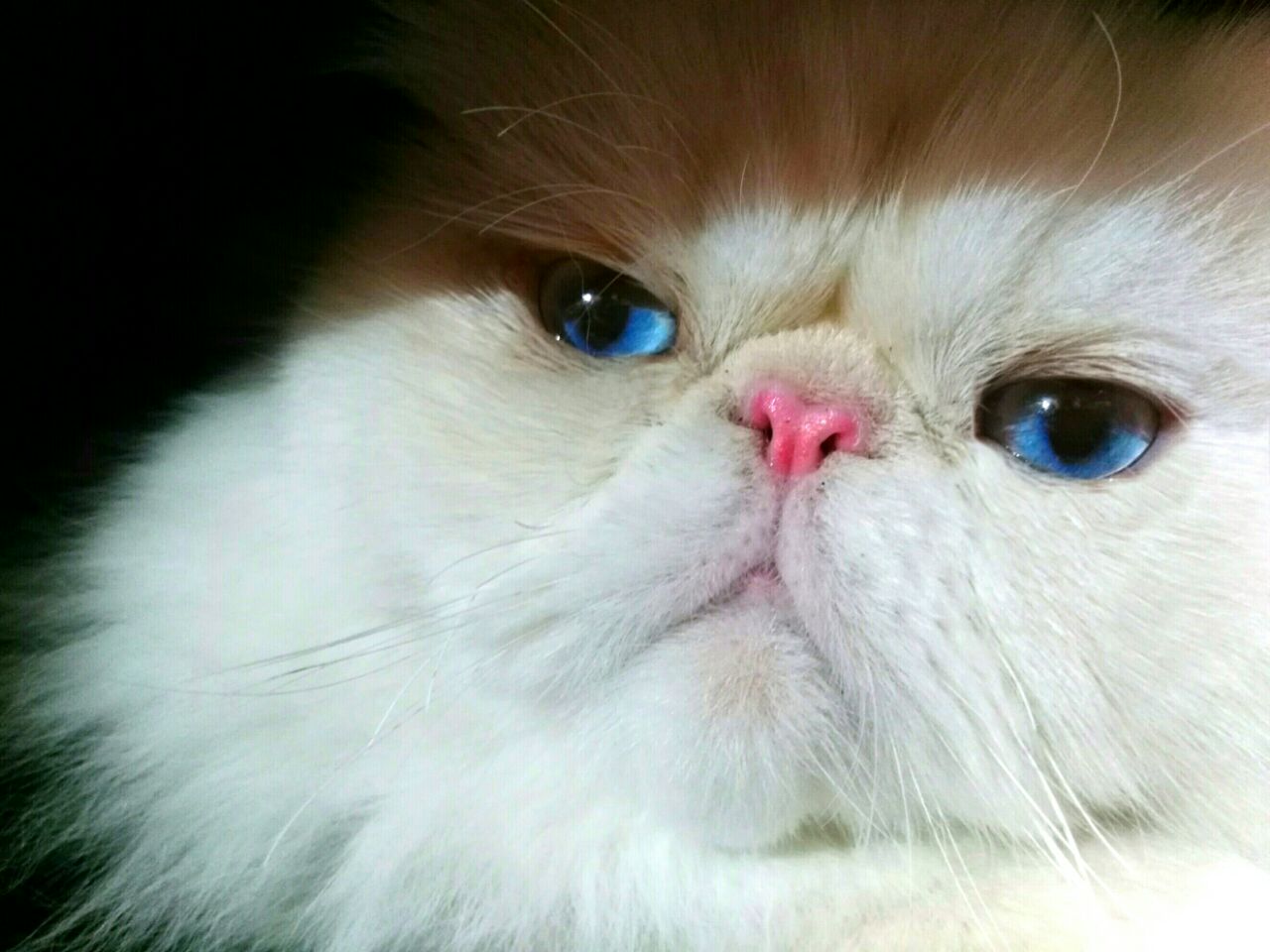
Like the Persian, the Himalayan is a brachycephalic breed which predisposes it to health issues such as respiratory infections, epiphora, corneal abrasions, ulcers, and corneal sequestration. Himalayans are also susceptible to polycystic kidney disease, a hereditary condition that results in cysts growing in the kidney. Himalayans have a higher incidence of feline asthma. In a review of over 5,000 cases of urate urolithiasis the Himalayan was under-represented, with an odds ratio of 0.37. A study of cats presented to the University of Missouri Veterinary Medical Teaching Hospital that underwent radiography found four Himalayans out of a population of 16 to have hip dysplasia, higher than the 6.6% average for all cats.
Himalayans are predisposed to dermatophytosis (ringworm).
The Himalayan is also predisposed to urticaria pigmentosa, a type of benign mast cell disorder.
Idiopathic facial dermatitis, also known as facial dermatitis of the Persian and Himalayan cat, is a type of dermatitis only observed in the Persian and Himalayan cat. It is characterised by greasy skin, debris adhering to the folds of the face and nose, ceruminous otitis externa, secondary bacterial folliculitis and Malassezia dermatitis, and pruritus. Onset is at 10 months to six years.
In popular culture
- In the CBS television detective series Tucker's Witch (1982), a Himalayan cat named Dickens is the familiar to witch Amanda Tucker. Amanda Tucker has a telepathic link with Dickens, who provides her and her husband with clairvoyant clues to help them solve mysteries. Dickens is featured prominently in the show's opening and closing credits.
- In the spoof film Date Movie (2006), Mr. Jinxers is a parody of his Meet the Parents counterpart.
- In the movies Homeward Bound: The Incredible Journey (1993) and Homeward Bound II: Lost in San Francisco (1996), one of the main characters is a Himalayan cat named Sassy (voiced by Sally Field).
- The main character of the anime/manga Prince of Tennis, Ryoma Echizen, owns a Himalayan cat named Karupin (or Kalpin in the English translation).
- Martha Stewart owns three Himalayans, named after composers: Beethoven, Mozart and Bartók. The cats have been featured in her commercials for Kmart, on her television show, Martha Stewart Living, and in her magazine, such as the cover of the February 1999 issue.
- A Himalayan named Luna the Fashion Kitty became a social media phenomenon in 2011 with a popular Facebook page, a website, and several media references.
- A Himalayan-Persian named Colonel Meow became an Internet celebrity in 2012, and entered Guinness World Records 2014 as the cat with the longest fur.
- Mr. Jinx (also known as Jinxy, or simply just Jinx) from the Meet the Parents trilogy is a seal-point peke-faced Himalayan with an all-black tail.
- The "narrator" of David Michie's series of books that begins with "The Dalai Lama's Cat" is a Himalayan cat.
- A community-created cosmetic item for the Medic and Spy classes in the 2007 computer game Team Fortress 2 is a Red Point Himalayan cat named "Harry".
Gallery
File:Himalayan-sharapova.jpg|Red (flame) point File:Strathcona-Siamese-Persian-mix-cat-3730.jpg|Blue-point File:Chocolate Himlayan.jpg|Chocolate-point File:Himalayan Persian.jpg|Red-point File:Himalayan close-up.jpg|Tortie-point File:Himalayan Male Cat 5 years Old Lilac Point.jpg|alt=Himalayan Male Cat 5 years Old Lilac Point|5-year-old male lilac-point File:Himalayan Cat Male with Brown Colour 3.JPG|Male Himalayan cat with brown colouring (note the points inherited from siamese and relatively long hair inherited from Persian parent) File:Himalayan cat m3.JPG|Seal lynx point Himalayan cat File:Bluepoint Himalayan Kitten Cirrus at 6 months by Asilverstein 2014mar14 IMG 2542b.jpg|Example of blue-point feline markings on juvenile male File:Sealpoint Himalayan Kitten Genghis at 6 months by Asilverstein 2014mar14 IMG 2626.jpg|Example of seal-point feline markings on juvenile male File:Seal point himalayan.jpg|Seal-point Himalayan
References
References
- (1936). "Siamese–Persian Cats". American Genetic Association.
- Berg, Linda. (1999). "The Himalayan Persian". [[Cat Fanciers' Association]] (CFA).
- (10 March 1994). "A Little Cat Feat: A Covina woman's efforts at cross-breeding wild and domestic felines are paying off handsomely.". [[Los Angeles Times]].
- "Persian Standard".
- "Persian Standard".
- "Himalayan Breed Synopsis".
- (27 August 2019). "Himalayan Breed".
- "Himalayan Standard".
- "Himalayan Cat".
- (2012). "Risk factors for urate uroliths in cats.". [[Journal of the American Veterinary Medical Association]].
- (1999). "Hip Dysplasia: A Feline Population Study". Wiley.
- (2016-09-19). "Small Animal Dermatology". Saunders.
- (2011-01-25). "Blackwell's Five-Minute Veterinary Consult Clinical Companion". Wiley-Blackwell.
- (2011-01-25). "Blackwell's Five-Minute Veterinary Consult Clinical Companion". Wiley-Blackwell.
- (July 2014). "Tucker's Witch – "The Good Witch of Laurel Canyon"".
- (15 November 2017). "Date Movie 2006".
- (12 February 1993). "Homeward Bound: The Incredible Journey".
- "Karupin".
- (21 January 2009). "Fluffy Himalayan Cats".
- Lilit Marcus. (2011-11-07). "Meet Luna, the Fashion Kitty - Bitches in Stitches - Racked National". Racked.com.
- Sandler, Corey. (2007). "Econoguide Walt Disney World Resort Universal Orlando, 5th Edition". Globe Pequot.
- "Steam Community Market - Harry".
This article was imported from Wikipedia and is available under the Creative Commons Attribution-ShareAlike 4.0 License. Content has been adapted to SurfDoc format. Original contributors can be found on the article history page.
Ask Mako anything about Himalayan cat — get instant answers, deeper analysis, and related topics.
Research with MakoFree with your Surf account
Create a free account to save articles, ask Mako questions, and organize your research.
Sign up freeThis content may have been generated or modified by AI. CloudSurf Software LLC is not responsible for the accuracy, completeness, or reliability of AI-generated content. Always verify important information from primary sources.
Report