From Surf Wiki (app.surf) — the open knowledge base
Highland games
Scottish games
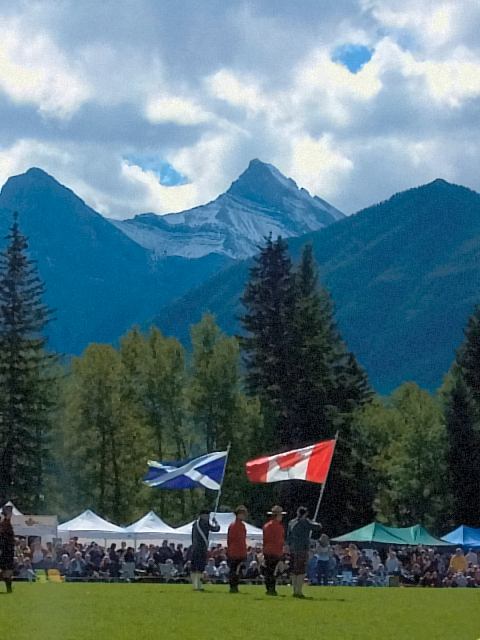
Scottish games
Highland games () is a competitive strength sport with events held in spring and summer in Scotland and several other countries with a large Scottish diaspora as a way of celebrating Scottish and Celtic culture, especially that of the Scottish Highlands. Certain aspects of the games are so well known as to have become emblematic of Scotland, such as the bagpipes, the kilt, and the heavy events, especially the stone put, Scottish hammer throw, weight throw, weight over bar, caber toss, keg toss and sheaf toss. While centred on competitions in piping and drumming, dancing, and Scottish heavy athletics, the games also include entertainment and exhibits related to other aspects of Scottish and Gaelic cultures.
The Cowal Highland Gathering, better known as the Cowal Games, is held in Dunoon, Scotland, every August. It is the largest Highland games in Scotland, attracting around 3,500 competitors and somewhere in the region of 23,000 spectators from around the globe. Worldwide, however, it is exceeded in terms of spectators by three gatherings in the United States: the estimated 30,000 that attend Grandfather Mountain in North Carolina; the New Hampshire Highland Games & Festival, which attracts over 35,000 annually; and the even larger Northern California gathering—the largest in the Northern Hemisphere—that has taken place every year since 1866. This event, the Scottish Highland Gathering and Games, is currently held on Labor Day weekend in Pleasanton, California; and the sesquicentennial event was held on 5–6 September 2015, attracting a record crowd close to 50,000.
Highland games are claimed to have influenced Baron Pierre de Coubertin when he was planning the revival of the Olympic Games. De Coubertin saw a display of Highland games at the Paris Exhibition of 1889.
History
Ancient games
The first historical reference to the type of events held at Highland games in Scotland was made during the time of King Malcolm III (, c. 1031 – 13 November 1093) when he summoned men to race up Craig Choinnich overlooking Braemar with the aim of finding the fastest runner in Scotland to be his royal messenger. There is a document from 1703 summoning the clan of the Laird of Grant, Clan Grant. They were to arrive wearing Highland coats and "also with gun, sword, pistol and dirk". From this letter, it is surmised that the competitions would have included feats of arms. There are also thought to have been events where the strongest and bravest soldiers in Scotland would be tested. Musicians and dancers were encouraged to reveal their skill and talents and so be a great credit to the clan that they represented. Some modern sources suggest more these games would originate from the deer hunts that the inhabitants of the Highlands engaged in.
Attempts have been made to discover earlier traditions of games, although evidence is thin. The primary sources are from the bardic traditions of both contests between clans and of tests to select retainers for clan chiefs. An example of a possible early games venue is at Fetteresso.
Modern games


The modern Highland games are largely a 19th-century development, from the period following the Jacobite rebellions and subsequent ban on Highland dress.
By the mid-20th century, annual Highland games events, modelled on the traditional events in Scotland along with some elements borrowed from the mòd festivals, had been established not just in Scotland but throughout the United States, Canada, Australia, New Zealand, and South Africa, among other places with a notable Scottish diaspora, which totals about 50 million people worldwide. (The earliest such events in North America go back quite a way, to 1836 in New York and at least 1863 in Nova Scotia.) The modern, rather commercialised gatherings have done much to promote tartan, kilts, and other elements of Highland culture abroad, having up to tens of thousands of attendees, a large proportion of them in Highland dress. The games are the primary source of business for a cottage industry of professional kiltmakers outside of Scotland, and are the main recruiting grounds of the numerous clan societies.
While the Scottish Highland Games Association says there are dozens of such events in Scotland, there were at least 260 annual Highland games events worldwide as of 2000, more than 100 of them in the US alone, and dozens more in Canada. They are closely intertwined with bagpipe band competitions (which date to 1781), a lasting source of Highland imagery in their regiment-inspired uniforms; the 2013 World Pipe Band Championships in Glasgow drew over 8,000 pipers and drummers from all over the world.
The games' rather flamboyantly tartaned subculture, a "shortcut to the Highlands", is sustained outside Scotland primarily by multi-generational Scottish descendants rather than by direct Scottish expatriates. Sir Malcolm MacGregor, chief of Clan Gregor and then convenor of the Standing Council of Scottish Chiefs (well aware of tartan's connections to tourism and other Scottish economic interests) wrote in 2016 of the games events beyond Scotland that "it is the stuff of kilts and cabers, but it is the Scotland those not living in Scotland want it to be." Ian Brown (2012) coined the term tartanism (as distinct from tartanry) for this international tokenisation of tartan, kilts, and other symbols of the Highlands as ethnic-identity markers, evolving to some degree independently to suit the cultural needs of the New World Scottish diaspora and unrestrained by the views of the originating Scottish "home" culture. Michael B. Paterson (2001) hypothesises that the fondness for Highland symbols and activities among the diaspora may be due to the European-descended populations in these countries lacking much of a direct experience of culture deeper than a few generations, and being dominated by nuclear family structure; Highland games, clan tartans, Burns suppers, St Andrew's societies (more than 1,200 of them just in the US), etc. provide a sense of shared roots, heritage, identity, and a broader and more elastic notion of family, as well as fostering Old World, "mother country" connections. Fiona K. Armstrong (2017) writes: "It is a feudal longing in a modern age. It is a yearning for some supposedly comforting and ordered past." According to Ian Maitland Hume (2001):
This swell of diasporic tartan enthusiasm seems to have been triggered in the 1950s, the beginning of the age of affordable powered flight, as clan chiefs like Dame Flora MacLeod of Clan MacLeod travelled abroad to promote Scottish tourism and other connections. (At least 1 in 5 Scottish-descended people surveyed in 2017 by VisitScotland, the national tourism board, expressed an interest in travelling to Scotland.) However, in 2009, the US-based Council of Scottish Clans and Associations reported a drop in the number of active clan societies (which peaked at 170, and drive considerable tourism as well as historic-place restoration efforts), with up to a 25% decrease in individual memberships, as well as some of the annual games events coming to an end; "new technology" (i.e. the Internet) seemed to be related.
Events
Heavy events
In their original form centuries ago, Highland games revolved around athletic and sports competitions. Though other activities were always a part of the festivities, many today still consider Highland athletics to be what the games are all about—in short, that the athletics are the games, and all the other activities are just entertainment. Regardless, it remains true today that the athletic competitions are at least an integral part of the events.
Stone put/ putting the heavy stone

Main article: Stone put
Similar to the modern-day shot put as seen in the Olympic Games, instead of a steel shot, a large stone of variable weight is often used. There are two versions, differing in allowable technique: The Braemar Stone uses a 20–30 lb (9.1–13.6 kg) stone for men (13–18 lb or 6–8 kg for women) and does not allow any run up to the toeboard or "trig" to deliver the stone, i.e., it is a standing put. In the Open Stone using a 16–25 lb (7.3–11.4 kg) stone for men (8–12 lb or 3.5–5.5 kg for women), the thrower is allowed to use any throwing style so long as the stone is put with one hand with the stone resting cradled in the neck until the moment of release. Most athletes in the open stone use either "glide" or "spin" technique.
Scottish hammer throw
Main article: Scottish hammer throw
This event is seen as the precursor to the modern hammer throw seen in track and field events worldwide. However the Highland Games version has some differences. In the Scottish event, a round metal ball weighing 16 or 22 lb (7.25 or 10 kg) for men, or 12 or 16 lb (5.5 or 7.25 kg) for women, is attached to the end of a shaft about 4 feet (1.2 metres) in length and made out of wood, bamboo, rattan or plastic. With the feet in a fixed position, the hammer is whirled about one's head and thrown for distance over the shoulder. Hammer throwers sometimes employ specially designed footwear with flat blades to dig into the turf to maintain their balance and resist the centrifugal forces of the implement as it is whirled about the head. It substantially increases the attainable distance.
Weight throw/ weight for distance

Main article: Weight throw
This event has two variations (usually considered two separate events) to it, depending on the weight of the implement. One using a light (28 lb for men and 14 lb for women) and the other a heavy (56 lb for men, 42 lb for masters men, and 28 lb for women) weight. The weights are made of metal and have a handle attached either directly or by means of a chain. The implement is thrown using one hand only, but otherwise using any technique. Usually a spinning technique is employed. The longest throw wins.
Weight over bar/ weight for height

Main article: Weight over bar
In this event, the athletes toss either a 25.4 kg (56 lb/ 4-stone) weight for men, 19 kg (42 lb) for masters men, and 12 kg (28 lb) for women, a weight with an attached handle over a horizontal bar using only one hand. It requires the weight to be kept between the legs before swinging it up in a pendulum like manner, and releasing when it is at its apex, directly overhead. Each athlete is allowed three attempts at each height. Successful clearance of the height allows the athlete to advance into the next round at a greater height. The competition is determined by the highest successful toss with fewest misses being used for tie-breakers. It is also used in some Strongman competitions.
Caber toss
Main article: Caber toss
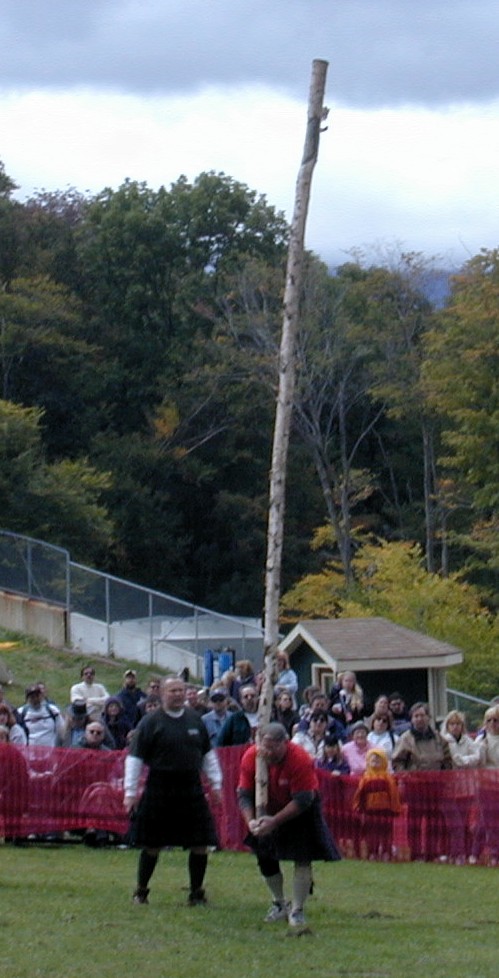
In this staple event, competitors toss a large tapered pole called a "caber" () usually made from a larch tree. The term "caber" derives from the Gaelic word cabar, which refers to a wooden beam. It can be between 16-20 ft tall and weigh 90-150 lb. The primary objective is to toss the caber so that it turns end over end, falling away from the tosser. Ideally it should fall directly away from the tosser in the "12 o'clock" position. The movement can be broken down to several segments. The tosser first balances the caber upright against his or her shoulder and neck (tapered end should be downwards). The tosser then crouches, sliding their interlocked hands down the caber and under the rounded base, and lifts it in their cupped hands. The tosser then walks or runs a few paces forward to gain momentum, and flips the tapered end upwards so that the large end hits the ground first, and if well tossed, the caber falls directly away from the tosser. The judging of Caber toss might be deceptive. The straightest end-over-end toss scores highest. If the caber lands on its end but falls back towards the thrower, the score is lower than for any end-over-end throw, but is based upon the maximum vertical angle that the caber achieved (side-judging may involve a second judge). End-over-end tosses are scored according to the hours on a clock, with a 12 o'clock score being highest (falling directly away from the thrower), down to a 9 or 3 for cabers that reach a vertical, before falling to the side.
Keg toss
Main article: Keg-tossing
This event which is predominately evolving from Irish Highland games, involves the heaving of a standard half-barrel beer keg over a horizontal bar using both hands. The keg is completely emptied for better stability and to avoid injuries. The basic technique involves swinging the keg in a pendulum like manner and releasing when it is at its apex. The event or its modified variations are quite often used in modern day Strongman competitions. In 2010 World's Strongest Man the 8 keg standardization was introduced where the competitors had to throw 8 beer kegs of increasing weights ranging from 17 to 24 kg over a 4-meter bar. Keg for maximum height is also a staple Highland games and Strongman event with 12.5 kg, 15 kg and 25 kg being the most common weights used.
Sheaf toss
Main article: Sheaf toss
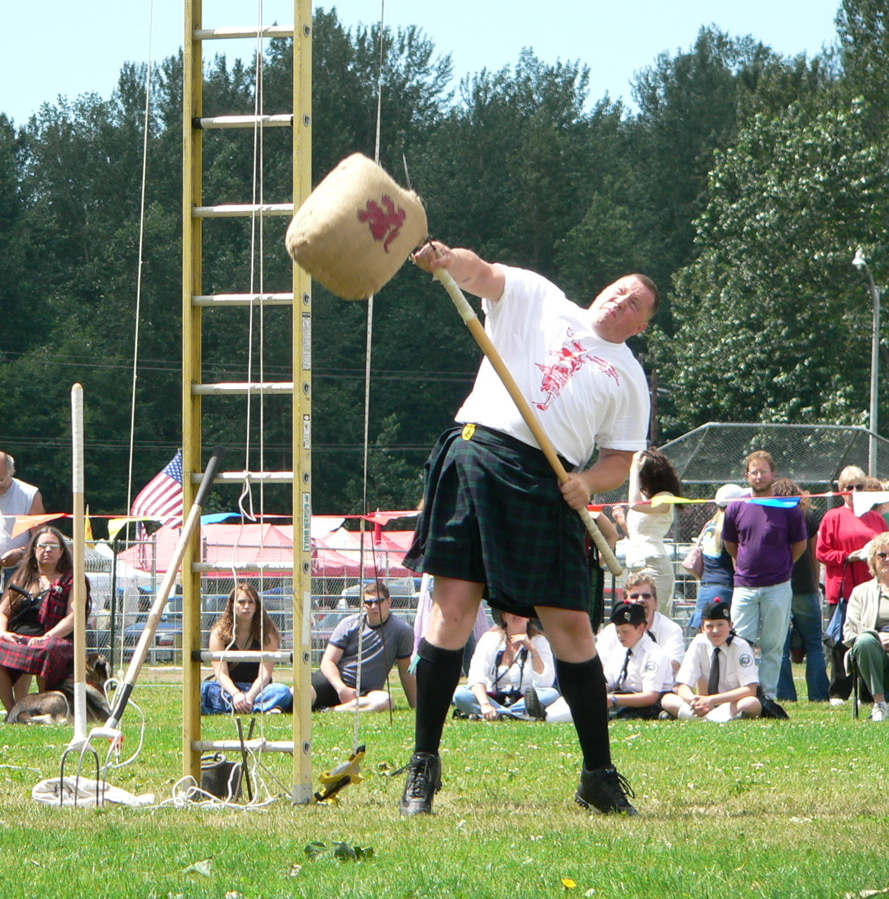
In this event, a bundle of straw (the sheaf) weighing 20 lb for the men and 10 lb for the women, and wrapped in a burlap bag is tossed vertically with a pitchfork over a raised bar much like that used in pole vaulting. The progression and scoring of this event is similar to the Weight over bar. However, there is significant debate among athletes as to whether the sheaf toss is in fact an authentic Highland event. Some argue it is actually a country fair event, but many agree that it is a great crowd pleaser. It is also a traditional sport in the Basque Country, and is often featured at agricultural shows such as the annual Sykehouse Show in South Yorkshire, England.
Maide-leisg
Maide-leisg (Gaelic for 'lazy stick', ) is a trial of strength performed by two competitors sitting on the ground with the soles of their feet pressing against each other. Thus seated, they hold a stick between their hands which they pull against each other until one of them is raised from the ground. The oldest maide-leisg competition in the world takes place at the Carloway show and Highland games on the Isle of Lewis. There's also a popular variation of the event performed in Yakuts communities often called Mas-wrestling.
Many of the heavy events competitors in Scottish highland athletics are former high school and college track and field athletes who find the Scottish games are a good way to continue their competitive careers. Increasingly in the US, the heavy events are attracting women, as well as master-class athletes, which has led to a proliferation of additional classes in heavy-events competitions. Lighter implements are used in the women's classes.
Music


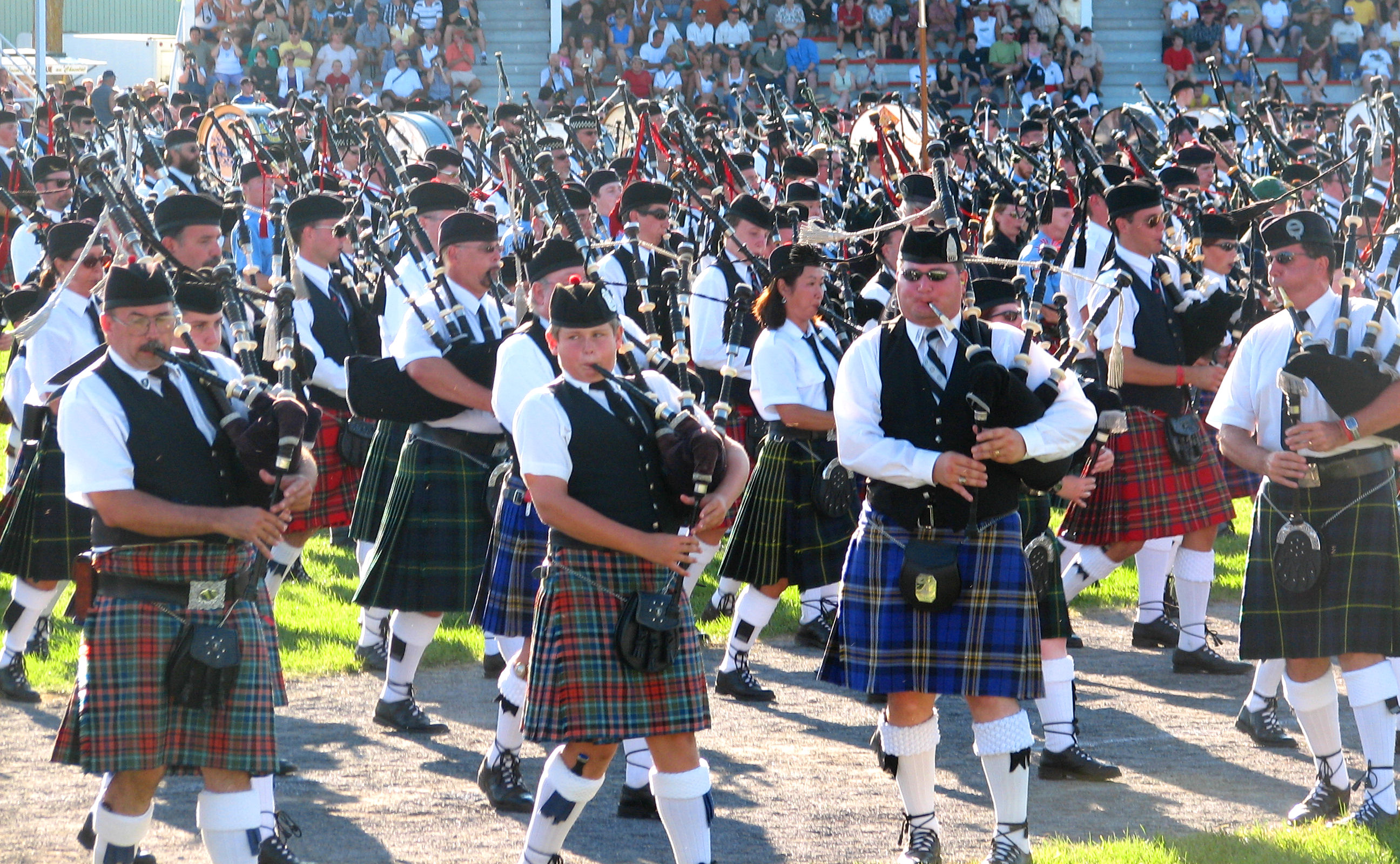
For many Highland games festival attendees, the most memorable of all the events at the games is the massing of the pipe bands. Normally held in conjunction with the opening and closing ceremonies of the games, as many as 20 or more pipe bands will march and play together. The result is a thunderous rendition of Scotland the Brave or Amazing Grace, and other crowd-pleasing favorites.
The music of the great Highland bagpipe has come to symbolize music at the games and of Scotland itself. In addition to the massed bands (when all the attending pipe bands play together), nearly all Highland games gatherings feature a wide range of piping and drumming competition, including solo piping and drumming, small group ensembles and full the pipe bands.
Music at Highland games gatherings also includes other forms, such as fiddling, harp circles, and Celtic bands.
Dance
The Cowal Highland Gathering hosts the annual World Highland Dancing Championship. This event gathers the best competitive dancers from around the world who compete for the RSOBHD sanctioned World Championship title. But most other Highland Games have dancing as well. The impressiveness of the performance varies wildly depending on the section dancing, with the 4/5/6 year old Primary dancers bringing the cuteness but not necessarily the technique compared to the 10-30+ year olds that are typical of the Premier (Open) section. The dances performed can vary quite a lot depending on the size of the dancing boards, access to swords for dancing over, and just preference of which dances to perform. Among the most common dances are the Highland Fling, the Sword Dance or the Ghillie Callum, the Seann Triubhas, the Irish Jig and the Hornpipe. Of these dances three (Highland Fling, Sword Dance, and Seann Triubhas) are performed wearing the semi-traditional kilt whilst the Irish Jig and the Hornpipe have specific outfits for their dances.
Secondary events and attractions

At modern-day Highland Games events, a wide variety of other activities and events are generally available. Foremost among these are the clan tents and vendors of Scottish related goods. The various clan societies make the Highland games one of the main focus of their seasonal activities, usually making an appearance at as many such events as possible. Visitors can find out information about the Scottish roots and can become active in their own clan society if they wish. These are more common at Highland Games held outside of Scotland as there is less of a demand for them in Scotland, which is not to say that they do not pop up from time to time.
At modern games, armouries will display their collections of swords and armour, and often perform mock battles. Various vendors selling Scottish memorabilia are also present selling everything from Irn-Bru to the stuffed likeness of the Loch Ness Monster.
Herding dog trials and exhibitions are often held, showcasing the breeder's and trainer's skills. In addition, there may be other types of Highland animals present, such as the Highland cattle.
Various traditional and modern Celtic arts are often showcased. These could include harpers' circles, Scottish country dancing, and one or more entertainment stages. In addition, most events usually feature a pre-event ceilidh (a type of social event with traditional music, dancing, song, and other forms of entertainment).
Various food vendors will also offer assorted types of traditional Scottish refreshment and sustenance.
In popular culture
The Highland games phenomenon is satirised by Neil Munro in his Erchie MacPherson story, "Duffy's Day Off", first published in the Glasgow Evening News on 22 August 1904.
Major events in Scotland
| Location | Name of Event | Details |
|---|---|---|
| Alva, Clackmannanshire | Alva Highland Games | Johnstone Park, Alva at the foot of the Ochil Hills. First held in summer 1856. |
| Blair Atholl, Perthshire | Atholl Gathering | Europe's only private military unit, the Atholl Highlanders, open the games in the grounds of Blair Castle. |
| Braemar, Aberdeenshire | Braemar Gathering | Attended by the British royal family. |
| Brodick, Isle of Arran | Brodick Highland Games | First held in 1886. |
| Burntisland, Fife | Burntisland Highland Games | Second oldest in the world |
| Carloway, Isle of Lewis | Carloway Show and Highland Games | Home to the oldest 'Maide Leisg' competition in the world |
| Ceres, Fife | Ceres Highland Games | Oldest free games in Scotland |
| Crieff, Perthshire | Crieff Highland Games | Home of the Scottish Heavyweight Championships and has the Duke of Rothesay (Prince William) as the Royal Chieftain |
| Dunoon, Argyllshire | Cowal Highland Gathering | Biggest games in Scotland |
| Glenisla, Angus | Glenisla Highland Games | Started in 1869 |
| Gourock, Inverclyde | Gourock Highland Games | The first Highland games of the Scottish season – held on the second Sunday in May |
| Halkirk, Caithness | Halkirk Highland Games | Started in 1886 |
| Inverkeithing, Fife | Inverkeithing Highland Games | |
| Lochearnhead, Perthshire | Balquhidder, Lochearnhead and | |
| Strathyre Highland Games | Cameron, MacLaren and MacGregor clans linked to the games | |
| Luss, Dunbartonshire | Luss Highland Gathering | Clan Colquhoun linked to the games. Held regularly since 1875. |
| Strathdon, Aberdeenshire | Lonach Highland Gathering & Games | Held by The Lonach Highland & Friendly Society Est. 1823, features the march of the Lonach Highlanders consisting of Forbes, Wallace and Gordons |
| Perth, Perthshire | Perth Highland Games | Held on the second Sunday in August |
| Pitlochry, Perthshire | Pitlochry Highland Games | |
| Portree, Skye | Isle of Skye Highland Games | |
| St. Andrews, Fife | St. Andrews Highland Games | |
| Stirling | Stirling Highland Games | First Stirling Highland Games were held in July 1870 |
| Tobermory, Isle of Mull | Mull Highland Games | Held every third Thursday in July, supported by Clan MacLean; considered one of the most picturesque Games events, overlooking Tobermory Bay and the Sound of Mull |
| Inverness | Inverness Highland Games | Staged in the world's oldest highland games stadium, Northern Meeting Park |
| Nairn | Nairn Highland Games | Always one of the largest and most popular amateur gatherings in the North, the Nairn Highland Games have been an annual feature on Nairn’s summer calendar since being moved to 10 August in 1867. Prior to that, they were a winter Games, first held on 25 December 1865. The town is justifiably proud of this, the foremost event in the Burgh calendar. |
Major events outside Scotland
Australia
| Location | Name |
|---|---|
| Daylesford, Victoria | Highland Gathering |
| Maclean, NSW | Maclean Highland Gathering |
Belgium
| Location | Name |
|---|---|
| Alden Biesen | Scottish weekend |
Bermuda
| Location | Name |
|---|---|
| Somerset (2012); Pembroke (2013) | Bermuda Highland Games |
Brazil
| Location | Name |
|---|---|
| Estância Velha, Rio Grande do Sul | Scout Highland Games - GEJL46RS |
| Sapucaia do Sul, Rio Grande do Sul | Brazilian Scottish Highland Games |
Canada
On 1 August 1997, Canada Post issued "Highland Games" designed by Fraser Ross, based on photographs by Andrew Balfour. The 45¢ stamps are perforated 12.5 x 13 and were printed by Canadian Bank Note Company.
| url=http://www.ccsna.org/games/state_province.html | title=Calendar of Highland Games and Scottish Events in North America | publisher=Clan Campbell Society | access-date=25 May 2014 | archive-url=https://web.archive.org/web/20100212125208/http://www.ccsna.org/games/state_province.html | archive-date=12 February 2010 | url-status=dead | df=dmy-all}} | Name | Month Held | Alberta | British Columbia | Manitoba | New Brunswick | Nova Scotia | Ontario | Quebec | Saskatchewan |
|---|---|---|---|---|---|---|---|---|---|---|---|---|---|---|---|---|---|
| Calgary, Alberta | Calgary Highland Games | September | |||||||||||||||
| Canmore, Alberta | Canmore Highland Games | September | |||||||||||||||
| Edmonton, Alberta | Edmonton Scottish Society Highland Gathering | June | |||||||||||||||
| Grande Prairie, Alberta | Grande Prairie Highland Games | June | |||||||||||||||
| High River, Alberta | Foothills Highland Games | August | |||||||||||||||
| Red Deer, Alberta | Red Deer Highland Games | June | |||||||||||||||
| Coquitlam, British Columbia | BC Highland Games | June | |||||||||||||||
| Kamloops, British Columbia | Kamloops Highland Games | July | |||||||||||||||
| Penticton, British Columbia | Penticton Scottish Festival | July | |||||||||||||||
| Victoria, British Columbia | Victoria Highland Games | May | |||||||||||||||
| East Selkirk, Manitoba | Manitoba Highland Gathering | June | |||||||||||||||
| Winnipeg, Manitoba | Pavilion of Scotland, Folklorama | August | |||||||||||||||
| Winnipeg, Manitoba | Transcona Highland Gathering | September | |||||||||||||||
| Fredericton, New Brunswick | New Brunswick Highland Games | July | |||||||||||||||
| Moncton, New Brunswick | Moncton Highland Games | June | |||||||||||||||
| Perth-Andover, New Brunswick | Gathering of the Scots Festival | May | |||||||||||||||
| Antigonish, Nova Scotia | Antigonish Highland Games | July | |||||||||||||||
| New Glasgow, Nova Scotia | Festival of the Tartans & Highland Games | July | |||||||||||||||
| Almonte, Ontario | North Lanark Highland Games | August | |||||||||||||||
| Cambridge, Ontario | Cambridge Highland Games | July | |||||||||||||||
| Cobourg, Ontario | Cobourg Highland Games | June | |||||||||||||||
| Embro, Ontario | Embro Highland Games | July | |||||||||||||||
| Fergus, Ontario | Fergus Scottish Festival and Highland Games | August | |||||||||||||||
| Georgetown, Ontario | Georgetown Highland Games | June | |||||||||||||||
| Kincardine, Ontario | Kincardine Scottish Festival & Highland Games | July | |||||||||||||||
| Kingston, Ontario | Kingston Scottish Festival | May | |||||||||||||||
| Maxville, Ontario | Glengarry Highland Games | August | |||||||||||||||
| Sutton, Ontario | The Georgina Gathering | June | |||||||||||||||
| Uxbridge, Ontario | The Highlands of Durham Games | July | |||||||||||||||
| Montreal, Quebec | Montreal Highland Games | August | |||||||||||||||
| Moose Jaw, Saskatchewan | Saskatchewan Highland Gathering & Festival (not to be held in 2015) | May | |||||||||||||||
| Regina, Saskatchewan | Saskatchewan Highland Gathering & Festival | May |
Czech Republic
| Location | Name |
|---|---|
| Brno | MonteBú Highland Games |
| Sychrov Castle | Skotské hry Sychrov |
Hungary
| Location | Name |
|---|---|
| Csesznek, Veszprém | Scottish Highland Games (Skót Felföldi Játékok) |
| Zichyújfalu, Fejér | Highland Games Cup (Felföldi Játékok Kupa) |
Indonesia
| Location | Name |
|---|---|
| Jakarta | Jakarta Highland Gathering |
New Zealand
| Location | Name |
|---|---|
| Hororata | Hororata Highland Games (2011) |
| Fairlie | Mackenzie Easter Show & Highland Games (1898) |
| Paeroa | Paeroa Highland Games & Tattoo (1993) |
| Turakina | Turakina Highland Games (1864) |
| Waipu | Waipu Highland Games (1871) |
Switzerland
| Location | Name |
|---|---|
| Abtwil, St. Gallen | : Appowila Highland Games |
| Fehraltdorf, Zurich | Highland-Games Fehraltdorf |
| Ingenbohl, Schwyz | Highland Games Innerschweiz |
United States
| Location | Name |
|---|---|
| Palmer, Alaska | Alaska Scottish Highland Games |
| Phoenix, Arizona | Scottish Highland Games |
| Prescott, Arizona | Prescott Highland Games & Celtic Faire |
| Tucson, Arizona | Tucson Celtic Festival & Scottish Highland Games |
| Monterey, California | Monterey Scottish Games & Celtic Festival |
| Pleasanton, California | Scottish Highland Gathering and Games |
| San Diego, California | San Diego Scottish Highland Games & Gathering of the Clans |
| Santa Cruz County, California | Scottish Renaissance Festival featuring the Loch Lomond Highland Games & Celtic Gathering |
| Ventura, California | Seaside Highland Games |
| Woodland, California | Sacramento Valley Scottish Games & Festival |
| Elizabeth, Colorado | Elizabeth Celtic Festival |
| Estes Park, Colorado | Longs Peak Scottish-Irish Highland Festival |
| Brooklyn, Connecticut | Scotland Connecticut Highland Games |
| Dunedin, Florida | Dunedin Highland Games and Festivals |
| Green Cove Springs, Florida | Northeast Florida Scottish Highland Games |
| Marianna, Florida | The Big Bend Highland Games & Scottish Festival |
| Sarasota, Florida | Sarasota Highland Games |
| Blairsville, Georgia | Blairsville Scottish Festival & Highland Games |
| Stone Mountain, Georgia | Stone Mountain Highland Games and Scottish Festival |
| Honolulu, Hawaii | Hawaiian Scottish Festival and Highland Games |
| Columbus, Indiana | Columbus Scottish Festival and Highland Games |
| Indianapolis, Indiana | Indianapolis Scottish Highland Games and Festival |
| South Bend, Indiana | Celtic Festival and Bryan Verkler Invitational Highland Games |
| Davenport, Iowa | Celtic Festival and Highland Games of the Quad-Cities |
| Eminence, Kentucky | Highland Renaissance Festival |
| Glasgow, Kentucky | Glasgow Highland Games |
| Baton Rouge, Louisiana | The Highland Games of Louisiana |
| Belfast, Maine | Belfast Celtic Celebration |
| Andover, Maine | Mountain Misfits Athletics |
| Windsor, Maine | Maine Highland Games and Scottish Festival |
| Hallowell, Maine | Hallowell Backyard Games |
| Mount Airy, Maryland | Frederick Celtic Festival |
| St. Leonard, Maryland | Southern Maryland Celtic Festival and Highland Gathering |
| Florence, Massachusetts | Glasgow Lands Scottish Festival |
| Alma, Michigan | Alma Highland Festival and Games |
| Livonia, Michigan | St. Andrew's Society of Detroit Highland Games |
| Parchment, Michigan | Kalamazoo Scottish Festival |
| Sparta, Michigan | Sparta Celtic Festival |
| St. Charles, Missouri | Missouri Tartan Day Festivities |
| St. Louis, Missouri | St. Louis Scottish Games and Cultural Festival |
| Hamilton, Montana | Bitterroot Celtic Games & Gathering |
| Kalispell, Montana | Flathead Celtic Festival |
| Lincoln, New Hampshire | New Hampshire Highland Games & Festival |
| Las Vegas, Nevada | Las Vegas Celtic Society Highland Games |
| Altamont, New York | Capital District Scottish Games |
| Liverpool, New York | CNY Scottish Games & Celtic Festival |
| Olcott, New York | Niagara Celtic Heritage Festival & Highland Games |
| Old Westbury, New York | Scottish Festival and Games |
| Huntersville, North Carolina | Loch Norman Highland Games |
| Laurinburg, North Carolina | Scotland County Highland Games |
| Linville, North Carolina | Grandfather Mountain Highland Games |
| Winston-Salem, North Carolina | Bethabara Highland Games |
| Tulsa, Oklahoma | ScotFest |
| Portland, Oregon | Portland Highland Games |
| Bethlehem, Pennsylvania | Celtic Classic Highland Games & Festival |
| Ligonier, Pennsylvania | Ligonier Highland Games |
| Charleston, South Carolina | Charleston Scottish Games and Highland Gathering |
| Greenville, South Carolina | Gallabrae Greenville Scottish Games |
| Elizabethton, Tennessee | Scottish Heavy Athletics Clinic and Competition / East Tennessee Celtic Festival |
| Gatlinburg, Tennessee | Gatlinburg Scottish Highland Games |
| Townsend, Tennessee | Smoky Mountain Scottish Festival and Games at Townsend, Tennessee |
| Arlington, Texas | Texas Scottish Festival and Highland Games |
| Austin, Texas | Austin Celtic Festival |
| Grapevine, Texas | Grapevine Celtic Heritage Festival and Highland Games |
| Houston, Texas | Houston Celtic Festival and Highland Games |
| Sherman, Texas | Sherman Celtic Festival and Highland Games |
| Moab, Utah | Scots on the Rocks |
| Payson, Utah | Payson Scottish Festival |
| Salt Lake City, Utah | Utah Scots Festival |
| St. George, Utah | RedStone Games |
| Delaplane, Virginia | Virginia Scottish Games and Festival |
| Radford, Virginia | Radford Highlander's Festival |
| Enumclaw, Washington | Pacific NW Scottish Highland Games & Clan Gathering |
| Kelso, Washington | Kelso Highlander Festival |
| Bridgeport, West Virginia | North Central West Virginia Scottish Festival and Celtic Gathering |
| Milwaukee, Wisconsin | Milwaukee Highland Games |
| Waukesha, Wisconsin | Wisconsin Highland Games |
References
Informational notes
Citations
Bibliography
References
- "Cowal Highland Gatcitationhering".
- "Cowal Highland Gathering". cowalgathering.com.
- (12 July 2010). "Grandfather Mountain Highland Games Fast Facts".
- "Scottish Games Draw Record Crowds".
- "150th Scottish Highland Gathering & Games".
- Horne, Marc. (25 April 2010). "Highland games were the model for modern Olympics". The Times.
- "Coastal Highland Games".
- Antonioli, Marina; "The Highland Games – guida ai giochi scozzesi"; ''CelticPedia''.{{unreliable source?. (July 2023)
- [[#AFK. Armstrong (2017)]], p. 256.
- [[#AFK. Armstrong (2017)]], p. 283.
- [[#PJ. Porter (1998)]], p. 5.
- . (2015). ["History of the Antigonish Highland Games"](https://celticlifeintl.com/history-of-the-antigonish-highland-games/). *Celtic Life International*.
- [[#AFK. Armstrong (2017)]], p. 238.
- [[#AFK. Armstrong (2017)]], p. 254.
- [[#AFK. Armstrong (2017)]], p. 13, 278.
- [[#AFK. Armstrong (2017)]], p. 264.
- [[#PMB. Paterson, M. B. (2001)]], p. 190.
- [[#AFK. Armstrong (2017)]], p. 260, 273.
- [[#PMB. Paterson, M. B. (2001)]], p. 218.
- Calder, Jenni. (2010). "Scots in the USA". Luath.
- [[#PMB. Paterson, M. B. (2001)]], pp. 195, 218.
- [[#AFK. Armstrong (2017)]], pp. 253–254, 280.
- [[#AFK. Armstrong (2017)]], p. 253.
- [[#BI1. Brown (2012)]], p. 7.
- [[#PMB. Paterson, M. B. (2001)]], pp. 187–188, 208, 212.
- [[#AFK. Armstrong (2017)]], pp. 255, 289–290.
- Maitland Hume, Ian. (2001). "The contemporary role of the kilt and tartan in the construction and expression of Scottish American identity". University of Edinburgh.
- [[#AFK. Armstrong (2017)]], p. 261.
- [[#AFK. Armstrong (2017)]], pp. 254, 263–264, 266–267, 273, 283.
- Munro, Neil, "Duffy's Day Off", in Osborne, Brian D. & Armstrong, Ronald (eds.) (2002), ''Erchie, My Droll Friend'', [[Birlinn Limited]], Edinburgh, pp. 258 - 261, {{isbn. 978-1-84158202-3
- Forsyth, Valerie. (4 July 2018). "A Walk in the Past: The history of the Famous Alva Games". Alloa Advertiser.
- "The Atholl Gathering".
- "Brodick Highland Games, Brodick".
- "Glenisla Highland Games". glenislahighlandgames.co.uk.
- "Gourock Highland Games". gourockhighlandgames.org.uk.
- "Canadian Postal Archives Database". collectionscanada.gc.ca.
- "Calendar of Highland Games and Scottish Events in North America". Clan Campbell Society.
- "Calgary Highland Games". calgaryhighlandgames.org.
- "CANMORE HIGHLAND GAMES". canmorehighlandgames.ca.
- "Edmonton Scottish Society". edmontonscottishsociety.org.
- "Grande Prairie Highland Games". gphighlandgames.com.
- "Foothills Highland Games". foothillshighlandgames.com.
- Addie Otto. "Red Deer Highland Games Association Home Page". reddeerhighlandgames.ca.
- "The Kamloops Highland Games – July 11th 2015". kamloopshighlandgames.ca.
- "Welcome to the Penticton Scottish Festival".
- "Local Burns Events". victoriahighlandgames.com.
- "Manitoba Highland Gathering".
- Homefront Studios. "Ceud Mile Failte!". pavilionofscotland.ca.
- "Transcona Highland Gathering". transconahighlandgathering.org.
- "New Brunswick Highland Games Festival – Fredericton, 2008". highlandgames.ca.
- "Moncton Highland Games".
- "Gathering of the Scots – Home". gatheringofthescots.com.
- "Antigonish Highland Games". antigonishhighlandgames.ca.
- "Festival of the Tartans & Highland Games". festivalofthetartans.ca.
- "North Lanark Highland Games – Home". almontehighlandgames.com.
- "Cambridge Highland Games".
- "The 52nd Annual Cobourg Highland Games Festival". cobourghighlandgames.ca.
- "Embro Highland Games – Something for everyone". Embro Highland Games.
- [https://www.bramptonguardian.com/news-story/5988543-fergus-scottish-festival-and-highland-games/ "Fergus Scottish Festival and Highland Games"]. ''Brampton Guardian'', 13 August 2014
- "Georgetown Highland Games". georgetownhighlandgames.com.
- "Kincardine Scottish Festival and Highland Games – Kincardine Ontario Canada". kincardinescottishfestival.ca.
- "The Georgina Gathering June 21, 2014".
- "The Highlands of Durham Games". highlandsofdurhamgames.com.
- "Montreal Highland Games". montrealhighlandgames.qc.ca.
- (12 September 2014). "No highland games in Moose Jaw in 2015". [[Moose Jaw Times-Herald]].
- "Saskatchewan Highland Gathering & Festival". saskhighland.ca.
- "MonteBú Highland Games, Czech Rep.".
- "Highland games Sychrov, Czech Rep.".
- "Felföldi Játékok Kupa Zichyújfaluban". Velencei-tó Portál.
- "Highland-Games".
- Benz, Marco. (1 June 2024). "Highland Games Innerschweiz".
- "Alaska Scottish Highland Games".
- "Phoenix Scottish Games". arizonascots.com.
- Maryniak, Paul. (27 February 2022). "Phoenix Scottish Games a feast for the senses". SanTan Sun News.
- "Prescott Highland Games & Celtic Faire". prescottareacelticsociety.com.
- "Tucson Celtic Festival and Scottish Highland Games".
- "Monterey Scottish Games & Celtic Festival".
- "150th Scottish Highland Gathering & Games". thescottishgames.com.
- Eiland, Murray. (2018). "Gathering the Clans in California". The Armiger's News.
- "San Diego Scottish Highland Games". sdhighlandgames.org.
- "Santa Cruz Scottish Festival". santacruzscottishfestival.org.
- "Ventura Seaside Highland Games Home Page". seaside-games.com.
- "Sacramento Scot Games". sacramentoscotgames.org.
- "Elizabeth Celtic Festival". elizabethcelticfestival.com.
- "Longs Peak Scottish-Irish Highland Festival". Estes Park.
- "Scotland Connecticut Highland Games".
- "Dunedin Highland Games and Festival".
- "Northeast Florida Scottish Games & Festival". neflgames.
- "Big Bend Scots".
- "Sarasota Highland Games and Celtic Festival". sarasotahighlandgames.com.
- "Blairsville Scottish Festival – Welcome to the blairsville scottish festival website". blairsvillescottishfestival.org.
- "Stone Mountain Highland Games".
- "Hawaiian Scottish Festival and Highland Games".
- "Columbus Scottish Festival". scottishfestival.org.
- "Indianapolis Scottish Highland Game and Festival". indyscotgamesandfest.com.
- "Celtic Games". celtichighlandgames.org.
- "Kentucky Renaissance Fair".
- "The Highland Games of Louisiana".
- "Belfast Highland Games".
- "Maine Highland Games".
- "Southern Maryland Celtic Festival".
- "Glasgow Lands Scottish Games".
- "Alma Highland Festival". almahighlandfestival.com.
- "St. Andrew's Society of Detroit Highland Games". highlandgames.com.
- "Highland Games Kalamazoo Scottish Festival".
- "Sparta Celtic Festival".
- "Missouri Tartan Day". motartanday.
- "St. Louis Scottish Games". stlouis-scottishgames.com.
- "Bitterroot Celtic Games & Gathering". www.bcgg.org.
- "Flathead Celtic Festival". www.flatheadcelticfestival.com.
- "The New Hampshire Highland Games & Festival". nhscot.org.
- "Las Vegas Celtic Society".
- "Capital District Scottish Games". scotgames.com.
- "CNY Scottish Games & Celtic Festival". cnyscottishgames.org.
- Vicki Banks. (1 January 2007). "NiagaraCeltic.com: Welcome to the Niagara Celtic Community: Home for All Things Irish, Scottish & Welsh in North America!". niagaraceltic.com.
- "Long Island Scottish Clan MacDuff". liscots.org.
- "Loch Norman Highland Games".
- "Scotland County Highland Games". schgnc.org.
- "Grandfather Mountain Highland Games". gmhg.org.
- "Bethabara Highland Games".
- "Oklahoma Scotfest".
- "Portland Highland Games Association". phga.org.
- "Celtic Classic 2015 – Bethlehem, PA – Highland Games, Irish and Celtic Music Festival". celticfest.org.
- "Ligonier Highland Games 2014". ligonierhighlandgames.org.
- "Scottish Society of Charleston". charlestonscots.org.
- "Upper East Tennessee Celtic Society".
- "Gatlinburg Scottish Highland Games – our 30th year in this location". gatlinburg-scottish-highland-games.org.
- "Scottish Festival and Games". smokymountaingames.org.
- "Texas Scottish Festival".
- "Austin Celtic Festival". austincelticfestival.com.
- "Houston Highland Games Association". houstonhighlandgames.com.
- "Texoma Society of Celts". shermancelticfest.com.
- "Virginia Scottish Games and Festivals". vascottishgames.org.
- "19th Annual Highlanders Festival – Radford University".
- "The Seattle Scottish Highland Games".
- "Highlander Festival". City of Kelso.
- "North Central West Virginia Scottish Festival & Celtic Gathering".
This article was imported from Wikipedia and is available under the Creative Commons Attribution-ShareAlike 4.0 License. Content has been adapted to SurfDoc format. Original contributors can be found on the article history page.
Ask Mako anything about Highland games — get instant answers, deeper analysis, and related topics.
Research with MakoFree with your Surf account
Create a free account to save articles, ask Mako questions, and organize your research.
Sign up freeThis content may have been generated or modified by AI. CloudSurf Software LLC is not responsible for the accuracy, completeness, or reliability of AI-generated content. Always verify important information from primary sources.
Report